WASHINGTON — In a coordinated crackdown targeting the financial pipelines sustaining Pyongyang’s military ambitions, the U.S. Department of the Treasury’s Office of Foreign Assets Control (OFAC) announced sweeping sanctions on October 28, 2026. The enforcement action targets 10 individuals and one critical entity for their roles in orchestrating and facilitating sprawling North Korean government-run IT worker schemes. These illicit operations have successfully infiltrated legitimate global corporations, generating hundreds of millions of dollars in revenue channeled directly into the Democratic People’s Republic of Korea’s (DPRK) unlawful weapons of mass destruction and ballistic missile programs.
The Treasury Department’s latest action strikes at the heart of a sophisticated, multi-year conspiracy. State-sponsored North Korean agents routinely seek out and secure remote employment with unsuspecting international companies by masking their true identities. Leveraging stolen credentials, fraudulent documentation, and professional proxy infrastructure, these operatives pass themselves off as non-North Korean freelancers and applicants. Once embedded within corporate networks, they earn substantial salaries in cryptocurrency and fiat currency, siphon the vast majority of those earnings back to the regime in Pyongyang, and occasionally exploit
their corporate access to gather sensitive data or probe network vulnerabilities.
A Growing Global Threat and Coordinated Response
According to findings by the United Nations panel of experts, North Korean IT worker operations now span dozens of countries across the globe, generating an estimated $250 million to $600 million in annual revenue for the regime. The sheer scale and adaptability of the threat have prompted an increasingly aggressive, synchronized response from international authorities and law enforcement agencies.
As early as May 2022, the Federal Bureau of Investigation (FBI), the Department of State, and the Treasury Department issued a joint advisory detailing the mechanics of these fraud networks. The advisory highlighted how DPRK operatives utilize virtual private networks (VPNs), rented proxy computers, and international facilitators to project a false domestic presence, duping corporate human resources departments and technical screening teams alike.

In the years following that joint warning, federal prosecutors within the U.S. Department of Justice have brought numerous criminal indictments against domestic facilitators. These individuals operated illegal "laptop farms"—housing racks of computers forwarded to international locations—to help North Korean workers fake a local presence while employed by American companies.
While previous law enforcement efforts heavily targeted the logistical entry points within Western countries, the latest OFAC designation zeroes in on the financial plumbing. Specifically, the action targets the specialized intermediaries and money laundering networks responsible for converting the workers’ vast cryptocurrency earnings into usable cash and traditional fiat currencies for the North Korean regime.
Russian Intermediaries and Financial Laundering Networks
The October 2026 sanctions explicitly single out several key facilitators who bridged the gap between North Korean digital wallets and real-world liquidity, often relying on Russian nationals and jurisdictions to obscure the trail of funds. Among those designated are Russian citizens Vitold Viktorovich Obertas and Ilya Aleksandrovich Boykov. According to OFAC and blockchain intelligence investigations, both individuals played pivotal roles in converting millions of dollars worth of cryptocurrency for front companies that provided operational cover for DPRK IT workers.
These front companies include entities such as Alis and Amnokang, both of which have been targeted by previous rounds of international sanctions. Investigators found that the relationships between these Russian nationals and illicit North Korean financial networks stretch back years, demonstrating a persistent, entrenched pipeline for sanctions evasion.
For instance, on-chain analysis reveals that Vitold Viktorovich Obertas has converted approximately $2 million in cryptocurrency for DPRK officials since early 2025, though investigative records show his financial interactions with the network date back to early 2023. Blockchain tracking demonstrates a clear flow of funds originating from wallets controlled by DPRK IT workers—who built code for various blockchains and decentralized finance (DeFi) protocols—directly to Obertas and other intermediaries.

The transaction history of these worker wallets closely mirrors that of traditional salaried employees, receiving bi-weekly transfers of stablecoins over extended periods. Once received, these assets were frequently converted into Ethereum and routed through consolidation addresses before being passed to facilitators like Boykov. Boykov subsequently moved the funds to services such as Garantex, a prominent Russian cryptocurrency exchange that has since been sanctioned, to facilitate the final cashout into fiat currency.
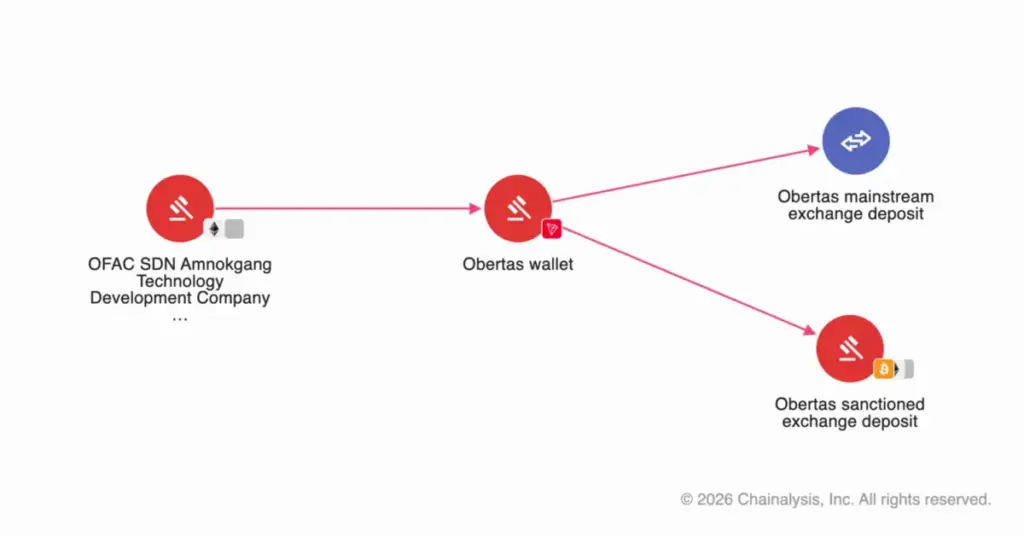
Obertas also served as a direct financial intermediary for the Amnokgang Technology Development Company, an entity designated earlier in March 2026 for managing DPRK IT worker delegations. Blockchain charts illustrate multiple direct transfers of stablecoins from Amnokgang-linked wallets to Obertas, who subsequently deposited the funds into accounts at both mainstream and sanctioned exchanges to convert them into traditional currency for North Korean handlers.
In addition to financial fixers, OFAC designated two high-level DPRK nationals, Kim Ki Hyok and Kim Hyo Dong, who directly managed North Korean IT worker delegations based in Russia. Both individuals operated under the umbrella of the Chinyong Information Technology Cooperation Company, an organization previously designated by OFAC in 2023 for its central role in funding the DPRK’s weapons programs. Kim Ki Hyok led an Alis-affiliated IT worker delegation and personally transferred nearly $500,000 in cryptocurrency for the group, while Kim Hyo Dong managed a separate Chinyong-subordinate delegation, engaged in sanctions evasion, and facilitated more than $100,000 in financial assets.
Deployment of FFTDC and the Evolution of AI in Infiltration
Expanding beyond individual facilitators, OFAC also designated the First Financial and Technical Development Center (FFTDC), a DPRK-controlled entity operating out of Russia. FFTDC has served as a primary institutional vehicle for deploying overseas IT workers who generate substantial revenue for Pyongyang.
Since 2025 alone, six Russia-based DPRK IT workers operating under FFTDC—identified as Kim Kyong Ju, Ri Thae Chol, So Hyon Jin, Han Yu Song, Kim Sung Gwan, and Hyon Se Il—have collectively generated more than $750,000 for the organization. All six workers were included in the Treasury’s latest sanctions announcement.

Notably, these operatives have increasingly integrated artificial intelligence tools and sophisticated technological methods into their operations to bypass traditional corporate hiring safeguards. Investigations reveal that DPRK agents use generative AI models to craft flawless, highly tailored resumes, write convincing cover letters, and generate professional profile photographs. In more advanced instances, operatives have deployed deepfake video technology during remote hiring interviews to conceal their true identities and nationalities.
These AI-driven capabilities have significantly lowered the technical and linguistic barriers for less-skilled operatives, enabling them to successfully navigate rigorous corporate screening procedures. This technological evolution has expanded the pool of workers the regime can successfully deploy, presenting a mounting challenge for employers who rely primarily on conventional remote interviews and document reviews as defensive measures.
Broader Patterns of Digital Asset Exploitation
The October 2026 sanctions represent a continuation of the U.S. Treasury’s sustained campaign to disrupt North Korea’s systematic abuse of digital assets and cryptocurrency networks for sanctions evasion. Over the past several years, Pyongyang has diversified its illicit revenue streams, combining sophisticated IT worker infiltration schemes with state-sponsored cyber heists, cryptocurrency thefts, and ransomware attacks directed at global targets. Blockchain analysis firms have consistently documented the regime’s growing proficiency in executing complex money laundering routines to shield stolen funds from law enforcement tracking.
In response to the Treasury’s latest designations, compliance and blockchain intelligence providers have updated their monitoring software to flag the newly identified cryptocurrency addresses. Financial institutions, cryptocurrency exchanges, and corporate compliance departments utilizing automated Know Your Transaction (KYT) solutions will now trigger immediate sanctions alerts when interacting with these designated wallets, significantly restricting the network’s remaining avenues for movement.
While regulatory bodies and compliance networks continue to tighten the net around North Korea’s financial facilitators, the persistent adaptation of AI tools and proxy infrastructure underscores the ongoing challenge faced by international corporations. Vigilance in identity verification, rigorous credential screening, and comprehensive blockchain monitoring remain critical lines of defense for organizations seeking to protect themselves from inadvertent complicity in the financing of the North Korean regime.
 Crypto Wallets & Security
 Crypto Wallets & Security
 Crypto Wallets & Security