The digital infrastructure sector is undergoing a profound structural evolution, with physical compute rapidly maturing into a transparently priced commodity market. This transformation took center stage at Yotta 2026, which drew more than 6,500 digital infrastructure leaders to the Caesars Forum in Las Vegas. The landmark event convened over 600 chief executive officers, upwards of 300 speakers, and more than 350 exhibitors across 180 distinct sessions. Having doubled in size once again after previously outgrowing the MGM Grand, the conference has firmly established itself as the premier annual gathering for the architects of modern computing power.
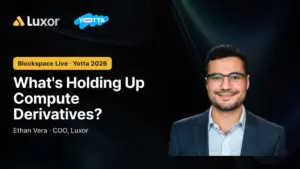
Among the attendees scouring the exhibition floor for powered shell opportunities, data center software, hardware scoping, and capital financing were Luxor executives Nick Hansen and Ethan Vera. Over three intensive days of meetings and panel engagements, Luxor’s leadership mapped out the shifting terrain of physical compute. Ethan Vera also stopped by the press room for Blockspace Live, broadcasting an in-depth conversation regarding the emerging market for compute derivatives and Luxor’s expanding artificial intelligence product suite. While general media coverage of summits like Yotta typically zeroes in on headline-grabbing microchip releases and raw megawatt capacity figures, the deeper narrative for industry operators revolves around the fundamental restructuring of how compute is built, financed, and monetized.
The Evolving Language of Compute and Commodity Markets
Opening the conference, Yotta co-founder George Rockett framed the event around a convergence that has quietly reshaped the industry: the building, the power source, the semiconductor, and the financial capital stopped being separate conversations a long time ago. The event’s tracks reflected this reality, dedicating extensive agendas to infrastructure financing, grid interconnection challenges, graphics processing unit economics, regulatory permitting, and public acceptance.
More strikingly, the daily vocabulary of the sector has shifted dramatically toward the terminology of commodity markets. Industry participants now routinely discuss offtake agreements, price indices, forward curves, residual values, and basis risk. Just three years ago, a prospective buyer’s primary inquiry was narrowly focused on hardware allocation metrics, such as how many H100 units could be secured. Today, buyers evaluate the asset’s overall yield, analyze who assumes utilization risk, and carefully calculate what the residual value of the hardware will be worth five years down the line.

Bitcoin miners are intimately familiar with this evolutionary trajectory. The application-specific compute of SHA-256 hashrate underwent a nearly identical transformation, evolving from a strictly technical specification into a transparently priced and easily hedgeable commodity. That maturation required a defined sequence: first came the establishment of a public reference price through hashprice indices in 2020, followed by over-the-counter forward contracts in 2022, and ultimately culminating in Commodity Futures Trading Commission-approved listed futures by 2024. General-purpose compute utilized for artificial intelligence and high-performance computing is currently navigating the early stages of this exact transition.
The Structural Realities Behind Compute Derivatives
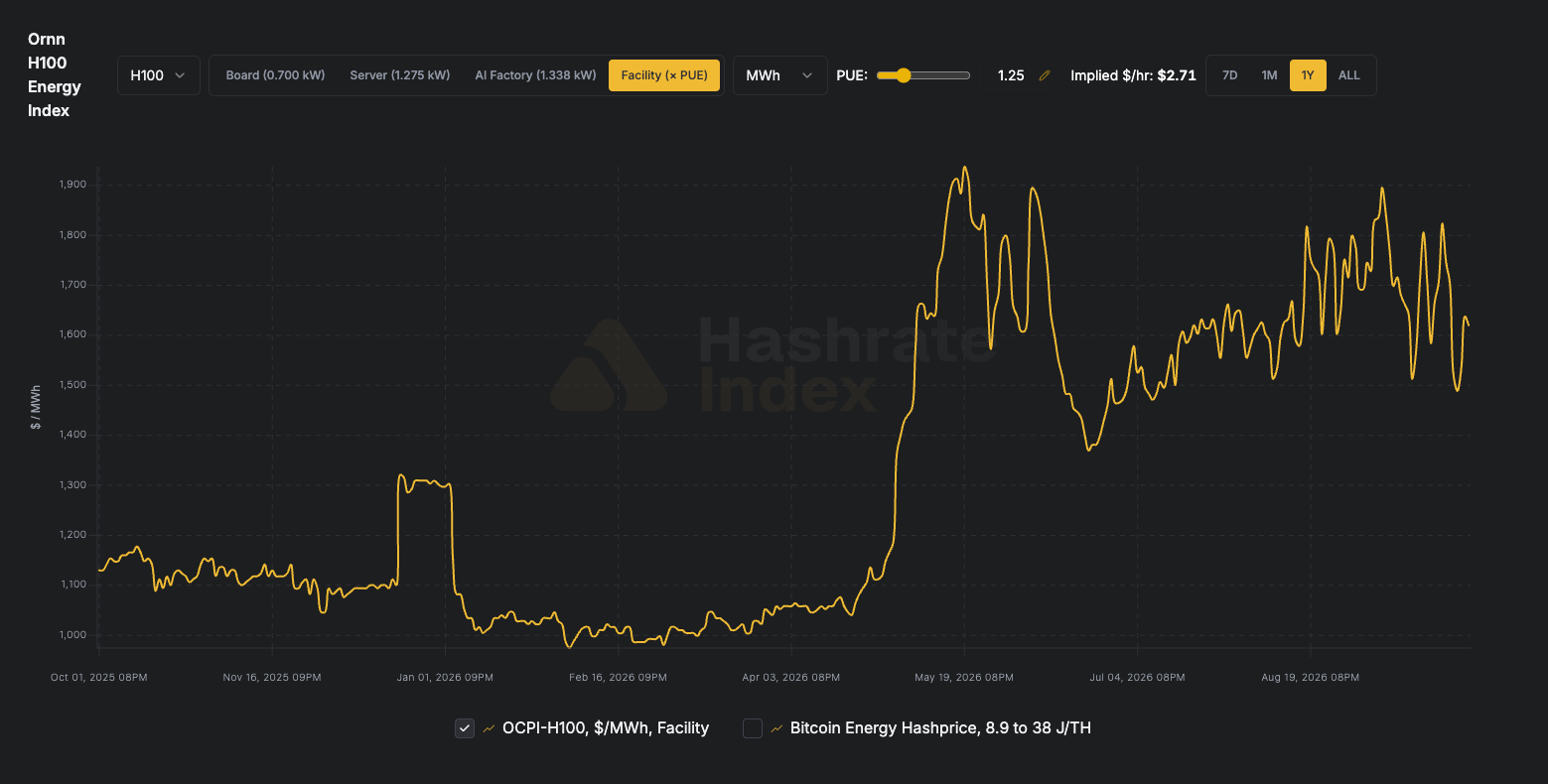
Despite widespread market anticipation, cash-settled compute futures initiatives face notable hurdles centered on index construction rather than a lack of underlying demand. Several exchanges, including the Chicago Mercantile Exchange with Silicon Data’s H100 and B200 rental indexes, the Intercontinental Exchange with Ornn’s Compute Price Index, and Nodal Exchange with Compute Desk benchmarks, have encountered regulatory delays. Notably, the Commodity Futures Trading Commission extended its review period for the CME contracts by 45 days, pushing a targeted listing date into November to scrutinize novel and complex questions regarding how easily rental prices can be manipulated when transactions largely flow through private brokers, cloud platforms, and bilateral negotiations.
According to Luxor COO Ethan Vera, the delay stems directly from index construction challenges. Existing indices rely heavily on on-demand bare metal rentals, which represent only a thin slice of how compute actually trades across the global market. The vast majority of the industry operates on long-term bare metal rental agreements, while short-term contracts are frequently managed via token generation. Because long-term contracts remain strictly proprietary and decentralized marketplaces only share pricing data when there is a clear commercial incentive, index providers have struggled to secure sufficient data volume to comfortably clear regulatory listing standards.
This dynamic underscores a common market misconception: that cash-settled, exchange-listed futures constitute the entirety of the compute derivatives market. In practice, a massive market for physically delivered compute already exists. A multi-year bare metal contract established between a neocloud provider and a frontier artificial intelligence laboratory functions essentially as a physically delivered forward contract. This mirrors the over-the-counter-first sequence observed in the Bitcoin hashrate forward market, identifying a clear service gap that specialized compute desks are actively working to bridge through enhanced pricing transparency.

Navigating Thin Token Margins and Bankable Revenue
Conversations among operators at Yotta consistently highlighted a central tension: while nearly everyone agrees that the ultimate consumer product is digital tokens, almost nobody can definitively explain how to safely underwrite one. Selling tokens increasingly resembles a commodity business rather than traditional software, characterized by razor-thin operating margins. Because these margins leave little room for error, open-weights token prices are expected to eventually find a firm floor. Providers that own physical servers and run optimized inference endpoints assume substantial operational risk, making it unsustainable to price below a double-digit gross margin over the long term.
This risk profile is amplified by hardware economics. Current medians on major hardware price indices peg an eight-GPU B300 node significantly higher than previous-generation H100 nodes. While each successive hardware generation performs vastly more computational work per dollar, the absolute capital outlay per GPU continues to climb, compounding the financial exposure resting on each operational node.
Consequently, the most dependable and bankable revenue in the entire infrastructure stack does not reside with companies selling tokens, but rather one layer down with those providing raw compute. Artificial intelligence laboratories either rent capacity or purchase hardware directly, committing hundreds of millions of dollars upfront. That foundational commitment generates predictable revenue for compute providers, insulating them from the shifting popularity of specific consumer applications.
To bridge the gap between volatile token margins and rigid infrastructure financing needs, innovative contract structures are emerging. Drawing inspiration from frameworks pioneered by major semiconductor manufacturers, operators are exploring structures that guarantee neocloud providers a baseline level of revenue per node while splitting upside profits if compute prices rise. This balances the need for a predictable revenue floor that commercial lenders will accept with the upside potential required by operators.

The Rise of Modular Data Centers and Prefabricated Infrastructure
Physical exhibition spaces at Yotta offered a clear visual signal of industry adaptation, moving far beyond pitch decks into working scale models. Outdoor exhibits featured fully operational modular data centers, microgrid generators, and closed-loop liquid cooling systems, allowing attendees to walk directly inside pre-fabricated units. Dozens of infrastructure providers showcased modular hardware solutions, with a significant portion transitioning from digital renders to active production deployments.
The primary driver behind this modular shift is project sequencing. Grid interconnection approvals, local permitting processes, and the procurement of long-lead electrical equipment dictate the timeline of any facility buildout, but prefabricated modular pods dramatically compress the construction phases under an operator’s direct control. While factory-built capacity typically carries a higher cost per megawatt and restricts custom architectural adjustments, it trades capital for precious time, shaving months off deployment schedules.
This mirrors the evolution of containerized Bitcoin mining hardware, though with significantly higher thermal density and cooling demands. While mining containers traditionally focus on moving massive volumes of air across application-specific integrated circuits, modern artificial intelligence pods utilize liquid-cooled architectures designed around high-wattage racks equipped with coolant distribution units and advanced leak detection systems. Procurement preferences also reflect a maturing market; serious operators increasingly demand tier-one hardware components, comprehensive warranties, and rapid on-site support to ensure multi-million-dollar clusters maintain maximum uptime.
International Expansion Amid U.S. Permitting and Regulatory Hurdles
Domestic infrastructure development faced mounting headwinds this year as regulatory friction expanded beyond pure electrical grid constraints. State-level legislative actions, such as moratoriums on new hyperscale data centers and local zoning restrictions across numerous jurisdictions, have complicated domestic deployment timelines. When layered on top of regional demand forecasts that already heavily outrun local electrical generation and transmission capacities, multi-year wait times for power combined with regulatory uncertainty create a risk profile that challenges traditional investment committees.
In response to these domestic bottlenecks, capital is increasingly flowing toward international emerging markets. A notable shift has occurred within the financing sector, where institutional lenders and energy offtakers who previously viewed emerging-market compute as uninvestable are actively underwriting overseas projects. The presence of creditworthy offtake agreements transforms foreign jurisdictions from a disqualifying risk factor into a manageable pricing input.
This international arbitrage mirrors the historical migration of Bitcoin hashrate toward regions featuring abundant stranded energy resources, though artificial intelligence infrastructure carries much tighter latency tolerances and stricter requirements for political and economic stability. Mining operators who have successfully built and managed operations in international markets possess invaluable site control, grid relationships, and localized operating experience that institutional capital is now actively seeking to leverage.
The Strategic Outlook for Infrastructure Operators
As Yotta 2026 demonstrated, private credit and equity markets show no signs of slowing down their financial backing for digital infrastructure, though interest rates and terms continually re-price underlying operational risks. For infrastructure operators, the central planning challenge remains navigating shifting bottlenecks—oscillating between scarce electrical power, delayed data center construction permits, abundant capital, and concentrated end-client demand.
Bitcoin mining operators are uniquely positioned to navigate these complexities, possessing energized sites, established grid relationships, proven demand-response flexibility, and a decade of specialized experience in lifecycle management for high-density compute hardware. As artificial intelligence compute solidifies its status as a fully realized commodity complete with forward curves and established credit markets, operators across the digital infrastructure landscape recognize that the most durable and defensible position in the stack remains the one closest to the power source.
 Cryptocurrency Mining
 Cryptocurrency Mining
 Cryptocurrency Mining