After enduring two consecutive quarters of contraction, the Bitcoin network’s global hashrate has finally halted its downward spiral. According to the Q4 2026 Global Hashrate Heatmap update from Hashrate Index, the network’s total computational power finished the third quarter at approximately 941 exahashes per second (EH/s), remaining effectively flat compared to the ~940 EH/s recorded in the previous quarter.
While a flat headline figure might suggest a period of quiet stagnation, a closer look beneath the surface reveals an unusually active quarter defined by profound geographic shifts. The United States shed another 10 EH/s of mining capacity, while Russia countered with an 8 EH/s increase. Meanwhile, Ethiopia abruptly gave up a third of its total hashrate due to severe hydroelectric constraints, and Pakistan more than tripled its processing power.
The global map of Bitcoin mining is no longer shrinking in overall scale, but the continuous redistribution of its compute power is reshaping the industry. Analysts, investors, and network observers are closely tracking these movements to understand where the network’s foundational infrastructure lives and where it is heading next.
From Falling to Flat
Following two successive quarters of decline, the network hashrate’s thirty-day simple moving average registered around 941 EH/s at the close of Q3 2026. This marks the first quarter of the year in which the metric failed to register a decline. However, market participants emphasize that a flat period is not synonymous with a robust recovery.
The network remains roughly 8.7% smaller than it was at the same time last year, when it hovered near 1,031 EH/s in Q4 2025, and it sits roughly 15% below its historic peak achieved in November 2025. The most significant shift is the deceleration of the market bleed. Marginal mining machines that were economically unviable under prevailing hashprices have largely been powered down, while network difficulty has adjusted downward sufficiently to keep surviving operations profitable.
This stabilization has allowed for fascinating dynamics at the country level. Five major nations experienced movements exceeding 4 EH/s in either direction during the quarter. In a period where the total global metric barely budged, this represents a massive relocation of Bitcoin’s global compute capacity.
Market Concentration and Regional Shifts
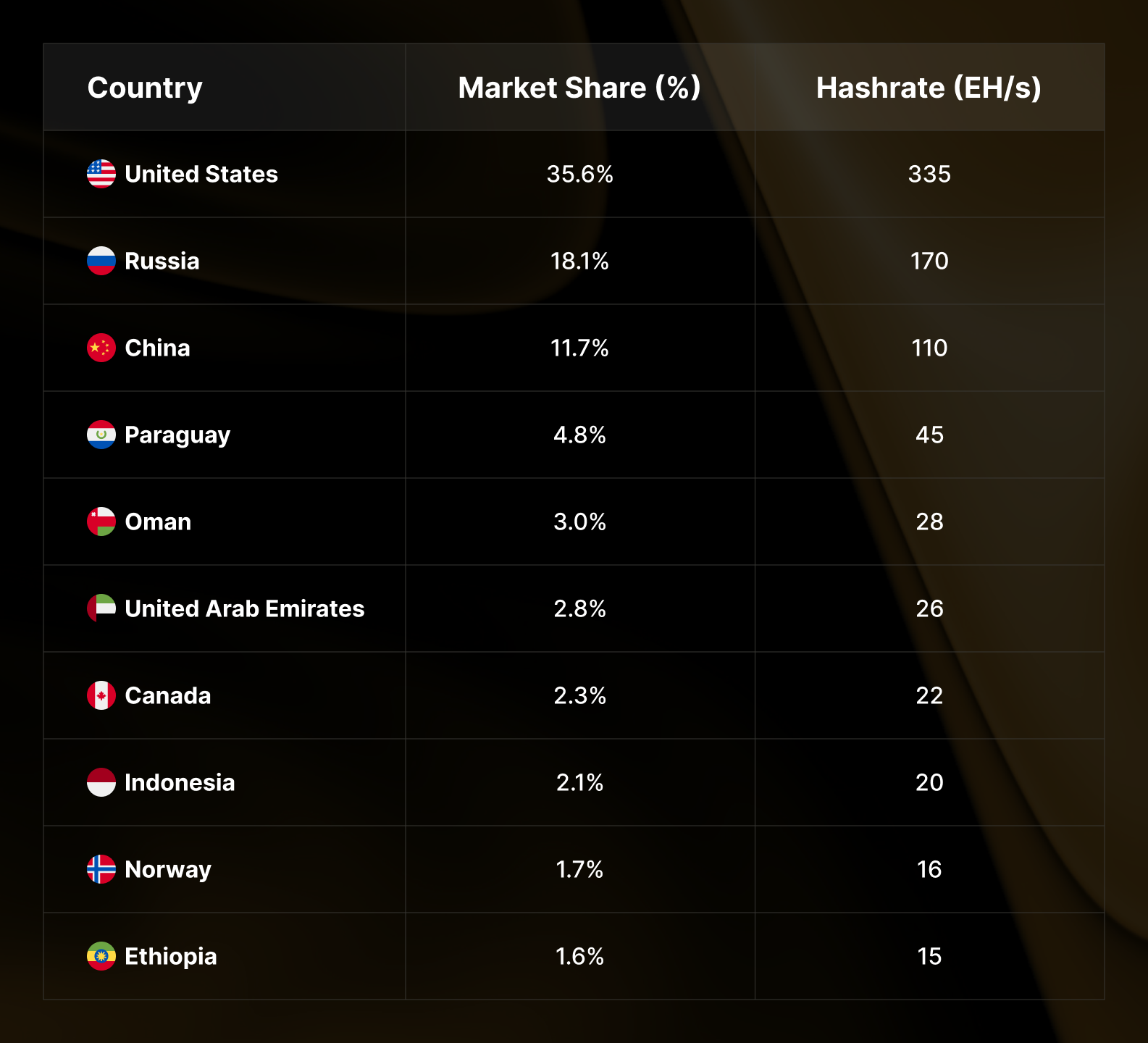
Bitcoin mining remains a heavily concentrated industry, with the top three countries commanding roughly two-thirds of the global hashrate. However, the concentration among the top tier slipped slightly from 66.2% to 65.4%, marking the second consecutive quarterly drop. The United States is steadily giving up market share faster than other dominant nations like Russia can absorb it.
The broader top-ten rankings experienced notable internal shuffling. Oman climbed past the United Arab Emirates to secure the fifth spot globally, while Indonesia advanced from ninth to eighth on the back of a genuine 3 EH/s gain. Conversely, Ethiopia slipped from eighth down to the tenth position. Kazakhstan hovered at eleventh place with roughly 15 EH/s for the second straight quarter, putting it virtually neck-and-neck with Ethiopia for the final top-ten slot as the industry transitions toward 2027.
Comparing the fourth quarter to the third, the global map split cleanly between a contracting developed core and a rapidly expanding frontier. Developed markets continue to shed traditional mining capacity, but the motivations vary widely across regions.
The Great Pivot: Bitcoin Mining Versus Artificial Intelligence
When examining the twelve-month perspective, long-term trends become much clearer than quarterly noise. Every market that experienced net growth over the past year is rooted in low-cost or stranded energy stories. On the other hand, the decliners tell a much more complex story about global energy markets and technological competition.
Traditional mining hubs like Canada and the United Arab Emirates are not losing hashrate because local electricity has become expensive. Canadian mining capacity relies heavily on abundant hydro resources in provinces like Quebec, Manitoba, and British Columbia, while Abu Dhabi operates on a mix of natural gas, solar, and nuclear-backed supply.
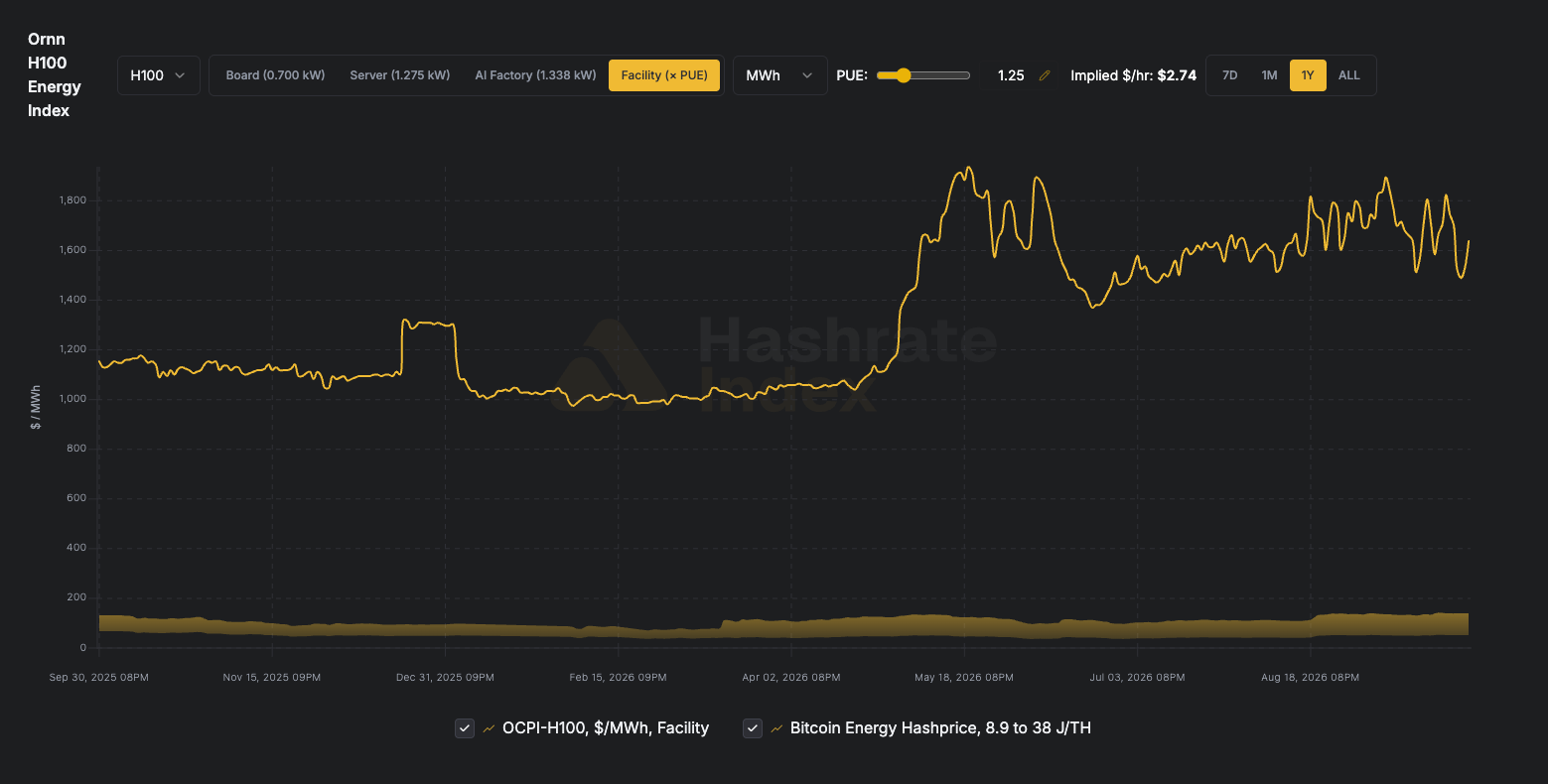
Instead, these jurisdictions lost hashrate because their local energy assets found far more lucrative applications. Both regions host sophisticated digital infrastructure operators that are well-advanced in the pivot toward artificial intelligence and high-performance computing that dominated the tech landscape throughout 2026. The economic reality is stark: AI compute frequently generates anywhere from $1,500 to $3,500 per megawatt-hour, whereas traditional Bitcoin mining yields a range of roughly $50 to $150 per megawatt-hour.
This distinction is crucial for understanding the future trajectory of the network. A marginal ASIC machine that goes offline due to a temporary drop in hashprice can easily be switched back on if market conditions improve. However, electrical capacity that is locked into multi-year commercial leases with AI tenants cannot be reclaimed easily, even if the price of Bitcoin rallies and network difficulty drops. Consequently, recent market decliners are splitting into three distinct categories: capacity converting directly to AI and high-performance computing, ongoing regulatory pressures in specific jurisdictions, and macroeconomic impairments.
Standout Growth Markets and the Ethiopian Correction
Paraguay continues to anchor the group of nations expanding steadily through the current down-cycle. The country added another 1 EH/s to reach approximately 45 EH/s, capturing the number four spot globally with a 12% year-over-year increase anchored by Itaipú hydropower. Indonesia stands out as the quarter’s clearest structural gainer, climbing to roughly 20 EH/s and securing a top-eight slot with an 18% annual growth rate driven by Southeast Asian hydro diversification. Meanwhile, Norway has maintained a steady output of approximately 16 EH/s for four consecutive quarters.
The most dramatic reversal story of the quarter, however, belongs to Ethiopia. The East African nation saw its hashrate plummet from approximately 23 EH/s down to 15 EH/s, marking a 35% quarterly decline that pushed it down to the tenth global ranking and erased gains made since mid-2025. Measured from its peak of 27.5 EH/s in the first quarter of 2026, the country’s mining sector has contracted by 45% in three quarters due to acute environmental pressures rather than regulatory hostility.
On September 15, Ethiopian Electric Power drastically curtailed electricity supplies to Bitcoin miners, cutting deliveries to roughly 23% of contracted volumes. This steep reduction—representing a cut of about three-quarters—was triggered when reservoir inflows fell by approximately 20% under the influence of El Niño-driven dry weather conditions. Because Ethiopia relies overwhelmingly on centralized hydroelectric generation, and because its mining operators tend to run massive, high-density facilities, the sudden loss of water availability hit the local industry with immediate and severe force. Industry observers warn that Ethiopian hashrate is likely to remain constrained or fall further unless upcoming seasonal water inflows show a meaningful recovery.
The Frontier Reaccelerates
While established hubs contracted or faced environmental setbacks, frontier markets stepped in to absorb displaced hardware. Pakistan and Venezuela combined to add roughly 9.5 EH/s during the quarter, nearly offsetting the entire decline recorded in the United States.
Pakistan experienced a dramatic surge, climbing from approximately 2.5 EH/s to 8 EH/s. This represents a genuine structural step change rather than a minor statistical rebound, pushing the country past several regional peers. Venezuela similarly crossed into double digits with approximately 10 EH/s, representing a 122% year-over-year increase. Notably, this growth occurred despite a formal government prohibition on cryptocurrency mining that has remained in force since mid-2024. Geolocated network traffic and regional reporting indicate that surviving operations largely function as informal or semi-legitimate enterprises rather than state-backed ventures.
At the same time, Iran recorded a modest uptick in hashrate, moving from 2 EH/s to 3 EH/s in the first sign of recovery since regional geopolitical tensions escalated earlier in the year.
As the global network transitions into the final stretches of the year, the concentration of computing power continues to evolve away from traditional Western strongholds toward regions offering novel energy arrangements, stranded power assets, or flexible regulatory environments, ensuring that the global distribution of Bitcoin’s infrastructure remains in a state of constant flux.
 Cryptocurrency Mining
 Cryptocurrency Mining
 Cryptocurrency Mining