Achieving massive scale while preserving absolute financial privacy has long remained the ultimate challenge for privacy-focused blockchain networks. For the Zcash community, however, protocol builders have formulated a comprehensive strategy to dramatically scale private ZEC payments, with the first major milestone arriving on-chain this week.
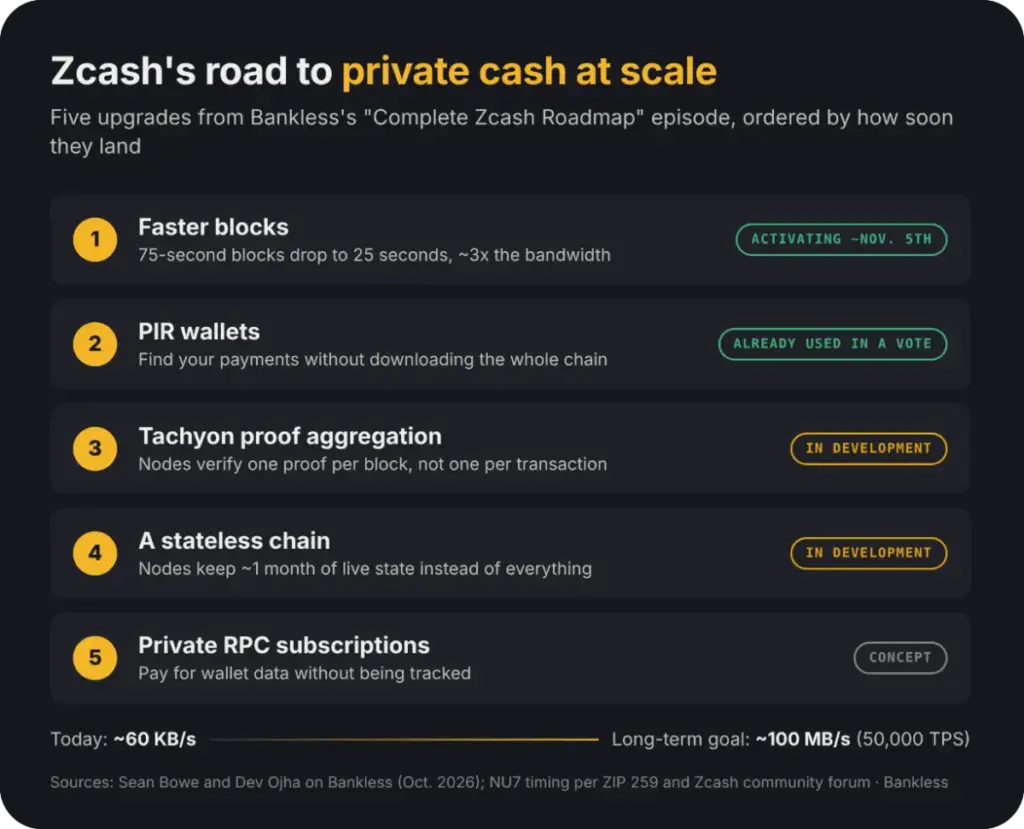
In a recent episode of the Bankless podcast titled "The Complete Zcash Roadmap," Zcash co-founder Sean Bowe and protocol contributor Dev Ojha outlined an ambitious vision for the network. They detailed how Zcash can evolve from its current throughput of approximately 60 kilobytes per second toward Ojha’s long-term goal of 50,000 transactions per second, representing an astonishing 100 megabytes per second and a 166,500% expansion in network capacity.
This transformation hinges on a series of foundational upgrades designed to overhaul block production, wallet synchronization, cryptographic proof verification, state storage, and infrastructure economics. Together, these technological leaps aim to solve the historical trade-offs between decentralization, scalability, and privacy.
Faster Blocks and Immediate Network Bandwidth
The first major milestone on this scaling roadmap arrives with the network’s ninth major upgrade, known as NU7. As previously established by the core development timeline, NU7 is scheduled to activate overnight between November 5th and November 6th (UTC). This upgrade will fundamentally alter block production by reducing average block times from the current 75 seconds down to just 25 seconds.
Because individual block sizes will remain consistent, this structural shift will effectively triple the chain’s overall bandwidth to roughly 180 kilobytes per second. Beyond simply accelerating block times, Ojha noted that the engineering team is looking to adopt established bandwidth-optimizing techniques already deployed by other high-throughput networks. These methods include erasure coding, which splits blocks into redundant fragments allowing nodes to rebuild them without downloading entire files, alongside improved gossip protocols for faster node-to-node communication.
Notably, Zcash is achieving these throughput gains while firmly maintaining its Proof-of-Work consensus model. Ojha characterized this initiative as an endeavor to pioneer high-throughput Proof-of-Work architecture for the first time in the history of decentralized networks. However, this shift introduces minor operational quirks inherent to probabilistic mining models. With a 25-second average, roughly 1% of blocks will be mined in about 250 milliseconds, while another 1% will take longer than 110 seconds to propagate. While faster blocks go live this week with NU7, the broader throughput engineering will continue to unfold over the next two years.
Private Information Retrieval and Modern Wallet Architecture
As network throughput scales upward, traditional methods of wallet synchronization break down entirely. In public transparent networks, wallets easily query centralized or decentralized servers to check balances and transaction history. In contrast, Zcash utilizes shielded addresses where transaction details remain completely private, meaning nobody can passively observe who paid whom.

Historically, this privacy guarantee meant Zcash wallets had to download every single transaction on the ledger locally to independently scan and determine which ones belonged to the user. That resource-intensive approach would become completely unviable once the network scales toward 100 megabytes per second. To solve this dilemma, developers are implementing Private Information Retrieval (PIR).
Under a PIR paradigm, a user’s wallet transmits an encrypted query to a server holding the public chain data. The server then computes and returns the requested answer using homomorphic encryption—a mathematical framework that allows computations to be performed directly on encrypted data without ever exposing the underlying information. Interestingly, the practical viability of this advanced cryptography has been heavily accelerated by the broader artificial intelligence boom. Because PIR heavily relies on massive matrix-vector multiplications, the rapid cheapening and acceleration of specialized GPU hardware designed for AI workloads has made these privacy-preserving queries computationally feasible.
While querying external servers might initially raise concerns regarding trusted intermediaries, developers emphasize that PIR will function similarly to Remote Procedure Calls in the Ethereum ecosystem. Anyone can spin up their own independent provider, and user wallets can seamlessly switch between multiple competing providers. This infrastructure is already beginning to see real-world testing, with Bowe confirming that Zcash successfully utilized PIR during a recent coinholder vote, marking what is believed to be a first for any cryptocurrency project.
Tachyon Proof Aggregation and Cryptographic Overhauls
Beyond network bandwidth and wallet synchronization, processing computational overheads on full nodes presents a severe bottleneck. Under current architecture, a full node must verify the zero-knowledge proof of every single shielded transaction sequentially, one by one. To address this limitation, Bowe is leading a comprehensive cryptography overhaul known as Tachyon.
Tachyon introduces recursive SNARKs—advanced cryptographic proofs capable of verifying other proofs. By rolling multiple zero-knowledge proofs into a single aggregated proof, the computational burden on full nodes is drastically reduced. Instead of verifying thousands of standalone proofs individually, nodes only need to verify a single rolled-up proof periodically.
This recursive verification system is expected to deliver at least a fivefold scaling improvement immediately upon deployment. The underlying mechanics mirror how layer-two ZK-rollups bundle transactions on Ethereum, with developers explicitly acknowledging Ethereum’s pioneering role in bringing recursive proofs into production environments. While Tachyon code is currently being integrated into the cryptography stack behind the Zakura full node, it has not yet been activated on the mainnet, and a public launch date remains unannounced.
Tackling State Bloat with a Stateless Chain
Alongside proof aggregation, Tachyon addresses the critical issue of state bloat. Every time a user spends shielded ZEC, the network generates and records a nullifier—a unique cryptographic marker designed to prevent the same funds from being spent a second time. Unlike transparent ledgers that can eventually prune historical data, privacy-preserving networks must permanently retain these ever-growing nullifier lists to ensure network security.

To prevent this data from expanding indefinitely, Tachyon incorporates state compression techniques. Under this framework, full nodes would only maintain approximately the most recent month of live network state locally. Historical data older than that window would be queryable through trustless mechanisms whenever necessary. Bowe developed this foundational technique alongside cryptographer Ian Miers in a formal academic research paper.
While developers readily admit that petabyte-scale throughput cannot be crammed onto lightweight consumer hardware like a Raspberry Pi, this state compression strategy ensures that operating a full node at high throughput will require manageable storage capacity, likely around a couple hundred gigabytes rather than unsustainable amounts of data. This architectural upgrade remains actively under development as a core component of the Tachyon initiative.
Economic Sustainability and Private RPC Subscriptions
The final frontier of the Zcash scaling roadmap focuses on network economics and infrastructure sustainability. In major smart contract ecosystems like Ethereum or Solana, infrastructure providers such as MetaMask or Phantom subsidize RPC servers because they can monetize user interactions through wallet features and token swaps. Because Zcash does not track its users, it lacks these monetization vectors, leaving a small group of altruistic providers to host network data for free.
To avoid relying indefinitely on ecosystem altruism, Ojha has proposed a private subscription model. Users would prepay for a set number of queries—such as 1,000 requests per month—with their wallets converting that payment into cryptographic, one-time-use tokens. Each subsequent data query burns a single token using the exact same double-spend prevention mechanisms that secure ZEC payments. This economic design allows infrastructure providers to cryptographically verify a valid subscription without ever learning the identity of the specific subscriber making the request. While still largely conceptual, developers view the model as a clear and solvable economic puzzle.
As Zcash prepares for the activation of NU7 this week, developers emphasize that the broader urgency behind these scaling initiatives stems from modern surveillance pressures. The rapid maturation of artificial intelligence has made tracking individuals across transparent public ledgers trivial, heightening the necessity for robust, scalable financial privacy. The comprehensive roadmap also touches upon long-term goals including post-quantum cryptography, formal governance structures, and protocol-level funding debates as the community charts its path toward global-scale private money.
 Tokenomics & Digital Assets
 Tokenomics & Digital Assets
 Tokenomics & Digital Assets