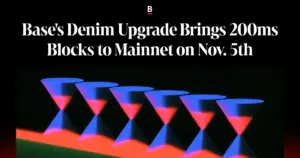
According to the latest node release published on GitHub, the Denim upgrade marks the retirement of Flashblocks, the interim mechanism previously utilized to achieve faster transaction confirmation experiences on the network. By moving directly to a native throughput of five blocks per second, Base is streamlining its consensus and execution pipeline, bypassing the need for auxiliary sequencing tricks. This transition effectively slashes block intervals down to 200 milliseconds, placing Base among the fastest execution environments in the broader blockchain ecosystem and moving transaction finality closer to the instantaneous feel associated with traditional Web2 applications.
The shift to 200-millisecond blocks is designed to eliminate friction for everyday onchain interactions, ranging from decentralized finance trading and automated market maker execution to high-frequency gaming and interactive consumer applications. In the competitive landscape of Ethereum Layer 2 scaling solutions, speed and throughput are paramount differentiators. By drastically shrinking the window between blocks, Base aims to provide developers with a smoother canvas for building responsive applications that do not suffer from the noticeable latency historically plaguing distributed ledger technologies.
However, this dramatic acceleration comes with a vital caveat that developers and application teams must address immediately. For any decentralized application, smart contract protocol, or tooling infrastructure that implicitly counts blocks as a proxy for time, the Denim upgrade introduces a profound shift in operational dynamics. In smart contract development, it has long been common practice to estimate time intervals, vesting schedules, lock-up periods, or governance voting durations based on an expected number of blocks. With Base moving from a two-second block schedule to five blocks every single second, the rate at which blocks accumulate has multiplied by a factor of ten.
Consequently, any onchain logic that calculates time elapsed by multiplying a hardcoded block count by the old block duration will experience severe compression. A process that was previously expected to take a specific number of days based on two-second blocks would now execute ten times faster if the underlying smart contract code relies rigidly on block heights rather than real-world timestamps or oracle-driven time feeds. This architectural reality requires development teams currently deploying or maintaining applications on Base to audit their codebases thoroughly ahead of the November 5 activation. Ensuring that time-sensitive mechanisms rely on robust time measurement methods rather than naive block-counting assumptions has become an urgent priority across the ecosystem.
The transition to the Denim hard fork reflects the rapid evolution of rollup technology. As Layer 2 networks mature, core developers are increasingly pushing the boundaries of what execution environments can handle without sacrificing decentralization or security guarantees inherited from Ethereum. Base’s trajectory—moving from its initial launch phases to successive performance upgrades like Denim—highlights the continuous engineering effort required to bridge the gap between niche cryptographic infrastructure and global-scale consumer adoption.
As the deployment window approaches, node operators, infrastructure providers, and decentralized application developers are finalizing their preparations for the network transition. The activation at 18:00 UTC on November 5 will mark the definitive end of the Flashblocks era and the beginning of a high-speed operational standard for the network. While the tenfold increase in block generation rate promises a remarkably fluid experience for end users, the broader ecosystem will be watching closely to see how smoothly applications adapt to the new temporal reality of a blockchain that produces five blocks every second.
 Tokenomics & Digital Assets
 Tokenomics & Digital Assets
 Tokenomics & Digital Assets