As global energy markets face unprecedented demand from high-intensity computing facilities, a fierce competition is playing out behind the meter. Three distinct types of hardware—Zcash mining Application-Specific Integrated Circuits (ASICs), Bitcoin mining rigs, and artificial intelligence graphics processing units (GPUs)—are increasingly vying for the exact same power capacity. Determining the ultimate winner among these heavyweight contenders, however, comes down to how the economics are measured, specifically regarding energy efficiency, capital expenditure, and utilization rates.
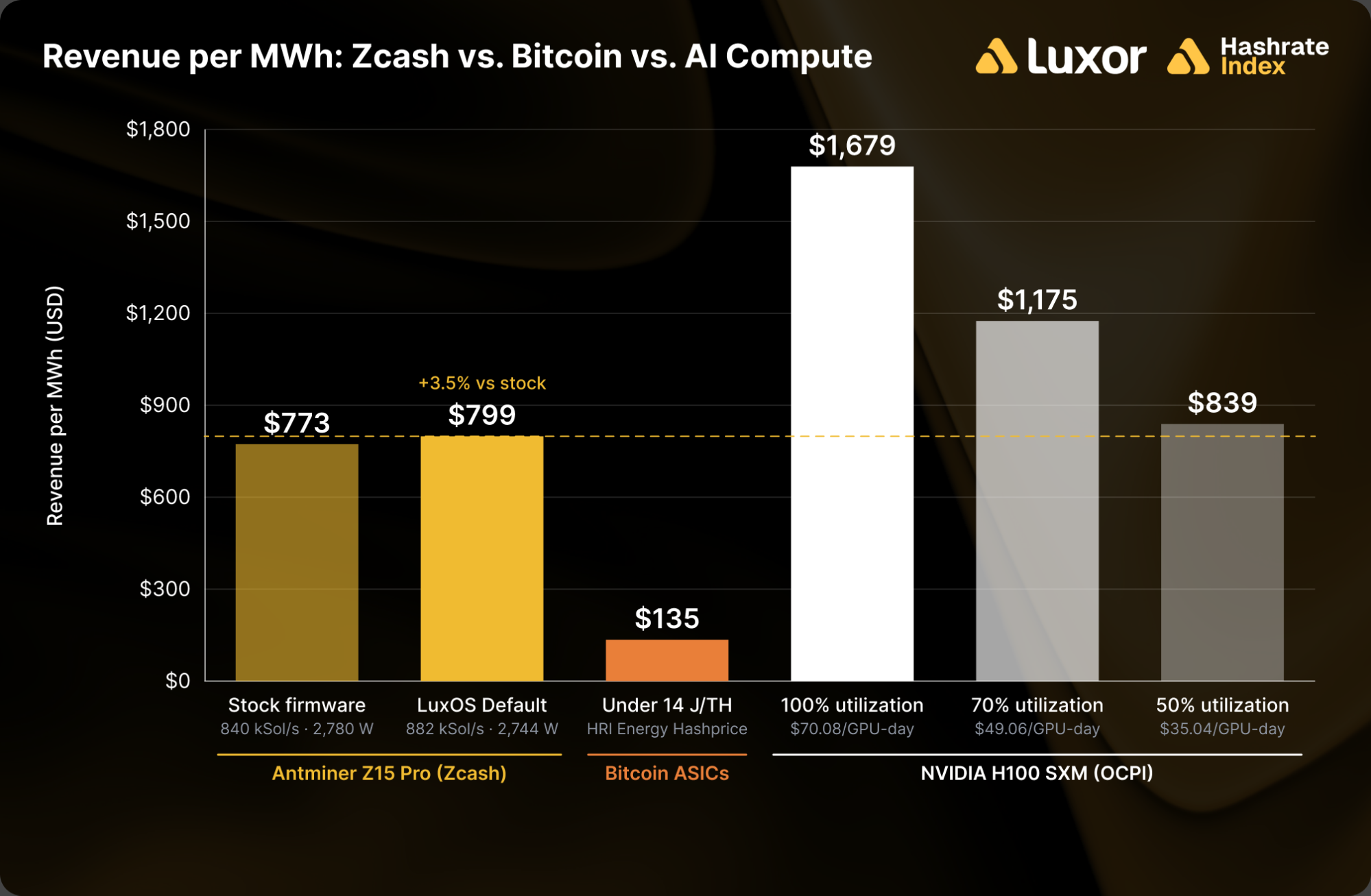
Market analyses from mid-October 2026 highlight the shifting dynamics of this multi-front compute race. Priced at a baseline energy cost of $0.08 per kilowatt-hour, an Antminer Z15 Pro mining Zcash yields approximately $770 of revenue per megawatt-hour. Meanwhile, top-tier Bitcoin ASICs generate roughly $135 under current hashprice conditions. At the high end of the revenue spectrum, a rented NVIDIA H100 pulls in approximately $1,680 per megawatt-hour—provided it remains fully utilized.
Energy serves as the fundamental common denominator shared by all three machine classes, making revenue per megawatt-hour the cleanest initial metric for comparison. Analysts evaluating these platforms on October 13 utilized a Zcash price of $1,185 with a network hashrate resting at 27.8 GSol/s. Under these parameters, the economic realities of each machine type reveal stark contrasts in margin, capital efficiency, and operational constraints.
Three Machines, One Megawatt of Power
Because miners process a fixed daily reward of 1,440 ZEC, a stock Antminer Z15 Pro grosses around $51.54 per day. After factoring in a power expenditure of $5.34 at standard industrial rates, the hardware retains a robust $46.20 in daily gross profit. This translates to an exceptional 90 percent profit margin and allows the machine to remain economically viable up to an astonishing power break-even threshold of $0.77 per kilowatt-hour—nearly ten times the electricity costs typically paid by standard industrial mining operations.
In contrast, contemporary Bitcoin mining hardware struggles to compete on a pure revenue-per-megawatt basis. With the broader hashprice hovering near $39.71 per petahash per day, energy hashprice metrics place modern fleets operating under 14 joules per terahash at roughly $135 per megawatt-hour, while S21-class hardware sits closer to $98. Previous estimates suggesting Zcash mining could yield several times the returns of traditional Bitcoin operations have proven conservative, especially as ZEC prices sustained an extended upward trajectory throughout the autumn months.
The true wildcard in this compute showdown is the NVIDIA H100. Based on recent cluster settlements of $2.92 per GPU-hour, a single H100 generates $70.08 in daily revenue. When factoring in facility power consumption of 1.74 kilowatts per GPU—which accounts for data center Power Usage Effectiveness overhead—the return scales to approximately $1,679 per megawatt-hour, more than double the output of a stock Z15 Pro. While isolating the GPU board’s direct wall draw inflates the metric past $4,000 per megawatt-hour, industry experts emphasize that facility-level calculations provide the only fair comparison, as ASIC power figures inherently include broader infrastructure draws.
Despite its impressive revenue generation, the H100 maintains its dominant position only when continuously rented. If rental demand slumps and utilization drops to 50 percent, revenue declines to roughly $839 per megawatt-hour, placing it on nearly equal footing with the Z15 Pro. Market models indicate that the critical crossover threshold where GPU earnings match Zcash ASICs sits between 46 and 48 percent utilization.
Capital Intensity and the Advantage of ASICs
While AI hardware commands the lead in pure energy revenue, the financial equation completely inverts when evaluated through the lens of capital expenditure. Equipping a single megawatt with Antminer Z15 Pros requires deploying approximately 360 machines, translating to a hardware investment of roughly $3.2 million to $5.8 million housed within a relatively inexpensive warehouse shell.
Equipping that same megawatt-hour with AI infrastructure, however, requires an entirely different financial commitment. A megawatt of H100s comprises roughly 575 GPUs. With new 8-GPU nodes commanding between $31,000 and $40,500 per GPU since their market introduction, the hardware alone demands an outlay of $18 million to $23 million, dropping to roughly $13 million for refurbished units. Furthermore, these systems must be housed inside Tier-3 data center facilities that frequently cost more to construct than the computing hardware itself.
Consequently, while a Z15 Pro requires substantial upfront capital, its rapid payback period of 6 to 11 months on robust daily profits highlights the traditional advantage held by mining hardware: fast deployment and lower capital intensity relative to AI infrastructure. The narrative that specialized cryptocurrency mining can rival or outperform artificial intelligence workloads holds true primarily on build speed and capital efficiency, though it falls short on revenue generated per unit of energy during peak rental cycles.
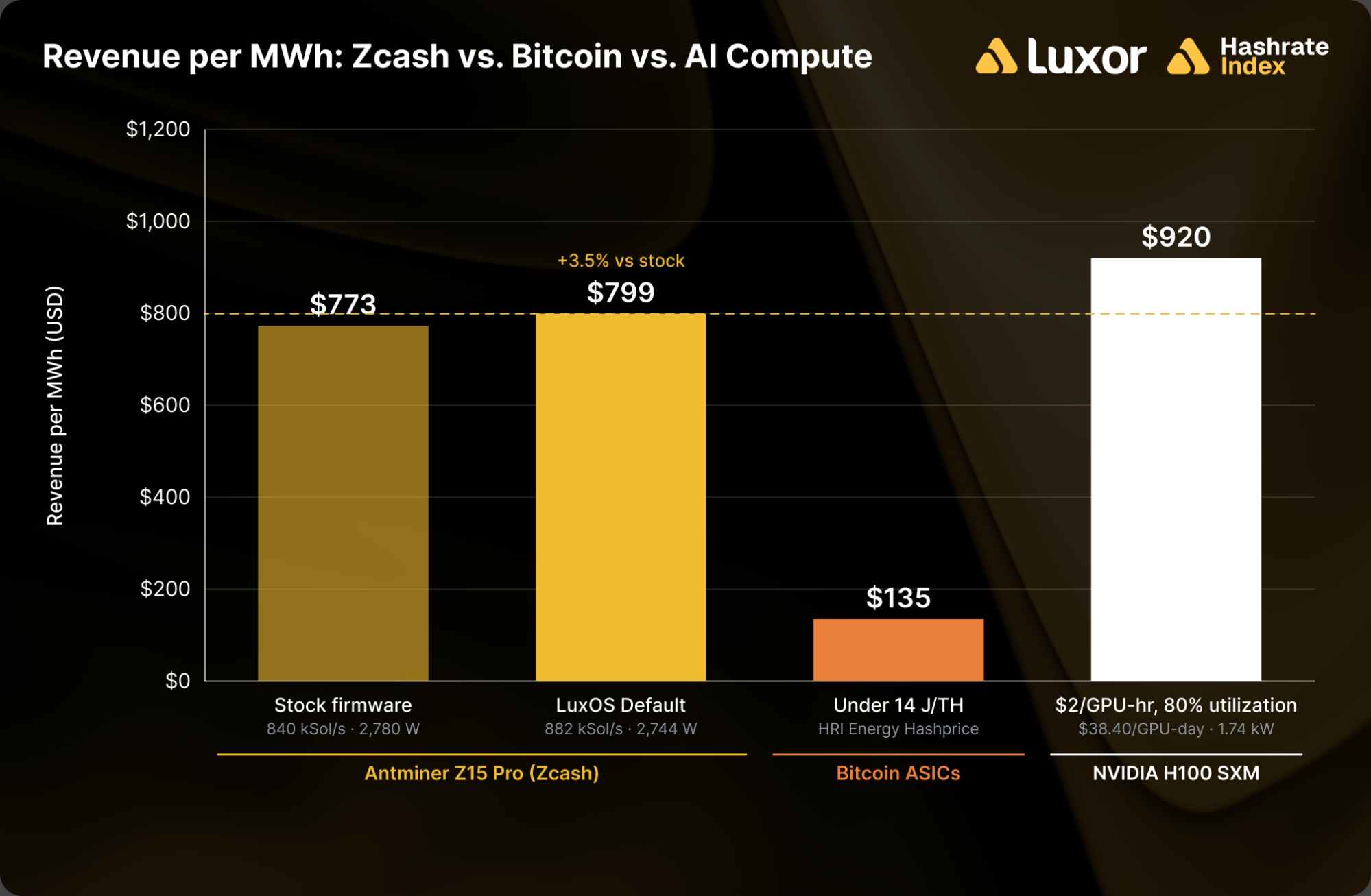
As lower cloud rental rates and fluctuating utilization figures enter the equation, the performance gap between these compute classes narrows rapidly. If H100 rental rates soften to $2.00 per GPU-hour at an 80 percent utilization rate, the hardware generates roughly $920 per megawatt-hour—only a modest margin above an optimized Z15 Pro. Pushing utilization below 70 percent at that price point allows the ASIC to surpass the GPU in revenue generated per megawatt-hour before even factoring in the massive disparity in upfront capital expenditures.
Price Movements and Hashrate Growth
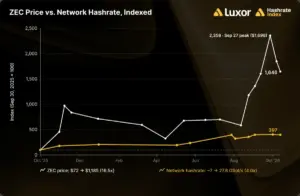
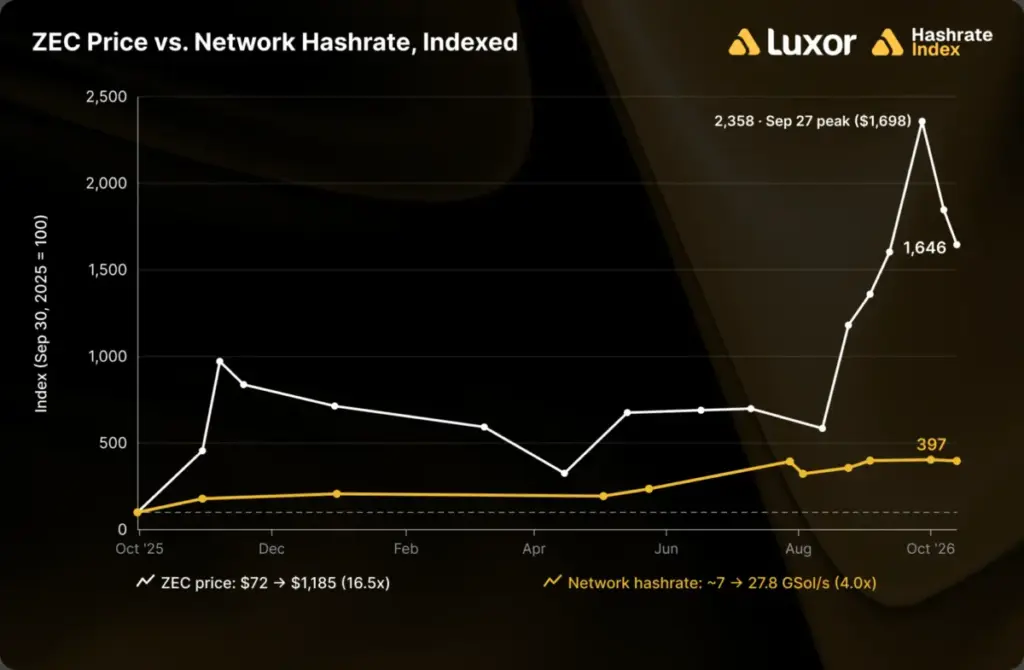
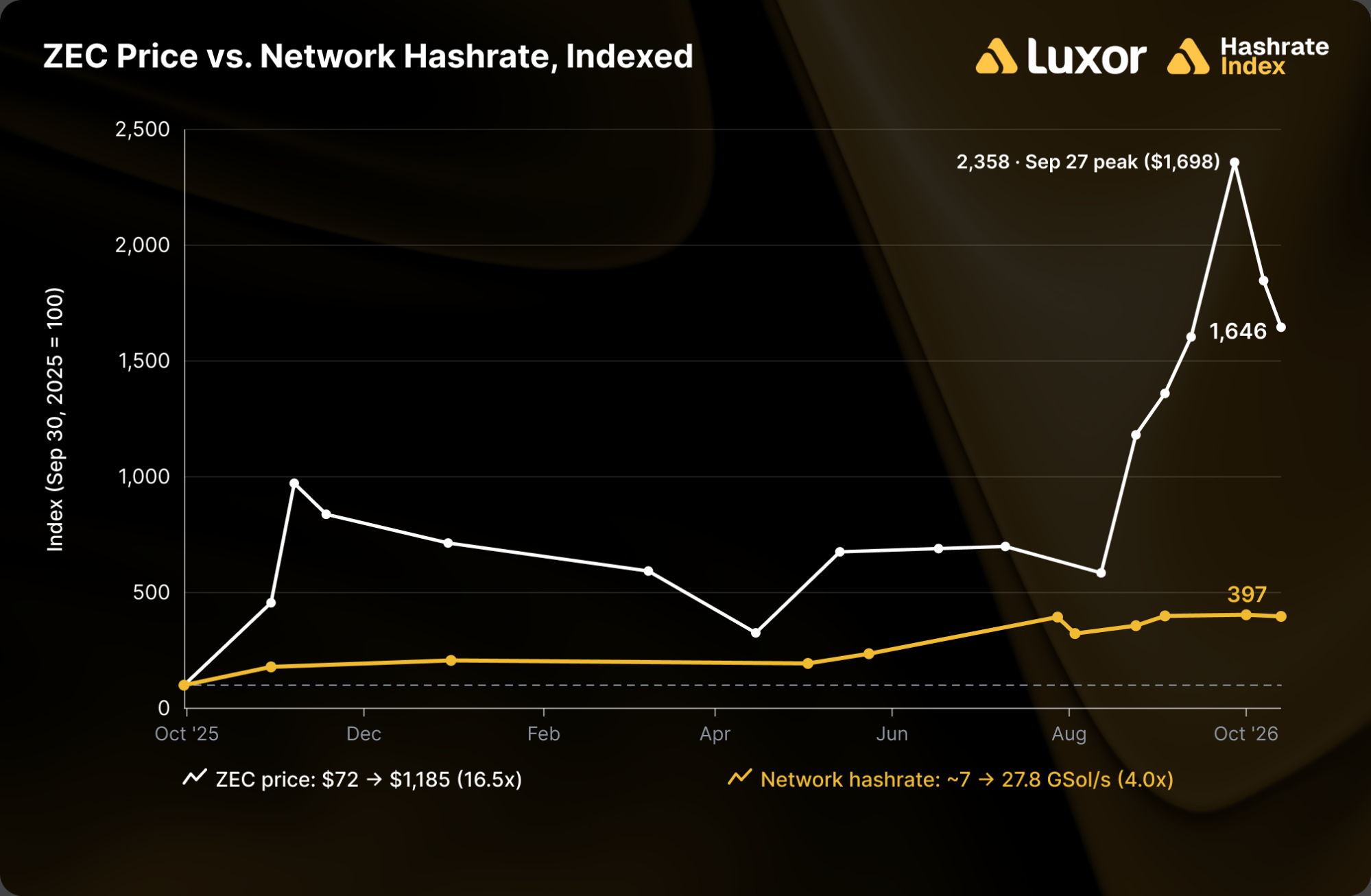
The remarkable profitability of Zcash mining hardware in late 2026 is largely the result of dramatic token price appreciation outpacing network hashrate expansion. Over a twelve-month period leading into October, Zcash network hashrate surged roughly fourfold from approximately 7 GSol/s to 27.8 GSol/s. During this same window, the price of ZEC experienced historic volatility, climbing from $72 to a peak of nearly $1,698 before correcting downward by roughly 30 percent.
Crucially, network hashrate lagged behind token price movements throughout the major market rallies, remaining relatively subdued even during intervening market drawdowns. Because the daily issuance rate for Zcash miners remains fixed at approximately 1,440 ZEC, every newly deployed machine increases network difficulty and dilutes existing participants. Despite the network growing to a scale equivalent to roughly 33,000 Z15 Pros drawing 90 megawatts of power, the hardware remains comfortably cash-positive at prevailing token prices.
The primary constraint limiting further hashrate expansion is not available power capacity, but rather physical hardware supply. In-stock Z15 Pros have grown increasingly scarce, with market prices climbing significantly over the course of the year. With Bitmain’s next-generation Equihash ASIC hardware not expected to hit the market until the second quarter of 2027—and major institutional buyers already securing priority allocations—operators have had to look toward firmware optimization to extract additional performance from existing deployments.
The Role of Firmware in Maximizing Deployed Hashrate
In the absence of new silicon deliveries prior to 2027, software optimization has become the primary mechanism for boosting Equihash hashrate across active installations. The integration of specialized third-party firmware support for the Z15 Pro has introduced advanced tuning profiles similar to those long utilized by large-scale Bitcoin mining operations.
Performance benchmarks evaluating stock configurations against customized overclocking profiles demonstrate nuanced operational trade-offs. Standard default profiles frequently achieve a modest efficiency gain, delivering increased hashrate from slightly reduced power draws and improving revenue metrics per megawatt-hour. However, aggressive overclocking profiles trade raw energy efficiency for absolute daily dollar returns, pushing hardware to its thermal and electrical limits.
While such aggressive tuning is highly profitable during periods of high token prices and low energy tariffs, it remains less suitable for power-constrained facilities or regions with high electricity costs. Because each incremental firmware adjustment alters the power break-even threshold, operators must carefully balance absolute revenue generation against facility power limitations.
Ultimately, the contemporary compute landscape cannot be defined by a single race. When measured strictly by output per megawatt-hour, a fully utilized AI accelerator outperforms cryptocurrency mining hardware, while specialized mining ASICs maintain a substantial efficiency advantage over older Bitcoin generation equipment. When evaluated through capital expenditure and payback speed, however, ASICs retain a distinct operational advantage.
As energy providers and infrastructure developers continue to navigate the convergence of artificial intelligence and digital asset mining, operational success will depend heavily on hardware agility and the ability to maintain continuous uptime across diverse computing workloads.
 Cryptocurrency Mining
 Cryptocurrency Mining
 Cryptocurrency Mining