As Zcash marks its tenth anniversary, the prominent privacy-focused blockchain is confronting a challenge that most early-stage cryptocurrency networks would envy: it has accumulated a massive surplus of capital, sparking an intense internal debate over how to manage a treasury that has grown far larger than originally intended.
The conversation kicked off on Monday, October 26th, when Zcash co-founder Sean Bowe, who now leads Tachyon, published a draft Zcash Improvement Proposal (ZIP). His proposal aims to terminate the 8% cut of every block reward currently allocated to Zcash Community Grants (ZCG). According to Bowe, the grants program "was never designed to handle this amount of funding."
Bowe is hardly alone in recognizing this financial shift. His draft was one of four competing proposals to emerge on the Zcash forum and social media platforms, with some community members pushing for even more sweeping structural changes. This ironic twist comes after years of public criticism aimed at Zcash’s historical "dev tax." Ironically, on the very same day Bowe published his draft, Grayscale’s head of research, Zach Pandl, published a note crediting the protocol’s consistent financial support for research and development as the primary driver behind Zcash’s steady technical progress.
Now, the pushback is originating from within the core Zcash community. The central question facing stakeholders is how to handle a fixed slice of token issuance that has ballooned into a treasury significantly bigger than anticipated, and arguably far larger than necessary for ongoing operations. To understand how the network reached this juncture, it is helpful to examine the timeline and the financial mechanics driving the debate.
The Timeline and Structural Mechanics
Zcash Community Grants operates as a five-seat committee selected by the Zcash Foundation’s Community Advisory Panel, with the Cayman Islands-based Financial Privacy Foundation managing its funds. The core mechanic of the funding stream is that it pays out in native ZEC tokens rather than fiat currency. Over the past three years, ZEC has experienced a substantial rally, surging roughly 48-fold. As noted by industry analysts, the token previously recorded a remarkable 1,200% price increase during a compressed 41-day breakout window.
Bowe’s draft ZIP relies on data from ZCG’s public dashboard, which reports holdings of approximately 91,453 ZEC—valued at roughly $8.8 million at the time of reporting—alongside about $2.4 million in outstanding grant obligations. However, the dashboard has carried an "Updates required" label and has not been independently reconciled, making it a rough snapshot of the actual financial position.
Even accounting for these approximations, current calculations indicate that ZCG holds roughly $125 million in net funding. With the Financial Privacy Foundation reporting approximately $1.53 million in ZCG spending during the first quarter of the year—translating to an annual expenditure of about $6.1 million—the existing treasury alone covers roughly twenty years of operational spending at the current pace and token valuation.
The 8% issuance stream generates 144 ZEC daily, which amounts to 52,560 ZEC annually. At prevailing market prices, this inflow equals roughly $68 million per year—more than eleven times the spending rate recorded in the first quarter. If current parameters remain unchanged, ZCG is on track to receive approximately 109,000 additional ZEC before the stream expires at the third network halving expected in late 2028, assuming the upcoming NU7 network upgrade activates on schedule. This incoming amount exceeds the entirety of the treasury held today, representing roughly $142 million at current valuations.
By comparison, the ZCG dashboard tallies the total value of all approved grants at approximately $24.3 million to date, meaning the current treasury is roughly five times larger than all historical funding distributed thus far. This rapid accumulation stems directly from the appreciation of ZEC, as a fixed percentage cut of block issuance automatically increases in dollar terms when the underlying asset climbs in value, irrespective of budgeted expenditures.
The timing of Bowe’s proposal coincided with a separate wave of community backlash regarding ZECsy, an outreach grant designed to pitch private ZEC payments at adult-industry conventions. That grant requested $550,000, and ZCG approved its first nine monthly milestones in August. Although Bowe’s proposal did not explicitly mention the controversial grant, the surrounding debate quickly escalated into a broader discussion concerning governance and ultimate control over ZCG’s capital.

Competing Proposals on the Table
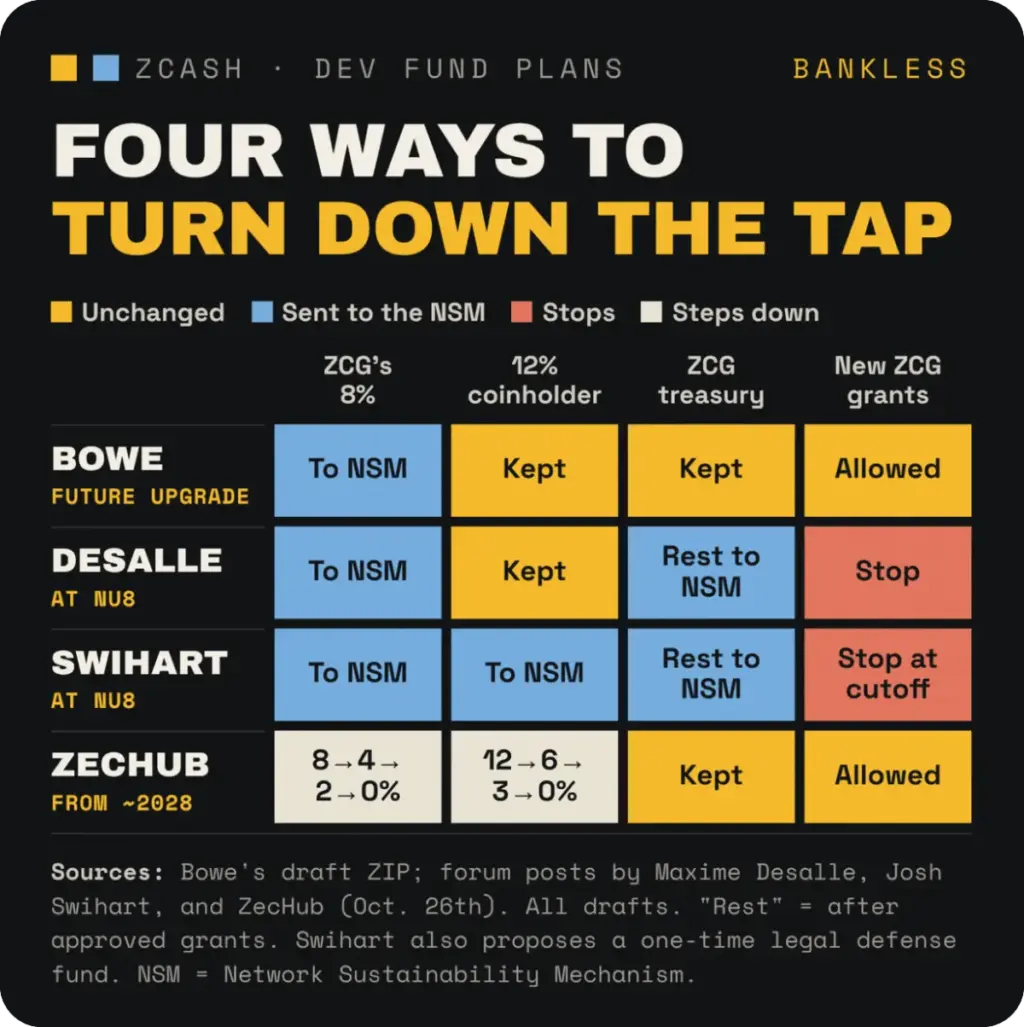
Four distinct proposals have surfaced in quick succession, each offering a different vision for the future of Zcash funding streams.
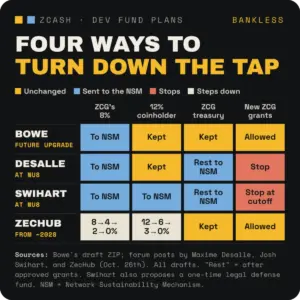
Sean Bowe’s draft ZIP represents the narrowest intervention. It seeks to terminate ZCG’s 8% funding stream at a future network upgrade—separate from NU7—and redirect that percentage to the Network Sustainability Mechanism (NSM) for the remainder of its originally scheduled duration. Under this plan, ZCG would retain its existing treasury and could continue approving new grants, while the separate 12% coinholder fund would remain untouched.
The Network Sustainability Mechanism is introduced with the NU7 upgrade, slated for early November. The NSM functions as a reserve for ZEC removed from circulation, which is later reissued to miners along a smooth curve while maintaining the strict 21-million token cap. Under current specifications for NU7, that reissued distribution begins around early 2031, meaning the redirected tokens are deferred rather than permanently burned.
Maxime Desalle, an investor at Winklevoss Capital, put forward a more aggressive proposal on the community forum. Desalle suggested ending ZCG entirely at the NU8 network upgrade and routing its 8% allocation to the NSM. Under his framework, ZCG would cease approving new grants immediately upon passage, and once all outstanding milestones were paid out, any remaining treasury capital would be swept into the NSM, while coinholder-backed grants would continue.
Josh Swihart, founder and CEO of the Zcash Open Development Lab, outlined a proposal to retire both the 8% grants stream and the 12% coinholder stream at NU8. Both streams would be redirected into the NSM until the third halving. ZCG would honor approved grants and transfer the remainder to the NSM, with a single carve-out: a one-off legal defense endowment for core Zcash developers subject to a coinholder vote. Swihart argued that targeting only one component of the development fund would be insufficient, noting that the coinholder stream faces a similar accumulation dynamic of roughly 216 ZEC per day, equal to about $100 million annually at current prices.

Finally, ZecHub introduced a "Soft Landing" proposal designed to find a middle ground. This plan maintains the current structure until the third halving, after which both streams would be halved at each successive network halving—stepping down from 8% to 4%, 2%, and finally 0%, and from 12% to 6%, 3%, and 0%—to reach zero by approximately 2036.
The Case For and Against Structural Cuts
The arguments in favor of cutting ZCG’s stream center primarily on governance and accountability. Critics like Desalle emphasize that the funds belong to coinholders, yet coinholders lack direct control over their deployment because ZCG answers to an advisory panel convened by the Zcash Foundation, leading to potential alignment disconnects. For instance, during polling for the NU7 upgrade, the Community Advisory Panel backed Zcash Shielded Assets with 70.4% support, whereas 98.6% of participating coinholder votes went against it. Because Zcash has established functional coinholder voting mechanisms, Bowe’s proposal explicitly prioritizes direct coinholder decisions over continued automatic accumulation by an independent grants committee.
Conversely, arguments against dismantling the stream focus on the destination of the capital and the long-term health of protocol development. Responding to Desalle’s proposal, ZODL engineer Jack Grigg argued that terminating ZCG without a dedicated development-focused replacement amounts to an explicit decision to allocate more money to miners by starving the chain of necessary maintenance and engineering resources.
Cryptographer Ian Miers, a co-author of the original Zerocash paper, echoed this sentiment, suggesting that redirecting funds solely to miners without supporting research resembles a circuitous way of subsidizing network operators. Other committee voices warned that abandoning a dedicated reserve fund entirely would be an overly confident move.
Additionally, the timeline of the Network Sustainability Mechanism has drawn criticism from supporters of spending cuts. Dev Ojha, who leads Valar Group, noted that dampening spending now to redirect funds to miners beginning a decade from now is a prudent concept, but argued that the NSM activation should not precede Zcash’s fifth halving in 2036.

Broader Context and Next Steps
Zcash currently occupies a unique position in tokenomics. Bitcoin allocates 100% of block rewards to miners, leaving developer funding dependent on donations and external corporations. Meanwhile, the Ethereum Foundation relies on its own treasury, operating under a policy that scales annual spending down from 15% to 5% over five years without drawing directly from current token issuance.
Zcash’s funding mechanism, by contrast, relies on a fixed percentage of issuance that automatically scales with market prices in both directions. When ZEC was trading at lower levels in 2024, previous proposals argued that ZCG lacked the financial runway enjoyed by older entities like the Electric Coin Company and the Zcash Foundation. Now, the network confronts the precise inverse of that problem. Notably, Bowe’s proposal considered and rejected a price-triggered cap, arguing that such a mechanism would introduce unnecessary policy complexities and operational dependencies.
None of the current proposals are final. Each requires a formal network upgrade, and node developers ultimately retain the autonomy to decide what code they ship. Representatives for ZCG and the Zcash Foundation have not yet issued formal responses, and no official coinholder vote has been scheduled. As the community continues to debate the future of its treasury, stakeholders will be watching for subsequent improvement proposals and official commentary, viewing the dilemma not as an existential crisis, but as a welcome challenge for a maturing blockchain entering its second decade.
 Tokenomics & Digital Assets
 Tokenomics & Digital Assets
 Tokenomics & Digital Assets