Luxor’s Monthly Lookback Series offers an in-depth exploration of Bitcoin hashrate market activity, charting the shifting dynamics of hashprice trends, forward market participation, trading volume, and contract performance. Looking back at September 2026, the Bitcoin mining sector navigated a delicate balance between rising asset prices and escalating network difficulty, resulting in a remarkably steady month for hashprice value.

September 2026 Spot Hashprice and Its Core Constituents
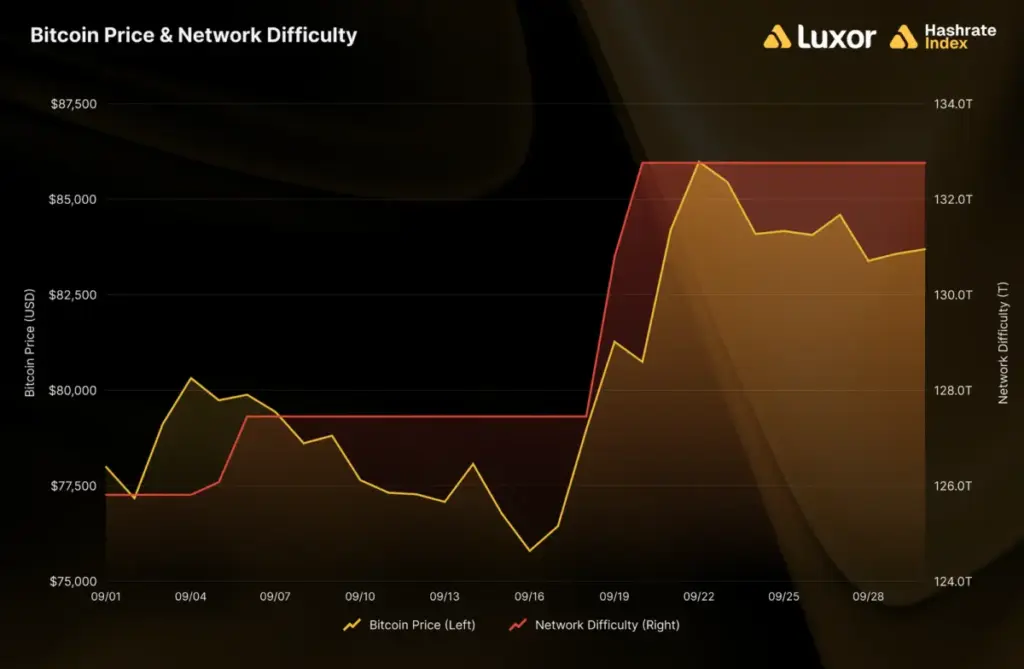
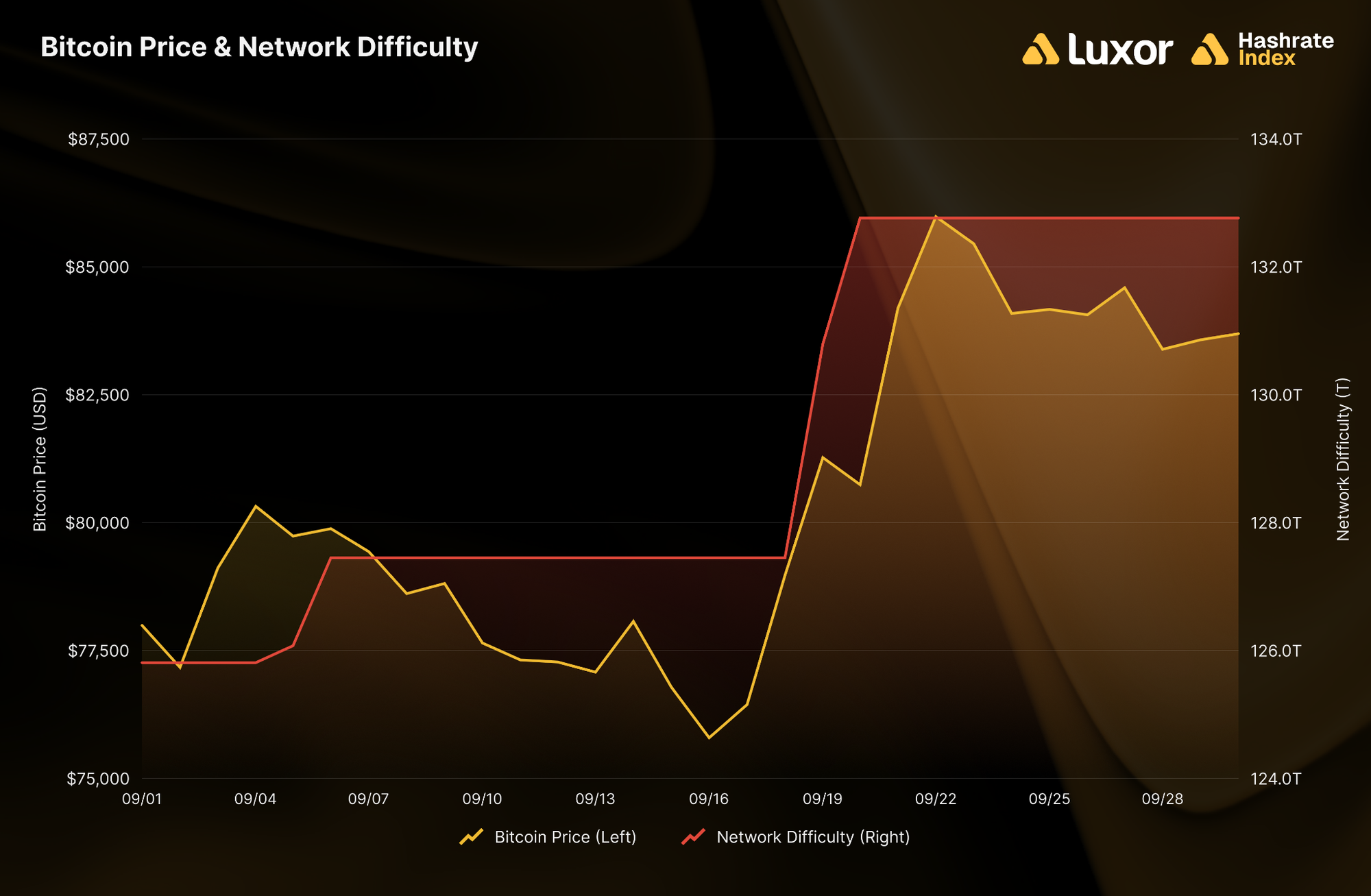
August’s robust Bitcoin rally added $7.70 to hashprice in just twelve days, closing out the month with a lingering question for miners: would Bitcoin continue its upward trajectory, or would surging network difficulty claw back those hard-fought gains? September ultimately delivered a combination of both forces. Bitcoin climbed another 7.3% from its monthly open to its close, while network difficulty expanded by 5.5% across two distinct upward retargets. Consequently, spot hashprice finished the month within a mere $0.71 of where it had begun.
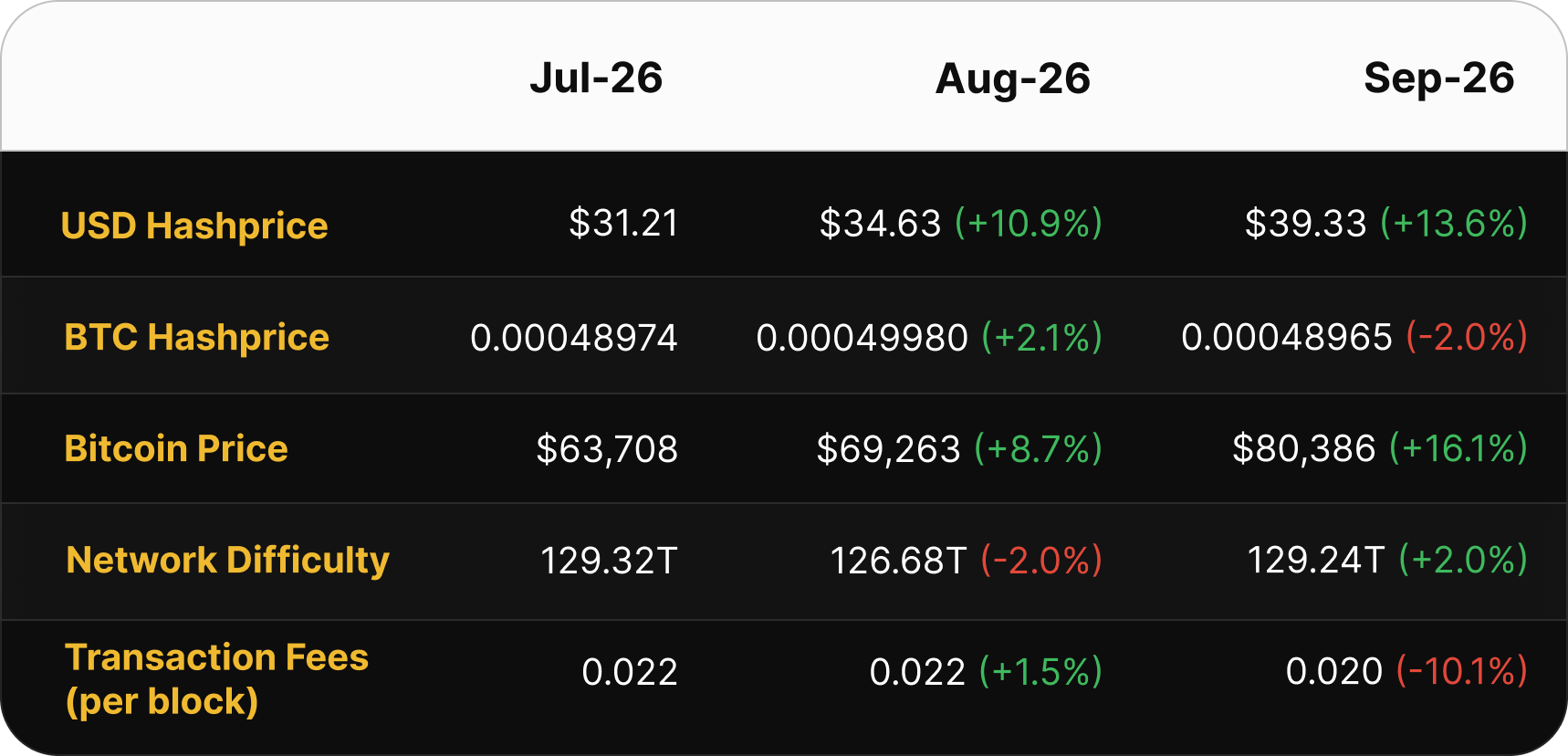
USD hashprice successfully defended the ground won during August while capturing modest additional gains. The month opened at $39.21 per PH/s/day, closed slightly higher at $39.92 representing a 1.8% increase, and averaged $39.33—marking the highest monthly average recorded since January. Notably, nine separate days settled above the $40 threshold, representing the highest frequency of days above that mark in any single month since November 2025, compared to just one such day in August.
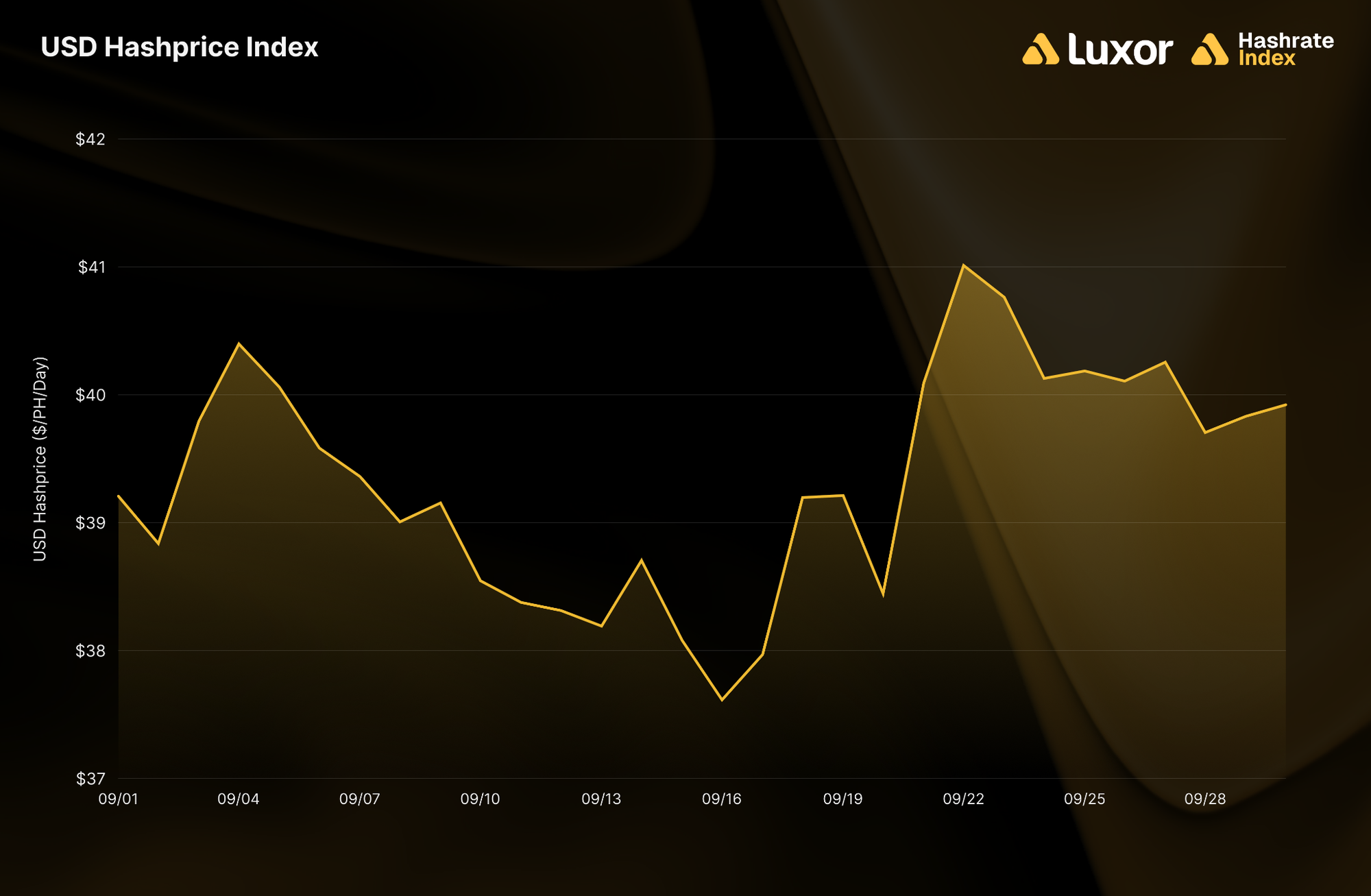
The monthly trading range remained exceptionally narrow by the standards of 2026, touching a low of $37.61 on September 16 before peaking at $41.01 six days later. Beneath these surface figures, Bitcoin’s appreciating spot price pushed hashprice upward, while rising network difficulty exerted an opposing downward pressure in near-equal measure.
Bitcoin Price Volatility: Two Difficult Days Followed by a 13% Weekly Surge
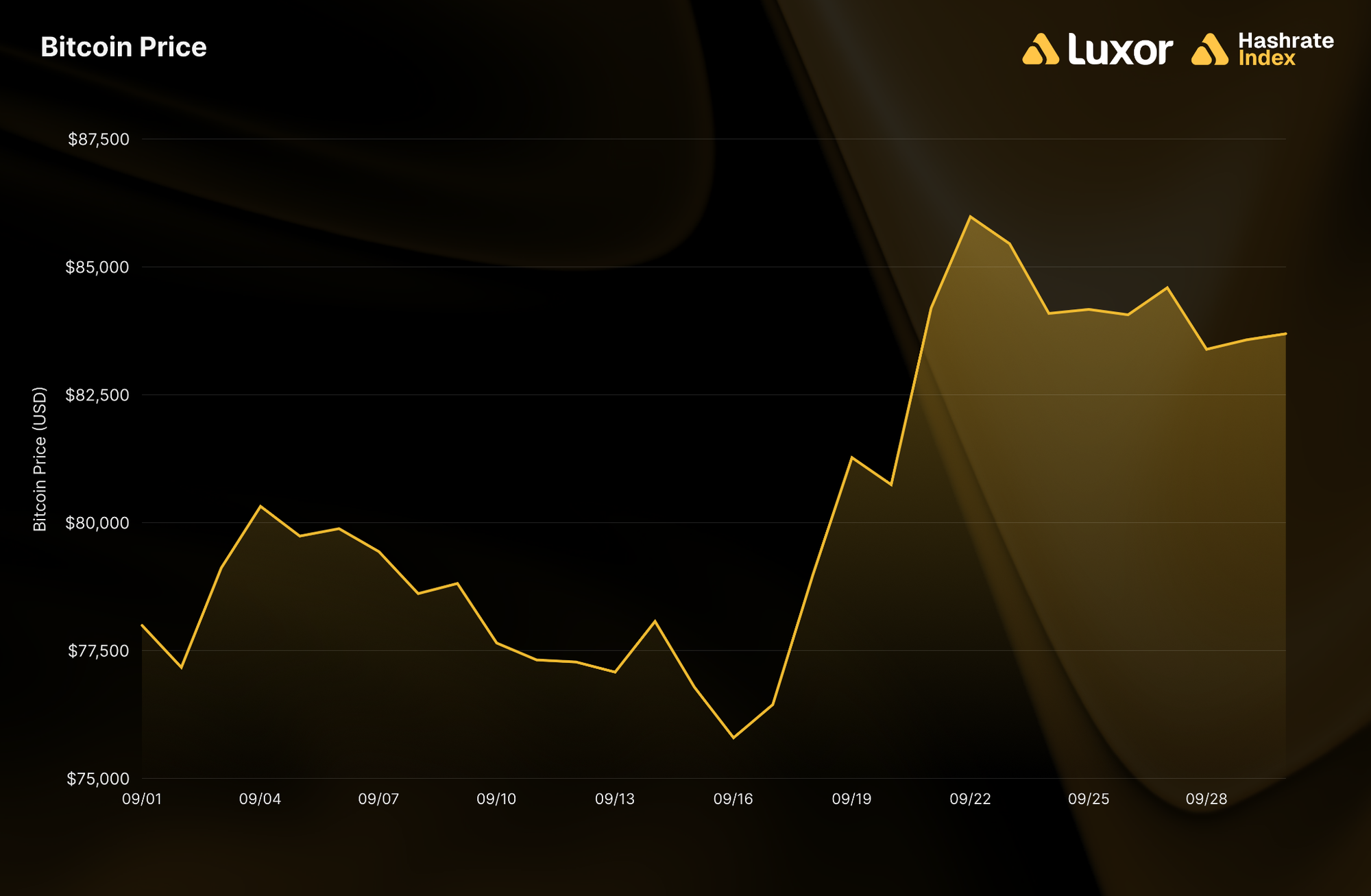
Bitcoin opened September trading at $77,984 and closed at $83,687, securing a 7.3% gain while averaging $80,386 for a 16.1% month-over-month increase. The asset reached its monthly high of $85,973 on September 22.
However, the month was not without significant macro headwinds. Two scheduled market risks materialized within a 24-hour window, both dealing a heavy blow to sentiment. On September 15, the United States Senate failed to invoke cloture on the Clarity Act with 41 votes against the measure, effectively stalling the legislation for the remainder of 2026. Just a day later on September 16, the Federal Open Market Committee announced a unanimous decision to raise interest rates by 25 basis points to a target range of 3.75% to 4.00%, marking the first rate hike executed by the central bank since July 2023. Bitcoin’s monthly low of $75,791 coincided directly with this rate announcement.
Despite these regulatory and macroeconomic setbacks, the market rebounded aggressively. Between September 16 and September 22, Bitcoin surged 13.4% to reach $85,973, marking its largest six-day advance since the August market breakout. This recovery was supercharged by massive institutional inflows into U.S. spot exchange-traded funds, which absorbed $999 million on September 21 alone—the largest single-day intake of the year and the highest since October 2025. Total net inflows for the month reached $2.65 billion, successfully pushing 2026 net flows back into positive territory. According to estimates from Bloomberg Intelligence, the average U.S. spot-ETF holder returned to a profitable cost basis for the first time since January.
At the closing price of $83,687, Bitcoin finished September down 32.8% from its October 6, 2025 all-time high of $124,485, an improvement over the 37.1% deficit recorded at the end of August. The asset remained 13.1% below its 2026 peak of $96,278 established on January 15. On a quarterly basis, Bitcoin delivered a 41.8% gain, marking its strongest performance since the fourth quarter of 2024.
Network Difficulty and Hashrate Expansion
Network difficulty averaged 129.24T, representing a 2.0% increase, and closed the month at 132.76T. Two scheduled difficulty adjustments occurred during September, both resulting in upward revisions: a 1.31% increase on September 5 followed by a 4.16% surge on September 19, which marked the largest single retargeting adjustment since late June. With a net gain of 5.52% across these two adjustments, September recorded the highest monthly rate of difficulty growth since October 2025.
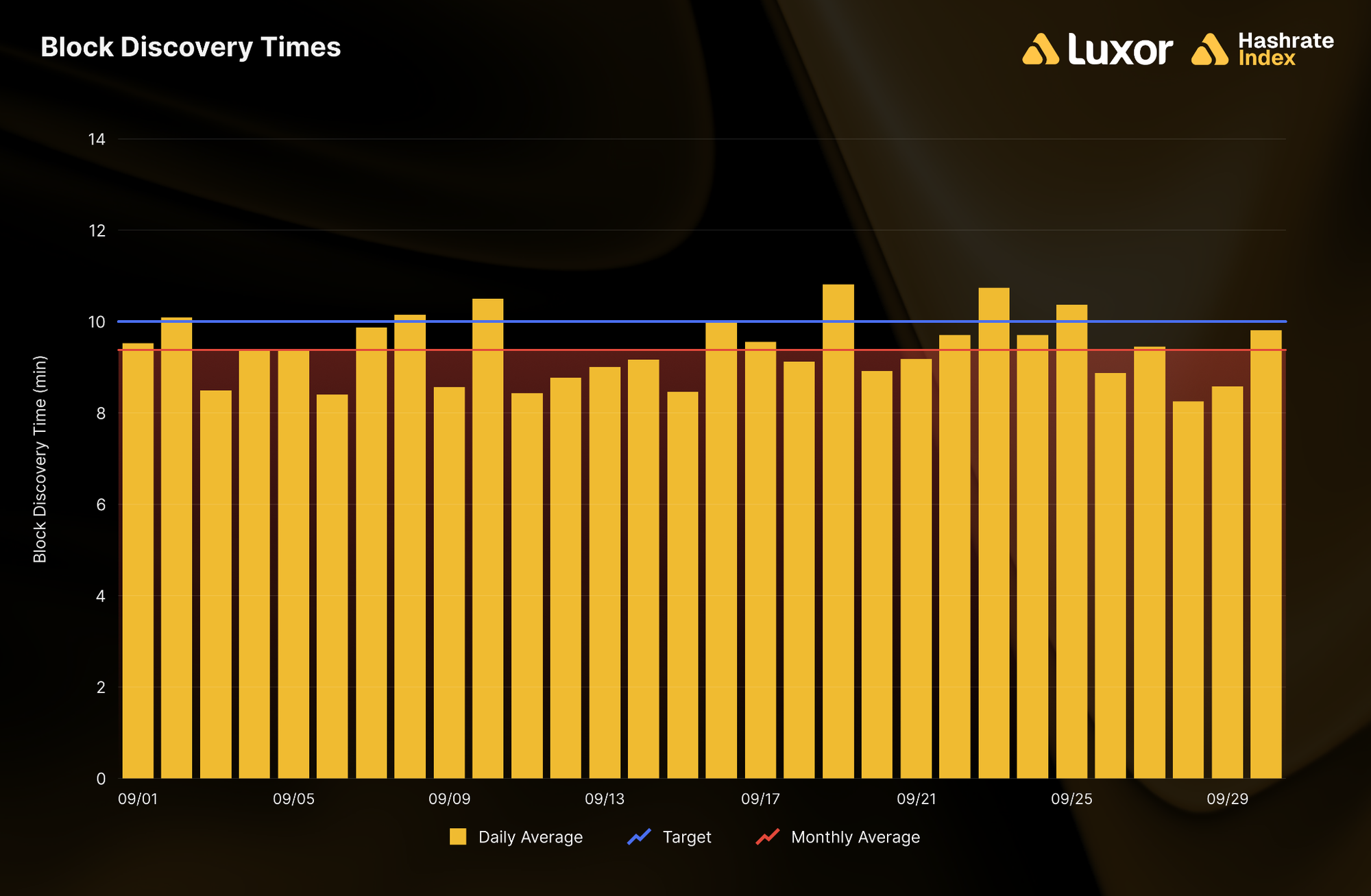
Average block times shortened to 9 minutes and 23 seconds, making it the fastest month for block production since February, with 23 out of 30 days falling below the standard 10-minute target. As the Texas summer came to a close, mining operations that had previously curtailed their fleets returned to full capacity. Consequently, the 7-day network hashrate average climbed from 926 EH/s to 975 EH/s over the course of the month.
Reflecting on the summer cooling season, the Electric Reliability Council of Texas recorded its four coincident peak demand intervals on June 18, July 22, August 24, and September 12. While July’s peak of 90.96 gigawatts established the seasonal high, September’s peak of 86.49 gigawatts at 4:30 PM Central Time served as the final critical interval. A flexible-load client utilizing Luxor Energy successfully dispatched curtailment protocols across all four peak intervals, enduring 120 hours of operational downtime over 47 dispatch days, with fewer than ten of those hours occurring in September. Evaluated against prevailing transmission rates, the financial savings from avoided transmission charges outweighed the mining margins relinquished by a factor of roughly 14 to 1. The final upward difficulty adjustment of 4.16% landed precisely one week after the conclusion of the final peak demand interval.
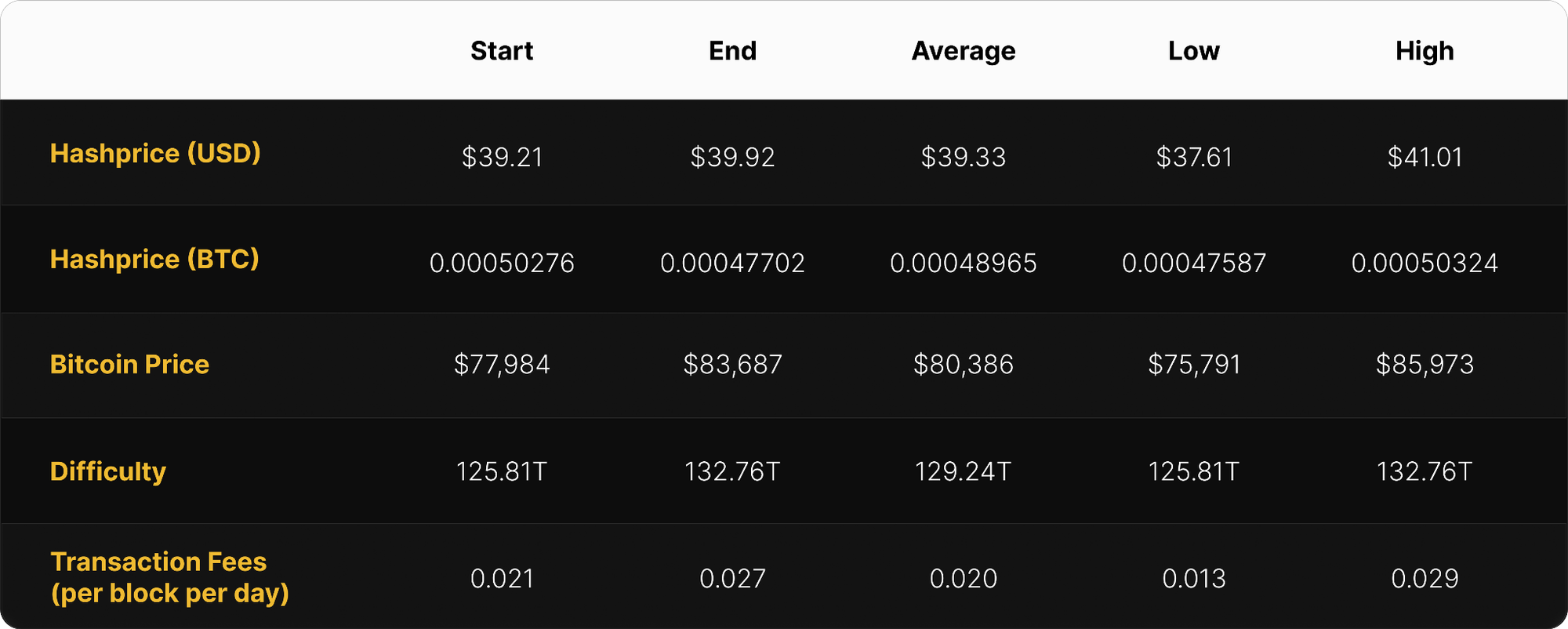
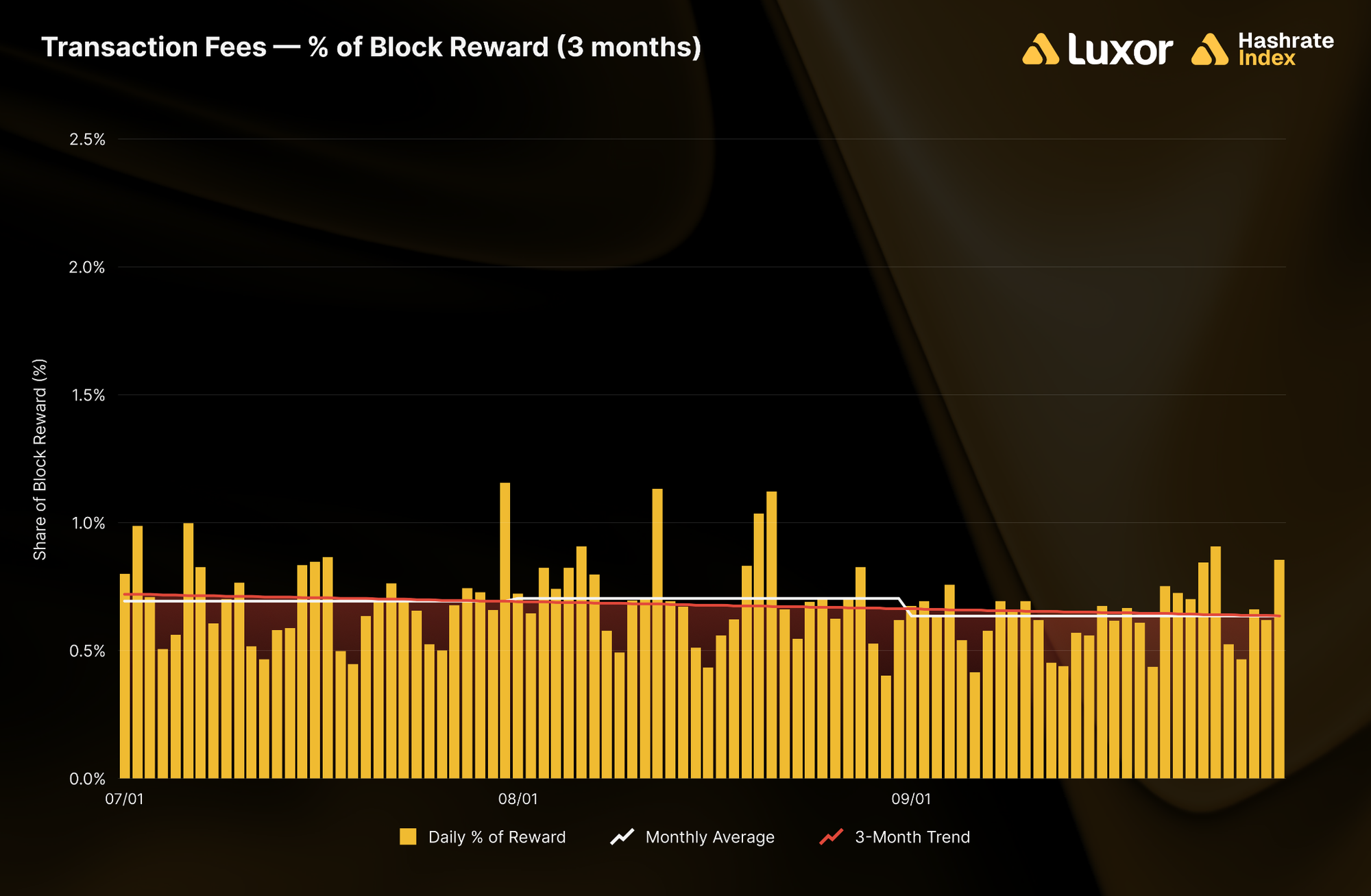
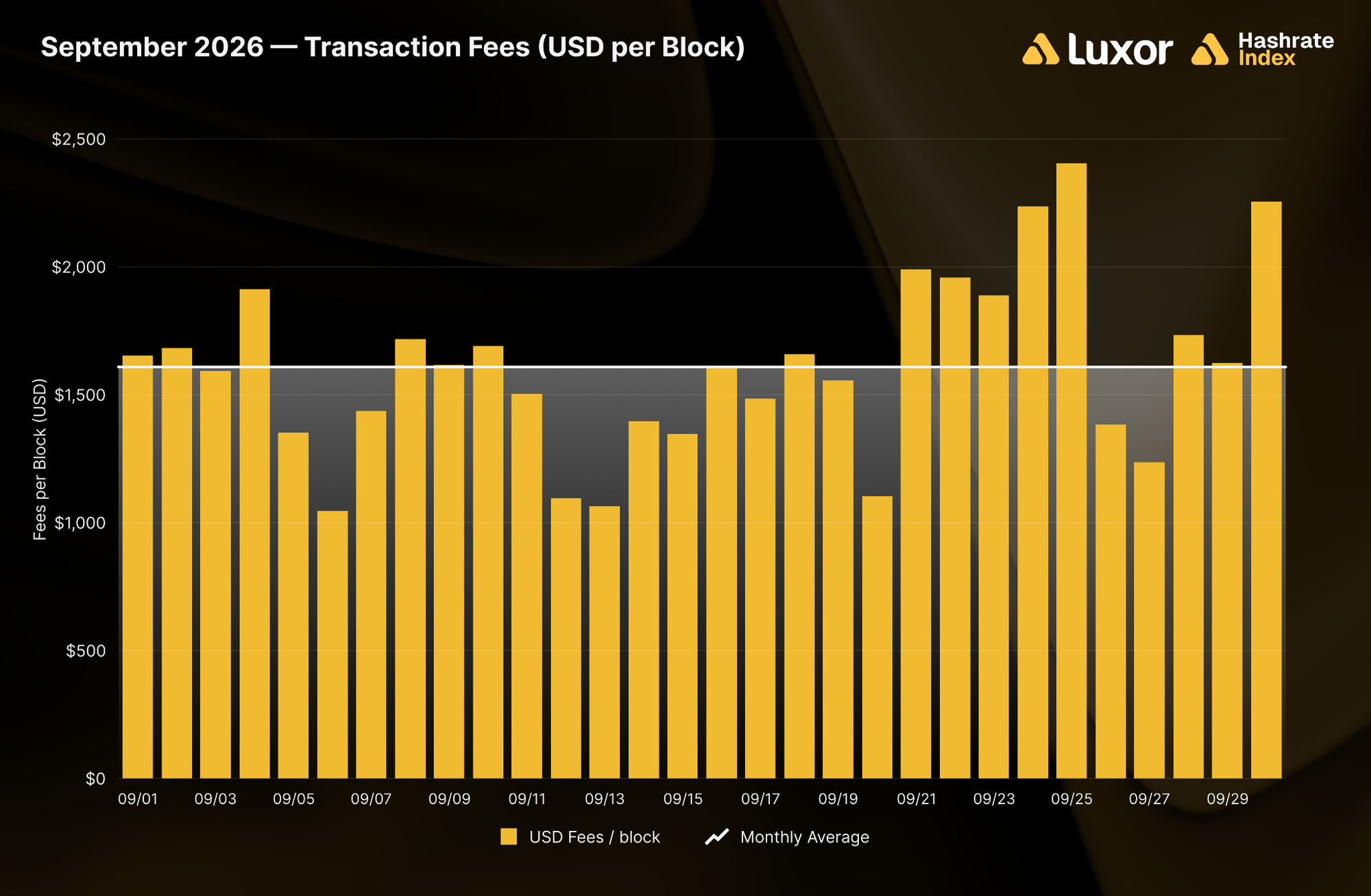
Meanwhile, transaction fee collections experienced a downward trend, falling 10.1% to average 0.0199 BTC per block, the lowest level recorded since May. Transaction fees accounted for just 0.63% of total block rewards, extending a streak of fifteen consecutive months where fees remained below 1% of block subsidies. Daily fee generation ranged from 0.013 to 0.029 BTC per block, devoid of any significant network congestion or outlier blocks. In U.S. dollar terms, the average block generated approximately $1,607 in fees, representing a 4.8% increase driven entirely by Bitcoin’s appreciating spot price.
Hashrate Market Derivatives and Forward Trading Activity
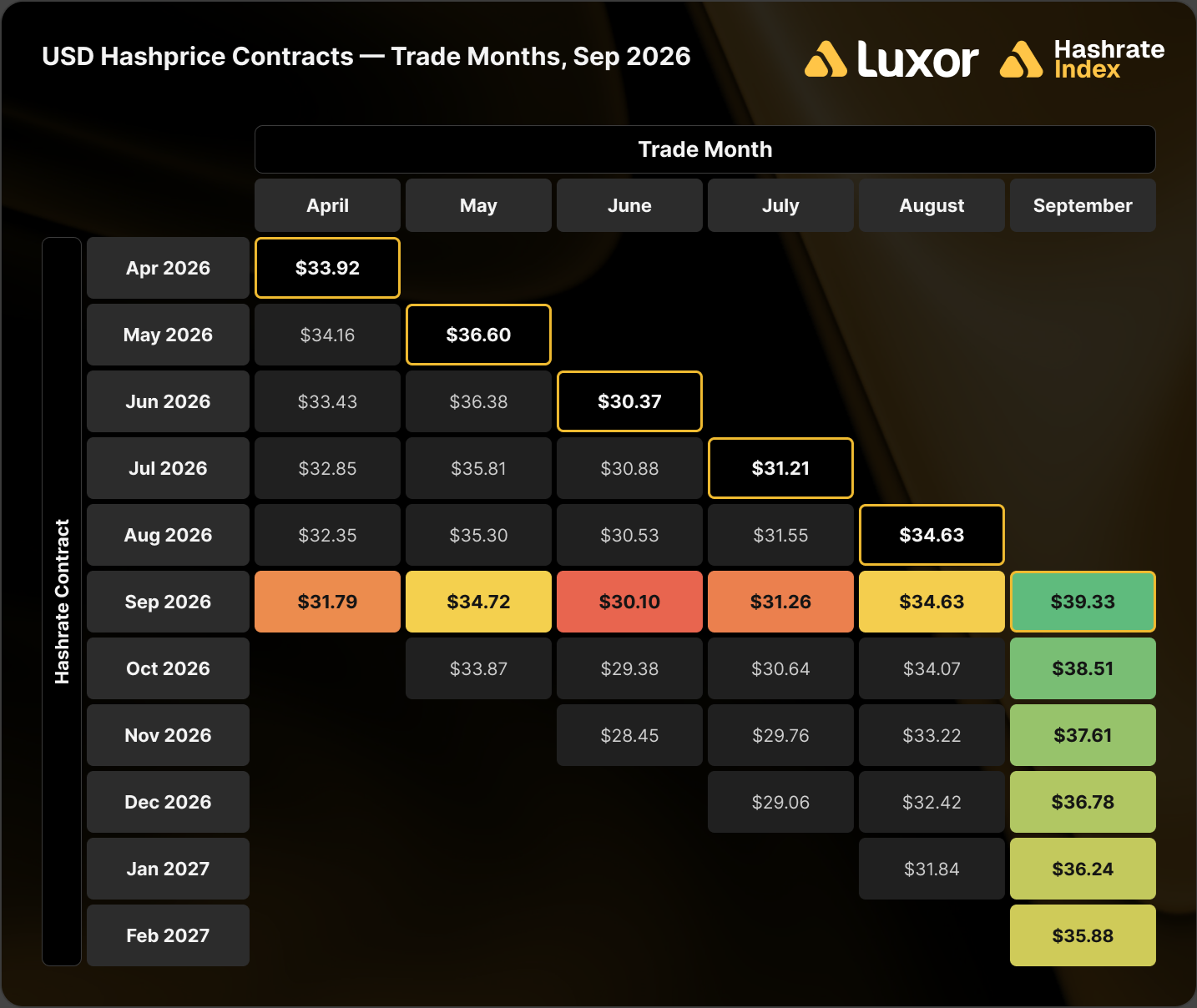
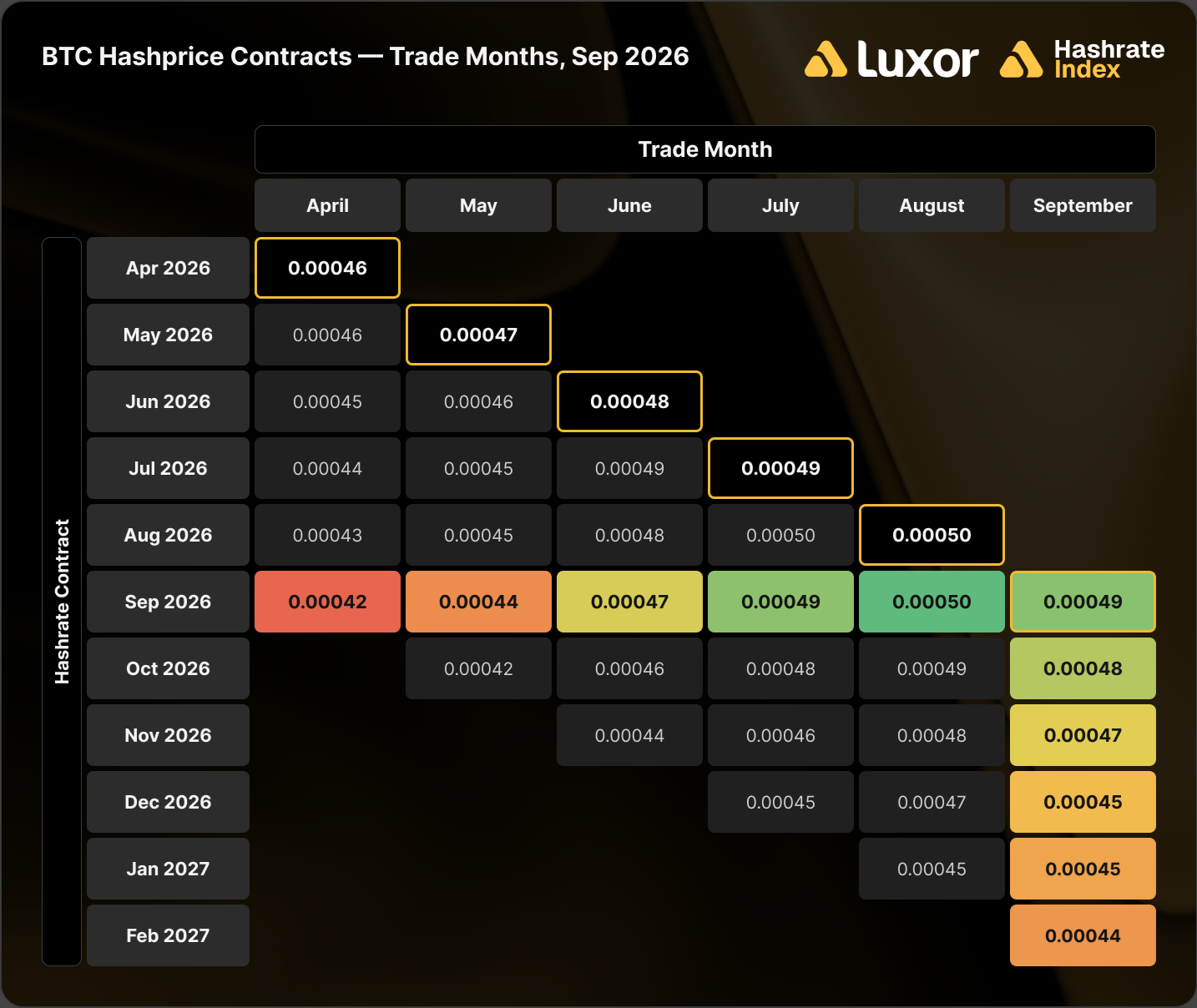
The analysis of September’s hashrate market activity centers on how forward contracts traded in preceding months and how the forward curve shifted throughout the period in response to fluctuating pricing dynamics.
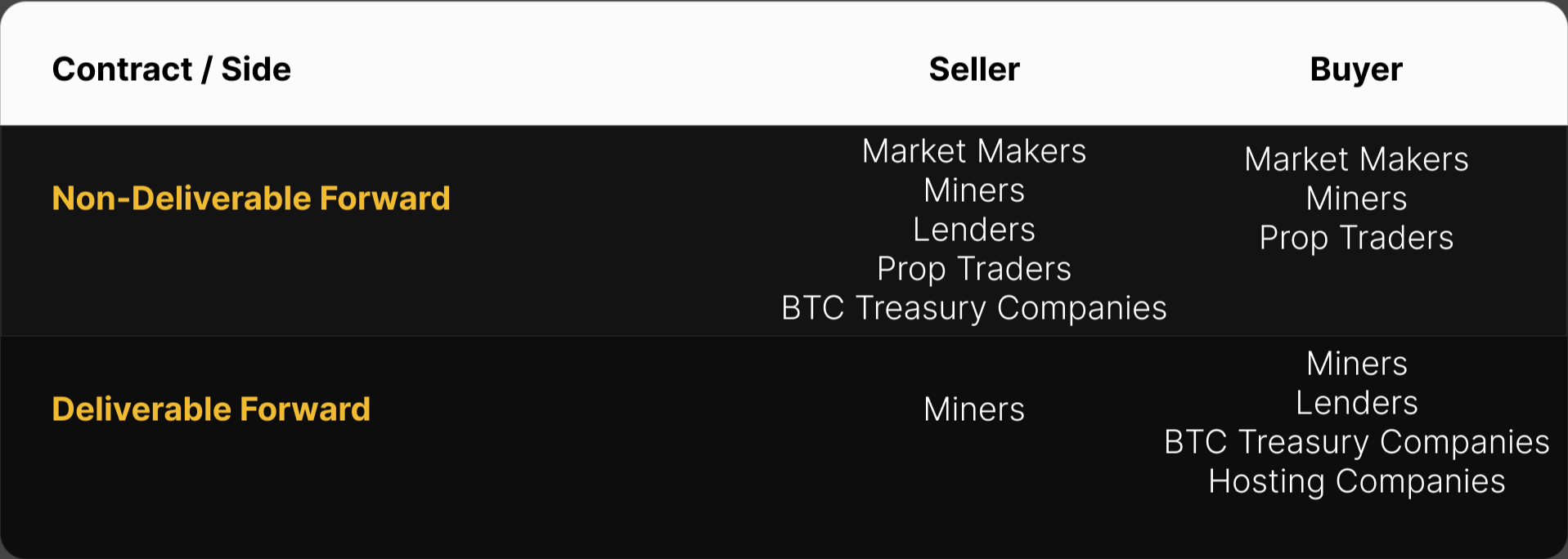
Market participation on Luxor’s deliverable and non-deliverable hashrate forward markets demonstrated distinct operational strategies among industry stakeholders. Throughout September, commercial lenders maintained an active presence on the buy side of deliverable forward contracts, while public and private mining enterprises utilized the contracts to sell forward, secure non-dilutive financing, and fund fleet expansions. Because deliverable forwards require upfront prepayment, they characteristically trade at a discount relative to non-deliverable forwards to compensate buyers for credit risk and capital costs. Pairing a deliverable contract with an offsetting non-deliverable contract allows participants to lock in this pricing spread as a fixed Bitcoin-denominated yield for lenders or a predictable financing cost for miners. In September 2026, this implied cost of capital yielded between 6% and 13% annualized.
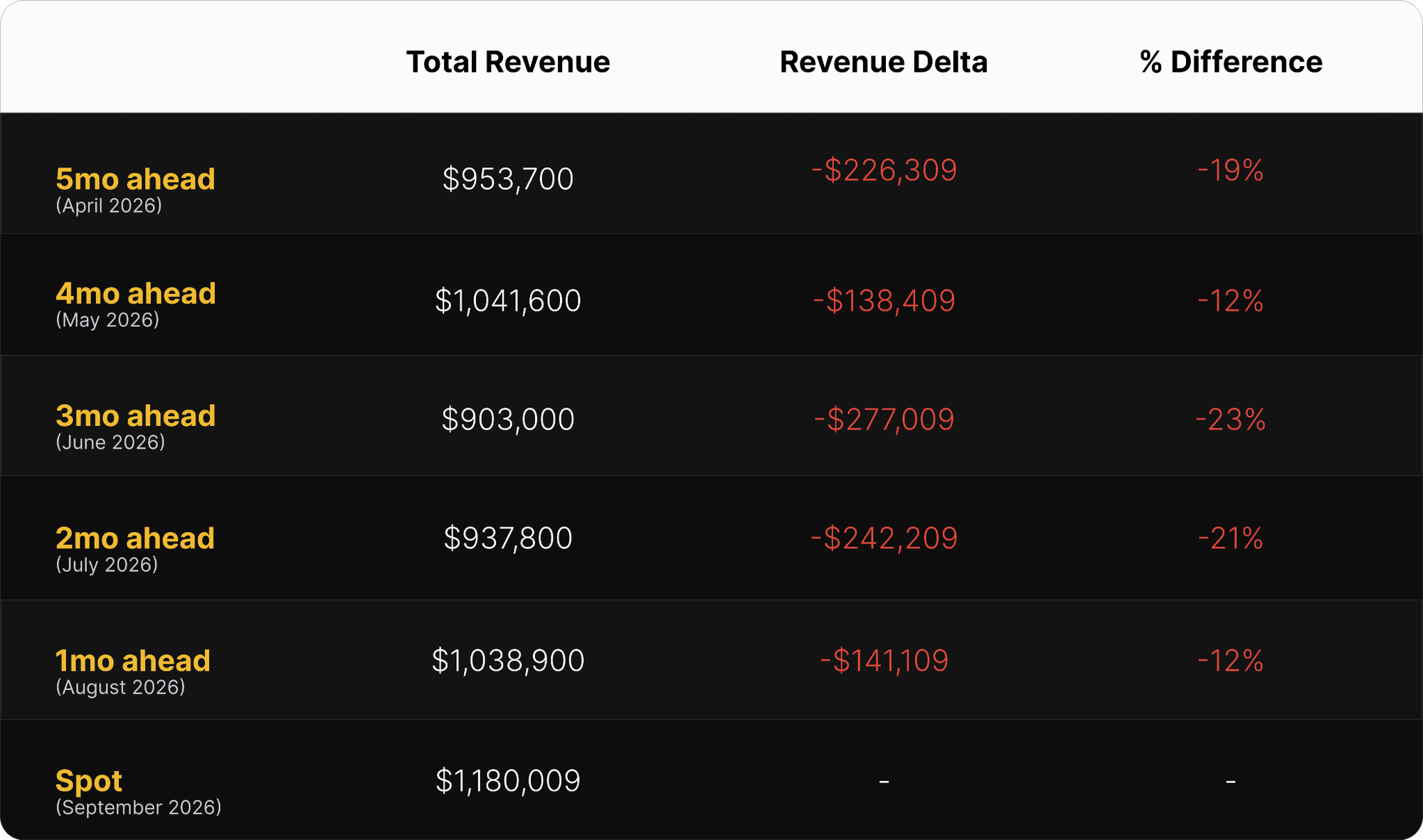
September notably marked the first month since July 2025 in which every dollar-denominated hedging position registered a loss compared to spot settlements. Sellers of the September USD contract locked in rates between $30.10 and $34.72 per PH/s/day, falling well short of the $39.33 spot settlement price.
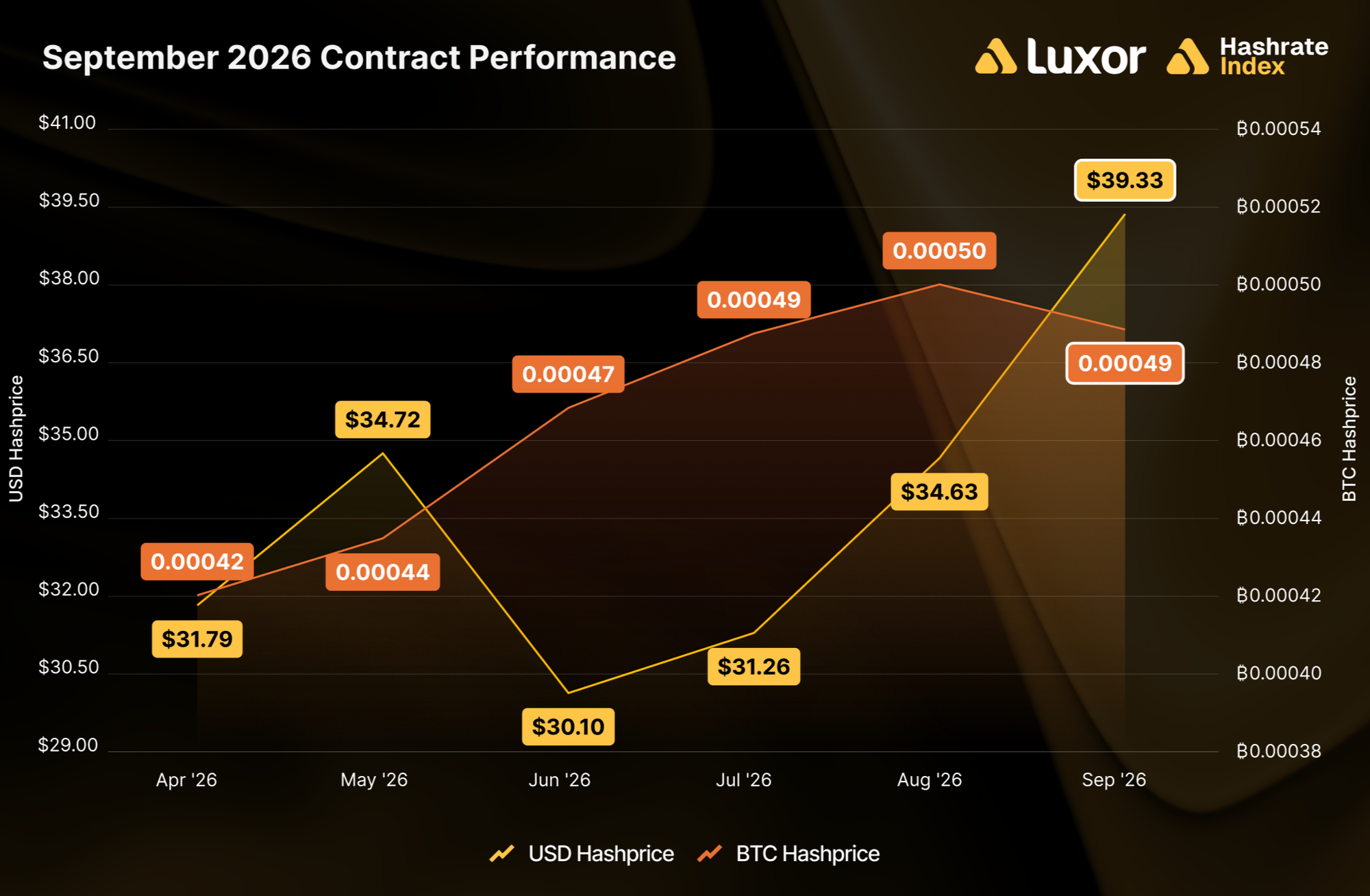
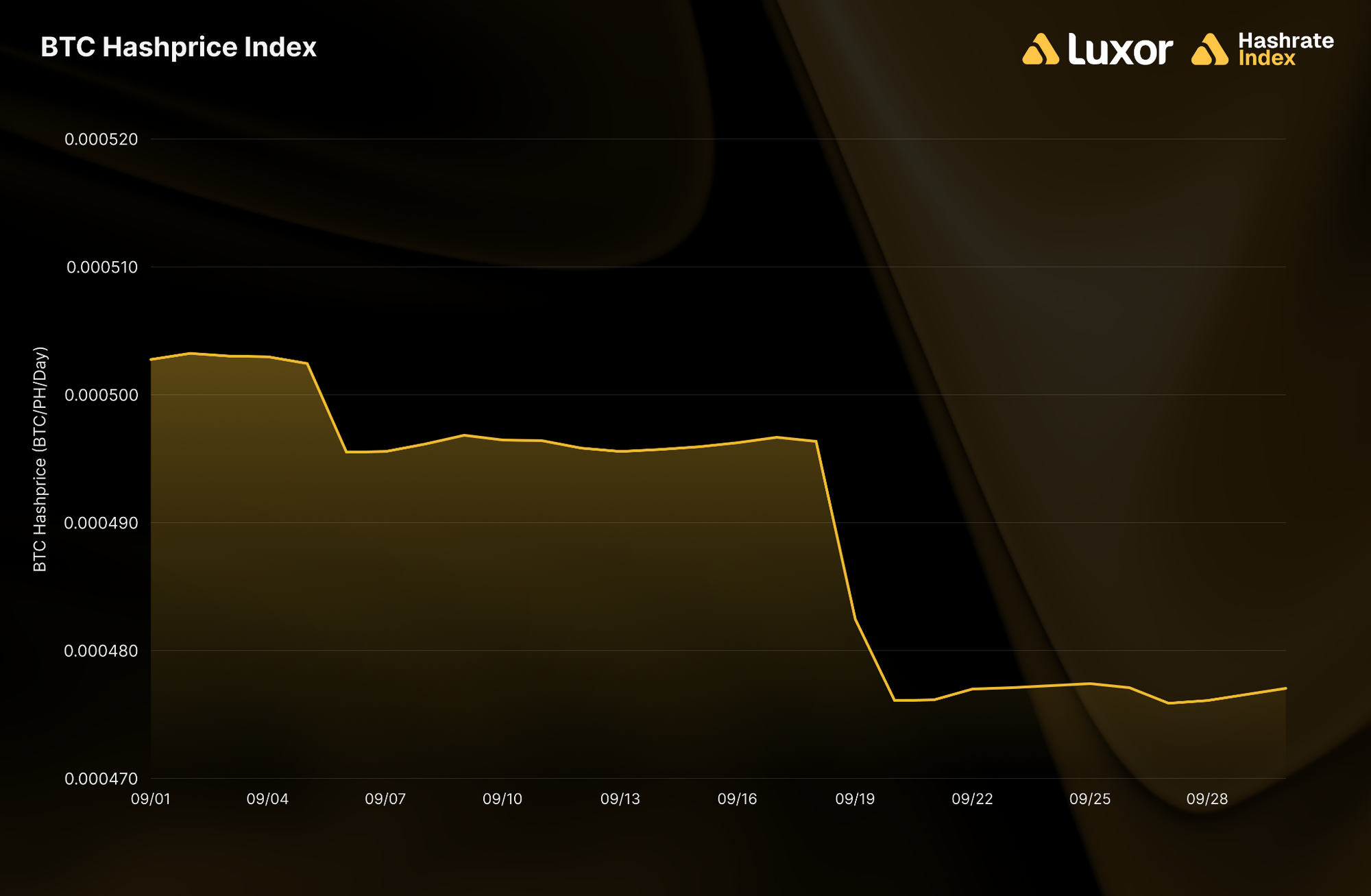
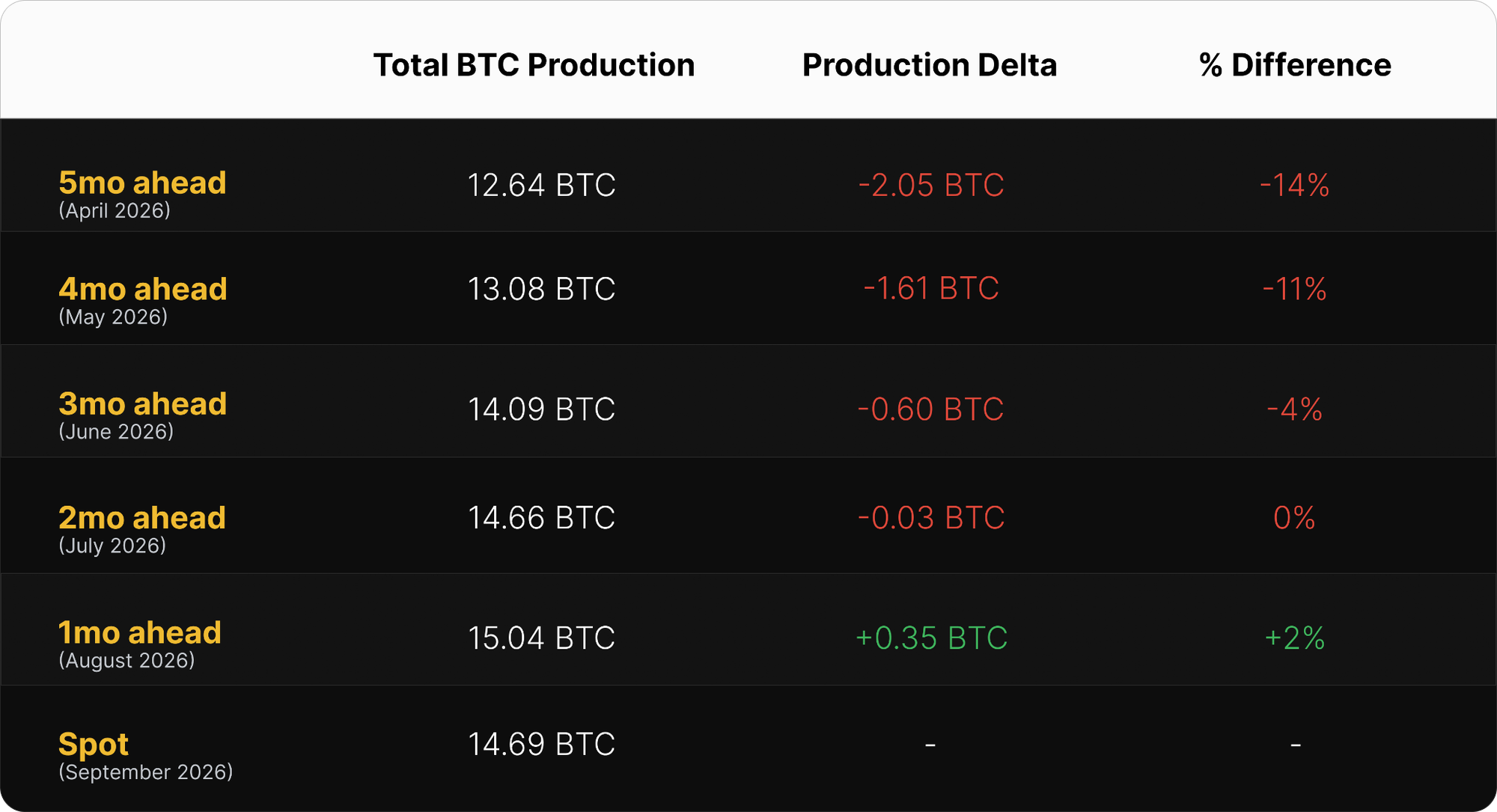
Conversely, the streak for Bitcoin-denominated hedges was broken. From April through August, every BTC-denominated hedge underperformed relative to spot mining. In September, however, August’s one-month forward sale executed at 0.00050 BTC per PH/s/day outperformed the 0.00049 spot settlement by 2.4%. Longer-dated horizons spanning two to five months continued to trail spot rates, maintaining a trend observed consistently since January.
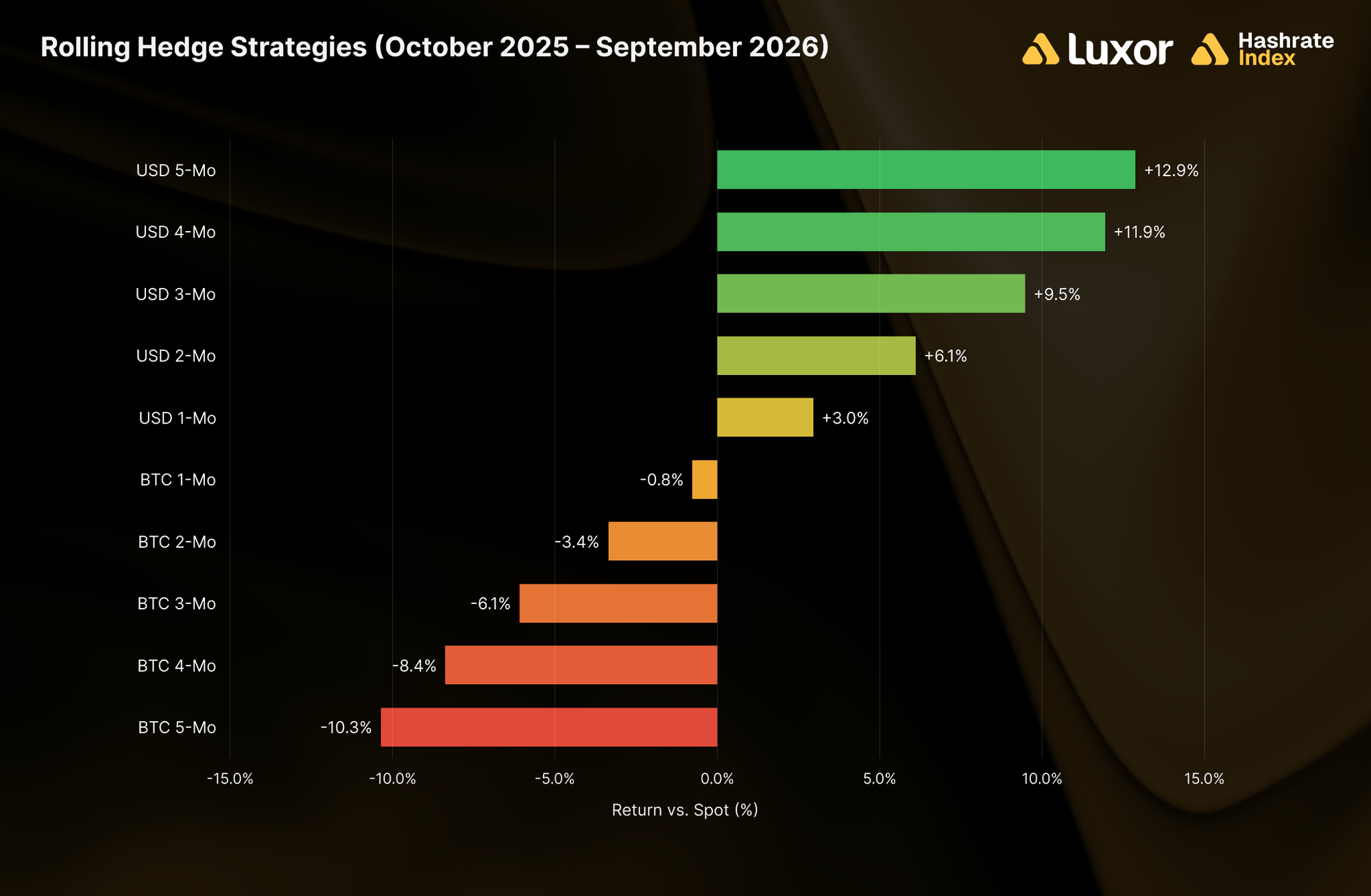
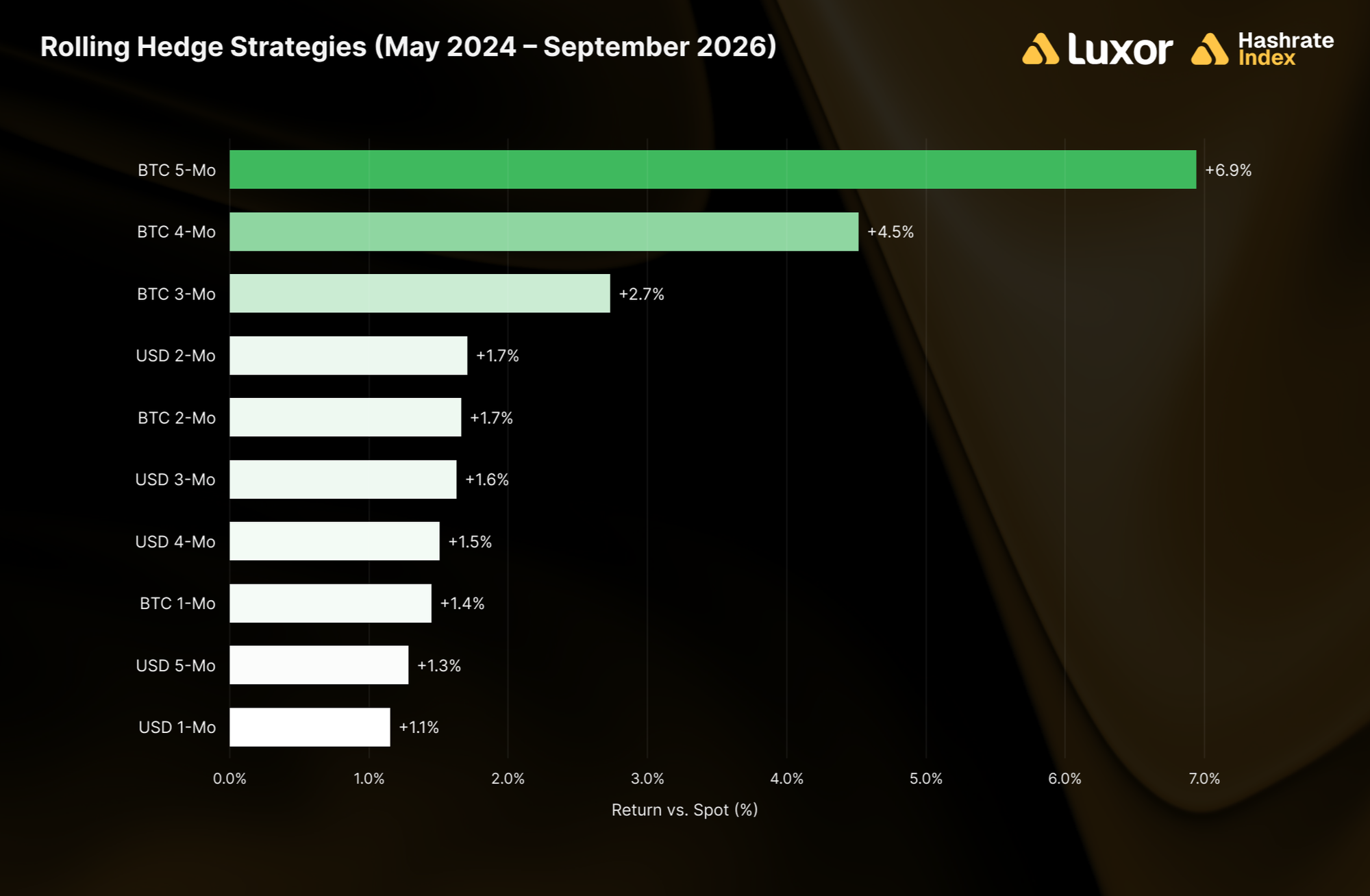
Across the trailing twelve months, rolling USD hashprice hedges outperformed spot mining across every maturity horizon, generating gains ranging from 3.0% for one-month contracts to 12.9% for five-month contracts. In contrast, rolling Bitcoin hashprice hedges registered losses across all horizons, declining between 0.8% and 10.3%. Both outcomes stem from two primary macroeconomic shifts over the past year: a falling Bitcoin price that pulled USD hashprice below forward sale prices, and declining network hashrate efficiency trends that pushed BTC hashprice above forward sale levels.
Forward Curve Projections and Future Outlook
Looking toward the final quarter of the year, the forward market for the subsequent five months spanning October 2026 through February 2027 priced in anticipated increases in both Bitcoin’s spot price and network difficulty. The USD-denominated hashrate forward curve rose at a slightly slower pace than spot values, with lock-in rates for the winter strip increasing between 2.8% and 5.3% over the course of the month, compared to a 3.9% increase in spot hashprice. Simultaneously, the BTC-denominated forward curve declined by 1% to 4% across the strip, indicating that market participants had fully incorporated expectations of intensified mining competition.
Implied Bitcoin prices derived from the ratio of USD to BTC forward contracts hovered between $84,400 and $86,600 across the five-month strip. Factoring in September’s average transaction fee collection of 0.0199 BTC per block, these contracts imply steady upward momentum in network difficulty and total hashrate, with implied difficulty stepping up from 133.2T in October to 147.1T by February 2027. In hashrate terms, the forward curve prices the network expanding from 953 EH/s in October to over 1 exahash per second, reaching 1,029 EH/s in January 2027 and 1,053 EH/s by February.
As October trade gets underway, market fundamentals show continued resilience, with hashprice averaging $40.37 and Bitcoin holding near $84,655 through the first week of the month. With the seasonal conclusion of Texas peak demand management protocols, miners have redeployed curtailed capacity, bringing the 7-day hashrate average close to 1 exahash per second. Historical seasonal patterns indicate that October frequently brings substantial difficulty expansion, averaging nearly 10% month-over-month growth over the preceding four years. Whether Bitcoin’s spot price can outpace this incoming wave of network difficulty will ultimately dictate whether miners can maintain profitable margins through the conclusion of 2026.
 Cryptocurrency Mining
 Cryptocurrency Mining
 Cryptocurrency Mining