DefiLlama, a dominant force in cryptocurrency data analytics, is leveraging its influential market position to settle high-stakes financial bets, literally. On October 20th, the platform announced a strategic partnership with Trueo, a permissionless prediction market protocol built on the Base network, to launch specialized prediction markets. These new offerings will settle strictly according to verified DefiLlama data, covering critical onchain metrics such as protocol revenue, DeFi exploits, and high-profile chain performance indicators.
As onchain revenue increasingly becomes the primary dividend metric for evaluating crypto projects like traditional businesses, these new markets function similarly to crowd-priced earnings estimates for decentralized finance protocols. Conversely, exploits remain one of the industry’s most persistent structural risks, and the newly established exploit markets are designed to attach a live, tradeable price to that ongoing vulnerability. While the prediction venues are still in their early stages and maintain relatively modest liquidity, the initiative carries significant potential to reshape how market participants evaluate protocol performance and security risk.
How the Markets Work
The initial slate of offerings introduced through the partnership spans several categories. These include monthly revenue lines for prominent platforms such as Hyperliquid, Pump, Uniswap, Aero, Papertrade, and Collector Crypt. Additionally, the markets feature October exploit or bad debt contracts for major lending protocols like Aave and Morpho, alongside weekly tracking markets predicting whether any major hack exceeding $1 million or $5 million will hit the broader crypto ecosystem.
Participants trade within these prediction venues using TYD, which serves as Trueo’s USDC-backed stablecoin. The protocol’s minting mechanism dictates that a single TYD token can be split to mint one "YES" share and one "NO" share, with the winning side ultimately redeeming for a full TYD. Notably, YES and NO shares trade independently within their own respective Uniswap liquidity pools. This structure allows traders to interpret a YES share price of 0.82 TYD, for instance, as an 82 percent implied probability of the event occurring.
DefiLlama functions as the primary source of truth for the underlying data, while Trueo’s optimistic oracle handles market resolution. The resolution mechanism incorporates bonded proposals, a strict 12-hour challenge window, and a formal escalation path for handling potential disputes. In exchange for its role, DefiLlama earns creator fees as the designated curator of each market. Because these are still emerging markets with individual liquidity pools ranging roughly between $10,000 and $25,000, market participants note that many of the initial offerings may present compelling mispricings.

Earnings Estimates for Onchain Businesses
The launch mirrors a broader shift across the cryptocurrency sector where market participants increasingly value crypto projects based on holder revenue and fundamental business performance. However, what the crypto industry has historically lacked is the traditional corporate earnings ritual, complete with published analyst consensus estimates and stock price reactions driven by earnings beats and misses.
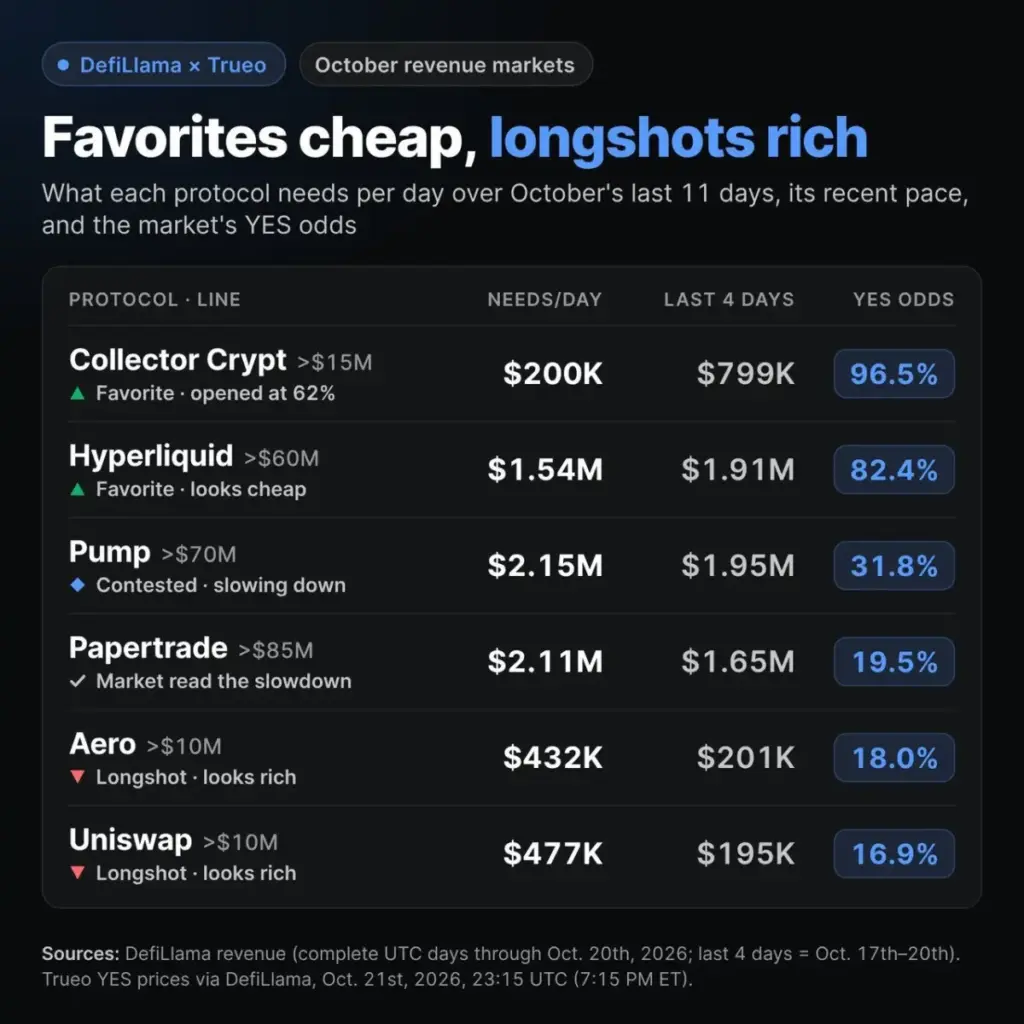
The new DefiLlama revenue markets introduce a crowd-priced equivalent to this dynamic. Because onchain earnings print in real time, each market page displays the current run rate directly alongside the prevailing betting odds. Analyzing the performance of October revenue through October 20th against what each tracked protocol requires over the final days of the month reveals distinct behavioral patterns among traders.
Market data shows that favorite outcomes are frequently trading cheap relative to their actual performance. For example, Collector Crypt requires approximately $200,000 per day to clear a $15 million monthly milestone, and its worst full day of October exceeded $218,000. Despite this steady performance, its prediction market opened at a modest 62 percent probability. This discrepancy prompted DefiLlama Chief Revenue Officer Patrick Scott to remark that traders were essentially selling dollars for 94 cents. Similarly, Hyperliquid has averaged roughly $2.15 million per day against the $1.54 million it requires, yet the market continues to price an 18 percent chance of a monthly miss.
On the flip side, longshot outcomes are frequently trading rich. Uniswap requires roughly $477,000 per day to hit a $10 million target, meaning it would need to surpass its best day of October every single day for 11 consecutive days. Aero requires approximately 90 percent of its best-day performance sustained through the end of the month. Both assets currently trade at 17 to 18 percent odds despite having cleared $15 million in September, a feat that would require an immediate and sustained volume surge to repeat.
Meanwhile, Papertrade is experiencing greater harmony between its market odds and actual activity. The 1,000x exchange booked approximately $61.8 million in revenue from its October 10th launch through October 20th, a pace that a naive mathematical average would suggest makes an $85 million monthly finish a virtual lock. However, launch day alone accounted for roughly $25.2 million, and daily revenue has since slid from $7.5 million to $1.45 million. At its more recent pace, Papertrade is projected to finish closer to $80 million, a trajectory that the prediction market accurately anticipated as odds slid from 68 percent to 19.5 percent in under two days.
These pricing behaviors demonstrate the classic favorite-longshot bias that has been documented at traditional racetracks and prediction venues for decades. Bettors routinely tend to overpay for longshot outcomes and underpay for favorites, particularly in thin, newly established markets. This structural inefficiency led Patrick Scott to point out on launch day that significant opportunities exist for arbitrageurs to balance these markets.

Putting a Price on Hack Risk
Beyond protocol revenue, the integration extends into exploit prediction markets, introducing novel mechanisms for hedging security risks. Scott noted that if a market prices a protocol exploit at a 1 percent probability, spending that 1 percent to purchase YES shares effectively allows a participant to fully hedge their position against a security failure. However, the weekly exploit markets behave very differently from the specific protocol exploit markets.
The weekly markets are priced closely to historical averages. With roughly five days remaining in a given week, the market for a hack exceeding $1 million sat at 82.7 percent, while the market for a hack exceeding $5 million sat at 50.6 percent. According to DefiLlama’s historical hacks database, roughly 82 percent of all five-day stretches over the preceding 12 months experienced a hack of at least $1 million, while 47 percent experienced a hack of at least $5 million. This indicates that the prediction market is pricing the trailing base rate with remarkable accuracy.
The complication is that the broader crypto ecosystem has experienced an elevated threat environment. DefiLlama has logged 111 hacks exceeding $1 million so far during the year, compared to 70 total incidents during the previous year. Over the preceding six months, 92 percent of five-day stretches recorded a major exploit. If this heightened threat regime persists, the weekly YES contracts may be undervalued.
In contrast, individual protocol markets are priced to reflect a significant security premium. With approximately ten days remaining in October, the YES side for Aave traded at 6.8 percent, while Morpho traded at 11.9 percent. The Aave prediction market specifically pays out upon the occurrence of a hack exceeding $1 million or the accumulation of $1 million in bad debt.
The bad debt component represents a particularly salient risk vector, as Aave’s most notable recent stress event involved collateral dynamics rather than a pure smart contract bug. When the rsETH bridge operated by Kelp DAO experienced a drainage incident, the attacker borrowed against the compromised assets on Aave V3, leaving the lending protocol managing between $124 million and $230 million in potential bad debt.
When evaluating the cost of these prediction markets against traditional alternatives, plain insurance products remain significantly cheaper. Nexus Mutual, a prominent decentralized cover protocol, quoted approximately $6.75 to protect $10,000 of deposited capital in Aave V3 for a standard 28-day minimum term. Securing comparable nominal protection through Trueo currently requires purchasing roughly $680 worth of YES shares at a 6.8 percent probability, covering only the remaining ten days of October before accounting for slippage and liquidity constraints.

Industry observers emphasize that these financial products are fundamentally distinct. Traditional cover protocols like Nexus require policyholders to provide concrete proof of their own direct financial losses, enforce a standard 5 percent deductible, and typically would not cover collateral blowups stemming from third-party bridge failures. Conversely, a Trueo YES share pays out automatically upon the defined market condition being met, regardless of whether the contract holder lost any personal funds.
While part of the premium pricing reflects this broader trigger mechanism, market analysts suggest that the persistent gap is largely driven by the favorite-longshot bias, where purchasing YES shares on a rare protocol hack functions as an ultimate longshot wager. On the opposing side, market participants purchasing NO shares are effectively underwriting the risk. While prominent figures in the decentralized finance community have suggested that major applications could supply treasury capital to supply liquidity to these markets, questions remain regarding potential conflicts of interest, such as a protocol selling NO shares on its own smart contracts prior to experiencing an exploit. A more structurally sound approach would likely mirror traditional reinsurance, involving diversified capital spread across numerous independent markets.
The Hacker Problem and Future Outlook
A recurring concern regarding security prediction markets is whether malicious actors could abuse the system by intentionally executing an exploit to profit from their winning prediction positions. Addressing this critique, DefiLlama representatives pointed out that attempting to manipulate a prediction market would significantly increase the perpetrator’s probability of identification and law enforcement intervention. Furthermore, the potential financial payout from a prediction market remains minuscule compared to the massive sums blackhat hackers extract directly from compromising targeted protocols.
As these exploit prediction markets grow, expanding sufficiently to cover substantial retail and institutional deposits, the risk profile could evolve. Security researchers note that an ideal hack market must maintain enough liquidity to provide valuable intelligence to the broader ecosystem without scaling to the point where it becomes a secondary financial incentive for bad actors.
The partnership between DefiLlama and Trueo is expected to expand further, driven by planned infrastructure migrations, such as Trueo expanding its operations to the Ethereum mainnet, and rising user demand. Protocol representatives have indicated intentions to launch significantly more prediction markets if the initial offerings maintain strong user reception and healthy liquidity, signaling that onchain prediction markets are establishing a permanent foothold in crypto data analytics.
 Tokenomics & Digital Assets
 Tokenomics & Digital Assets
 Tokenomics & Digital Assets