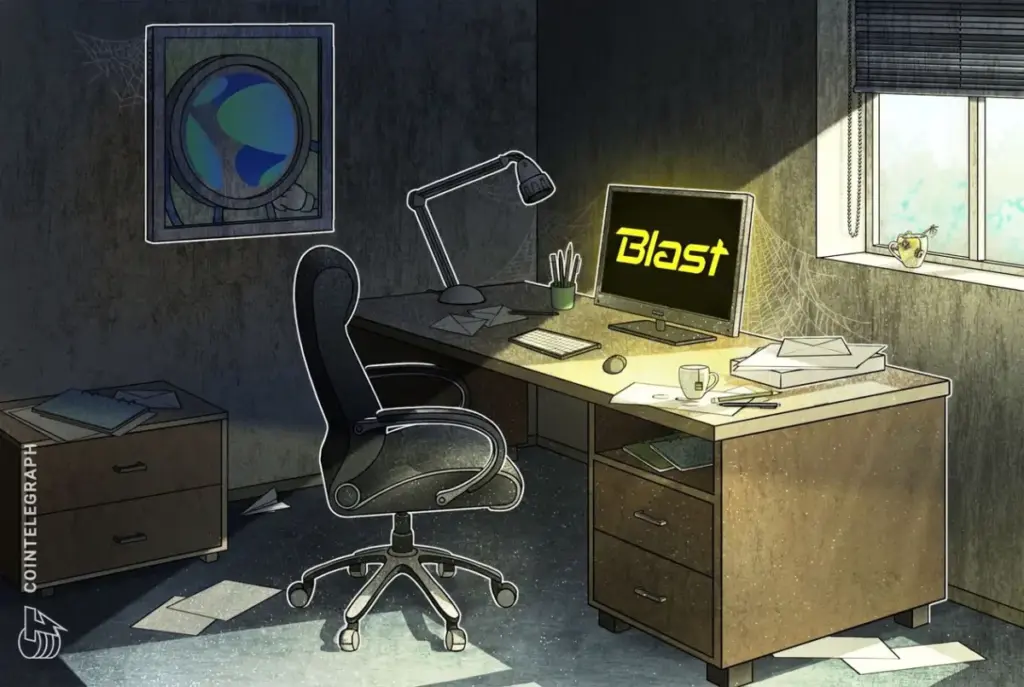
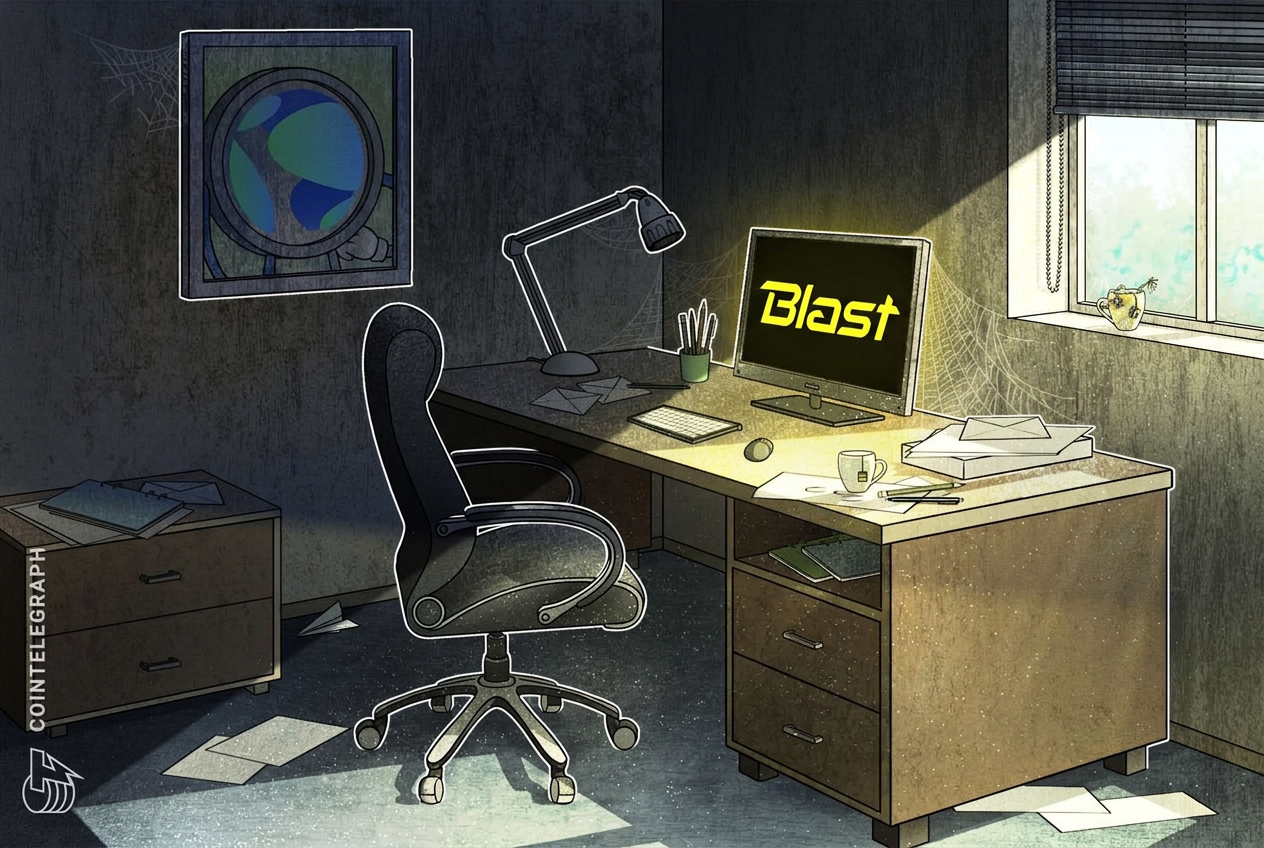
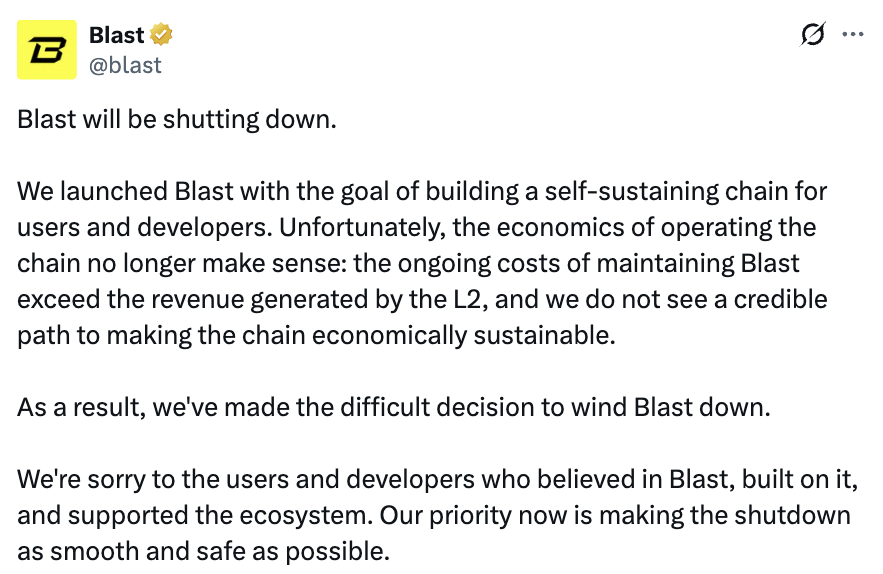
Ethereum layer-2 network Blast is officially shutting down after operating costs outpaced the revenue generated by the blockchain. The sudden closure marks a dramatic conclusion for a network that once commanded billions of dollars in total value locked during its explosive entry into the decentralized finance and scaling ecosystem.
In a statement published on Friday through a post on the social media platform X, the Blast team announced that it sees no credible path toward making the network economically sustainable. Consequently, developers and users have been strongly advised to withdraw their digital assets back to the Ethereum mainnet as soon as possible.
"We launched Blast with the goal of building a self-sustaining chain for users and developers," the team stated in their official announcement. "Unfortunately, the economics of operating the chain no longer make sense."
To facilitate a smooth exit for participants, the network is immediately reducing its standard withdrawal delay to a much shorter 24-hour window. However, withdrawals will be temporarily unavailable while Blast begins the process of unwinding its Lido assets. Protocol representatives estimate that this specific technical unwinding process will take approximately one week to complete.
Users have been given a firm deadline of October 26 to execute their withdrawals directly through Blast’s official web interface. After this cutoff date, assets will technically remain accessible on the underlying smart contracts, but standard frontend withdrawal features will no longer be supported. Instead, anyone seeking to retrieve their funds after October 26 will be forced to interact directly with the Blast bridge contracts deployed on the Ethereum mainnet.
To assist those affected, the network has confirmed that it will publish detailed, step-by-step technical instructions for withdrawing directly through the bridge contracts ahead of the impending October 26 deadline. The core team continues to urge all remaining participants to proactively move their funds back to the Ethereum mainnet well before the interface closure to avoid unnecessary friction.
Blast Emerged From Blur’s NFT Boom
The origins of Blast trace back to the height of the non-fungible token market boom and the rapid ascent of Blur, the prominent NFT marketplace founded by Tieshun “Pacman” Roquerre. Blur originally launched in October 2022 with a specific focus on professional traders, utilizing aggressive token incentives and rewards to challenge established platforms like OpenSea. By the end of 2022, Blur had successfully surpassed OpenSea in total trading volume, extending its dominance into early 2023 through a heavily publicized token airdrop and trader reward system.
Capitalizing on the momentum and brand recognition built by Blur, Roquerre unveiled the Blast network in November 2023. The layer-2 scaling solution introduced several novel concepts to the Ethereum ecosystem, most notably native yield generation on deposited Ether and stablecoins, combined with a points program tied to an anticipated future token airdrop.
This aggressive incentive structure proved remarkably effective at capturing market attention and capital. Before its official mainnet launch in February 2024, the network managed to attract more than $2 billion in total user deposits through its pre-launch bridging campaign, instantly positioning itself as a major contender among Ethereum scaling solutions.
However, the rapid influx of capital proved difficult to sustain as broader market conditions shifted. Blast’s growth faced significant headwinds amid a prolonged downturn across both the broader decentralized finance sector and the specific NFT markets that birthed its founding team.
According to data compiled by DeFiLlama, Blast’s decentralized finance total value locked has experienced a catastrophic decline since reaching an all-time peak of roughly $2.2 billion in June 2024. In the months following that high-water mark, the network’s TVL plummeted by more than 98%, reflecting a severe exodus of capital, liquidity, and active developers.
The downward trajectory mirrored challenges faced by its sister platform, Blur. The NFT marketplace has undergone a similarly steep contraction from its own early-2024 peak. While Blur’s total value locked once rose comfortably above $200 million during its most active periods, it now stands at approximately $27 million, underlining the broader deflationary pressures affecting the ecosystem projects associated with Roquerre.
With the October 26 interface deadline rapidly approaching, market participants and remaining liquidity providers are now racing to unwind their positions and return their holdings safely to the Ethereum mainnet as Blast prepares to close its doors permanently.
 Non-Fungible Tokens (NFTs)
 Non-Fungible Tokens (NFTs)
 Non-Fungible Tokens (NFTs)