Ethereum layer-2 scaling network Blast is officially shutting down its operations after finding that its ongoing operating costs have exceeded the revenue generated by the blockchain. The sudden closure marks a dramatic fall for a network that once commanded billions of dollars in total value locked and arrived on the scene with immense hype backed by the creators of the successful NFT marketplace Blur.
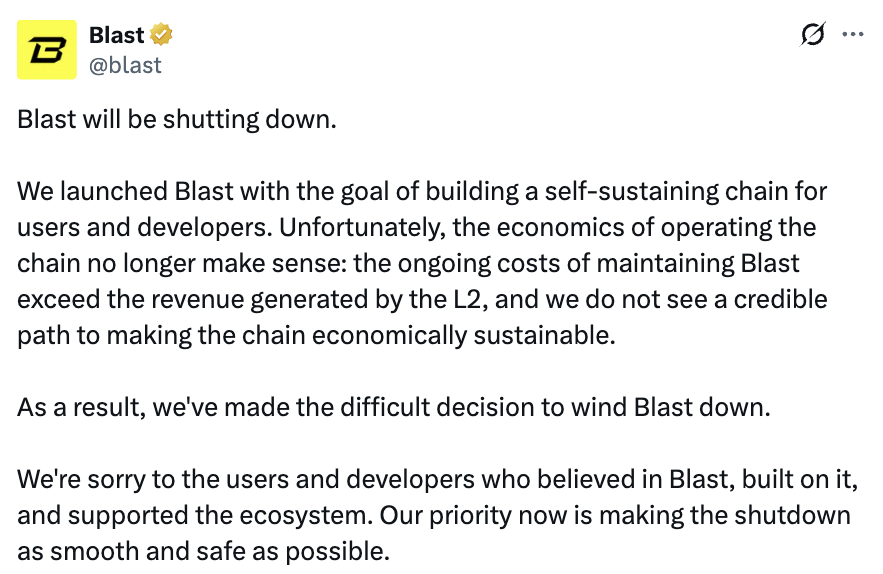
In a formal announcement posted on X on Friday, the Blast team stated that they see no "credible path" to achieving long-term economic sustainability for the network. As a result, the project is winding down operations and strongly urging all users to withdraw their digital assets back to the Ethereum mainnet as soon as possible.
"We launched Blast with the goal of building a self-sustaining chain for users and developers," the team wrote in their public statement. "Unfortunately, the economics of operating the chain no longer make sense."
To facilitate a smooth exit for depositors, the network is immediately reducing its standard withdrawal delay to just 24 hours. However, withdrawals will be temporarily unavailable while Blast begins the complex process of unwinding its underlying Lido staking assets. The team estimates that this asset unwinding process will take approximately one week to complete.
Following this brief operational pause, users will have a clear window to reclaim their funds. The Blast interface will remain active for withdrawals until Oct. 26. After this crucial deadline passes, users will no longer be able to use the standard web interface for withdrawals. Instead, any remaining assets will still be accessible, but withdrawing them will require users to interact directly with the underlying Blast bridge contracts deployed on the Ethereum mainnet.
The Blast team has promised to publish comprehensive instructions detailing how to withdraw funds directly through the bridge contracts well ahead of the Oct. 26 cutoff date. In the meantime, developers and leadership are strongly advising all community members to move their assets off the layer-2 network and back onto the Ethereum mainnet before the deadline to avoid technical complications.
Blast Emerged From Blur’s NFT Boom
The rise and fall of Blast are deeply intertwined with the broader trajectory of its creator, Tieshun “Pacman” Roquerre. Roquerre first captured the attention of the wider cryptocurrency community as the founder of Blur, a specialized non-fungible token marketplace that launched in October 2022. Blur entered a crowded and competitive market dominated heavily by OpenSea, but it quickly carved out a massive market share by deliberately targeting professional traders with lucrative token incentives and advanced trading tools.
By the end of 2022, Blur had successfully surpassed OpenSea in overall trading volume, establishing a dominant lead in early 2023. This rapid ascent was heavily fueled by a highly anticipated token airdrop and ongoing trader rewards programs that incentivized high-frequency trading behavior. Building upon the momentum of Blur, Roquerre unveiled Blast in November 2023. The new layer-2 network promised unique value propositions, including native yield generation on Ether and popular stablecoins, alongside a gamified points program tied to an anticipated token airdrop.
This aggressive marketing and yield-bearing strategy struck a powerful chord with the crypto market, helping the protocol attract more than $2 billion in total deposits even before its official mainnet went live in February 2024. At its height, Blast was celebrated as one of the most successful Layer-2 launches in Ethereum history, drawing significant capital away from competing scaling solutions and capturing the imaginations of decentralized finance speculators.
However, the rapid growth experienced by Blast ultimately proved difficult to sustain over the long term, particularly amid a broader and persistent downturn in the broader NFT and speculative digital asset markets. As enthusiasm cooled across the sector, Blast began to experience a steady and unrelenting capital flight.
According to data tracked by DefiLlama, Blast’s decentralized finance total value locked has experienced a catastrophic decline. The metric has fallen by more than 98% from its peak of roughly $2.2 billion, which was recorded in June 2024. The continuous outflow of capital drained the network of the liquidity required to sustain a thriving ecosystem of decentralized applications and developers, eventually rendering the network financially unviable to maintain.
The downward pressure was not limited to the Blast layer-2 network alone; its sister platform Blur has undergone a strikingly similar contraction. Blur’s total value locked, which surged past $200 million during its early 2024 peak, has similarly dwindled down to about $27 million, underscoring the deep structural challenges facing projects that relied heavily on aggressive initial token incentives and speculative fervor to bootstrap user acquisition.
 Non-Fungible Tokens (NFTs)
 Non-Fungible Tokens (NFTs)
 Non-Fungible Tokens (NFTs)