The Ethereum Name Service (ENS) has officially deployed the largest upgrade in its history, marking a major technical milestone for the protocol. Notably, the rollout took place directly on the Ethereum mainnet, moving away from the Layer 2 scaling network that the development team had spent years planning and building.
The deployment of ENSv2 went live on Layer 1, arriving roughly nine months after ENS formally scrapped Namechain, the rollup infrastructure originally designed to host the protocol revamp. This decision reflects a broader, rapidly accelerating shift across the decentralized application ecosystem. Over the past year, a growing list of prominent applications and protocols have chosen to leave Layer 2 networks, canceled plans to launch proprietary rollups, or shut down chains they had already deployed, opting instead to migrate their core contracts back to Ethereum Layer 1.
This widespread pivot back to the mainnet has been heavily influenced by structural changes in Ethereum’s underlying capacity. The Ethereum gas limit, which dictates how much computational workload fits into a single block, doubled from 30 million to 60 million over the course of the year. As a result of this expanded capacity, transaction fees on Layer 1 fell dramatically, altering the economic calculus that had previously driven developers toward external rollups.
At the same time, maintaining a dedicated Layer 2 network has proven to be an expensive and complex endeavor for many projects. The financial and operational overhead required to secure and sustain proprietary chains has led several prominent networks to scale back their operations. The broader infrastructure landscape is clearly undergoing a significant structural reassessment as developers weigh the trade-offs of fragmented ecosystems against the deepening security and liquidity of the Ethereum mainnet.
Why ENS Stayed on Ethereum
The Ethereum Name Service serves as a foundational pillar of the Web3 user experience, translating complex hexadecimal wallet addresses into human-readable, domain-style identifiers like william.eth. The launch of ENSv2 introduces a total architectural overhaul of the protocol. Under the new system, every individual ENS name is capable of running its own independent registry for subnames. Furthermore, domain owners are granted fine-grained permission controls, and protocol fees can now be paid directly in stablecoins such as USDC.
The most notable aspect of the deployment, however, is its home on Layer 1. Early planning for the protocol revamp heavily emphasized moving the system to a Layer 2 environment. Development efforts eventually coalesced around Namechain, a dedicated rollup intended to support the enhanced scalability and feature set of ENSv2. Observers at the time viewed the move as a natural stepping stone toward mainstream adoption.
Ultimately, the development team altered its course as Ethereum’s base layer evolved. Nick Johnson, the founder of ENS, explained the strategic U-turn by pointing to the rapid scaling of Ethereum’s mainnet, noting that Layer 1 was scaling faster than almost anyone had predicted in prior years. Registration gas costs for ENS users plummeted by roughly 99% over the preceding year as the base layer expanded its throughput. Additionally, maintaining the protocol directly on Layer 1 avoids the added trust assumptions and security fragmentation inherent in external rollup architectures. Ethereum co-creator Vitalik Buterin voiced his support for the decision shortly after the announcement, affirming that keeping the protocol on the base layer was a sound architectural choice.
The Dominos
ENS is the most recent high-profile project to alter its scaling roadmap, but it is far from an isolated case. The ecosystem has witnessed a steady sequence of similar migrations over the past year.
Synthetix stands out as an early mover in this trend. Despite being among the pioneering protocols to launch on an Ethereum rollup back in 2021, the project published an assessment declaring that the multi-rollup model had introduced severe liquidity fragmentation and other structural inefficiencies. Synthetix began winding down its Layer 2 deployments and ultimately opened its new perpetual exchange directly on Ethereum Layer 1. Reflecting on the broader industry trajectory, founder Kain Warwick noted that despite years of championing the Layer 2 narrative, the economic and structural reality ultimately pointed the project back toward the mainnet.
A major catalyst for this strategic reassessment came from Vitalik Buterin, who published an analysis arguing that the progress of Layer 2 networks toward full decentralization had been significantly slower and more difficult than originally anticipated, even as Layer 1 scalability advanced. The post concluded that the original framework defining the role of rollups in Ethereum’s scaling roadmap required a fundamental re-evaluation. Shortly after this perspective gained traction within the developer community, ENS officially pulled the plug on its Namechain rollup initiative.

Other projects have followed a similar trajectory. Superseed, a protocol whose economic design originally relied on utilizing fees from its own proprietary Layer 2 to subsidize user loans, deprecated its chain and initiated a migration of its entire ecosystem back to Ethereum Mainnet, replacing network-level fees with application-layer yield strategies. Similarly, prediction market protocol Trueo announced its return to Ethereum from an external rollup environment, drawing public approval from leading ecosystem contributors. Further migration activity has also been visible across various application-specific projects, with multiple NFT-focused platforms and community ecosystems shifting their core operations back to Layer 1.
State Comes Home
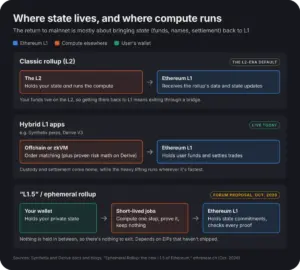
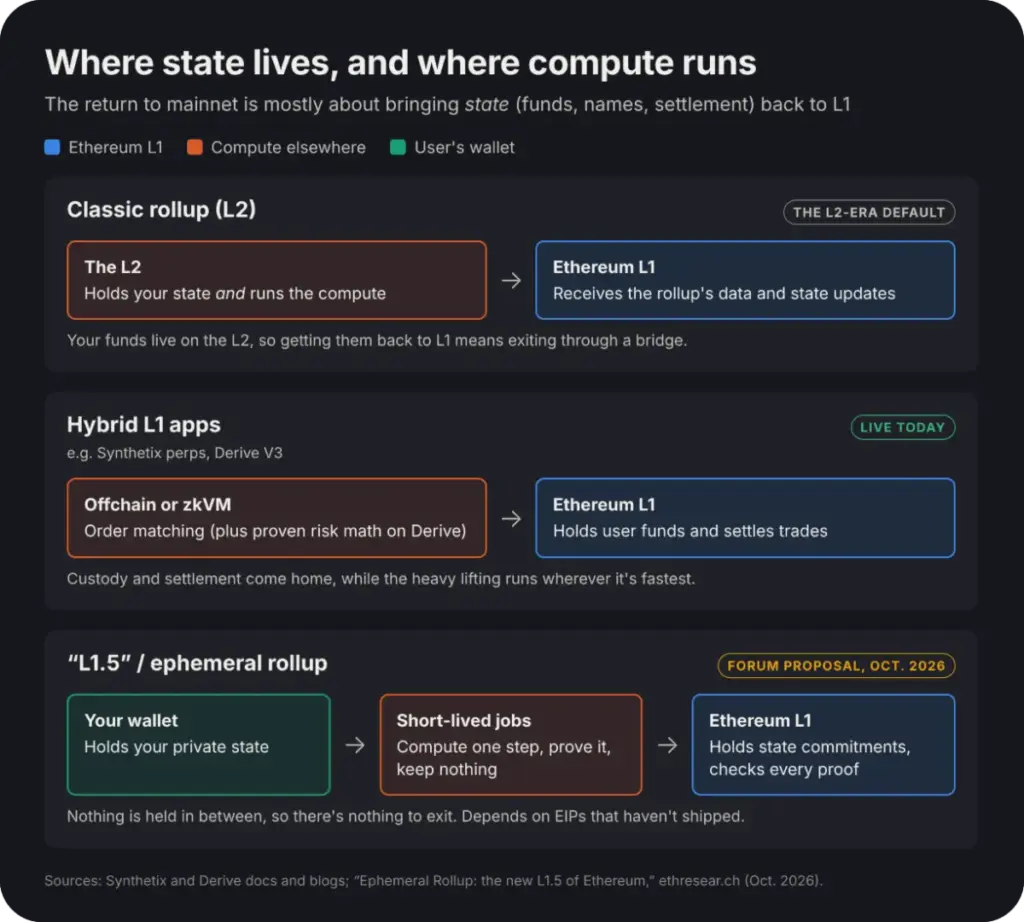
Beneath these individual migrations lies a subtler, structural evolution in how decentralized applications are architected. Developers are increasingly separating where their operational state and custody reside from where their heavy computation takes place.
This separation is evident in the design of modern decentralized finance applications. In the case of upgraded perpetual exchange architectures, order matching and high-frequency computations are handled offchain for optimal speed and performance, while user funds remain securely held in custody within Ethereum Layer 1 contracts where trades ultimately settle. Similar hybrid models utilize zero-knowledge proofs to verify complex risk calculations offchain while anchoring asset security directly to the base layer.
The architecture of ENSv2 operates along similar lines. The core ownership records and valuable non-fungible token names remain anchored securely on Layer 1, while lightweight, gasless subnames can resolve efficiently from external environments or via standardized offchain data retrieval protocols. This approach contrasts sharply with the traditional rollup model, which attempts to bind both state storage and execution to a single auxiliary chain, complicating asset retrieval and fragmenting liquidity.
At the same time, technical avenues are emerging to blur the boundaries between Layer 1 and scaling environments. Initiatives like the Ethereum Economic Zone aim to establish synchronous composability across Ethereum and its rollups, allowing smart contracts across different execution layers to interact seamlessly within a single atomic transaction. Rather than pulling applications entirely off Layer 2 networks, this framework seeks to integrate rollups more cohesively into the broader mainnet experience, a direction already being explored by governance communities like GnosisDAO, which voted to transition its network toward an interoperable rollup framework.

More experimental architectural concepts continue to be proposed within the research community as well. Proposals such as ephemeral rollups aim to push the separation of state and compute even further by utilizing short-lived execution environments that leave no persistent state behind, relying entirely on Layer 1 to verify execution proofs and maintain global user state.
Of course, the sustainability of this migration trend depends heavily on Ethereum maintaining sufficient base-layer capacity. If application demand scales faster than the underlying block gas limit, transaction fees could rise, potentially shifting the economic balance once again. While upcoming core upgrades and testnet iterations continue to push operational gas limits significantly higher, development timelines and activation schedules remain subject to rigorous security testing.
Despite these variables, the overarching direction of travel is clear. A growing number of applications are bringing their most critical state, asset custody, and settlement processes back to the security of the Ethereum mainnet. ENS is simply the latest major protocol to make the journey, leaving the broader developer community to watch closely as the next wave of infrastructure decisions unfolds across the ecosystem. Users holding legacy domains can manage their upgrades to the new protocol standard directly through the official ENS interface.
 Tokenomics & Digital Assets
 Tokenomics & Digital Assets
 Tokenomics & Digital Assets