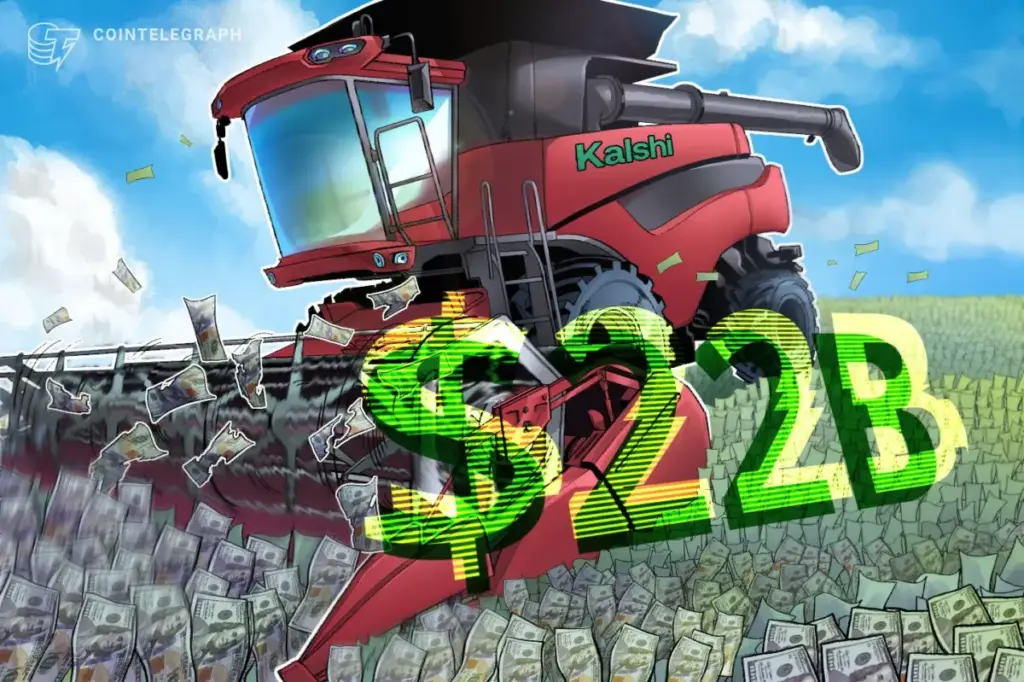
Prediction marketplace Kalshi has reached a staggering $22 billion valuation following the close of a massive $1 billion Series F funding round, highlighting the surging venture capital interest in regulated event trading platforms.
The fresh capital injection effectively doubles Kalshi’s valuation from just five months prior, signaling a meteoric rise in market confidence. The high-profile funding round was led by venture capital firm Coatue Management, with significant participation from prominent institutional and tech investors including Andreessen Horowitz, Sequoia Capital, Morgan Stanley, and Ark Invest.
This substantial financial raise arrives at a time when institutional investors and venture capitalists increasingly view prediction markets as one of the fastest-growing and most dynamic segments within digital finance. The momentum is further reinforced by broader market trends, such as Andreessen Horowitz’s crypto unit, a16z crypto, which recently secured $2.2 billion for its latest fund and explicitly identified prediction markets as a core investment theme moving forward.
Having captured significant market share, Kalshi has firmly established itself as one of the industry’s dominant trading platforms. A company spokesperson recently revealed to Bloomberg that Kalshi’s annualized revenue run rate has now surpassed the impressive milestone of $1.5 billion.

Unlike its primary rival Polymarket, which operates primarily on decentralized blockchain infrastructure, Kalshi runs a centralized and federally regulated marketplace. This regulated structure allows users to trade directly on the outcomes of a wide array of real-world events, encompassing everything from political elections and crucial economic data releases to pop culture milestones and sports.
The combined might of Kalshi and Polymarket has driven immense retail and institutional activity, accounting for the vast majority of the more than $25 billion in prediction market trading volume recorded across the sector last month.
As part of its broader growth strategy, Kalshi has also aggressively expanded its ambitions within the digital asset space. The company recently appointed John Wang as its head of crypto to spearhead these efforts. Outlining the platform’s vision, Wang told Forbes, "We would like to have Kalshi’s prediction markets in every large crypto app," signaling an intent to embed the regulated marketplace deeply into the broader cryptocurrency ecosystem via partnerships and integrations with popular tools like the Phantom wallet.
Regulatory Scrutiny Intensifies as Prediction Markets Expand
The latest wave of heavyweight venture backing coincides with a shifting narrative on Wall Street. Leading financial analysts and research firms now argue that prediction markets are rapidly evolving beyond simple retail speculation into sophisticated institutional financial tools.
In a recent comprehensive research note, investment bank Bernstein noted that prediction markets are officially entering an "institutional era." This transition is primarily being driven by escalating demand for bespoke block trades and custom event contracts, which allow corporations, funds, and financial institutions to hedge effectively against specific macroeconomic, political, and geopolitical risks.

However, even as institutional adoption accelerates, the sector faces mounting legal and regulatory headwinds, particularly within the United States.
According to reports from NPR, Kalshi is currently entangled in at least 19 federal lawsuits regarding whether its complex event-based contracts violate traditional state gambling laws. State-level regulators and authorities in jurisdictions including Massachusetts, New Jersey, Arizona, Nevada, Illinois, and Connecticut have actively challenged Kalshi’s operations. These state bodies argue that certain sports and event-based contracts offered on the platform amount to unlicensed, unregulated gambling rather than legitimate financial derivatives.
Political pressure has similarly intensified inside the nation’s capital. Democratic lawmakers have raised alarms and called for tighter, more comprehensive federal oversight of prediction markets following growing public concern over "suspicious trades" tied sensitive geopolitical events and national security developments.
In a proactive response to these growing regulatory challenges, Kalshi has significantly bolstered its policy and compliance bench. The company recently brought on former Obama administration staffer Stephanie Cutter as a high-level policy adviser. Industry observers widely view the strategic appointment as an effort by Kalshi to strengthen its institutional relationships in Washington and successfully navigate the increasingly complex political landscape surrounding the prediction market industry.
 Crypto Startups & Venture Capital
 Crypto Startups & Venture Capital
 Crypto Startups & Venture Capital