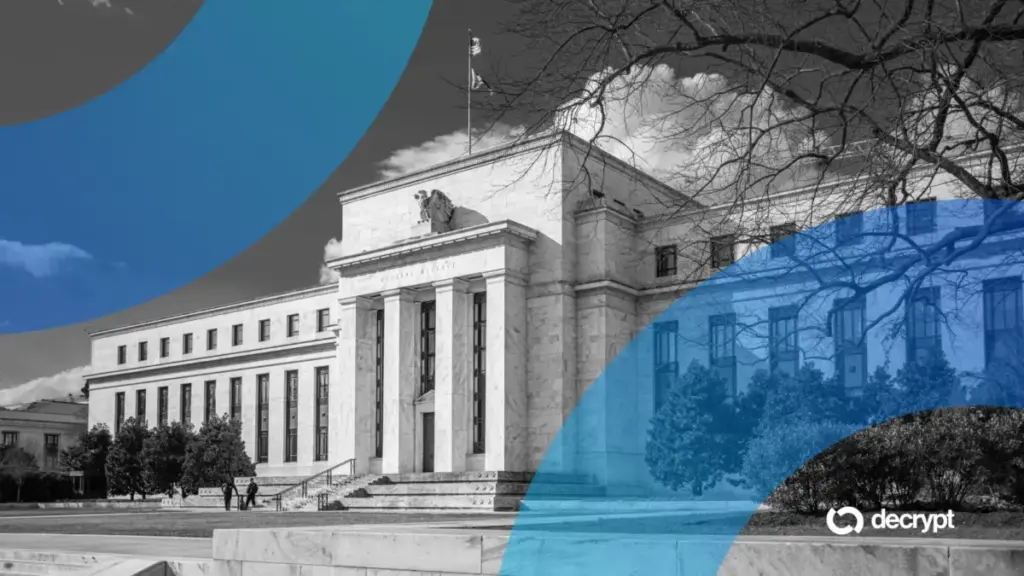
The Federal Reserve is set to announce its latest interest rate decision at 2:00 p.m. ET today, and financial markets are pricing in an overwhelming certainty that the central bank will keep borrowing costs unchanged.
According to the CME FedWatch tool—which converts interest rate futures market activity into quantifiable probabilities—the odds of the Federal Open Market Committee (FOMC) enacting a "hold" stand well above 90%. Meanwhile, decentralized and traditional prediction markets have priced the likelihood of a pause even higher, reflecting a broad consensus among traders that policymakers will opt to catch their breath following September’s decisive policy shift.
The impending decision carries profound implications that extend far beyond Wall Street trading desks. The federal funds rate—the benchmark interest rate that commercial institutions charge one another for overnight loans—directly underpins the broader lending ecosystem. It establishes the baseline costs that everyday consumers face for credit cards, auto loans, personal financing, and mortgages.
Currently, the benchmark rate sits in a target range of 3.75% to 4.00%. That level was established in September when the Fed instituted its first rate hike since 2023, breaking a prolonged period of monetary policy stagnation through a unanimous 12-0 vote among committee members.
Economic Crosscurrents: Persistent Inflation and Cooling Labor Markets
Today’s widely anticipated pause comes against a backdrop of conflicting macroeconomic indicators. On one hand, inflationary pressures refuse to dissipate quickly. Data released by the Labor Department indicates that consumer prices climbed 3.7% over the 12-month period leading into September. The cost of living has been heavily aggravated by energy expenses; gasoline prices alone surged 9.1% during the single month of September, pinching household budgets nationwide.
On the other hand, clear signs of deceleration are emerging within the U.S. labor market. Employers added a meager 29,000 jobs in September, falling far short of Wall Street forecasts that had anticipated roughly 90,000 new hires. Despite the sluggish pace of job creation, the national unemployment rate held steady at 4.2%, suggesting that while hiring has cooled significantly, mass layoffs have not yet materialized to destabilize the broader economy.
A major catalyst behind the sticky inflation figures is the energy sector. Crude oil has been trading stubbornly near the $100-per-barrel threshold, propelled higher by supply chain disruptions stemming from the ongoing U.S.-Iran conflict. Higher crude prices inevitably cascade down the economic chain, driving up gasoline and freight transportation costs. Eventually, these elevated logistics expenses manifest on grocery store shelves and retail inventories, feeding an upward spiral in consumer prices.
The Bond Market and the Crypto Squeeze
Persistent inflation places upward pressure on government borrowing costs, as investors demand higher yields to compensate for the diminishing purchasing power of fixed-income returns. This dynamic has driven up U.S. Treasury yields, creating an attractive, nearly risk-free alternative for capital that might otherwise flow into speculative assets.
The benchmark 10-year Treasury yield—which heavily influences long-term consumer borrowing costs, including residential mortgages—is hovering around 5%. This follows a peak of 5.31% reached earlier in the month on October 5, providing investors with robust yields without requiring exposure to market volatility.
For digital assets like Bitcoin, this high-yield environment presents a formidable headwind. Bitcoin generates no yield and remains notoriously volatile for traditional institutional investors. Consequently, when risk-free government debt offers attractive returns, capital tends to rotate out of risk-on sectors, including cryptocurrencies and equities.
Bitcoin’s price currently hovers around $80,700, lingering just below a crucial technical barrier. This area has historically acted as support but has since transitioned into a stubborn resistance zone where sellers have repeatedly thwarted upward momentum throughout the year.
Furthermore, the structural mechanics of leveraged trading tend to amplify market reactions around major Federal Reserve events. When leveraged traders utilize borrowed capital to magnify their market positions, sudden price swings can trigger automated liquidations on exchanges, intensifying selling pressure.
A stark illustration of this vulnerability occurred following Federal Reserve Chair Kevin Warsh’s address at the annual Jackson Hole economic symposium in August. Within a 24-hour window of his remarks, roughly $481 million in crypto derivatives positions were forcibly liquidated, with long positions accounting for over $360 million of the washouts.
Looking Ahead to December: The Threat of a "Hawkish Hold"
Even as markets anticipate a rate pause today, traders are already shifting their focus toward the final FOMC meeting of the year, scheduled for December 8-9. Current pricing in interest rate futures and prediction markets suggests a 75% to 80% probability that the central bank will resume its tightening cycle by implementing another quarter-point rate increase before the year concludes.
This expectation is grounded in official communications from the central bank. Minutes from the September FOMC meeting revealed that a majority of officials judged that an additional rate increase would likely prove appropriate by the end of the year. Furthermore, several members remarked that the prevailing interest rate at the time remained "not restrictive or only mildly restrictive."
Consequently, Wall Street analysts are characterizing today’s expected outcome as a "hawkish hold." This terminology implies that while the central bank will leave borrowing costs unchanged for the immediate session, its accompanying statement and tone will likely signal that further monetary tightening remains firmly on the table for upcoming meetings.
When questioned in September about the likelihood of subsequent rate hikes, Chair Warsh declined to lock the central bank into a rigid path. "I’m not going to prejudge any future decisions we make," Warsh told reporters at the time, adding characteristically: "This won’t surprise you: I’m not in the forward guidance business." His remarks highlighted the Fed’s preference for maintaining flexibility rather than committing to predictable policy trajectories.
For market watchers parsing today’s announcement, analysts note that dissents—votes cast against the majority policy decision—will serve as the most telling indicator of internal committee sentiment. The Fed’s July policy meeting concluded with a 9-3 vote featuring three dissenting members who favored an immediate rate hike. Should a similar or larger dissent pattern emerge in favor of tightening today, it would signal that a December rate hike is rapidly approaching a foregone conclusion.
The Federal Reserve will not publish its updated Summary of Economic Projections—including updated growth, inflation, and interest rate forecasts—at today’s meeting. Those comprehensive projections are scheduled to accompany the December rate decision.
 Decentralized Applications (dApps)
 Decentralized Applications (dApps)
 Decentralized Applications (dApps)