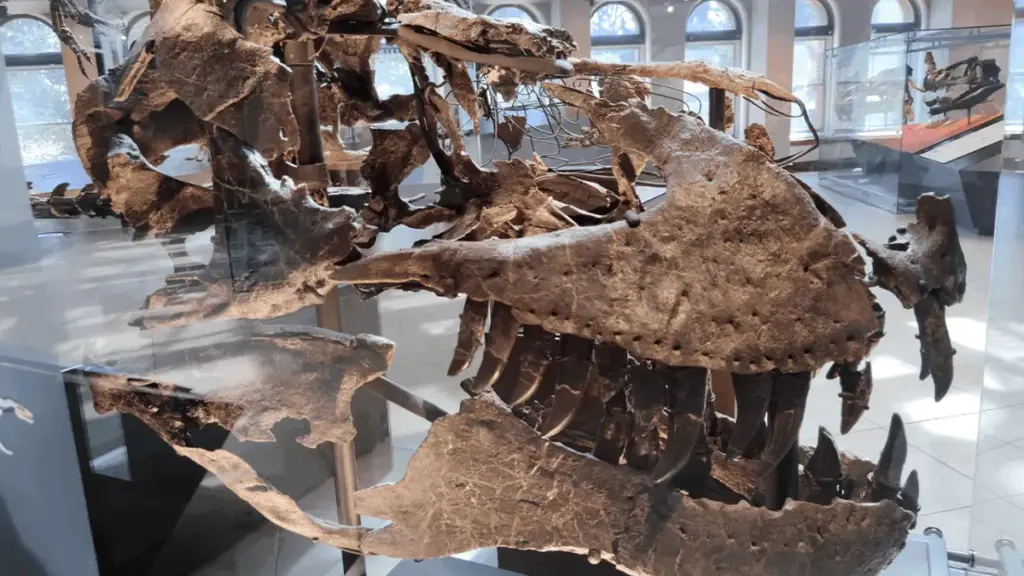
The best thermometer for Tyrannosaurus rex may have been hiding right inside its formidable, bone-crushing mouth. In a scientific breakthrough that bridges millions of years of evolutionary history, a study published on September 16, 2026, in the journal Science Advances has utilized chemical signatures locked inside fossilized tooth enamel to establish the first direct estimate of the apex predator’s internal body temperature. The meticulous analysis places the king of the dinosaurs at roughly 97 degrees Fahrenheit (36 degrees Celsius)—a thermal reading that is nearly identical to that of a living human being.
For decades, paleontologists, geochemists, and evolutionary biologists have engaged in fierce debates regarding the metabolic strategies of the largest dinosaurs. Were creatures like Tyrannosaurus rex slow-moving, cold-blooded reptiles dependent on the sun to warm their massive frames, or were they warm-blooded powerhouses akin to modern birds and mammals? This new study moves the scientific conversation firmly away from generalized anatomical inference and into the realm of precise chemical measurement. It represents the kind of generational step-change in paleontology that occurs only when advanced laboratory techniques mature and are finally applied to longstanding, stubborn mysteries.
To unlock a temperature signal that has remained stable for 66 million years, the research team turned to an exceptionally durable biological archive: tooth enamel. Led by UCLA geochemists Randon J. Flores and Robert A. Eagle, the study analyzed three distinct Tyrannosaurus rex teeth to reconstruct the animal’s thermal biology. Two of these exceptionally well-preserved teeth originated from a famous, approximately 70 percent complete T. rex skeleton affectionately nicknamed "Thomas," which is housed and curated at the Natural History Museum of Los Angeles County.
The core chemical trick behind the breakthrough relies on what geochemists call "clumped isotopes." Over millions of years, tooth enamel preserves rare bonds that form between carbon and oxygen isotopes within the mineral matrix. The relative abundance of these molecular clumps is dictated strictly by temperature: they form more frequently in cooler environments and less frequently in warmer ones. Because tooth enamel is composed of large, highly durable crystals, it resists chemical alteration, leaching, and recrystallization far better than bone tissue does. This makes enamel an extraordinarily reliable forensic archive for deep-time physiological research.
To read that ancient temperature signal, Flores and Eagle utilized a precision dental drill to harvest microscopic enamel samples from the teeth. They then dissolved the resulting mineral powder in phosphoric acid, releasing carbon dioxide gas, which was subsequently analyzed using a mass spectrometer. The precision of the data allowed the team to peer directly into the metabolic furnace of a creature that has been extinct since the end of the Cretaceous period.
"No one’s been able to make a temperature measurement like this before," said UCLA geobiologist Robert A. Eagle, emphasizing the unprecedented nature of the lab work. When the mass spectrometer data was fully processed, the results pointed clearly to a reading of about 36 degrees Celsius, or 97 degrees Fahrenheit. Eagle framed the discovery succinctly, noting that the team found T. rex operated at roughly the same thermal baseline as modern humans. While the authors acknowledged that they could not completely rule out minor seasonal variations in their samples, independent tests on different sections of the teeth belonging to the "Thomas" specimen produced statistically indistinguishable temperatures, underscoring the robustness of the findings.
This 97-degree Fahrenheit estimate occupies a fascinating and revealing middle ground in the history of vertebrate physiology. It sits comfortably above the thermal baselines of modern cold-blooded reptiles, such as crocodilians and lizards, which typically operate in a range of 82 to 86 degrees Fahrenheit depending on ambient conditions. However, it also sits noticeably below the body temperatures of modern birds—which frequently clock in between 104 and 109 degrees Fahrenheit—even though birds are the direct evolutionary descendants of theropod dinosaurs.
This intermediate thermal zone carries profound implications for understanding how tyrannosaurs lived, hunted, and survived. It suggests that Tyrannosaurus rex generated substantial internal metabolic heat, lifting its body temperature well above the surrounding environmental conditions, without necessarily operating at the high-octane, hyper-metabolic levels seen in today’s birds.
UCLA professor and co-author Aradhna Tripati connected these physiological insights directly to the geography and ecology of the Late Cretaceous. "What the teeth tell us is that T. rex was warmer than the environment around it," Tripati explained, noting that an animal capable of maintaining such a steady internal temperature would possess significant ecological advantages. "A warm-blooded T. rex is a T. rex that can go almost anywhere on the continent, including the Arctic."
This newfound physiological evidence provides critical support for a growing body of work suggesting that large tyrannosaurs were remarkably well-adapted to cooler climates. Notably, the isotopic findings harmonize with field discoveries such as a Tyrannosaurus rex footprint uncovered in Alaska in 2022, which indicated that these apex predators successfully roamed high-latitude regions that experienced chilly, sub-tropical or temperate conditions. By combining field paleontology with advanced isotopic geochemistry, researchers are steadily dismantling the outdated view of dinosaurs as sluggish, environment-dependent beasts, replacing it with a picture of complex, warm-bodied predators capable of conquering diverse and demanding prehistoric worlds.
 Bitcoin & Major Altcoins
 Bitcoin & Major Altcoins
 Bitcoin & Major Altcoins