In a significant strategic pivot, the MegaETH Foundation has officially rebranded as MEGA
and committed $30 million from its treasury to build and launch its own native products. The foundation’s flagship initiative will be an advanced AI inference market slated to debut in December, marking a bold transition for a project that originally positioned itself as an ultra-fast Ethereum Layer 2 network.
The rebranding and capital allocation come at a crucial crossroads for the ecosystem. Despite initial fanfare as an Ethereum scaling solution designed for exceptional speed, the chain’s Total Value Locked has experienced a steep decline, currently sitting just under $10 million, down significantly from its peak of over $245 million in May. Co-founder Shuyao Kong candidly addressed the pivot on social media, noting that the drastic change in direction became necessary after building one of the fastest chains in the industry yet experiencing a distinct lack of product-market fit.
While the exact mechanics, participating providers, and specific models that will populate the upcoming marketplace remain under wraps ahead of the December launch, a newly released three-page whitepaper outlines the foundation’s core thesis and strategic vision. The move highlights a broader, rapidly accelerating industry trend toward the financialization of artificial intelligence services and the rise of decentralized inference markets.
The Pitch
MEGA’s entry into the space is built upon what the foundation identifies as a fundamental supply paradox within the current artificial intelligence landscape. According to the whitepaper, numerous independent, third-party providers currently run the exact same open-source models as major labs, but they do so at a fraction of the cost charged by the primary developers.
To illustrate this dynamic, the foundation points to data from OpenRouter regarding models like GLM 4.6. While the original developer, Z.ai, prices the model at $2.20 per million output tokens, alternative providers offer the same service for less—such as Venice at $1.75 and DeepInfra at $2.00. Despite these notable price differentials, buyers consistently gravitate toward familiar brand names, continuing to pay a premium.
MEGA’s proposed solution is the introduction of a framework it calls "Purified Intelligence." This system is designed to implement rigorous checks on a provider’s model integrity, data privacy, and security protocols, effectively bridging the trust gap and reassuring buyers that unknown third-party providers are safe to use. The overarching goal is to foster an ecosystem where AI inference becomes entirely interchangeable, moving toward a reality where the identity of the underlying provider matters progressively less to the end user.

By leading its pitch with trust and model verification, MEGA hopes to solve the hesitation that keeps users tied to more expensive providers. However, this foundational premise enters a crowded and rapidly evolving marketplace where similar trust and verification mechanisms are already being developed across the board.
Verification Is Advancing Without MEGA
The primary challenge facing MEGA’s core thesis is that the verification problem is already being solved by numerous other teams, often using open tools that are readily available to the broader market.
While model-swapping by unofficial resellers remains a documented issue—such as a March study of three reseller services that found 46 percent of identity checks failed—the infrastructure to catch these discrepancies is arriving from multiple directions simultaneously. Existing routing platforms already reward lower pricing by default and help diagnose tool-calling software discrepancies between providers.
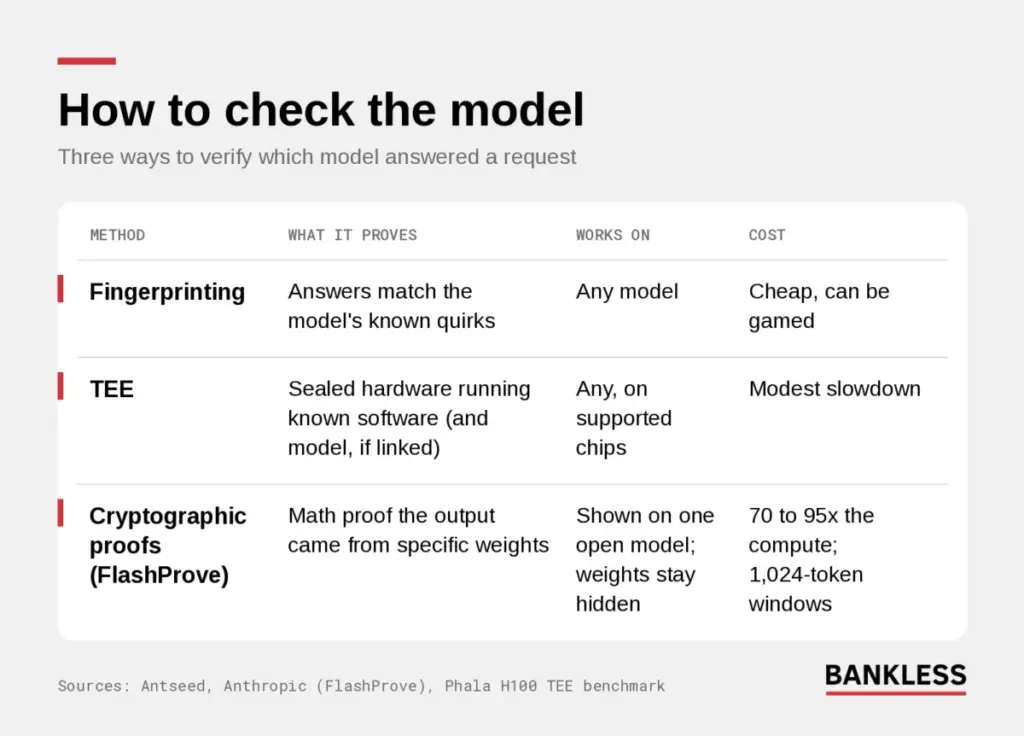
Furthermore, technical solutions for verifying model outputs are maturing rapidly. Fingerprinting techniques attempt to match answers against known behavioral quirks of specific models, providing a cheap verification method that can theoretically be applied to any model. Trusted Execution Environments offer another path by ensuring that sealed hardware runs specified software and models securely, introducing only modest computational slowdowns. Meanwhile, advanced cryptographic proofs, such as FlashProve, provide strict mathematical guarantees that a specific output originated from designated model weights, though currently at a significantly higher computational cost.
Although MEGA’s whitepaper acknowledges these existing verification methods and their respective limitations, it has not yet clarified which specific approach, or combination of approaches, its platform will ultimately adopt. Because independent developers and competing platforms are already deploying these verification tools openly, buyers’ traditional reasons for distrusting third-party providers are naturally fading. Consequently, simply shipping verification features may not be enough to help MEGA stand out in an increasingly competitive field.
Where MEGA Could Stand Out
With model verification quickly becoming an industry standard, the long-term success of MEGA’s inference market will likely depend on two more distinctive concepts outlined in its whitepaper: advanced privacy solutions and future capacity trading.
The first differentiator is privacy. MEGA proposes a mechanism that scrubs sensitive details from a user’s prompt before it reaches a provider, alongside a system that splits computational tasks between trusted and untrusted nodes. Because true privacy through sealed hardware is currently limited primarily to open-source models, data scrubbing serves as a vital workaround for users seeking privacy while querying closed frontier models.

However, implementing this effectively has proven notoriously difficult. Other projects have previously attempted similar client-side scrubbing applications to protect user data when interacting with models like GPT and Claude, only to encounter performance inconsistencies across different devices and ultimately scale back or remove the features. For MEGA’s privacy approach to succeed, it must operate securely outside of MEGA’s own direct visibility—either on the user’s local device or within dedicated hardware—otherwise, users are simply shifting their trust from the provider to the platform itself.
The second major concept involves future compute capacity. MEGA’s framework envisions a system where buyers can reserve specific models, volume levels, and minimum performance thresholds—such as speed and reliability—for a set window at a predetermined price. Eventually, these capacity reservations could become tradeable assets. This mechanism functions similarly to corporate hotel block bookings ahead of major conferences, allowing companies to lock in essential compute capacity for product launches and resell their allocations if plans change. Furthermore, providers could leverage these committed future demands to secure financing and acquire additional hardware.
While traditional financial exchanges are beginning to plan futures contracts for basic GPU hours, those instruments typically price raw hardware compute rather than specific AI model outputs. MEGA’s capacity contracts would introduce a marketplace for the actual utility of the model. This model-level forward market represents an area where blockchain infrastructure could offer a clear and unique utility that current inference platforms do not yet provide. At the same time, a notable tension remains in an industry where inference costs consistently decline and models are rapidly outdated within months, raising questions about why buyers would commit to long-term pricing today.
What’s Still Missing
Despite the ambitious scope outlined in the foundation’s whitepaper, both core concepts currently remain in the planning stages. No code has been made publicly available, and the documentation lacks granular details regarding provider qualification standards, the entities responsible for executing verification checks, or the exact infrastructure that will house the privacy tools.
Questions also remain regarding the utility of the network’s native token within the newly rebranded ecosystem. When asked about the role of the MEGA token in the upcoming market, co-founder Shuyao Kong indicated that the token will be integrated wherever viable use cases emerge. Furthermore, the allocation plan for the newly committed $30 million treasury fund—representing more than half of the project’s circulating market capitalization—has not yet been published in detail.
The upcoming launch in December is expected to provide much-needed clarity on these foundational questions. Observers and participants will be closely monitoring whether the platform can successfully onboard named providers with clear operational rules, implement privacy-preserving data scrubbing that operates independently of the platform, and execute the first verifiable forward capacity contracts with genuine counterparties. While verification may get the newly rebranded MEGA to the starting line, its ability to deliver on privacy and future capacity will ultimately determine whether it can carve out a lasting position in the decentralized AI landscape.
 Tokenomics & Digital Assets
 Tokenomics & Digital Assets
 Tokenomics & Digital Assets