The staggering $6.4 billion theft from cryptocurrency giant Binance began with a tactic that has increasingly become a hallmark of cyber espionage originating from the Democratic People’s Republic of Korea (DPRK): employment fraud.
For years, blockchain investigators at Chainalysis have tracked this evolving strategy, which takes many forms across the digital landscape. In the case of Binance, North Korean operatives lured a target into applying for a fabricated job opening before infecting the victim’s computer with malicious software. In other documented instances, state-backed attackers have flipped the script, acting as the job applicants themselves. Working under false pretenses, these operatives generate revenue for the regime, infiltrate corporate networks, or achieve both simultaneously.
Each of these malicious incursions leaves an undeniable footprint on public ledgers. Over the preceding 18 months, Chainalysis has attributed more than $14.3 million in direct losses to similar DPRK-linked fake interview and malware schemes. These operations have targeted a wide cross-section of the digital asset ecosystem, ranging from individual cryptocurrency holders and private wallets to major organizations, specialized protocols, and decentralized autonomous organizations (DAOs). Binance now stands as the most prominent victim in this expanding string of high-profile compromises.
Tom McLouth, senior intelligence analyst at Chainalysis, noted that investigators have identified dozens of other job interview compromises that successfully resulted in individual wallet breaches. While the financial losses in those earlier, smaller-scale incidents ranged from tens of thousands to millions of dollars, their true significance lies in what they taught the perpetrators.
Across successive compromises, DPRK threat actors systematically perfected and evolved their methodology. They refined their operational approaches and steadily built the sophisticated capabilities required to target increasingly high-value victims. As McLouth observed, this cumulative process is ultimately how a cybercrime syndicate executes the largest heist in digital asset history. Viewed through this strategic lens, the catastrophic breach at Binance represents the culmination of months, or potentially years, of meticulous preparation, testing, and operational practice.
How a Fake Interview Opened the Door to Binance
Binance released its initial findings detailing the multi-stage cyberattack orchestrated by DPRK actors against the exchange. The operation began months prior, in September, when an unsuspecting software engineer received an unexpected invitation to participate in a job interview.

According to Binance’s disclosures, the attackers invested weeks cultivating trust with the employee. They initially approached the target through a legitimate professional job platform, dangling an attractive career opportunity. Following two rigorous rounds of interviews conducted by representatives of a fictitious company, the Binance employee was instructed to download a specialized interview assignment. Unbeknownst to the engineer, the assignment contained hidden malicious code, providing the hackers with their crucial initial foothold.
From that foundational access point, the attackers deployed advanced malware and systematically exploited permissions tied to an internal artificial intelligence tool. This allowed them to move deeper into Binance’s core internal systems, eventually facilitating the unprecedented theft.
While the sheer financial scale of the breach was unprecedented, the method of entry followed a well-established pattern. Alec Zebrick, Chainalysis Senior Manager of Global Services, noted that DPRK actors have repeatedly utilized what security professionals call "contagious interviews." These campaigns specifically target corporate employees who possess privileged access rights, exploiting their credentials and operational permissions to quietly infiltrate internal infrastructure. Consequently, administrative employees and engineers who control access to sensitive systems remain exceptionally valuable targets for state-sponsored threat actors.
DPRK Malware Embeds Itself in Target Systems
The catastrophic Binance incident demonstrates how a deceptively simple fake interview can serve as a destructive entry point into even the most heavily fortified organizations. Industry partners and blockchain analysts have observed how attackers continually cultivate and refine this adversarial approach across multiple vectors.
Investigators have documented numerous cases where victims suffered the theft of private wallet keys from cloud storage providers following a malicious interview. In several instances, affected individuals reported that their seed phrases had never even been downloaded locally to the infected physical device. This strongly suggests that the attackers’ access extended well beyond local file directories, likely achieved through compromised cloud credentials or active browser sessions.
This intelligence aligns closely with independent security reporting from Microsoft regarding "contagious interview" malware designed to actively scour compromised systems for cryptocurrency seed phrases and password-manager artifacts. The credentials that attackers harvest early in an operation can open access to connected accounts far beyond the initial device. In the Binance operation, that identical foundational playbook—leveraging a fraudulent interview for an initial foothold—ultimately empowered the malicious actors to penetrate the exchange’s deepest infrastructure layers.

Inside DPRK’s Lucrative Illicit Employment Ecosystem
The Binance attack is far from an isolated incident; rather, it represents a single prominent node within North Korea’s highly lucrative illicit employment ecosystem. The regime utilizes a diverse array of sophisticated social engineering tactics, including elaborate recruitment schemes and fraudulent IT employment operations, to covertly infiltrate foreign companies.
Chainalysis has tracked several emerging techniques that illustrate how DPRK actors are constantly adapting these methodologies. One particularly concerning technological evolution involves the use of public blockchains to conceal malware instructions—a tactic security analysts refer to as Blockchain Dead Drops, or BDDs. Research indicates a fivefold surge in these blockchain-assisted cyberattacks over the past year, driven heavily by nation-state actors experimenting with decentralized infrastructure and open-weight artificial intelligence models.
North Korean operatives began employing these tactics, sometimes identified broadly as "Etherhiding," to maintain a resilient communication link between victim computers compromised during fake job interviews and their centralized command-and-control infrastructure. Threat actors favor blockchain transactions for staging command-and-control mechanisms because public ledgers offer far greater resilience than traditional hosting providers, which can be seized or shut down by law enforcement agencies.
On-chain analysis has uncovered sophisticated redundancy techniques deployed by DPRK actors. In some campaigns, communications are spread across two separate blockchains—such as TRON and Aptos—which then direct infected machines toward a third blockchain, Binance Smart Chain (BSC), where the primary malicious payload resides. If an infected machine fails to retrieve instructions from TRON, it automatically queries Aptos as a secondary backup. Regardless of the path, the device ultimately reaches BSC to download the necessary payload.
More recently, operators have utilized a method known as "null receiver" communication. In this setup, specific instructions are embedded directly into specially crafted blockchain addresses that are not controlled by any living person and are never used to store or manage cryptocurrency assets. Instead, the address string itself can be decoded by infected machines to execute commands.
DPRK’s IT Workers Fraudulently Embed in Companies
On the opposite side of North Korea’s employment fraud playbook lies its massive, state-sponsored IT worker scheme. In these operations, North Korean operatives pose as legitimate job applicants from Western or allied nations, utilizing stolen identities, fabricated resumes, and sophisticated obfuscation tools to secure remote technology roles at firms across the globe.

United Nations estimates suggest that this shadow workforce generates upwards of $600 million in annual revenue for the Pyongyang regime. This ecosystem frequently intersects directly with the cryptocurrency industry. While many IT workers attempt to embed themselves inside crypto-focused startups and protocols, the broader network also relies heavily on digital assets to launder illicit proceeds. Regulatory authorities, including the United States government, have issued formal sanctions targeting mixed networks of Russian and North Korean nationals who manage these infrastructure pipelines.
Chainalysis monitors the inclusion of cryptocurrency addresses in sanctions designations targeting DPRK IT worker networks alongside broader open-source intelligence. The workers themselves are typically deployed overseas in allied jurisdictions, where they use virtual private networks and stolen credentials to mask their true locations. Once successfully hired, these operatives frequently request payment in stablecoins to facilitate rapid cross-border transfers.
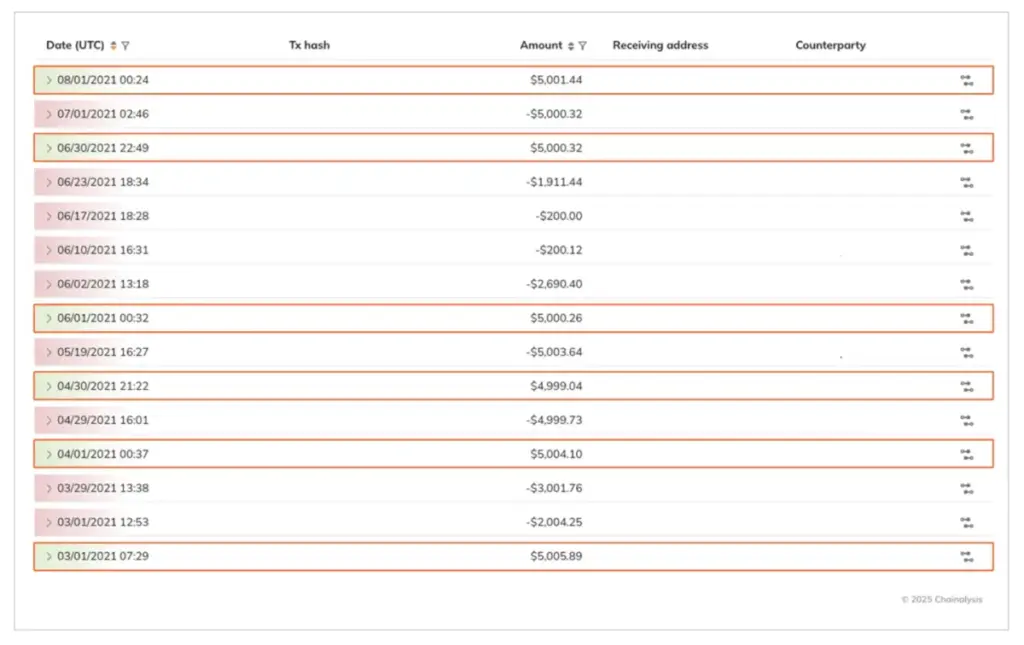
On-chain analysis has repeatedly identified wallets receiving regular incoming transactions consistent with corporate salary schedules. Once these funds are disbursed, the DPRK workers quickly transfer the cryptocurrency to intermediary networks managed by trusted brokers who handle the final layers of laundering.
How Chainalysis Follows the Money
The Binance investigation highlights how North Korea continues to develop, test, and refine a multi-pronged cybercrime machine. The exact same state-sponsored actors routinely exploit recruitment platforms, compromise sensitive corporate infrastructure, infiltrate legitimate businesses, and utilize cryptocurrency networks to move and obscure the resulting proceeds. As these adversarial tactics continue to evolve, modern organizations must look past conventional perimeter cybersecurity controls and pay closer attention to the underlying financial infrastructure that fuels these operations.
Blockchain intelligence remains critical to countering these threats. When combined with traditional cybersecurity measures and advanced threat intelligence, rigorous blockchain analysis enables organizations and investigators to identify, track, and freeze stolen funds. Furthermore, it helps map North Korea’s expanding financial networks while uncovering procurement and payment patterns that support ongoing sanctions investigations and international law enforcement enforcement.
The investigation into the Binance breach remains active, and blockchain analysts anticipate that the stolen funds will continue moving across various networks in the immediate future. Chainalysis continues to support Binance and the broader digital asset industry as investigators trace stolen capital, disrupt laundering pathways, and work to mitigate future risks.
 Crypto Wallets & Security
 Crypto Wallets & Security
 Crypto Wallets & Security