North America retained its position as the most influential region for global cryptocurrency markets during the 12-year reporting period ending July 1, 2026. Backed by the deep capital reserves of the United States investor base, evolving regulatory frameworks, and businesses bridging the gap between digital assets and traditional finance, the region continues to export its financial innovations worldwide. According to data tracking the industry’s sheer crypto-economic power, the United States and Canada collectively generated $3.02 trillion in on-chain economic activity during the period. This figure represents a modest 1.9% contraction compared to the previous cycle, a minor dip largely attributed to broader market corrections and a prolonged crypto bear market in the U.S.
Despite a 2.2% contraction in the U.S. domestic crypto economy—which brought its total volume to $2.78 trillion—the American market largely sustained the near-doubling of economic activity it achieved in the 2025 period. Institutional tailwinds, including the proliferation of exchange-traded funds (ETFs), accelerated tokenization of real-world assets, and the widespread adoption of dollar-pegged stablecoins, anchored these resilient valuations. Industry leaders note that the ecosystem has shifted from speculative experimentation to structural maturation. As Hoolie Tejwani, Head of Coinbase Ventures, observed, the foundational building blocks established in 2025 successfully transformed into functional products with active users, deep liquidity, and thriving markets over the course of 2026.

This evolution is particularly evident in three distinct, U.S.-developed product categories generating heavy activity both domestically and abroad: artificial intelligence commerce, stablecoins, and tokenized assets. Simultaneously, the Canadian crypto economy demonstrated remarkable resilience, expanding by 2.3% to approximately $250 billion, supported by robust peer-to-peer activity and a diverse, immigration-driven financial landscape.
The United States Leads the Emerging AI On-Chain Economy
The global race for artificial intelligence development has begun reshaping adjacent sectors, most notably digital payments. To understand how automated financial transactions are taking shape, researchers examined x402, a prominent digital payments rail enabling AI agents to execute financial transactions autonomously. As autonomous software increasingly pays for services on-chain, the United States has emerged as the primary incubator for these technologies.

Cornerstone American crypto entities, including Circle—the issuer of USDC, which serves as a primary currency for autonomous agents—and Coinbase, the developer of the x402 protocol, are actively supporting this burgeoning sector. Traditional financial heavyweights are also taking notice. Will Su, Head of Digital Assets Research at BlackRock, noted that the firm is monitoring agentic commerce closely, highlighting the potential for AI agents to generate substantial, round-the-clock demand for frequent, low-value micro-payments.
By the close of the 2026 reporting period, cumulative transaction volume on Base, the leading blockchain network for agentic commerce, surpassed 138 million transactions via the x402 protocol. On-chain settlement layers make these transactions viable in ways traditional payment rails cannot accommodate. Legacy credit card networks cannot profitably process sub-cent transactions due to fixed overhead costs. However, stablecoin networks that settle transactions for fractions of a cent make micro-payments economically viable, unlocking an entirely new market for pay-as-you-go digital goods, APIs, and real-time data retrievals.

Executives at Circle point to a clear division of labor emerging between traditional and blockchain rails, noting that card networks remain suited for consumer-prompted payments, while stablecoin rails handle machine-to-machine settlements that fall outside traditional economic viability. Data from the 16-month period ending September 2026 underscores this trend, with over 87% of x402 payments valued between one-hundredth of a cent and ten cents.
AI Payments Transition From Experimentation to Stickiness
While agentic commerce remains in an exploratory phase, adoption patterns indicate rapid maturation. In the earliest days of the x402 protocol, transactions were dominated by one-off users executing brief trades before abandoning their wallets. Over successive quarters, however, user retention and wallet activity have steadily increased.

When grouping wallets by the quarter in which they were initially funded, the share of wallets receiving a secondary funding deposit within 30 days rose from 70.6% in the third quarter of 2025 to 89.3% by the second quarter of 2026. This behavior mirrors traditional software subscription renewals, signaling that users find sufficient utility in automated payments to replenish depleted balances. Furthermore, the time elapsed between initial wallet funding and the first x402 transaction compressed dramatically. In late 2025, wallets maintained a median age of 73 days before executing their first protocol payment. By the third quarter of 2026, that median interval shrank to just 18 minutes, reflecting purpose-built wallets created specifically to facilitate immediate agentic commerce.
Autonomous agents are primarily utilizing these payment rails to acquire machine-readable information, including code reviews, financial intelligence, search APIs, model inference, and agentic tooling. Geolocation data indicates that American-funded AI agents account for roughly 30% of global agent-to-service transactions. U.S. wallets dominate specific upstream inputs, representing 88.1% of geolocated AI model inference payments, 41.8% of payments for agent frameworks, and 23.2% of data and search API transactions. In contrast, Chinese-linked wallets concentrated heavily on security and code analysis, accounting for 90% of transactions directed toward automated smart-contract auditing services like AgentLISA, alongside substantial shares in market intelligence and settlement rails.

The United States Exports Digital Dollars While Importing Digital Gold
The legislative passage of the GENIUS Act in mid-2025 reinforced the United States’ status as the world’s leading exporter of digital currency. Dollar-pegged stablecoins have transformed U.S. sovereign debt into a preferred settlement currency for international peer-to-peer transactions and cross-border trade. International adoption of digital dollars continues to generate billions of dollars in economic activity, benefiting both domestic issuers and the broader U.S. economy.
Conversely, while the U.S. exports stablecoins, it simultaneously imports bitcoin. Following the regulatory approval and launch of spot bitcoin exchange-traded funds in January 2024, the U.S. share of global bitcoin activity has climbed steadily. While stablecoins represent a smaller percentage of overall crypto activity within the United States than in overseas markets, American investors increasingly rely on bitcoin as a monetary alternative and store of value. This divergence highlights a distinct geographic separation in utility: international users adopt dollar stablecoins to address local banking and currency limitations, whereas U.S. institutional and retail investors utilize bitcoin to hedge against macroeconomic debt and government spending.

Cross-border data reveals that the United States transitioned into a net importer of bitcoin in 2026 for the first time since 2022. While retail transfers under $10,000 remained net outbound, institutional-grade transactions exceeding $10 million drove significant net inflows. Meanwhile, stablecoin circulation expanded significantly, with Circle reporting $73.3 billion of USDC in circulation at the end of the quarter—representing a 19% year-on-year increase—supported by more than $14.8 trillion in quarterly on-chain volume.
Tokenization and the Expansion of Real-World Assets
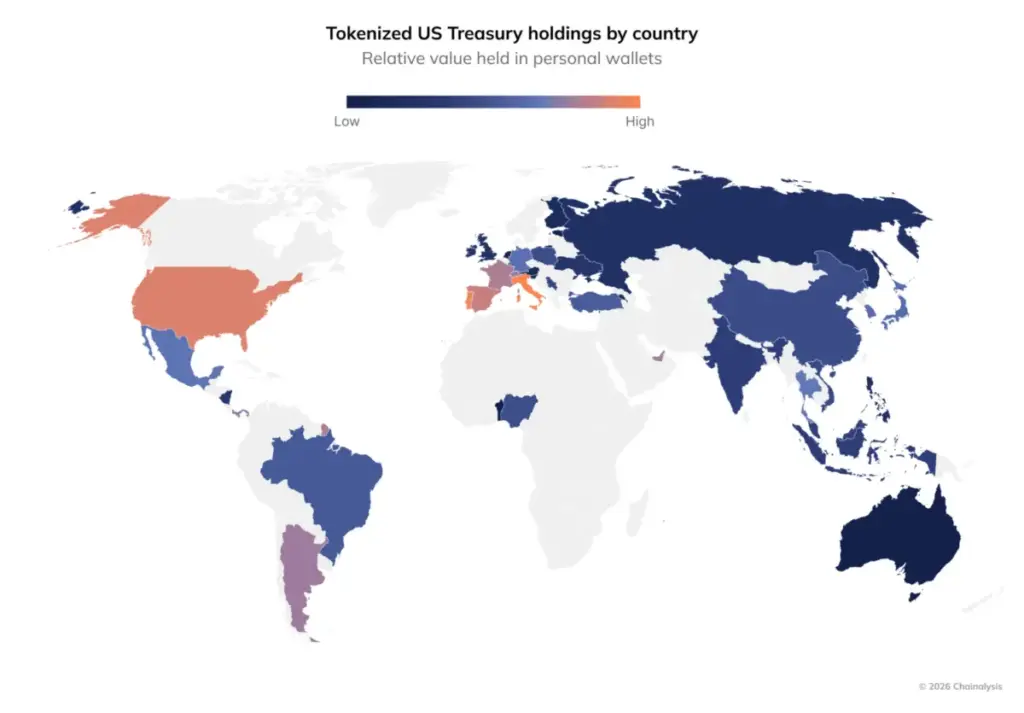
The tokenization of real-world assets expanded rapidly during the 2026 period, with the global tokenized asset market surging 135% year-over-year to reach $36.07 billion by the end of the second quarter. U.S. Treasury debt anchored this growth, remaining the single largest real-world asset category on-chain with $15.42 billion, which accounts for 42.8% of all tokenized asset value.

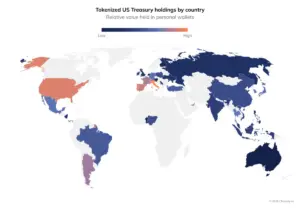
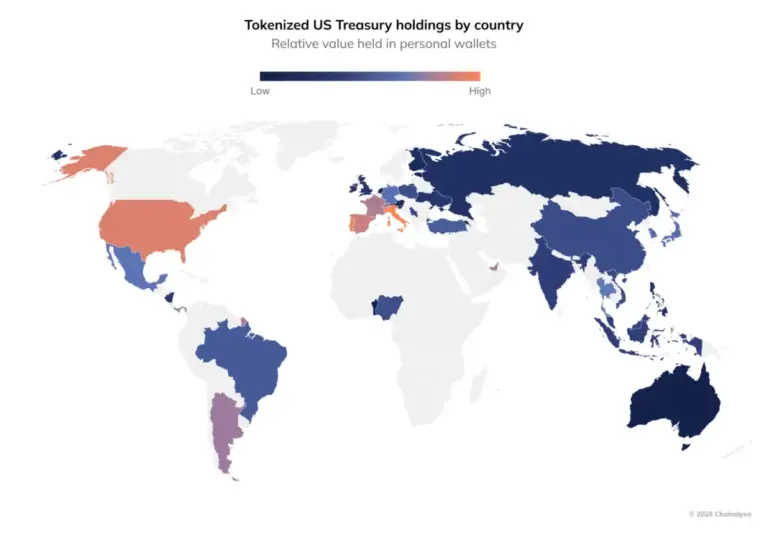
While U.S. investors comprise roughly 11.7% of the global tokenized asset holder base, international participation drives a significant portion of tokenized Treasury demand. Geolocated data indicates that Italy, Portugal, and Singapore represent major holdings by total value, while retail investors across various jurisdictions utilize tokenized structures to bypass traditional foreign brokerage barriers. This mechanism effectively extends wholesale U.S. debt instruments to retail participants globally, creating sustained foreign demand for U.S. government obligations.
Canada Emerges as a Global Leader in Peer-to-Peer and Remittance Flows
Canada maintained its position as the second-largest crypto economy in North America, expanding 2.3% during the 2026 period to reach a total volume of $247.7 billion. Despite its developed economic status, Canada exhibits unusually high rates of everyday cryptocurrency usage, ranking seventh globally in domestic and cross-border peer-to-peer flows among G7 nations.

Stablecoins represent 44% of Canadian dollar-based order book volume, up from 30% the previous year, with USDC capturing the vast majority of market share. This heavy reliance on USD-denominated stablecoins has drawn scrutiny from domestic policymakers concerned about potential displacement of Canadian sovereign debt demand.
Additionally, Canada’s large immigrant population—representing roughly 23% of the total population, the highest proportion within the G7—has fueled a thriving remittance economy. Outbound stablecoin and bitcoin transfers directed toward major remittance corridors in India, China, and the Philippines reached $2.36 billion during the period, encompassing 3.56 million transactions. Analysts note that temporary visa and study permit populations correlate closely with fluctuations in domestic peer-to-peer transaction volumes, as individuals with active cross-border financial obligations adopt blockchain rails to bypass traditional remittance fees that frequently exceed 6%.

As regulatory bodies in Canada implement new frameworks under the recent Stablecoin Act and international jurisdictions continue developing local digital asset standards, the broader North American market solidifies its role as the foundational infrastructure provider for global cryptocurrency adoption.
 Crypto Wallets & Security
 Crypto Wallets & Security
 Crypto Wallets & Security