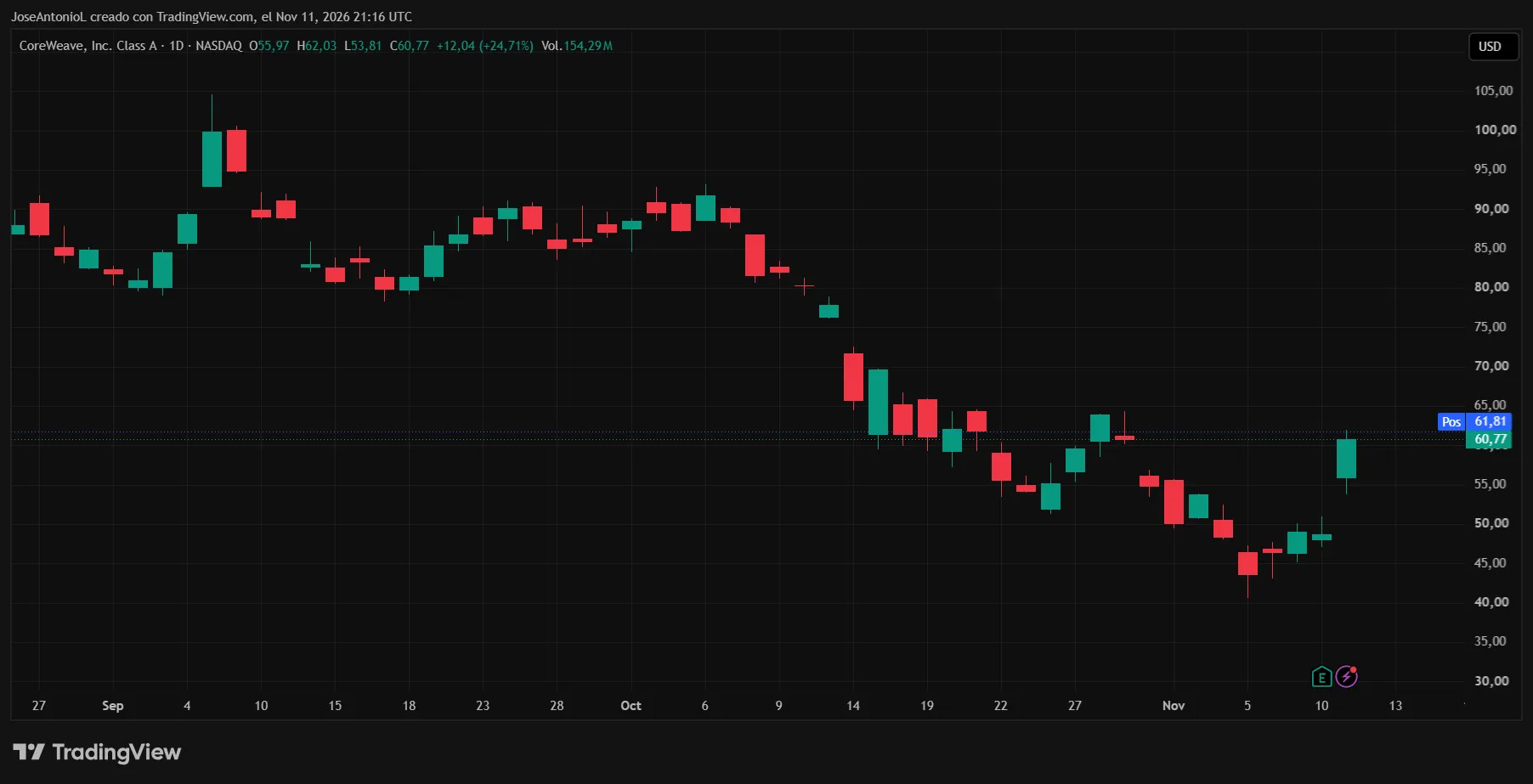
Nvidia-backed cloud provider CoreWeave saw its shares surge 24.7% on Wednesday, injecting much-needed momentum back into the artificial intelligence trade following weeks of persistent selling across global technology markets. The dramatic rally was fueled by the company’s latest financial report, which revealed skyrocketing demand for the expensive, power-hungry computing hardware that forms the backbone of the ongoing generative artificial intelligence boom.
For investors and market analysts anxiously monitoring the health of the broader technology sector, the report offered a crucial window into the mechanics of the modern AI economy. Specifically, CoreWeave’s performance provides a clear look at what happens downstream after chipmaking giant Nvidia sells its high-end processors to specialized cloud infrastructure providers.
During the third quarter, the specialized cloud provider posted $3.66 billion in revenue, representing a staggering 168% increase compared to the same period a year prior. Building on this momentum, the company aggressively raised its forward-looking sales forecast for fiscal year 2026, projecting total revenue between $13 billion and $13.3 billion. These robust figures immediately resonated across the market, helping to lift Nvidia shares alongside a wider cohort of AI infrastructure and data center stocks, including Nebius, IREN, Oracle, and Applied Digital, while nudging the broader Nasdaq composite up by 1.6%.
The operational model behind CoreWeave’s rapid expansion is straightforward yet capital-intensive. The company purchases massive quantities of advanced Nvidia GPUs, installs them into specialized, high-density data centers, and then rents out that raw computing power to organizations developing and running cutting-edge AI models, including major industry players like OpenAI.

Consequently, CoreWeave’s stellar revenue growth serves as tangible evidence that corporate customers remain firmly willing to pay premium prices for scalable AI computing capacity. However, financial analysts note that these top-line gains do not, by themselves, guarantee that the enormous capital expenditure required to build and maintain this infrastructure will translate into sustainable, long-term profits.
Why Nvidia Has So Much Riding on CoreWeave
The commercial relationship between Nvidia and CoreWeave extends far beyond a traditional supplier-customer dynamic. Recognizing the strategic importance of securing a reliable ecosystem for its hardware, Nvidia has repeatedly deepened its financial ties with the cloud provider. In January, Nvidia invested an additional $2 billion in CoreWeave shares at a price of $87.20 per share, further solidifying a joint initiative designed to scale up more than five gigawatts of specialized AI data center capacity by the end of the decade.
Under the terms of their expanded agreements, the two companies also committed to integrating next-generation Nvidia technology directly into CoreWeave’s infrastructure framework, including advanced hardware architectures like the Rubin platform and Vera CPUs. This positioning turns CoreWeave into both a premier commercial showcase and an anchor customer for Nvidia’s future hardware releases, well beyond the graphics processing units already humming inside its server racks.
"Together, we’re racing to meet extraordinary demand for NVIDIA AI factories," Nvidia CEO Jensen Huang remarked when the expanded partnership was officially unveiled in January.
Adding another layer to this intricate corporate web, Nvidia maintains an initial agreement valued at $6.3 billion to purchase CoreWeave’s unused computing capacity through April 2032, subject to specific contract conditions. Practically speaking, this arrangement functions as a financial backstop for CoreWeave, ensuring a guaranteed buyer for infrastructure capacity that it might not immediately lease out to third-party clients. Simultaneously, it guarantees that Nvidia retains immediate access to high-performance cloud computing built explicitly around its proprietary chips.

This dense web of interlocking transactions has inevitably drawn scrutiny from market observers, fueling both market enthusiasm and sharp criticism regarding the sustainability of current AI financing models. Skeptics have frequently pointed to the circular nature of these arrangements—wherein Nvidia supplies capital to leading AI model developers like OpenAI, who in turn spend those funds on computing power provided by companies like CoreWeave, which ultimately funnels capital back to Nvidia through hardware purchases. Market commentators and social media observers have dubbed this phenomenon "circular finance," viewing it alternately as an ingenious ecosystem strategy or a potential warning sign of an overextended sector. While these are fully valid commercial contracts backed by real operational needs, the overlapping financial relationships undeniably complicate efforts by independent analysts to measure true, organic market demand for AI services.
What the Earnings Say About the AI Boom
Beneath the headline-grabbing revenue figures, CoreWeave reported an astonishing $132.5 billion in its revenue backlog. This figure represents contracted business agreements that the company expects to fulfill and recognize over time, rather than immediate cash on hand. The firm reported active partnerships with a roster of prominent artificial intelligence firms, including OpenAI, Cohere, and Perplexity, while operating more than 1.7 gigawatts of active power capacity as of the end of September.
"This was a breakout quarter for CoreWeave, with revenue increasing by more than $1 billion sequentially," Chief Executive Officer Michael Intrator stated during the company’s earnings conference call.
Furthermore, CoreWeave disclosed expectations to pull in roughly $9 billion in customer prepayments and security deposits over the upcoming three-month window. Securing substantial cash inflows before delivering all contracted services could significantly alleviate the company’s immediate reliance on debt financing. This comes at a critical time when market participants have grown increasingly uneasy about the sheer volume of debt required to finance the rapid construction of power-hungry AI data centers.
The timing of CoreWeave’s earnings report was particularly consequential for equity markets. It arrived precisely as investors were grappling with a difficult question: whether the sharp pullbacks and losses experienced by AI-related stocks in recent weeks were indicative of a genuine cooling in enterprise demand, or merely lingering anxiety over the staggering capital costs required to sustain the buildout.
Specialized GPU-rental operations like CoreWeave occupy a unique niche often referred to by industry insiders as "neoclouds." Interestingly, many of these providers—including CoreWeave, which originally launched operations as an Ethereum cryptocurrency mining enterprise—trace their roots back to crypto infrastructure. These operators brought to the table a pre-existing familiarity with running massive fleets of dense, power-hungry hardware under grueling operational conditions.
Wall Street analysts have generally welcomed the latest numbers. According to Reuters, Bernstein analysts characterized the quarter as "about the best quarter we could have asked for," while simultaneously cautioning that CoreWeave would likely be among the enterprises most severely impacted if the broader shortage of available AI computing capacity begins to ease in the future.
The underlying risks facing the sector extend beyond any single partnership. The rapid cadence of hardware innovation means that newer processor generations can quickly render older GPUs less competitive, while external pressures such as regional electricity grid constraints, construction delays, and rising borrowing costs can severely squeeze operational margins. Furthermore, any sudden oversupply of AI computing power across the broader market would inevitably exert downward pressure on the rental pricing rates that drive CoreWeave’s bottom line. For now, however, the company’s stellar performance has successfully
quieted near-term doubts, proving that the appetite for AI infrastructure remains robust.
 Decentralized Applications (dApps)
 Decentralized Applications (dApps)
 Decentralized Applications (dApps)