The decentralized finance (DeFi) landscape is witnessing heightened market attention surrounding RedStone, a prominent blockchain oracle network, as its native token, RED, approaches a vital technical crossroad. Market analysts and swing traders are closely monitoring the RED/USDT trading pair as price action tests major support and resistance thresholds that could potentially dictate the asset’s medium-term trajectory and trigger a significant trend reversal.
At the heart of this market interest is RedStone’s expanding footprint within the Web3 ecosystem. As a specialized decentralized oracle network, RedStone delivers reliable, real-world data feeds to a wide array of decentralized finance protocols, smart contracts, and emerging tokenized assets, commonly referred to as real-world assets (RWAs). Powered by a modular infrastructure designed to seamlessly support multiple blockchain networks, the protocol aims to solve critical data-fetching bottlenecks that have historically challenged multi-chain environments.
Within this architecture, the RED token serves a foundational purpose. It plays an active role in maintaining network security, facilitating staking mechanisms, and driving ecosystem-wide incentives. Consequently, market participants often view the valuation of the token as a barometer for broader sentiment surrounding decentralized data services and multi-chain interoperability.
Fundamental Tailwinds and Ongoing Market Risks
From a broader fundamental perspective, RedStone operates in a rapidly expanding sector of the blockchain economy. The escalating demand for robust DeFi infrastructure, cross-chain data services, and the tokenization of traditional financial instruments presents a compelling long-term growth narrative. As institutional interest in real-world assets continues to mature, protocols capable of securely bridging off-chain data with on-chain execution environments are increasingly positioned to capture meaningful market share.
However, market observers emphasize that fundamental potential must be weighed against prevailing market realities. Token supply dynamics, intense competition within the decentralized oracle sector, and the overarching volatility of broader cryptocurrency market conditions remain critical risk factors for participants. These macroeconomic and sector-specific variables often dictate whether fundamental value successfully translates into sustained price appreciation on secondary markets.
Technical Outlook and Potential Trend Reversal
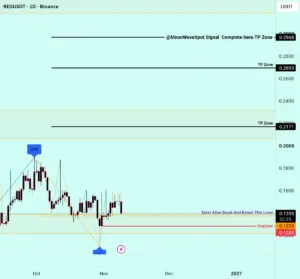
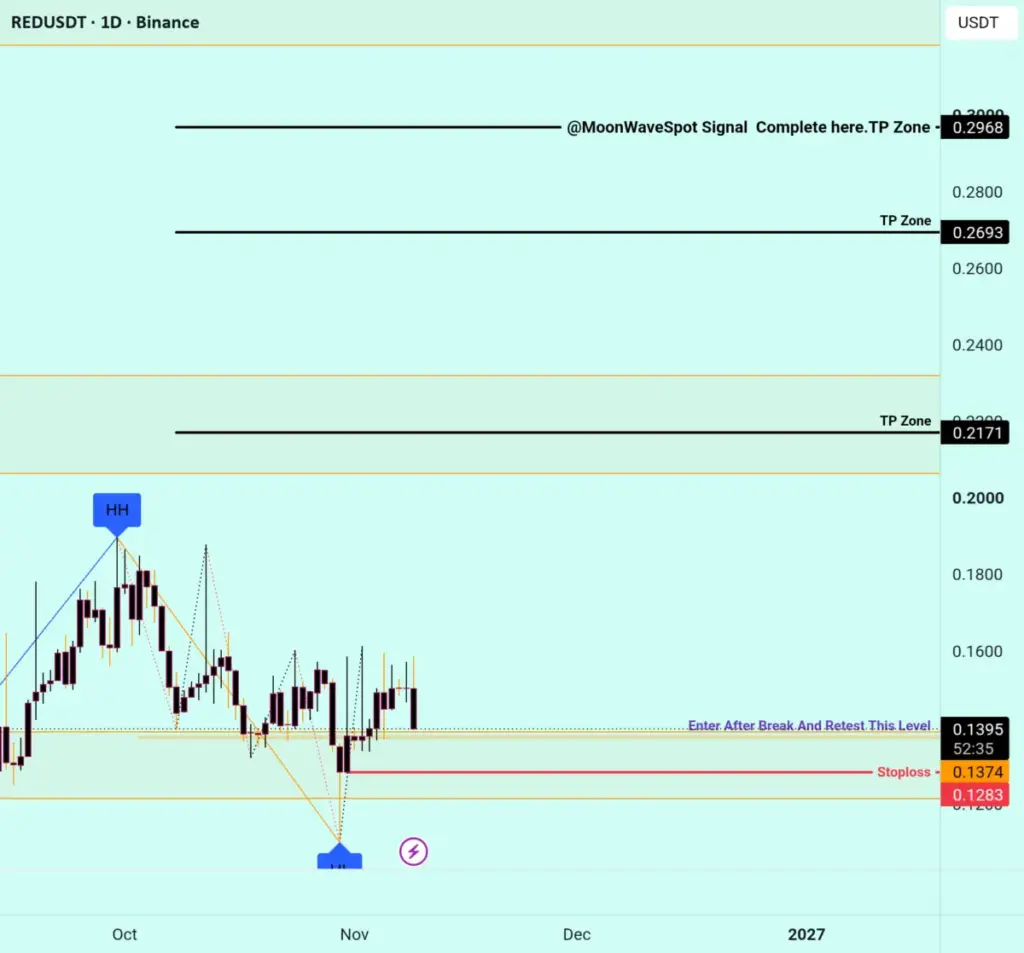
Against this fundamental backdrop, the technical structure of the RED/USDT trading pair has captured the spotlight among market analysts, notably highlighted by insights shared by MoonWave Spot Traders. Price action is currently consolidating near key technical levels that could determine whether the asset enters a bullish continuation phase or succumbs to renewed selling pressure.

According to technical assessments, a confirmed breakout above immediate overhead resistance, reinforced by expanding trading volume and positive bullish momentum, could serve as a powerful catalyst. Such a technical development would signal a prospective trend reversal, potentially clearing a path toward higher price targets and renewing market enthusiasm. Conversely, a failure to breach resistance—resulting in a sharp price rejection—or a breakdown below critical foundational support zones would likely invite renewed bearish pressure and prolong the current consolidation phase.
Market technicians tracking the pair note that confirming structural integrity is paramount before establishing definitive directional bias. Utilizing analytical frameworks such as the Ichimoku Cloud and momentum indicators helps market participants filter out false breakouts and assess the true strength behind underlying price movements.
Key Market Factors and Metrics Under Surveillance
Traders and analysts mapping the trajectory of the RED token are maintaining a vigilant focus on several interdependent market metrics and technical phenomena. The primary event horizon centers on the decisive breakout and subsequent retest of established resistance zones, which traditionally validates the strength of a shifting market structure.
In tandem with structural price levels, market participants are closely monitoring reactions around primary support and resistance barriers to gauge buyer and seller commitment. Technical indicators such as the Relative Strength Index (RSI) are also under scrutiny to identify potential momentum divergences that often foreshadow trend shifts or exhaustion among market participants. Furthermore, fluctuations in overall trading volume are being treated as a critical litmus test for the legitimacy of any near-term price expansion.
Beyond asset-specific indicators, the broader macroeconomic environment and the directional momentum of Bitcoin remain indispensable variables. Given that overall market sentiment heavily influences altcoin performance, the prevailing health and liquidity conditions of the wider crypto market will undoubtedly play a decisive role in shaping the outcome of the current technical setup.
Concluding Market Perspective
The ongoing price action surrounding RedStone (RED) underscores the complex interplay between robust blockchain infrastructure fundamentals and technical market behavior. As the asset navigates this critical juncture, the next confirmed structural move will likely provide much-needed clarity on its medium-term directional bias. Whether the network’s technological utility can successfully fuel a sustained technical breakout remains one of the more closely watched developments within the decentralized oracle sector.
Disclaimer: This analysis is for educational and informational purposes only and does not constitute financial advice, an endorsement, or a recommendation to buy or sell any financial instruments or cryptocurrencies. Cryptocurrency trading involves substantial risk of loss and is not suitable for every investor. Always conduct independent research and consult with a qualified financial professional before making any investment decisions.
 Crypto Investing & Trading
 Crypto Investing & Trading
 Crypto Investing & Trading