
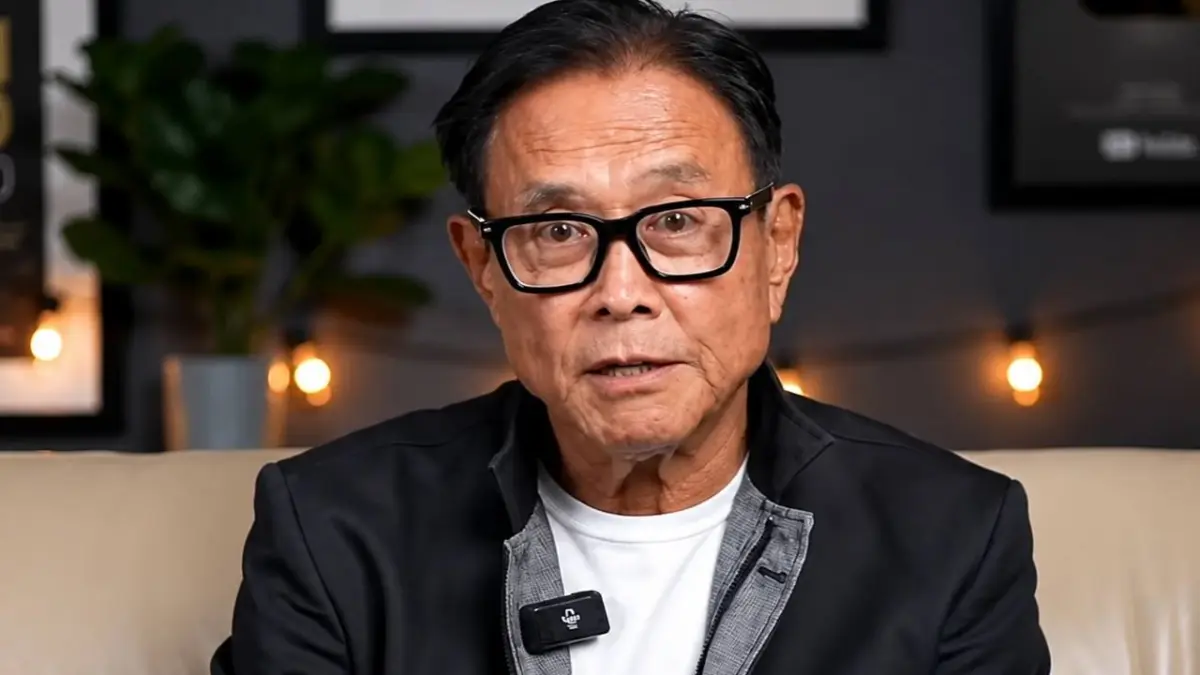
Renowned investor and author Robert Kiyosaki has once again voiced his long-standing skepticism regarding traditional fiat currencies, framing the ownership of Bitcoin and other hard assets as an essential form of financial insurance. Best known for penning the personal finance classic Rich Dad Poor Dad, Kiyosaki recently challenged the prevailing cultural narrative that anticipating economic downturns or monetary devaluation equates to pessimism. Instead, he argued that taking proactive measures to protect one’s wealth can seamlessly coexist with maintaining a constructive and positive outlook on life.
The discussion, which unfolded across social media platforms, highlights Kiyosaki’s broader philosophy on financial preparedness, a mindset that encourages individuals to step outside the traditional banking system and acquire tangible assets that cannot be artificially inflated or expanded by government decree.
Robert Kiyosaki Compares Bitcoin Ownership to Carrying Insurance
In a detailed commentary shared on the social media platform X, Robert Kiyosaki elaborated on his financial prepper approach, categorizing asset diversification as a fundamental precaution against escalating economic turbulence. To articulate his perspective, the celebrated author recounted a recent interaction with a woman who questioned whether maintaining such a defensive posture was inherently pessimistic. She suggested that practicing positive thinking might be a healthier and more productive mental framework for navigating daily life.
Kiyosaki countered her skepticism with a practical analogy, asking her whether she owned automobile insurance and whether the purchase of that coverage meant she actively hoped to get into a car accident. By drawing a direct parallel between safeguarding a vehicle against unforeseen road hazards and safeguarding lifetime savings against systemic financial risks, he highlighted the rational logic behind risk mitigation.
When his interlocutor readily acknowledged that auto insurance is merely a sensible precaution rather than an expression of doom, Kiyosaki pivoted the conversation to tangible wealth protection. He posed a direct and pointed question to her: whether she owned any gold, silver, or Bitcoin.
Following an exchange regarding the ongoing mechanics of government money creation—and how expanding fiat supplies systematically erode the purchasing power of ordinary citizens—Kiyosaki reiterated his absolute preference for decentralized and scarce stores of value. Summarizing his investment ethos, he stated that he exclusively wants money that the government cannot print.
This uncompromising stance reinforces his enduring support for Bitcoin, positioning it as a core pillar within a much wider, multi-asset investment strategy. Kiyosaki’s broader asset preferences have consistently extended beyond digital currency to include hard commodities such as gold, silver, and industrial inputs like oil, as well as digital assets like Ethereum. By presenting the ownership of cryptocurrencies and precious metals as a necessary shield against monetary instability, he continues to link his bullish macroeconomic positions to a fundamental defense against currency devaluation.
Purchasing Power Drives His Bitcoin Preference
At the heart of Kiyosaki’s public critiques is a persistent warning regarding the insidious nature of inflation, which he argues effectively steals wealth from savers even when their nominal bank account balances remain completely unchanged. He has frequently accused central banks, specifically the U.S. Federal Reserve, and government fiscal authorities of transferring wealth away from the populace through a combination of direct taxation and the hidden tax of inflation. The latter phenomenon describes a sustained rise in the general price level of goods and services across the broader economy, which ultimately leaves any given sum of currency able to purchase significantly fewer goods over time.
This distinction highlights a crucial divergence between nominal wealth and real purchasing power. While an individual may watch the dollar figure in their savings account stay the same or grow marginally through standard interest rates, the true measure of financial security lies entirely in what those savings can actually buy in the marketplace as the years progress.
To monitor these fluctuations, institutional bodies such as the Federal Reserve track changes in consumer prices using various economic indexes to gauge inflationary pressures. Kiyosaki leverages these very economic realities to explain why he consistently steers clear of traditional, government-issued fiat currency in favor of alternative value stores.
Bitcoin’s famously hard-coded supply limit of 21 million coins serves as a foundational pillar supporting Kiyosaki’s preference for assets that lie completely outside the control of central authorities. However, many financial analysts note that structural scarcity alone does not provide an absolute, guaranteed hedge against inflation. The market price of Bitcoin remains deeply tied to shifting investor demand and macroeconomic liquidity cycles, meaning its valuation can experience sharp declines even during periods when the cost of living continues to rise. Consequently, a fixed supply schedule ensures digital scarcity, but it does not automatically guarantee that an investment will retain its purchasing power across all economic environments.
Oil Income Broadens His Financial Preparation Strategy
Beyond his vocal advocacy for scarce digital and physical assets, Kiyosaki’s comprehensive approach to wealth preservation incorporates cash-flowing real-world enterprises, most notably petroleum extraction. He has detailed his ownership of domestic oil wells that generate regular revenue streams from buyers, which notably include various governmental entities. Rather than viewing the state purely as an adversary through taxation and monetary policy, Kiyosaki has portrayed these public sector clients as a reliable source of business revenue, effectively integrating an active income component into his overarching financial defense strategy.
This unique stance allows him to bridge the gap between fierce criticism of public monetary management and a pragmatic willingness to profit from government demand for vital energy commodities. His focus on inflation-resistant positioning has frequently tied rising energy prices and mounting national debt directly to the severe financial pressure bearing down on household savings. Within this framework, oil plays a fascinating dual role in his economic narrative: while surging energy prices can exacerbate household living expenses, active participation in production provides a robust business interest through which he can collect consistent revenues.
The renowned author’s wider portfolio also incorporates traditional income-generating properties, such as rental apartments, which he frequently references alongside American oil wells when issuing broader retirement warnings to the public. By engaging with both physical commodities and productive real estate, Kiyosaki encourages a holistic view of economic resilience that moves far beyond passive holding strategies. Concluding his commentary on financial preparedness, he posed a direct question to his followers regarding their own readiness, pointing to the unique commercial dynamics of his energy investments as an example of turning systemic government demand into personal financial strength.
 Bitcoin & Major Altcoins
 Bitcoin & Major Altcoins
 Bitcoin & Major Altcoins







