An attacker exploited a sophisticated bookkeeping flaw within UNCX Network’s shared vesting contract, turning a negligible leftover token position into an $86,000 windfall. The October 14 breach exposed vulnerabilities in a decentralized finance infrastructure system explicitly designed to lock assets and provide security assurances to cryptocurrency projects. While the immediate financial theft was measured at tens of thousands of dollars, the compromised smart contract held approximately $3.25 million in assets when security researchers first identified the ongoing exploit, leaving millions exposed before defensive measures could be enacted.
How an $86,000 Exploit Turned a Token Lock Into a Liability
Blockchain security firm Blockaid first sounded the alarm regarding the exploit targeting UNCX Network, which formerly operated under the name Unicrypt. Rather than deploying traditional attack vectors such as stealing private keys, compromising individual user wallets, or launching phishing campaigns against project founders, the malicious actor manipulated the smart contract’s internal accounting mechanics. This clever manipulation allowed the attacker to withdraw tokens belonging entirely to other users, bypassing authorization boundaries without breaking cryptographic keys.
According to technical breakdowns shared by Blockaid on social media, the attacker systematically created vesting positions within the shared token pool, released a large allocation, introduced a direct token donation, and then canceled a topped-up vest. This precise sequence of actions weaponized a tiny leftover vest, giving it the mathematical capability to drain locked tokens belonging to unrelated platform users.
What made the situation exceptionally alarming for security analysts was the sheer volume of capital still residing inside the targeted infrastructure. When Blockaid flagged the incident in real time, approximately $3.25 million remained locked within the affected Ethereum smart contract. Shortly after the initial alert, specialized security researchers at Exvul published a comprehensive technical analysis detailing the exact arithmetic flaw that permitted the unauthorized withdrawals.
What Is a Shared Token Vesting Pool?
To fully comprehend how the security breach occurred, it is necessary to examine the core functions of UNCX Network. Operating since 2020, the platform provides decentralized finance and cryptocurrency projects with essential infrastructure tools designed to lock liquidity and distribute project tokens according to predetermined, automated schedules. These services allow founders, core developers, and early investors to demonstrate to their communities and investors that certain asset allocations are cryptographically locked and cannot be sold or dumped onto the open market before an agreed-upon date.
Token vesting functions similarly to traditional corporate stock compensation plans found in conventional equity markets. Instead of receiving an entire allocation of tokens all at once upon launch, recipients acquire their digital assets gradually over a prolonged timeline, often following an initial waiting or cliff period. This programmatic arrangement successfully discourages premature selling pressure, dampens short-term market volatility, and helps keep project participants aligned with the long-term viability and growth of the ecosystem.
A shared vesting pool takes this foundational concept a step further by optimizing blockchain deployment costs. Rather than requiring developers to deploy a separate, dedicated smart contract for every single token allocation or team member, multiple decentralized finance projects can deposit their respective tokens into a common, shared smart-contract infrastructure. Each individual position maintains its own uniquely recorded balance and release schedule, while the underlying contract manages the global accounting logic for all participants simultaneously.
This communal approach offers significant convenience, lower deployment expenses, and easier administrative management. However, it introduces systemic risks. When a flaw develops within the shared bookkeeping architecture, funds belonging to entirely unrelated projects can suddenly find themselves exposed to risks originating from actions taken by other users sharing the same smart contract environment.
A Tiny Leftover Position Became the Attacker’s Golden Ticket
According to findings published by Exvul, the core vulnerability centered squarely on UNCX’s VestingManager contract and how the system managed released and canceled token shares. In the context of the smart contract, these shares function as internal accounting claims against the underlying tokens physically held inside the contract vault.
The attacker initiated the exploit by creating new vesting positions and subsequently releasing tokens from a substantially large position. Additional tokens were then deposited directly into the pool, followed by the cancellation of a previously funded position. This specific sequence of operations generated a critical accounting discrepancy within the contract’s internal ledger.
Security researchers explained that the contract’s release function successfully reduced the global tracking variable for total token shares, but failed to correspondingly remove the released shares from the individual position’s deposited shares record. When that same position was subsequently canceled, the contract calculated deductions using the original recorded deposit figure, effectively counting the exact same reduction twice. Combined with a direct token donation that further distorted the arithmetic, the calculations completely broke down.
The resulting mathematical anomaly produced a tiny residual vesting position that possessed the erroneous ability to claim assets backing the deposits of other users. In practical terms, the contract’s internal ledger no longer accurately reflected which entity was legally or programmatically entitled to specific balances. The attacker discovered a method to force a nearly empty position to behave as though it carried a massive ownership claim, allowing the contract’s own flawed mathematics to execute the theft without requiring compromised private keys.
Ten Tokens Taken as Researchers Trace the Money
Initially, early reports of the exploit indicated that the theft involved five distinct cryptocurrencies, specifically EDGEN, ZC, PEPECOIN, LO0P, and PAAL. However, a subsequent update released by UNCX Network expanded the official count to ten affected tokens across multiple blockchain networks.
This multi-token exposure highlights the core vulnerability of shared infrastructure models. The attacker was not merely withdrawing funds from an account under their direct control; instead, the flawed share calculations allowed a single manipulated position to reach across ecosystem boundaries and drain assets belonging to completely independent projects. For a platform whose entire business model revolves around establishing trust and preventing premature token withdrawals, this multi-project exposure presented a significant operational and reputational challenge.
UNCX Moves to Contain the Damage
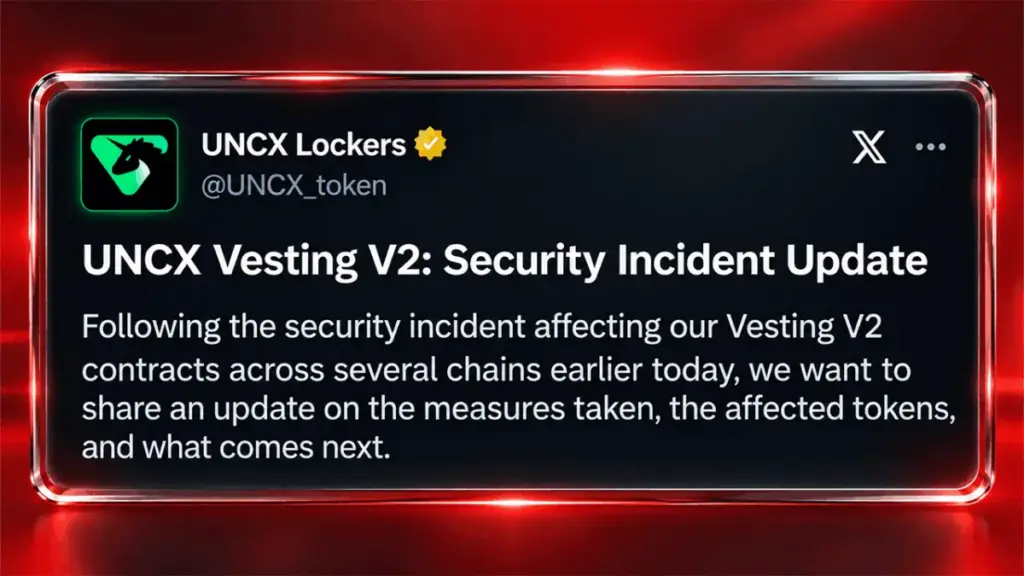
In response to the security breach, UNCX Network formally acknowledged the incident on social media and immediately halted the creation of new vesting positions within the affected contract while internal engineering teams reviewed transaction logs and assessed the broader financial damage. To deter further unauthorized interactions while investigations proceeded, the platform temporarily instituted flat fees of 100 ETH, or equivalent asset values, across its vesting contracts.
In a subsequent update issued during the evening hours on Wednesday, UNCX confirmed that the exploit ultimately impacted ten distinct tokens distributed across four major blockchain networks, including Ethereum, Base, BNB Chain, and the Robinhood Chain. To fortify the system against ongoing threats, the company raised flat fees above 1,000 ETH per lock, increased standard token fees to 5%, and permanently closed internal methods that could previously be utilized to bypass those transactional charges.
Despite the severity of the incident, UNCX emphasized that its standalone liquidity lockers and legacy vesting contracts remained entirely secure and unaffected by the vulnerability. Concurrently, the platform initiated active collaborations with law enforcement agencies and specialized incident response organizations such as SEAL 911 to investigate the breach and track the perpetrator.
Stolen Funds Remain Missing as Recovery Efforts Begin
As investigations continued, UNCX reported that neither the original attacker nor opportunistic copycats had returned any portion of the stolen funds. Platform representatives began direct outreach to all affected projects, strongly advising community members and traders against engaging in the trading of impacted tokens within compromised liquidity pools. Additionally, the development team announced preparations to release a comprehensive incident report detailing the financial findings alongside a structured recovery plan.
For the time being, the ultimate scope of financial losses remains fluid, and the perpetrators retain control of the stolen digital assets as ongoing blockchain analysis and law enforcement efforts unfold.
 Bitcoin & Major Altcoins
 Bitcoin & Major Altcoins
 Bitcoin & Major Altcoins