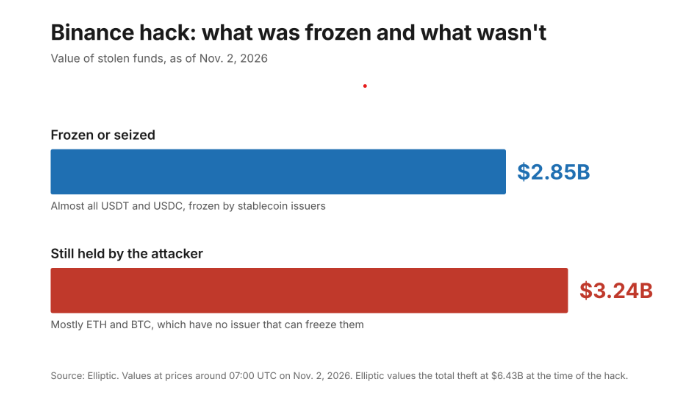
When the Federal Bureau of Investigation announced last weekend that North Korea was behind the staggering $6.3 billion Binance hack—an incident analysts are now officially terming the largest digital asset heist on record—the global cryptocurrency community was instantly thrust into familiar territory of panic and disbelief. Headlines immediately fixated on the sheer scale of the theft, detailing the intricate security vulnerabilities and the sophisticated methods employed by the threat actors.
However, amidst the widespread post-mortem analysis focusing heavily on the loss itself, a crucial and far more optimistic narrative has been largely overlooked: what actually went right during the crisis.
While it remains an undeniable fact that the malicious actors managed to siphon off a record-breaking $6.3 billion in digital assets, they have ultimately been unable to retain control over a massive portion of their illicit takings. Out of the total stolen volume, an impressive $2.85 billion in funds has already been successfully frozen. The primary mechanism behind this unprecedented defensive intervention comes down to the precise composition of the stolen capital. Of that $2.85 billion in intercepted funds, a striking 94 percent was held in stablecoins.
Although the hack itself represents a devastating blow to the broader digital economy, the rapid operational response highlighted a reality that frequently invites criticism from crypto purists. Centralized control, often viewed with intense skepticism within decentralization-focused circles, may actually serve as one of the most potent and effective tools currently available in the ongoing global fight against financial crime and digital asset theft. Unlike natively decentralized cryptocurrencies whose transactions are entirely immutable and censorship-resistant, fiat-backed stablecoins possess a unique architectural characteristic. They can be dynamically frozen by their issuing entities, providing victims, law enforcement, and exchanges with a rare, highly effective window of opportunity to prevent stolen capital from permanently disappearing into the hands of bad actors.
This unprecedented defensive capability, however, simultaneously introduces a deeply uncomfortable and complex question for the future of digital finance. If private corporate entities possess the unilateral, real-time power to freeze billions of dollars in user assets with the click of a button, who ultimately decides when, how, and under what exact legal circumstances they should be permitted to exercise that immense authority?
The United Kingdom now finds itself in a unique and strategic position to address this exact regulatory vacuum.
The Race to Get Rid of Stablecoins
To fully comprehend the monumental significance of the multi-billion-dollar asset freeze, one only needs to examine the frantic tactical maneuvers executed by the hackers during the immediate aftermath of the breach.
Clearly aware of the structural vulnerabilities tied to fiat-pegged tokens, the perpetrators understood that they operated under an exceptionally narrow timeframe to move the stablecoins before centralized authorities could mobilize a defense. Less than an hour after the initial breach began, the hackers had already dumped $325 million worth of stolen USDT—Tether’s flagship stablecoin—in exchange for Ether. The core motivation behind this high-speed swap was straightforward: divest from an asset class that could be frozen at the issuer’s discretion and migrate into a decentralized asset class that could not.
Fortunately, major stablecoin issuers demonstrated an extraordinary degree of operational agility. Tether executed its first major freeze a mere 37 minutes after the stolen funds touched the primary wallets controlled by the hackers. Rival issuer Circle followed suit just three minutes later, moving swiftly to block the further transfer and circulation of USDC.
Without these rapid, synchronized interventions orchestrated independently by Tether and Circle, a vastly larger percentage of the stolen billions would have crossed the threshold into untraceable territory, leaving victims with virtually zero recourse.

We Are Yet to Agree on the Rules
While the emergency freezes largely succeeded in mitigating the damage, the systemic reliance on ad-hoc corporate interventions exposes a glaring vulnerability. The defense worked primarily because a handful of private companies independently decided, in real-time, to utilize their administrative powers under extreme pressure.
The underlying problem, however, is that the digital asset industry still lacks a universally agreed-upon standard defining precisely when a freeze is legally justified, what evidentiary threshold is required, or how rapidly issuers are obligated to respond. The consequences of operating without these clearly defined regulatory guardrails are already manifesting in contentious legal battles across multiple jurisdictions.
For instance, Circle is currently facing a proposed class-action lawsuit filed by investors of Drift Protocol. The plaintiffs allege that Circle failed to freeze approximately $230 million in stolen USDC following an earlier exploit in April, arguing that the company possessed the technical capacity to stop the funds from moving but failed to act within a reasonable timeframe.
At the same time, Tether finds itself embroiled in a separate legal challenge in New York, brought by two businessmen claiming the company froze millions of dollars in their assets months before any formal seizure warrant had been legally issued. Tether has vigorously defended its actions in response to the case, dismissing the allegations as entirely baseless.
Operating professionally within the traditional payments and banking sector, freezes and account suspensions ordered by financial institutions are a familiar reality. Observers might logically argue that if commercial banks routinely exercise this authority, stablecoin issuers should be granted the same operational latitude.
The critical distinction, however, lies within the procedural framework. Traditional banks do not wake up and arbitrarily decide to freeze customer assets on a whim. Their administrative actions are invariably bound to strict legal triggers, regulatory oversight, and established due process that allows affected parties a clear pathway to challenge the decision.
Stablecoin issuers now wield equivalent, if not greater, financial power while being forced to operate at unprecedented speeds across porous international borders. It has clearly become imperative that this immense power is anchored to a predictable regulatory structure.
Britain Can Fix This
Introducing comprehensive regulation to govern stablecoin issuers naturally presents a significant logistical hurdle. Tether and Circle, as the two dominant industry giants, are not headquartered within the United Kingdom, meaning British regulators cannot simply issue direct mandates to dictate their global operational policies.
What the United Kingdom can decisively control, however, is precisely which digital assets and stablecoins are legally permitted to be marketed, traded, and held by UK-based retail and institutional customers. In fact, British authorities have already taken substantive steps in this direction.
Back in June, the Financial Conduct Authority published its comprehensive cryptoassets regulatory regime. Under the framework, UK-regulated trading platforms are required to conduct rigorous due diligence and publish detailed disclosure documents prior to listing any digital asset, a mandate that explicitly encompasses stablecoins issued overseas. This regulatory regime is scheduled to come into full legal force on October 25, 2027.
Simultaneously, the Bank of England is in the final stages of completing its Code of Practice for systemic stablecoin issuers, with implementation expected by the end of this year. This framework specifically targets stablecoins utilized widely enough for everyday payments that their operational failure or systemic shock could pose a threat to UK financial stability.
Neither of these existing regulatory frameworks currently establishes the explicit obligations surrounding the freezing of stolen funds that are urgently needed. Because both frameworks are still actively taking shape, the United Kingdom possesses a golden, time-sensitive opportunity to address this critical legislative gap now, rather than attempting to retrofit cumbersome compliance requirements years down the line.
Two Conditions for a UK Listing
A practical regulatory solution to this dilemma is entirely achievable. Before any stablecoin is approved for trading on a registered UK platform, its issuing entity should be required to formally satisfy two clear, standardized conditions.
The first condition is ensuring that the issuer is genuinely contactable and operationally prepared to act. While Tether and Circle responded with remarkable speed during the Binance crisis, the victim in that instance was the world’s largest cryptocurrency exchange, commanding immense industry leverage. A smaller, UK-based platform or a mid-sized digital business should be guaranteed that exact same responsive level of institutional support.
Working alongside various smaller crypto enterprises that lack Binance’s corporate profile or a direct communication hotline to top-tier issuers, the current reality leaves them vulnerable to being pushed to the back of the queue during an emergency.
The second condition requires the establishment of a transparent timetable governing the lifecycle of a freeze. If an issuer exercises its administrative power to freeze funds linked to suspected criminal activity, it should be legally mandated to notify the National Crime Agency within the exact same business day. Furthermore, the freeze should automatically expire after a defined period unless law enforcement secures an official court order to maintain the asset restriction.
Neither of these proposals represents an extreme or controversial regulatory overreach. Together, they would provide law enforcement agencies with a reliable window to intercept stolen capital while safeguarding ordinary market participants from having their legitimate assets frozen indefinitely without proper legal grounds.
The catastrophic Binance hack has vividly demonstrated that stablecoins can serve as a powerful line of defense, offering victims of crypto crime a realistic chance to intercept stolen wealth before it vanishes permanently. Ensuring that this protective mechanism exists should not remain a specialized privilege reserved exclusively for the world’s largest and most influential digital exchanges.
 Crypto Regulation & Policy
 Crypto Regulation & Policy
 Crypto Regulation & Policy