The cryptocurrency market is facing renewed headwinds as macroeconomic pressures converge with bearish technical indicators, putting significant downward pressure on major digital assets. United States spot XRP exchange-traded funds (ETFs) experienced a sharp reversal of fortune, shedding $10.4 million on November 9. According to data from SoSoValue cited by Benzinga, this marks the largest single-day net outflow for these investment products since March. The capital flight highlights growing investor caution as broader market sentiment sours amid tightening monetary policy expectations and a severe 30-day price correction that has left XRP down by roughly 24% over the past month.
The broader macroeconomic
climate has provided little relief for digital asset investors. Hotter-than-expected inflation data from the October Consumer Price Index (CPI) showed prices rising by 0.4%, surpassing the anticipated 0.23% increase. This persistent inflationary pressure has significantly altered market expectations regarding the Federal Reserve’s monetary trajectory, with the probability of a December interest rate hike surging to 84%. The shifting macroeconomic landscape sent shockwaves across the cryptocurrency sector, dragging flagship cryptocurrency Bitcoin down to an 11-week low during the trading session.
Despite the deteriorating price action and mounting bearish indicators, social media sentiment across platforms like X remains strikingly mixed. Pockets of the retail community continue to flood timelines with bullish "time to get rich" commentary, particularly as the token hovers around the $1.06 region. However, this optimistic retail chatter stands in stark contrast to the grim reality painted by institutional flow metrics and technical chart structures, where structural damage continues to accumulate.
Technical Breakdown and Price Action
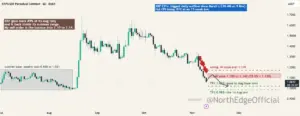
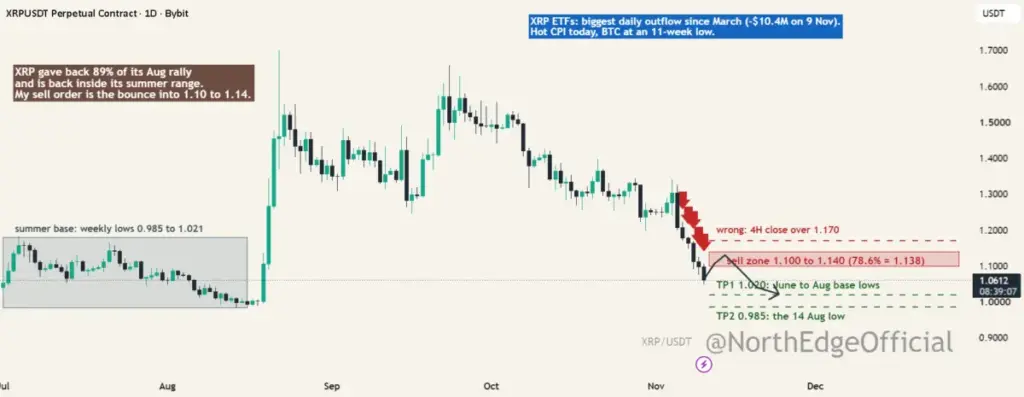
The current market distress follows a failed summer rally that saw XRP climb from a local low of $0.985 on August 14 up to a peak of $1.70 on August 22. In the weeks since that high, the asset has surrendered an astounding 89% of those gains, effectively erasing the summer breakout and driving the token back inside its previous consolidation range established between June and August. During that prior base-building period, weekly lows were established at 1.008, 1.021, 1.012, and 0.985, defining the critical support zones that are once again coming into focus as the market tests lower boundaries.
Moving average metrics further underscore the extent of the bearish reversal. XRP is currently trading significantly below its key weekly moving averages, sitting 15% under the 20-week average at 1.254, 25% under the 50-week average at 1.411, and 17% below the 200-week average at 1.286. Furthermore, the daily chart reveals relentless selling pressure, with every single daily close since November 5 settling below the crucial 200-day moving average, which currently stands at 1.265.
Short-term momentum indicators are similarly bleak. A previously established base formed on November 8 between 1.15 and 1.17 was decisively breached in a single four-hour candle, signaling a rapid collapse of support. Compounding this weakness, the market has printed six consecutive daily highs, each lower than the one preceding it, illustrating a clear pattern of declining buyer enthusiasm. Intraday price action has also shown consistent rejection at lower levels; across multiple four-hour candles since midnight on November 9, price action repeatedly wicked into the 1.100 to 1.126 range, yet failed to register a single closing print above 1.114. Notably, this zone coincides with the 78.6% Fibonacci retracement level of the entire August rally, calculated at 1.138, turning a former support area into a formidable overhead barrier.
Market Positioning and Risk Assessment
Navigating the current market environment requires strict risk management parameters as traders evaluate potential entry points and structural invalidation levels. Market participants are closely monitoring a specific technical setup where a four-hour candle wicks into the 1.100 to 1.140 zone before closing back underneath the 1.100 threshold. Under this scenario, potential downside targets are eyed near 1.020 and the deeper August low of 0.985. Conversely, the structural invalidation point—the level where the bearish thesis is rendered wrong—is marked by any four-hour candle closing decisively above 1.170. Additionally, traders are exercising caution with a strict contingency rule: the setup is to be entirely bypassed if a four-hour candle closes beneath 1.0475 first, as that would signify an unhedged acceleration of the downward trend before any relief bounce can materialize.
Risk-reward calculations for this configuration suggest a stop-loss placement of approximately 4.5%, with initial profit targets (TP1) set at roughly 9% and secondary targets (TP2) reaching near 12% from an entry baseline of 1.12. However, independent assessments of market probabilities highlight the complexity of the current landscape. Market analysts assign roughly a 45% probability that any attempted relief bounce will fail within the identified resistance zone, while estimating a 35% chance that XRP slides directly below 1.0475 without staging any notable bounce, thereby invalidating the trade setup altogether. There remains an estimated 20% likelihood that the asset reverses course entirely and registers a four-hour close above the 1.170 invalidation threshold.
Squeeze risks across the broader digital asset ecosystem remain elevated, complicating the near-term outlook. Market commentary on X highlights approximately $10 billion worth of Bitcoin short positions stacked near the $83,000 region, creating potential volatility catalysts that could spill over into altcoins. Concurrently, data compiled by Darkfost indicates that XRP futures funding rates have climbed to a one-year high, pointing to heavily leveraged positioning that could exacerbate sharp price swings in either direction. With the current technical recovery zone sitting roughly 3% to 7% above prevailing market prices, there remains a distinct possibility that the liquidity zone may never be filled. If XRP fails to generate the anticipated bounce, market participants are prepared to remain on the sidelines rather than force exposure in an uncertain environment.
Disclaimer
The information and publications contained herein are provided for informational purposes only and are not meant to be, and do not constitute, financial, investment, trading, or other types of advice or recommendations supplied or endorsed by TradingView. Market participants should conduct their own thorough research and risk assessment before engaging in any financial transactions or trading activities.
 Crypto Investing & Trading
 Crypto Investing & Trading
 Crypto Investing & Trading