Variational has officially opened its doors to the general public, removing the invite-only barrier that defined its early months and thrusting one of the most contrarian structural models in onchain trading into the open market.
This week, the project team announced that the private beta for Omni, its flagship trading application, had concluded. Moving forward, users seeking to sign up no longer require a referral code. When the platform was first highlighted climbing DefiLlama’s perpetual swaps leaderboard, the application remained strictly invite-only, making those early growth figures notably impressive given the gated access. Now that the gate has been lifted, market participants and analysts alike can fully scrutinize the underlying model itself: a trading architecture where a single dealer takes the opposing side of every single trade executed on the platform.
Backers of the protocol argue that this configuration represents the proper blueprint for building an efficient onchain brokerage. Conversely, critics contend that a single-counterparty setup stretches the definition of a decentralized exchange. To understand the current landscape, it is essential to examine how the platform has evolved since its private beta days, the mechanics driving its broker-like approach, and the ongoing debates surrounding its unique market structure.
What Has Changed Since the Private Beta
A brief refresher on the mechanics reveals that Omni operates entirely on a request-for-quote model. Instead of relying on a public order book where anonymous buyers and sellers are matched algorithmically, users request a specific price, and a designated market maker answers. That market maker is perpetually the Omni Liquidity Provider, a dedicated vault seeded directly by the Variational development team that quotes every trade and subsequently hedges its resulting exposure across other external trading venues.
The fee structure diverges from traditional crypto exchanges as well. There are currently no explicit trading fees levied on users. Instead, traders pay the spread, which represents the natural gap between the buy and the sell price. The protocol currently retains twenty percent of whatever revenue the liquidity provider collects through these spreads.
Since the early phases of the private beta, platform volume has roughly doubled. DefiLlama data indicates that cumulative volume figures have surged significantly, placing the venue near the top tier of perpetual swap platforms alongside established heavyweights like Hyperliquid and Lighter.
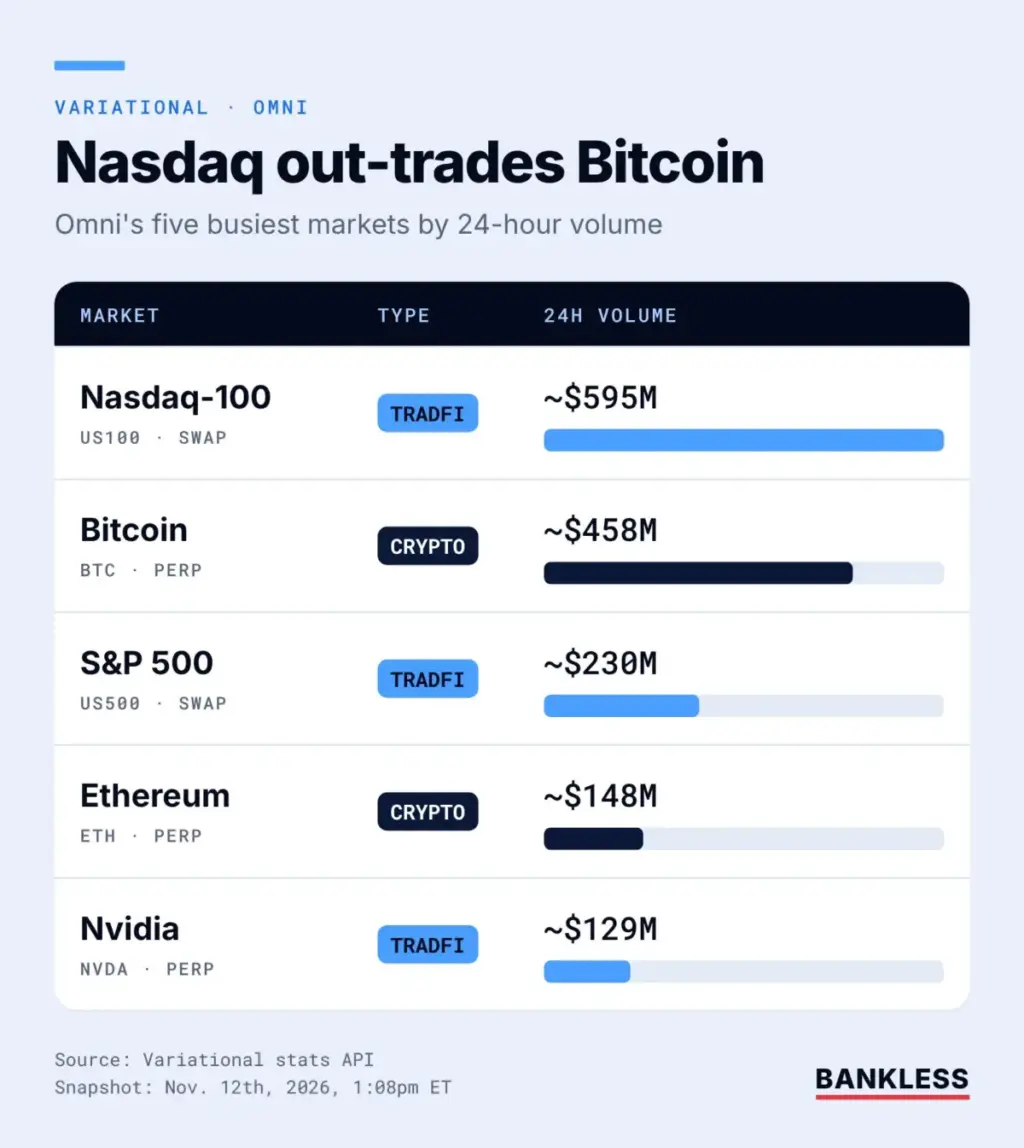
Notably, a substantial majority of that transactional activity is no longer confined to native crypto assets. Swaps, which comprise Omni’s dealer-sourced traditional finance markets covering assets such as gold, oil, and major stock indices, have captured a dominant share of the platform’s volume. Cumulative swaps volume has crossed major milestones, with traditional finance markets now accounting for over sixty percent of all volume passing through the Omni application.
Concurrently, the outlook surrounding the protocol’s upcoming native token, $VAR, has become clearer. Tokenomics disclosures released by the team earmarked a significant portion of total supply for a Genesis airdrop directed toward early points holders, scheduled the token generation event for late 2026, and stated an intention to utilize one hundred percent of treasury revenue to buy back and burn $VAR tokens. The points program, which was initially projected to conclude earlier, was extended to accommodate the updated roadmap.

The Broker Bet and TradFi Integration
Speaking about the foundational philosophy of the project, CEO Lucas Schuermann described Omni as operating on a broker-like model rather than functioning as a traditional exchange. Consequently, the comparisons the team frequently draws point toward traditional financial brokerages like Robinhood and Interactive Brokers rather than decentralized perp exchanges like Hyperliquid.
The rationale behind adopting a broker structure stems from the preferences of traditional finance dealers. Major market makers generally prefer to know the identity or credit profile of the counterparty they are transacting with before committing to a firm price quote. An anonymous, permissionless order book cannot natively satisfy that requirement, but a single dealer operating under established legal and operational agreements can. Thus, the Omni Liquidity Provider sits squarely in the middle, facing institutional dealers on one side and retail or professional traders on the other.
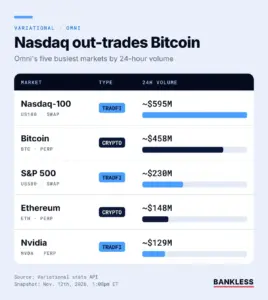
Traders have demonstrated a strong appetite for this configuration, particularly regarding cross-asset trading. Activity tracking traditional financial instruments, such as U.S. stock indices, frequently rivals or surpasses major cryptocurrencies like Bitcoin in daily volume.
The cost side of the equation has also faced scrutiny and held up under analysis. External research estimates that the platform’s average spreads translate to a very competitive basis-point cost relative to average perpetual swap fees found on rival decentralized exchanges. This suggests that the zero-fee marketing approach is not masking inflated execution costs.

Furthermore, data regarding funding rates—the recurring payments required to maintain leveraged positions—has highlighted a structural divergence during periods of market stress. During recent sharp pullbacks in traditional equity markets, perpetual funding rates on standard crypto venues spiked dramatically, while funding rates on Variational’s equity swaps remained notably stable. If this spread differential persists over time, it provides a structural advantage for market participants holding traditional asset exposure across multiple sessions.
The Single-Dealer Debate
Despite the impressive growth metrics, the platform’s architecture has sparked intense debate across the broader crypto community. Critics have challenged the nomenclature of the protocol, arguing that a system relying on a single counterparty to quote every market diverges from the ethos of decentralized exchanges. Traditional finance request-for-quote systems typically feature numerous competing dealers vying for order flow, whereas Omni relies on a unified liquidity provider.
In response, project leadership has emphasized that posting collateral transparently onchain provides a high degree of verifiability, and that the platform must ultimately win over users within a competitive free market characterized by numerous alternative trading venues.
From a technical perspective, user deposits do not reside directly within the operational control of the dealer. Each user interacts with an isolated onchain settlement pool holding solely their specific collateral, while the liquidity provider manages its hedging activities externally with its own dedicated capital. Leadership has noted that during external exchange security incidents, only a fraction of liquidity provider funds were exposed to third-party venues, ensuring that user margin remained insulated.

Nevertheless, critics point out potential tail risks documented within the protocol’s technical literature. In a theoretical scenario where the liquidity provider experienced severe insolvency, subsequent profits accrued by users could be classified as unpayable bad debt. Additionally, the exact composition of the liquidity provider’s hedging book remains opaque to external auditors.
A more frequent criticism centers on price discovery and execution quality. Relying on a single quoting entity eliminates direct peer-to-peer competition at the order level, leaving user protection primarily dependent on the ability to migrate funds elsewhere if spreads widen. While spreads have remained competitive during calm and volatile periods alike, the trust assumptions differ fundamentally from traditional order book decentralization. Leadership has acknowledged these distinct models, indicating that future institutional iterations of the platform may incorporate multi-dealer frameworks.
Road to the Token Generation Event
The transition of the application to a public mainnet environment serves as a critical milestone on the path toward the token generation event. The protocol’s roadmap outlined the public mainnet release, the expansion of additional swap markets, the deployment of professional trading APIs, and comprehensive disclosures regarding token utility and buyback mechanics.
With the public mainnet launch now complete, attention shifts toward the remaining infrastructure deliverables and the official token debut. Prediction markets and community sentiment trackers reflect realistic expectations regarding the exact timeline, keeping market participants closely attuned to upcoming platform updates, API expansions, and potential strategic partnerships as Variational navigates its next phase of growth.
 Tokenomics & Digital Assets
 Tokenomics & Digital Assets
 Tokenomics & Digital Assets