
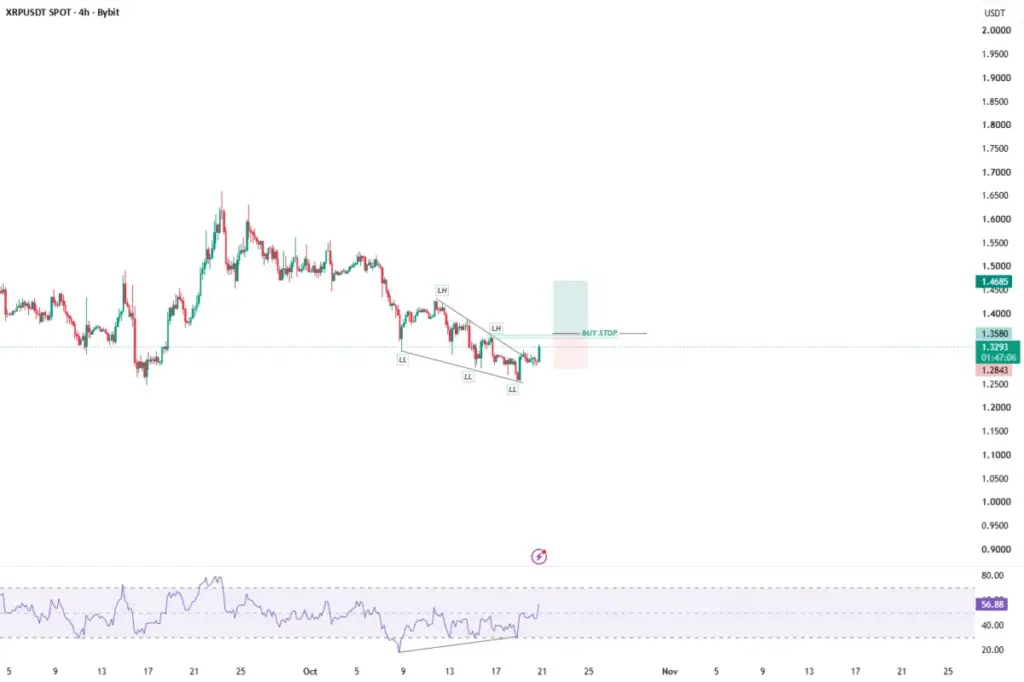
Cryptocurrency market participants are closely monitoring XRP as technical analysts highlight a developing bullish falling wedge pattern on the four-hour (H4) timeframe. The popular digital asset, traded against Tether as the XRPUSDT pair, has displayed price action characteristics that frequently precede trend reversals in technical analysis methodology. Market observers note that while broader macroeconomic and crypto-specific factors continue to influence market sentiment, chart-based formations are increasingly drawing the attention of short-term traders seeking localized opportunities.
The core of the current technical assessment centers on the four-hour chart, where XRP has been tracing a converging price channel defined by lower highs and lower lows over recent sessions. This particular configuration, widely recognized by chart technicians as a falling wedge, is traditionally interpreted as a bullish continuation or reversal pattern. As the price compresses between the downward-sloping trendlines, the range of movement narrows, signaling a gradual exhaustion of selling pressure among market participants.
Adding weight to the technical observation is a developing bullish relative strength index (RSI) divergence on the same four-hour timeframe. While price action has occasionally probed lower levels or moved sideways within the wedge boundaries, the RSI indicator has formed higher lows. Technical analysts interpret this divergence as a clear signal of weakening bearish momentum, suggesting that sellers are losing the conviction that drove the preceding downward leg. Such momentum shifts are frequently monitored by traders looking for early indications of an impending shift in market direction.
To capitalize on the potential reversal, market participants following this technical setup are eyeing a specific trade trigger rather than entering positions prematurely. According to the analysis, the designated trade trigger requires a buy stop order placed above the most recent lower high, which serves as the immediate neckline of the pattern. Entering the market upon a confirmed break above this structural barrier is a common strategy designed to filter out false breakouts and ensure that upward momentum has genuinely resumed before capital is committed.
The operational parameters outlining the trade setup provide specific price levels for execution and risk management. The proposed buy stop order is marked at 1.3580, establishing the entry point once the price successfully breaches the neckline resistance. To secure potential profits upon the realization of the pattern’s projected target, the take profit level is designated at 1.4685. Meanwhile, risk management protocols are addressed through a stop loss order positioned at 1.2843, designed to mitigate downside exposure should the pattern fail and prices break downward out of the wedge formation.
Based on these predetermined entry, target, and exit thresholds, the resulting risk-to-reward ratio for the trade setup calculates to approximately 1:1.49. This metric indicates that the potential reward for a successful trade outweighs the defined risk by roughly one and a half times, a proportion frequently evaluated by active traders when assessing the viability of chart-based strategies.
As with any technical analysis discussion within the digital asset ecosystem, market observers emphasize the importance of independent evaluation and risk management. The insights regarding the XRPUSDT H4 falling wedge serve strictly as a technical analysis concept intended for educational purposes.
Disclaimer: The information and publications provided in connection with this technical analysis are not meant to be, and do not constitute, financial, investment, trading, or other types of advice or recommendations supplied or endorsed by TradingView or related market platforms. Traders and investors are encouraged to read further details regarding terms of use and policies concerning investment decisions and trading risks before engaging in market activities.
 Crypto Investing & Trading
 Crypto Investing & Trading
 Crypto Investing & Trading







