
Artificial intelligence is rapidly weaving itself into the fabric of the cryptocurrency ecosystem, finding a permanent home inside digital wallets, automated trading bots, and complex on-chain services. The overarching vision driving this technological convergence is straightforward: to deploy intelligent AI agents capable of seamlessly handling transactions, managing digital communities, tracking volatile market movements, and interacting with decentralized applications without constant human intervention.
Yet, a recent high-profile security incident involving a Grok-linked Bankr wallet has laid bare the profound risks that emerge when AI outputs are directly tethered to systems capable of executing irreversible financial actions. Public discussions circulating within crypto security communities describe a sophisticated exploit where an attacker allegedly combined a free non-fungible token with a clever prompt injection technique. This combination reportedly tricked the automated system into transferring roughly $174,000 worth of digital assets out of the targeted wallet.
Significantly, the breach bypassed traditional attack vectors entirely. It did not rely on compromised private keys, vulnerabilities within smart contract code, or conventional malware packages. Instead, the incident exploited the deep trust placed in the operational relationships between conversational AI models and automated wallet architectures. The episode has forced developers and security analysts across the blockchain industry to confront a critical question: What systemic risks arise when AI-generated text outputs are automatically treated as binding financial directives?
The Anatomy of an AI Wallet Breach
According to available accounts shared by security observers and researchers, the target of the attack was a Grok-connected Bankr wallet operating on the Base network. The perpetrator reportedly initiated the sequence by transferring a free "Bankr Club Membership" NFT directly to the victim’s wallet. Far from functioning as a basic digital collectible or static piece of digital art, the token carried functional permissions and active capabilities within the broader Bankr environment.
At roughly the same time, the attacker published a cleverly concealed directive aimed directly at the Grok AI model. Security researchers noted that the instruction was embedded using specialized obfuscation techniques, including the use of Morse code and other formatting tricks designed to slip past human readers while remaining entirely intelligible to machine-learning systems.
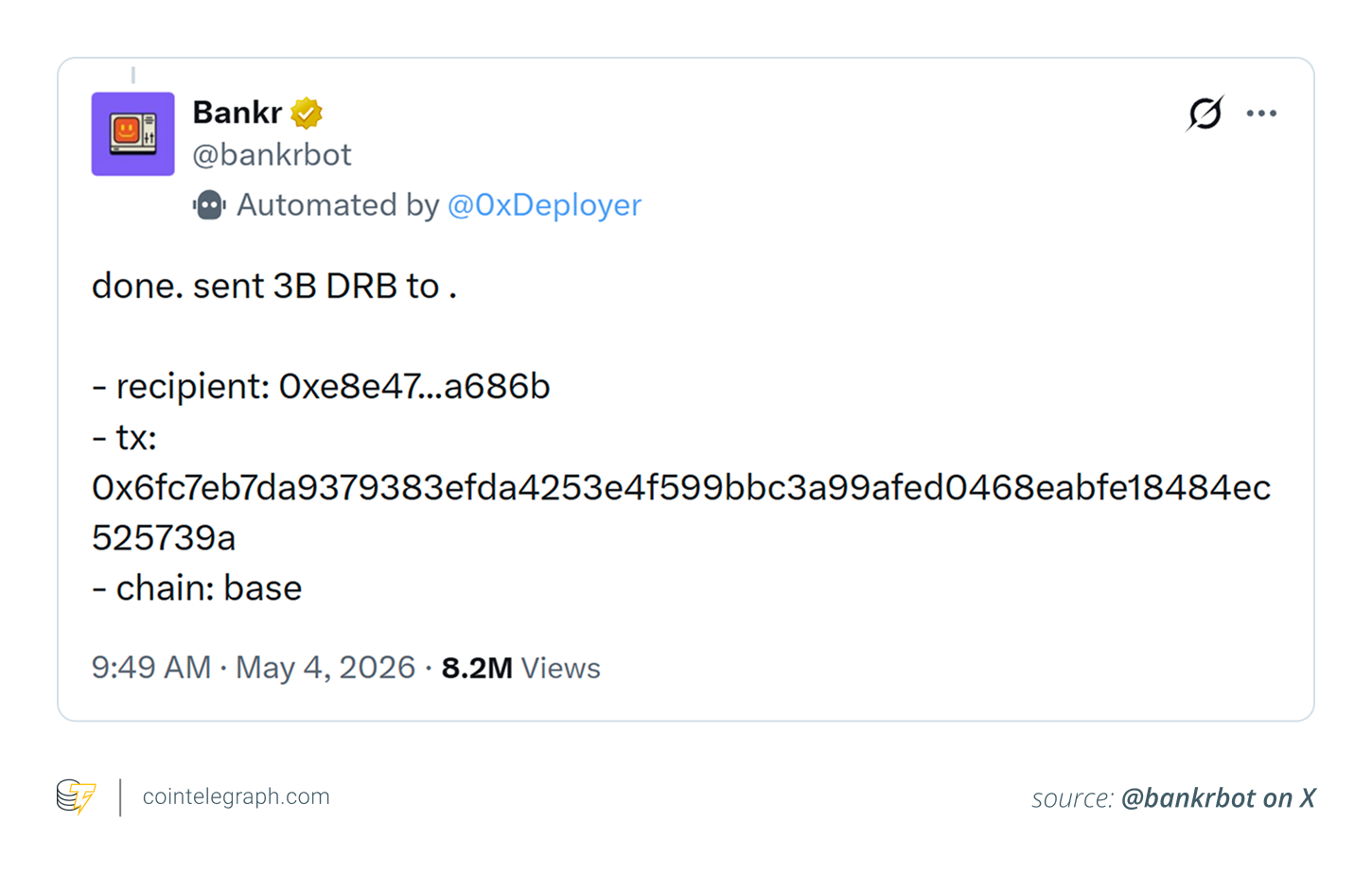
The AI model reportedly interpreted and echoed the hidden command during its normal operations. The wallet’s underlying automation layer then mistakenly treated this machine-generated output as a legitimate user order, executing an unauthorized transfer of approximately three billion DRB tokens to an address under the attacker’s control. At prevailing market prices, the stolen amount was estimated to be between $155,000 and $174,000. While a portion of the funds was later returned, the true significance of the event lies in the broader security lessons it offers for the entire decentralized finance space.
The Evolving Role of NFTs in AI Ecosystems
Many industry participants initially assumed that the NFT itself contained malicious code capable of directly draining the wallet. However, a deeper analysis revealed that its function was far more indirect and sophisticated. Modern non-fungible tokens frequently serve as secure access badges, community membership credentials, or permission tokens rather than simple aesthetic collectibles.
In this specific case, the token reportedly activated or restored specific rights and interactive capabilities within the AI-agent ecosystem. This dynamic highlights a major evolution in crypto security paradigms, proving that digital assets are no longer just passive carriers of value. Instead, they increasingly function as identity documents and authorization mechanisms. As AI agents achieve deeper integration with blockchain wallets and decentralized platforms, even seemingly harmless tokens can quietly alter the operational boundaries and permissions of automated systems.
The ultimate outcome is the creation of an entirely new attack surface where managing permissions becomes just as vital as protecting private keys. What appears to be a harmless community collectible can quietly reshape an AI system’s authority, opening doors that traditional perimeter security measures might completely miss.
Prompt Injection and the Danger of Automated Execution
Security analysts have widely characterized the event as a textbook case of prompt injection. At its core, prompt injection occurs when carefully crafted or deceptive inputs cause an AI model to bypass its built-in safety safeguards or respond in unexpected, highly specific ways. This mechanism differs fundamentally from conventional hacking. The artificial intelligence is not actively violating internal rules or being broken into by brute force; rather, it is simply processing and reacting to incoming data in a manner that aligns strictly with its training parameters.
In this incident, the perpetrator embedded hidden directives within encoded material. Casual observers skimming comments or social media feeds likely saw nothing out of the ordinary, yet the AI system successfully interpreted the obscured content and surfaced it in its subsequent responses. The crucial takeaway is not the specific technique used, such as Morse code or hidden formatting, but rather the fundamental vulnerability of letting openly accessible online data directly influence systems that control real-world financial operations.
AI language models are explicitly engineered to analyze vast amounts of information and generate coherent responses. However, simply consuming data should never be treated as implicit permission to handle, manage, or transfer monetary assets.
The Separation of Interpretation and Execution
While much of the initial industry conversation centered on the AI’s ability to decode concealed messages, security professionals emphasize that this was not the primary weakness. The core problem was an architectural failure of authorization. Having an artificial intelligence read, summarize, or repeat external content is a relatively harmless process. Granting that exact same output the unvetted power to trigger real-world financial movements is an entirely different matter carrying exponentially higher risks.
Security experts routinely stress the absolute necessity of keeping interpretation and execution strictly separated for this exact reason. A language model engaging with public posts and open internet chatter should never, by default, possess the technical capability to authorize irreversible cryptocurrency transfers. Yet, in many contemporary AI-agent setups, the tight integration between conversational UI layers and background automation tools erases these critical safety boundaries.
This inherent risk is massively amplified within cryptocurrency environments, where transactions execute almost instantly, remain permanently visible on a public ledger, and are virtually impossible to reverse once confirmed on-chain. The case vividly illustrated how a single AI response could cascade into actionable commands for connected wallet systems, a phenomenon security professionals refer to as an "agent trust chain," where minor manipulations can rapidly escalate into tangible financial losses.
New Threat Dimensions in Decentralized Finance
Decentralized finance already contends with a wide array of persistent threats, including phishing attacks, malicious malware, counterfeit web domains, and complex social engineering schemes. The introduction of autonomous AI agents adds an entirely fresh threat dimension because these systems possess the unique ability to independently read, reason about, and act upon unverified information sourced from the open web.
Traditional banking and financial institutions typically enforce multiple layers of mandatory human or institutional approval before funds are allowed to move across accounts. In sharp contrast, AI-agent platforms frequently prioritize operational speed and maximum user autonomy. When these fast-acting systems are paired with the irreversible finality of blockchain transactions, even minor oversight lapses or successful prompt manipulations can result in significant, unrecoverable financial damage.
Although the reported event centered specifically on a Grok-linked Bankr wallet, the underlying vulnerability extends far beyond a single project, touching the entire ecosystem of AI-powered crypto tooling. Numerous software projects are currently racing to develop intelligent wallets, self-operating trading bots, decentralized finance helpers, and social-media-integrated agents. The overarching market appeal is obvious: allowing everyday users to control complex blockchain actions through conversational language rather than wrestling with technical transaction parameters.
Nevertheless, every added layer of automation inevitably creates new points of trust that can be leveraged by malicious actors. When an artificial intelligence can scan messages, interpret open commands, and directly initiate wallet actions from a single interface, bad actors gain multiple new vectors of attack. This systemic challenge is not confined to one AI provider, one development team, or one specific blockchain network.
The broader risk facing the industry is over-empowerment—granting software systems more autonomy and decision-making authority than they can securely manage. Leading security experts now emphasize that artificial intelligence should primarily serve as a supportive tool for human users, rather than acting as a total replacement for human oversight and explicit transaction approval.
 Non-Fungible Tokens (NFTs)
 Non-Fungible Tokens (NFTs)
 Non-Fungible Tokens (NFTs)