
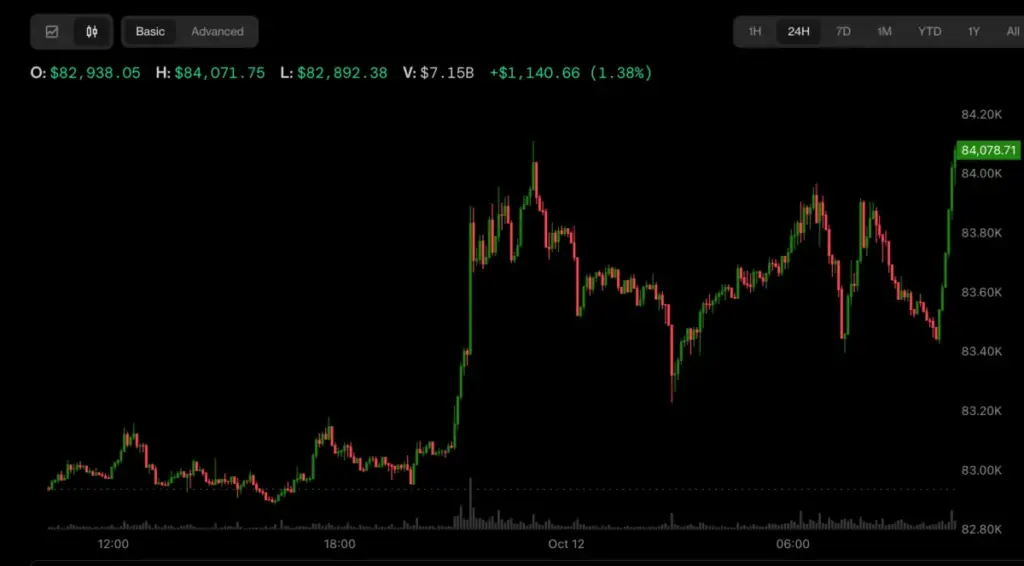
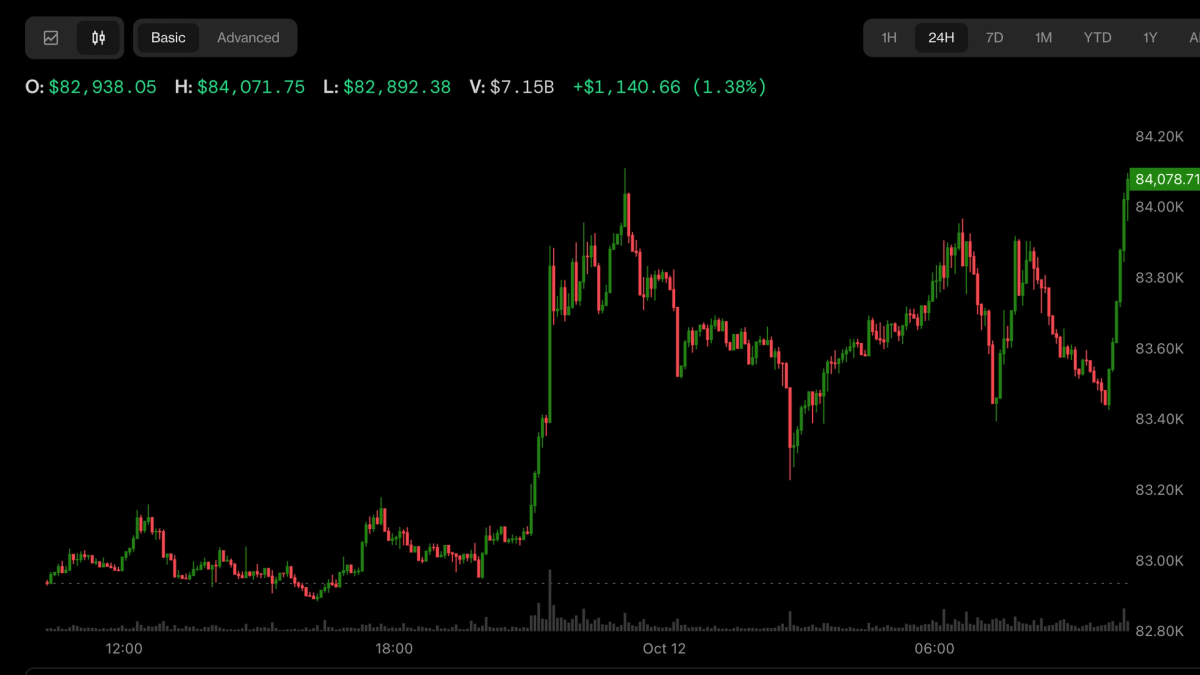
Bitcoin is holding firm on its weekend gains, trading back above the $84,000 threshold as the broader cryptocurrency market experiences a coordinated recovery. The leading digital asset by market capitalization has managed to shrug off significant institutional outflows from spot exchange-traded funds (ETFs) recorded last week, finding temporary relief as global oil prices move lower.
As of early Monday morning, Bitcoin was changing hands near $84,050, according to data from CoinDesk. The price action follows a modest dip to around $83,500 earlier in the day, remaining close to Sunday’s high of approximately $84,145. While Bitcoin continues to command the spotlight, the recent market momentum has not been isolated to the flagship cryptocurrency. Other major digital assets, including ether and XRP, experienced notable bids, alongside early indications of growing investor interest and capital rotation into alternative tokens across the wider asset class.
Industry observers note that the market’s positive price action has helped lift sentiment across a wide spectrum of digital assets following a turbulent stretch of macroeconomic and regulatory pressures.
"The recovery broadened across major virtual digital assets, with nine of the top ten advancing during the last 24 hours," said Purvang Mashru, lead analyst at BitDelta India, in an interview with CoinDesk. Highlighting the performance of various altcoins, Mashru pointed out that Avalanche led the charge among major tokens with a notable 5.1% jump to $10.91, while Chainlink posted a 2.4% gain to reach $13.35. Other prominent tokens also saw upward momentum, with Solana adding 1.2%, alongside positive movements for BNB, XRP, Dogecoin, and Cardano.
This resilient bounce in the crypto sphere coincided with a softer start to the week for traditional energy markets. West Texas Intermediate (WTI) crude futures fell 1.8% to $90.28 per barrel, effectively reversing a sharp price spike seen on Thursday that had injected fresh volatility and geopolitical uncertainty into global financial markets.
The recent downward pressure on fuel prices follows a significant policy announcement made by President Donald Trump on Friday. According to the administration, an agreement has been reached for Russia to supply 300,000 metric tons of diesel fuel to both international and domestic markets. This development represents a partial easing of longstanding U.S. sanctions on Russian oil imports, a move that immediately influenced commodity trading desks and brought a measure of calm to supply-constrained energy sectors.
However, the geopolitical backdrop remains fraught with complexity. Alongside the diesel supply announcement, Trump asserted that Russia and Ukraine had reached an immediate "energy ceasefire" designed to halt strikes on critical infrastructure. Despite these claims, Ukrainian officials quickly clarified that they had not been consulted on any such agreement, and reports indicated that Russian military strikes on Ukraine’s energy grid have continued unabated. The divergence between diplomatic assertions and ground realities leaves market participants hyper-aware of how quickly geopolitical headlines can shift macroeconomic sentiment.
Even with Bitcoin’s ability to defend its price levels above $84,000, market analysts remain cautious, pointing to persistent institutional headwinds and fragile capital flows into spot crypto products.
Last week, U.S.-listed spot Bitcoin exchange-traded funds registered a staggering outflow of $681 million, marking the largest weekly withdrawal since June, according to data compiled by SoSoValue. The vast majority of these capital withdrawals took place during a mid-week window on Wednesday and Thursday, reflecting underlying anxiety among traditional institutional investors.
"ETF flows remain volatile. US spot Bitcoin ETFs saw heavy outflows on October 7 and 8, signaling cautious institutional sentiment," Vikram Subburaj, CEO of India-based Giottus Exchange, explained to CoinDesk.
Echoing these concerns, Mashru also drew attention to the heavy ETF outflows while emphasizing that the broader macroeconomic environment continues to present a demanding backdrop for risk-on assets. Specifically, Mashru pointed to fixed-income markets, noting that Treasury yields reached dramatic 24-year highs during the week ending October 9, creating stiff competition for capital.
Looking ahead, market participants across the digital asset ecosystem are closely monitoring crucial technical and fundamental levels. Both Subburaj and Mashru highlighted the $82,000 price mark as a vital support level that market bulls must aggressively defend to prevent deeper retracements and a potential shift in medium-term market structure.
In addition to technical support levels, traders and analysts are turning their attention to upcoming macroeconomic data releases. The release of the U.S. inflation figures on October 14 is widely regarded by market watchers as the next major catalyst capable of steering both traditional and digital asset markets in the near term.
 Global Crypto Markets
 Global Crypto Markets
 Global Crypto Markets







