
As the cryptocurrency market navigates a shifting macroeconomic and operational landscape, the latest data paints a challenging picture for Bitcoin miners. For the week ending November 2, 2026, the intersection of declining spot prices, a recent upward difficulty adjustment, and contracting hashprice metrics has put pressure on industry participants. Despite slight improvements in transaction fee yields, the broader mining sector experienced a contraction across hash rate capacities, profitability indices, and publicly traded mining equities.
Bitcoin Market Performance and Price Action
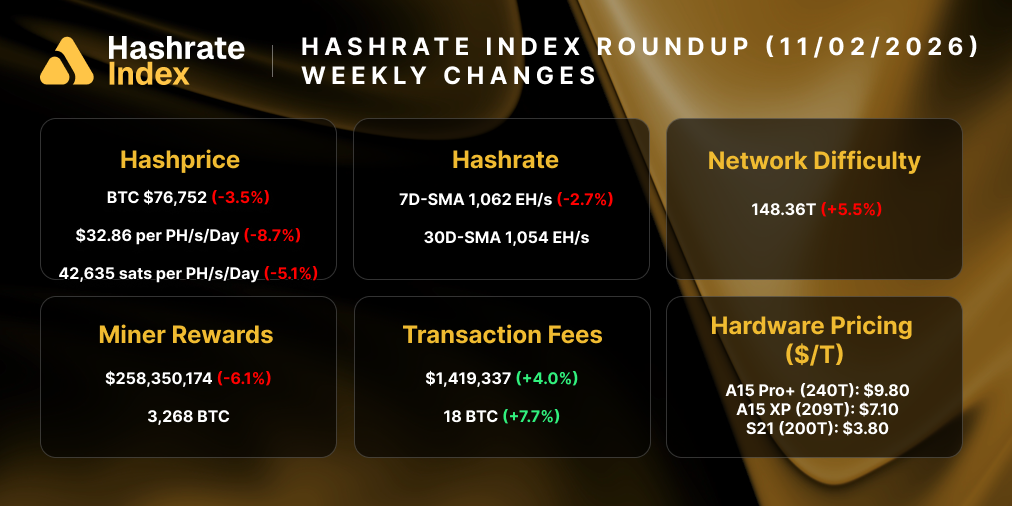
The broader macroeconomic environment weighed on the leading cryptocurrency over the past seven days. Bitcoin spot prices dropped by approximately 3.5%, moving from a week-opening level of roughly $79,510 down to $76,752. This downward movement contributes to a year-to-date performance metric of -12.2%.
On a 24-hour comparative basis, spot prices hovered near $77,424 before slipping further toward the close of the week. Meanwhile, Chicago Mercantile Exchange (CME) futures contracts for upcoming months presented a slight contango structure relative to immediate spot valuations. November CME futures registered at $77,180, marking a modest 0.6% increase over spot, while December and January contracts traded at $77,430 and $77,690, respectively. Despite these minor futures premiums, the immediate spot depreciation set a cautious tone for mining revenue streams throughout the network.
Hashprice and Operational Revenue Compression
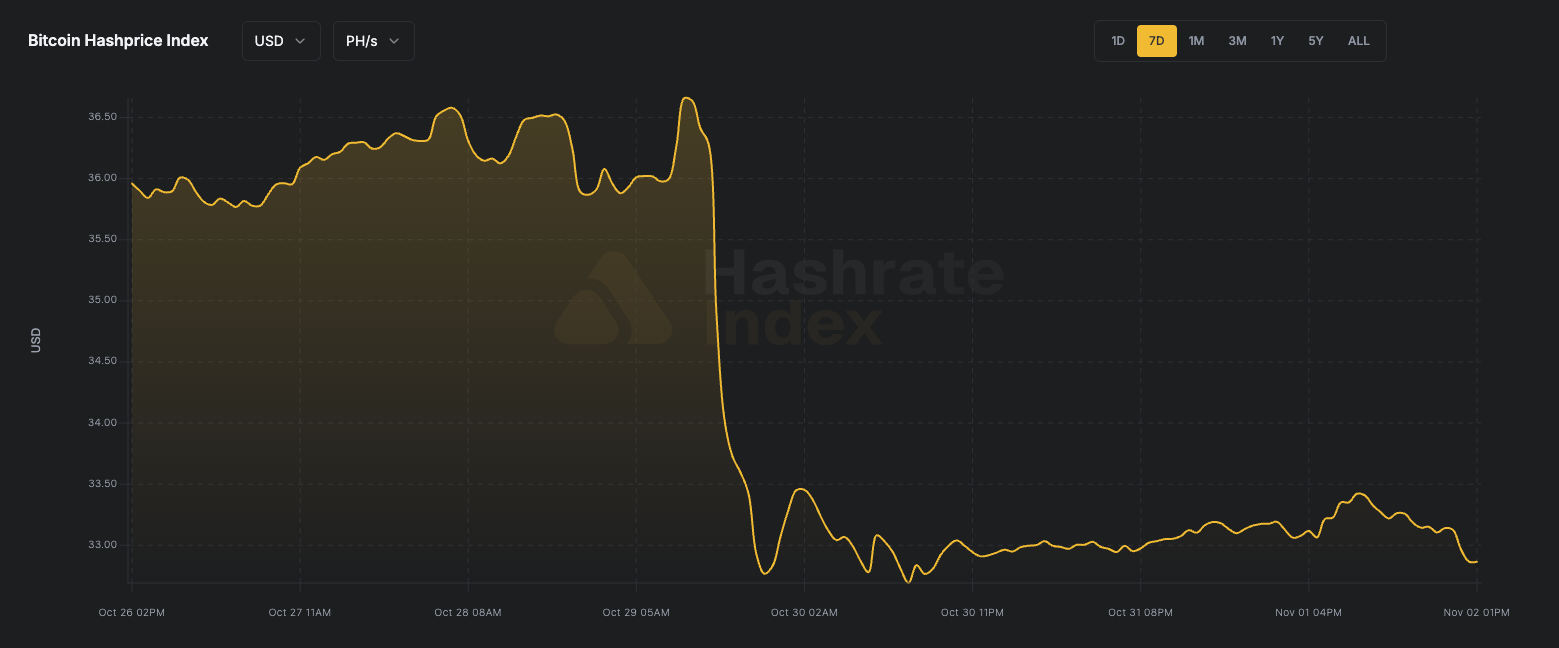
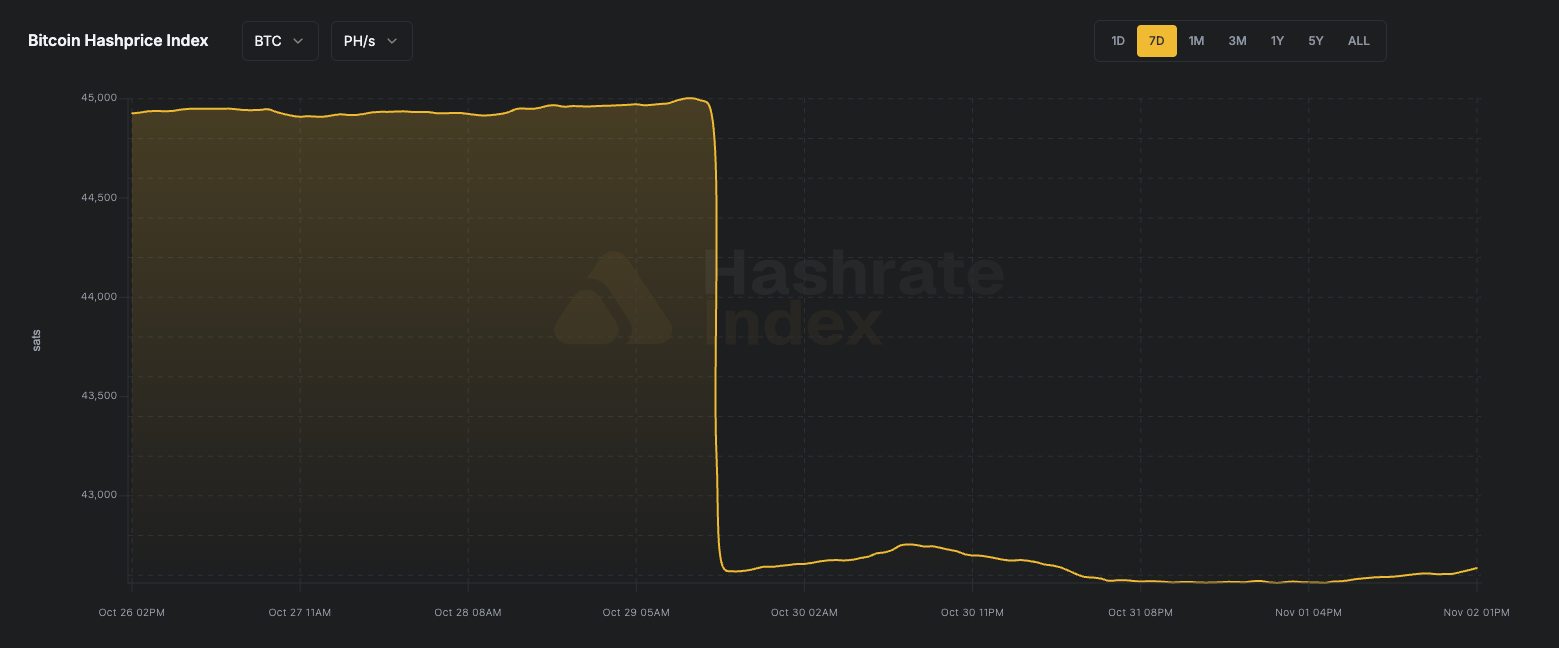
Mining profitability, commonly measured via hashprice, faced considerable headwinds over the week. USD hashprice—which calculates the daily expected revenue generated by a specific unit of computing power—dropped by 8.7%, falling from $35.99 per petahash per second per day (PH/s/Day) down to $32.86 per PH/s/Day. Over a broader 30-day window, average hashprice has retreated by 12.4%, settling at a monthly average of $37.49 per PH/s/Day.
Measured in native currency terms, the BTC hashprice experienced a parallel contraction. It declined by 5.1% over the week, moving from 0.00044922 BTC per PH/s/Day to 0.00042635 BTC per PH/s/Day.
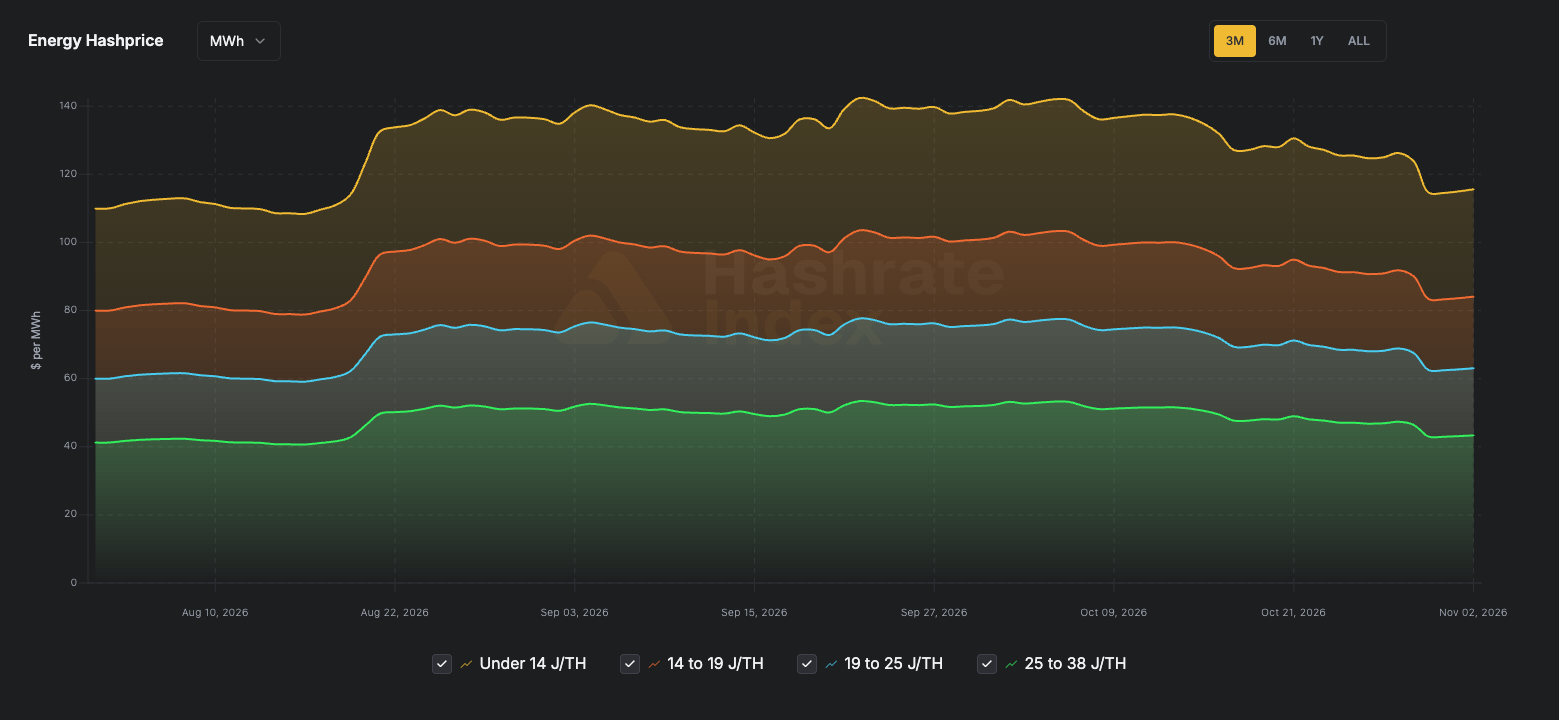
Altogether, miners collected approximately 3,268 BTC in block rewards over the course of the week, translating to roughly $258 million at prevailing market rates. When evaluated against fleetwide efficiency metrics, these figures indicate that operations utilizing older hardware generations are operating near or below breakeven thresholds, underscoring the ongoing industry reliance on hardware optimization and firmware upgrades to maintain positive operating margins.
Network Hashrate and Difficulty Adjustments
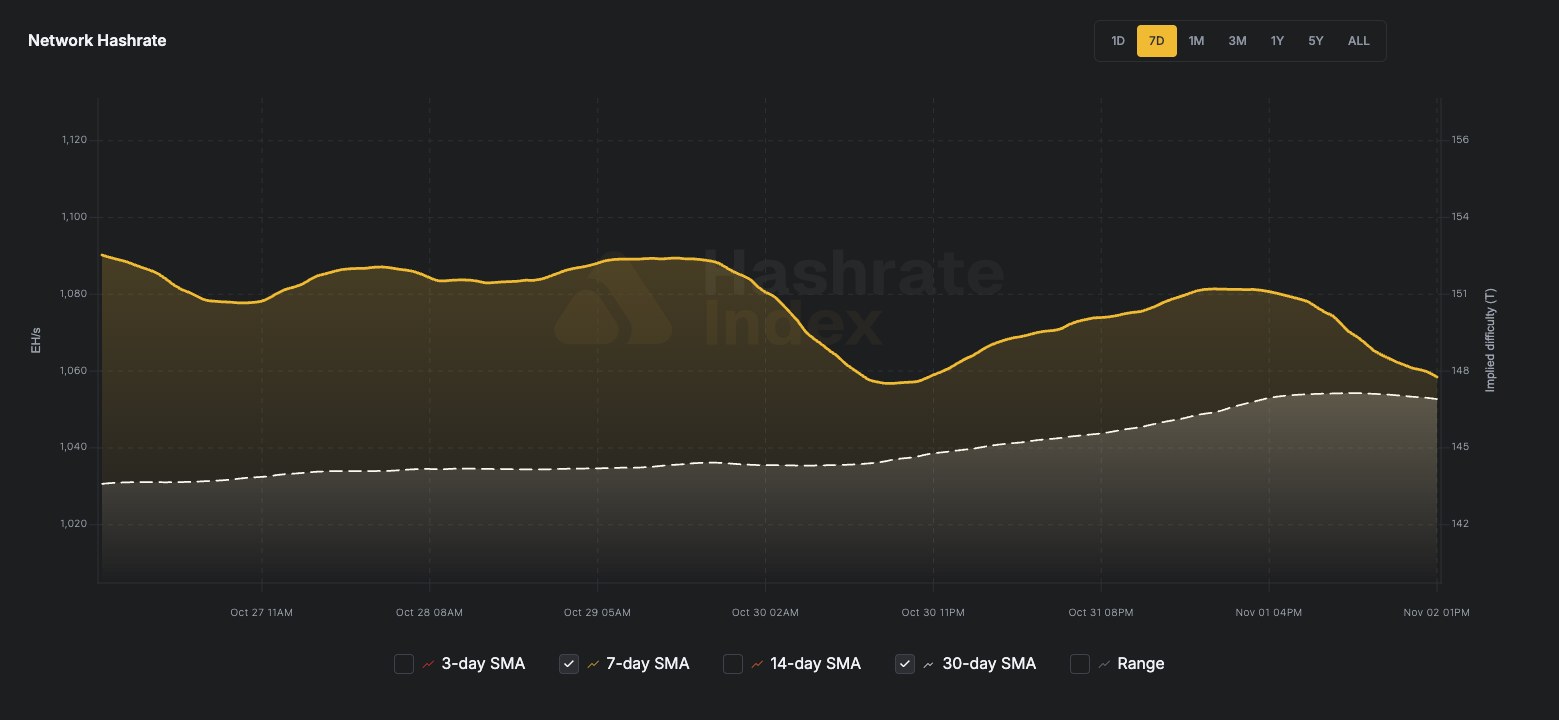
Network security and computational competition remained robust despite the compression in top-line revenues. The Bitcoin network’s 7-day simple moving average (SMA) for hashrate registered a minor decrease of 2.7%, shifting from 1,091 exahashes per second (EH/s) to 1,062 EH/s. The 30-day SMA remained steady at approximately 1,054 EH/s, indicating that wholesale fleet shutdowns have been minimal despite tighter margins.
This sustained computational power contributed to the network’s automated difficulty adjustments. The most recent adjustment, which took place on October 29, 2026, pushed network difficulty upward by 5.5% to reach 148.36T. Average block times over the final 24 hours of the week hovered slightly above the target at 10 minutes and 17 seconds.
Looking ahead to the next adjustment cycle projected for mid-November, early estimates suggest a potential difficulty correction of -2.8%. Analysts note, however, that early-epoch projections are subject to high short-term variance and will stabilize as more blocks are processed and network noise fades.
Transaction Fees and Revenue Composition
Transaction fees provided a small bright spot for miners, though they continue to represent a minor fraction of overall block rewards. Over the past week, miners collected an average of 0.0183 BTC per block per day in transaction fees, marking a 17.4% increase compared to the previous week’s average of 0.0156 BTC.
Over a broader 14-day and 30-day timeline, average transaction fees stabilized around 0.0170 BTC, reflecting an 8.0% gain over those periods. In total, transaction fees generated across the entire week amounted to approximately 18 BTC, or roughly $1.42 million. This accounted for approximately 0.55% of total block rewards, demonstrating that block subsidies continue to drive the overwhelming majority of miner income.
Forward Market Outlook and Derivatives
In the market for mining derivatives, participants looking to hedge future revenue streams faced similar pricing pressures. The Hashrate Forward Market priced in an average expected hashprice of $33.04, or approximately 0.00043 BTC, over the subsequent six-month horizon spanning November 2026 through April 2027. This forward curve suggests that market participants anticipate relative stability around current profitability levels rather than sharp near-term recoveries or dramatic collapses.
Public Bitcoin Mining Equities Retract
Publicly traded Bitcoin mining stocks mirrored the broader weakness in spot prices and hashprice metrics. Out of 18 tracked mining equities, 17 closed the week in negative territory, registering a median week-over-week change of -11.0%.
Selling pressure was widespread across major market capitalizations. Among the notable declines, Bitdeer (BTDR) led the downside with a 15.1% drop, bringing its market capitalization to $1.66 billion. Other prominent operators faced similar pullbacks, including Cipher Mining (CIFR) down 13.6%, Iris Energy (IREN) down 13.1%, and Core Scientific (CORZ) falling 7.5% with a market capitalization of $4.02 billion. Larger sector components such as Marathon Digital (MARA) and Riot Platforms (RIOT) saw more moderate contractions of 5.7% and 7.2%, respectively.
Conversely, Soluna Holdings (SLNH) managed to defy the broader sector trend, posting an 11.5% gain for the week and trading with a market capitalization of $0.19 billion. Data for one listed entity, Any, was unavailable at the time of reporting.
As the industry moves through the middle of the fourth quarter, mining operators will continue balancing efficiency upgrades and energy cost management against a backdrop of tight hashprice margins and fluctuating difficulty levels.
 Cryptocurrency Mining
 Cryptocurrency Mining
 Cryptocurrency Mining