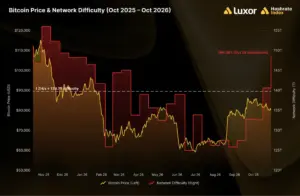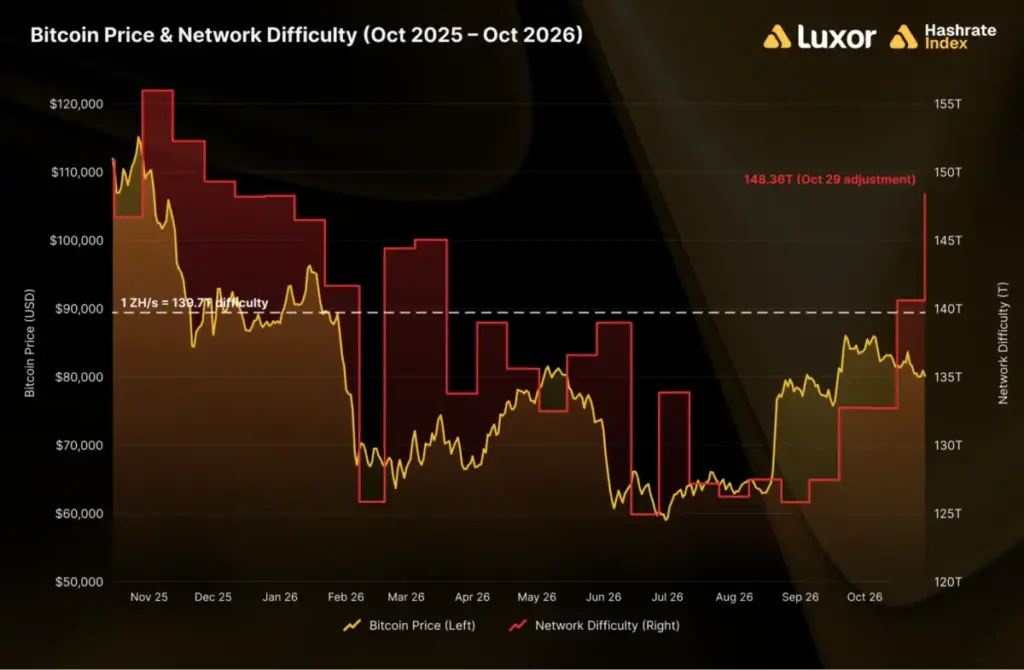
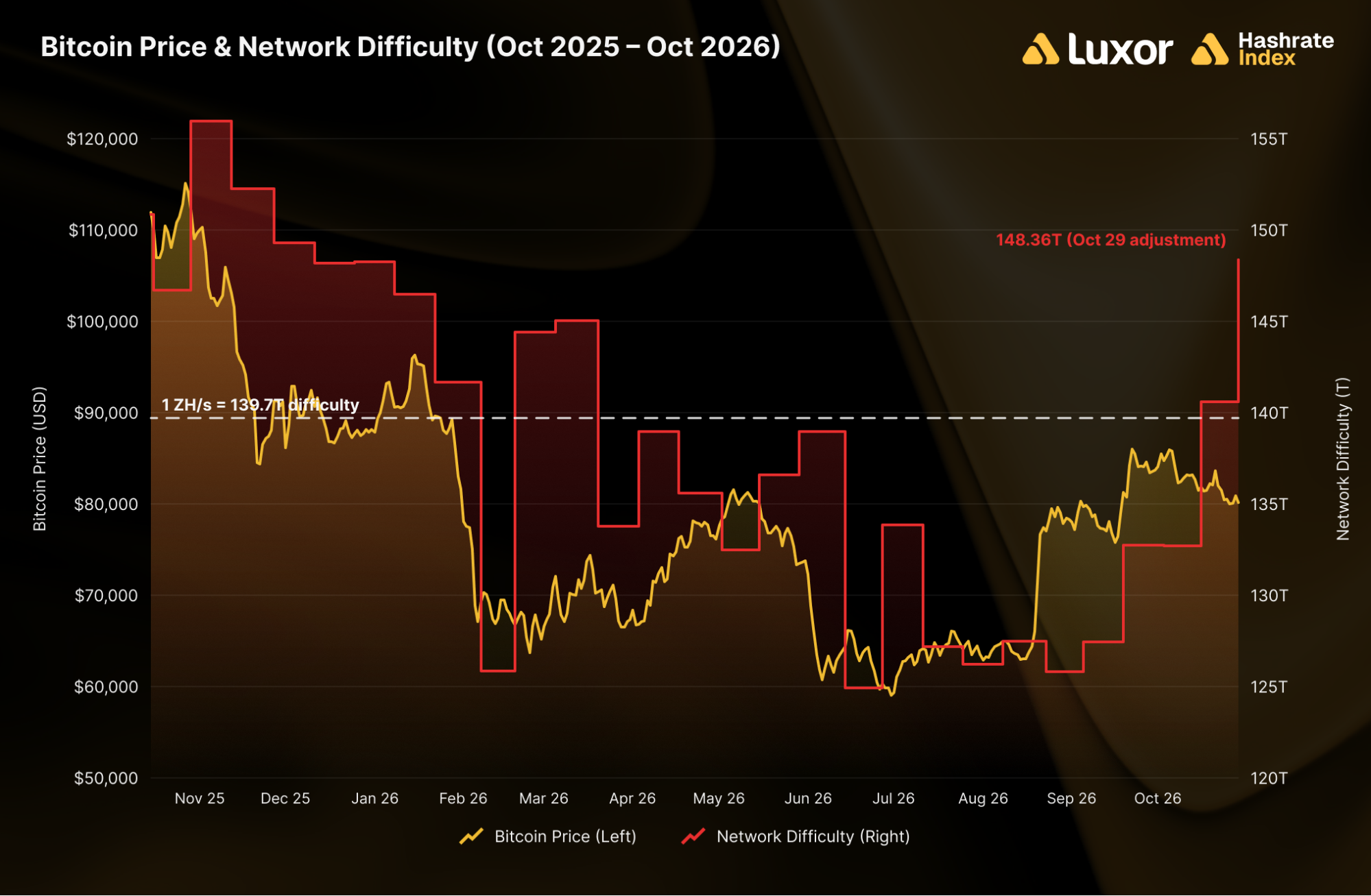
The Bitcoin network has officially crossed back above a major computational milestone. Following a difficulty adjustment at block 971,712 on October 16, network difficulty climbed 5.92% to reach 140.58T. This pushed the metric past the 139.70T threshold, a level that corresponds directly to a network hashrate of 1 Zetta-hash per second (1 ZH/s).
This pivotal upward adjustment snapped a prolonged streak of fifteen consecutive difficulty adjustments that had remained below the 1 ZH/s threshold, a dry spell stretching all the way back to March 20. The momentum continued shortly after with another upward adjustment on October 29, which added an additional 5.54% and brought total network difficulty to 148.36T.
The recovery marks a notable chapter in the ongoing maturation of the Bitcoin mining sector, reflecting changing operational dynamics across global fleets, seasonal power curtailment patterns in key markets like Texas, and shifting sentiment within Bitcoin’s derivatives and hashrate forward markets.

The Drawdown From the October 2025 Peak
To fully understand the significance of the network’s return above 1 ZH/s, analysts must look back at the dramatic market cycle that preceded it. Network hashrate previously touched a historic peak of 1,156 EH/s on a 7-day average basis on October 18, 2025. Network difficulty followed close behind, climbing to a record-shattering 155.97T just eleven days later.
At that exact juncture, Bitcoin was trading just two weeks shy of its all-time high of $124,485, and hashprice—the expected value of 1 Terahash of hashing power per day—hovered at a lucrative $46 per PH/s/day. However, the subsequent twelve months brought a steady unwind of those record highs.
Three primary forces stacked up to drive the prolonged drawdown. Market prices pulled back from their late-2025 zeniths, squeezing the profit margins of marginal operators. Simultaneously, seasonal power dynamics, particularly in major mining hubs like Texas, forced temporary shutdowns. Finally, older-generation hardware was systematically unplugged as the economic reality of lower hashprices caught up with less efficient mining facilities.

Throughout the first half of the year, difficulty tracked the broader downward trajectory of Bitcoin’s spot price. As the market began to recover following an August price rally, computational power began to flow back online. By late October, Bitcoin traded near $80,150—roughly 36% below its record peak—while network difficulty stood at 148.36T, sitting just 4.9% below its own all-time high.
Meanwhile, the 7-day average hashrate reached 1,088 EH/s on October 26, marking its highest reading since late December 2025. Because network hashrate and difficulty rebounded faster than the spot price of Bitcoin itself, hashprice compressed further, dropping to approximately $34 per PH/s/day following the October 29 adjustment compared to the $46 seen during the absolute peak.
Seasonal Shifts and the ERCOT 4CP Cycle
The cyclical nature of Bitcoin mining operations is deeply intertwined with regional energy markets, most notably the Electric Reliability Council of Texas (ERCOT). Texas has grown into a cornerstone of North American hashing capacity, but its heavy participation in demand-response programs profoundly impacts global hashrate statistics during the summer months.
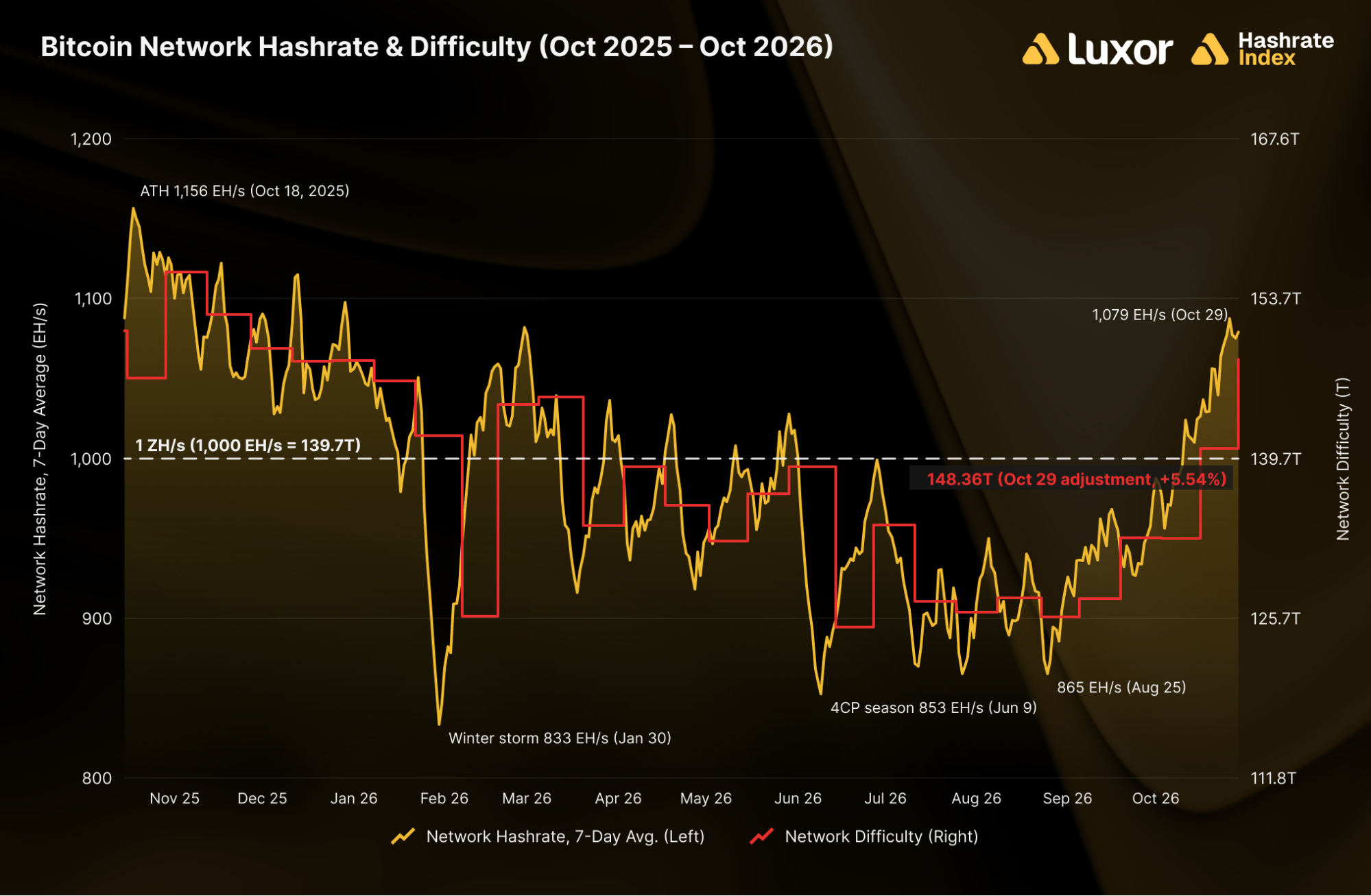
ERCOT’s four coincident peaks—known as 4CP—landed on June 18 at 82.0 GW, July 22 at 90.8 GW, August 24 at 90.2 GW, and September 12 at 86.2 GW, resulting in a four-interval average of 87.3 GW. During this intense summer cooling season, industrial power consumers, including large-scale Bitcoin miners, frequently curtail operations to help stabilize the local grid during peak demand hours.
The operational impact on the Bitcoin network was substantial. The eight consecutive difficulty adjustments recorded between June 14 and September 19 averaged a negative 0.44%. The June 14 adjustment alone saw a staggering 10.09% drop—marking the eighth-largest downward difficulty adjustment of the modern ASIC era going back to 2016. This was compounded by another 5.00% reduction on July 11. These mid-summer drops stacked routine price-driven marginal shutdowns on top of large-scale, deliberate 4CP curtailment.
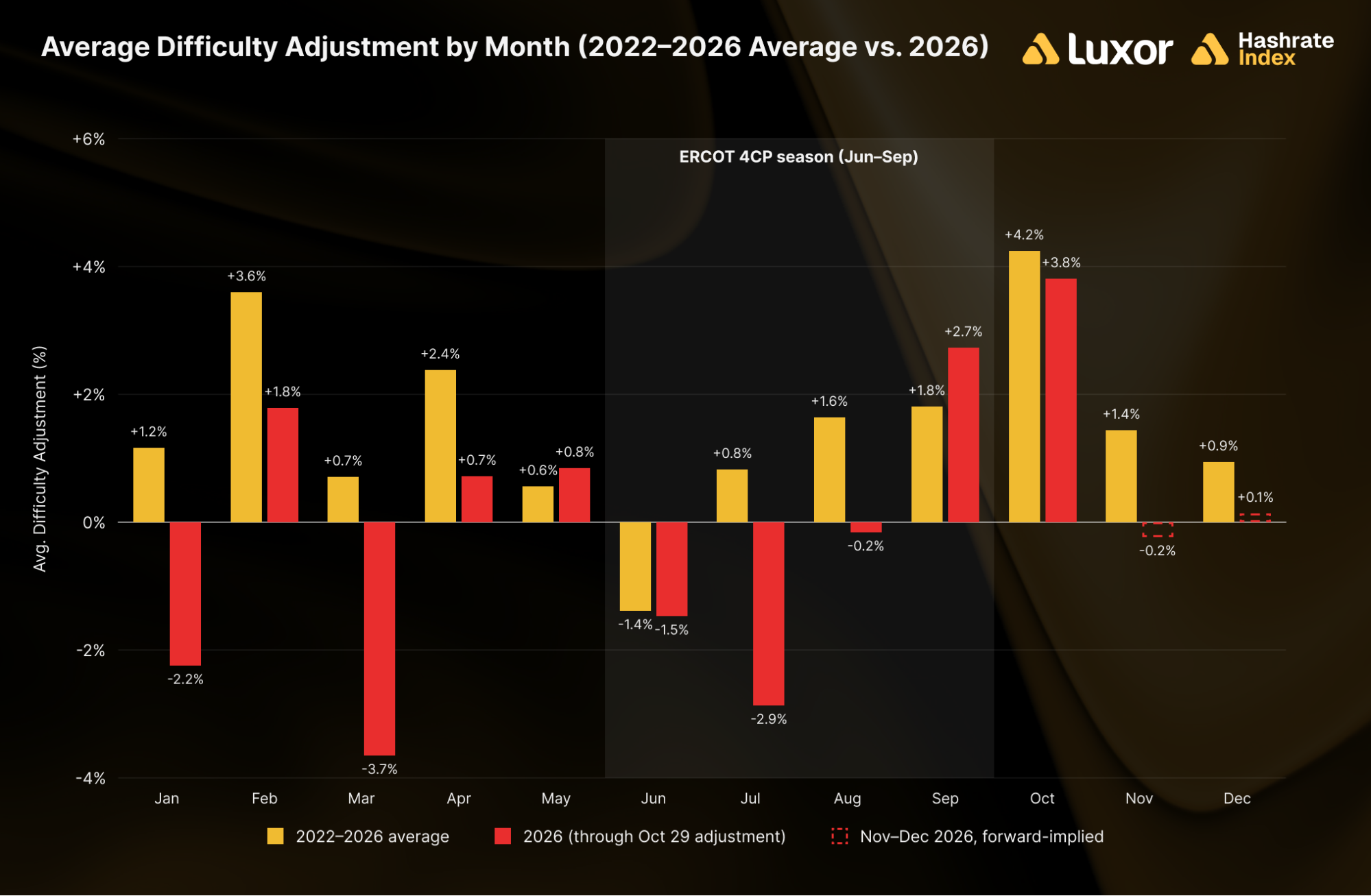
Looking at historical data from 2022 through 2026, adjustments spanning the June-to-September window averaged a modest +0.75%, contrasting sharply with the +1.90% average recorded during the other eight months of the year. October, by contrast, historically stands out as the strongest calendar month with an average adjustment of +4.25%, driven by the resumption of full-capacity operations as curtailed electrical load returns in Texas.
This seasonal rhythm repeated itself faithfully. Following the final ERCOT peak on September 12, difficulty began a rapid ascent, moving +4.16% on September 19, -0.03% on October 3, +5.92% on October 16, and +5.54% on October 29. This cumulative 16.4% surge vaulted the network from 127.45T to 148.36T, with October adjustments averaging nearly 3.8% each. Current forward curves indicate this sharp rebound will likely pause heading into the winter months, with implied projections pointing toward slight negative adjustments in November and minor growth in December.
Evolution of the Hashrate Forward Market
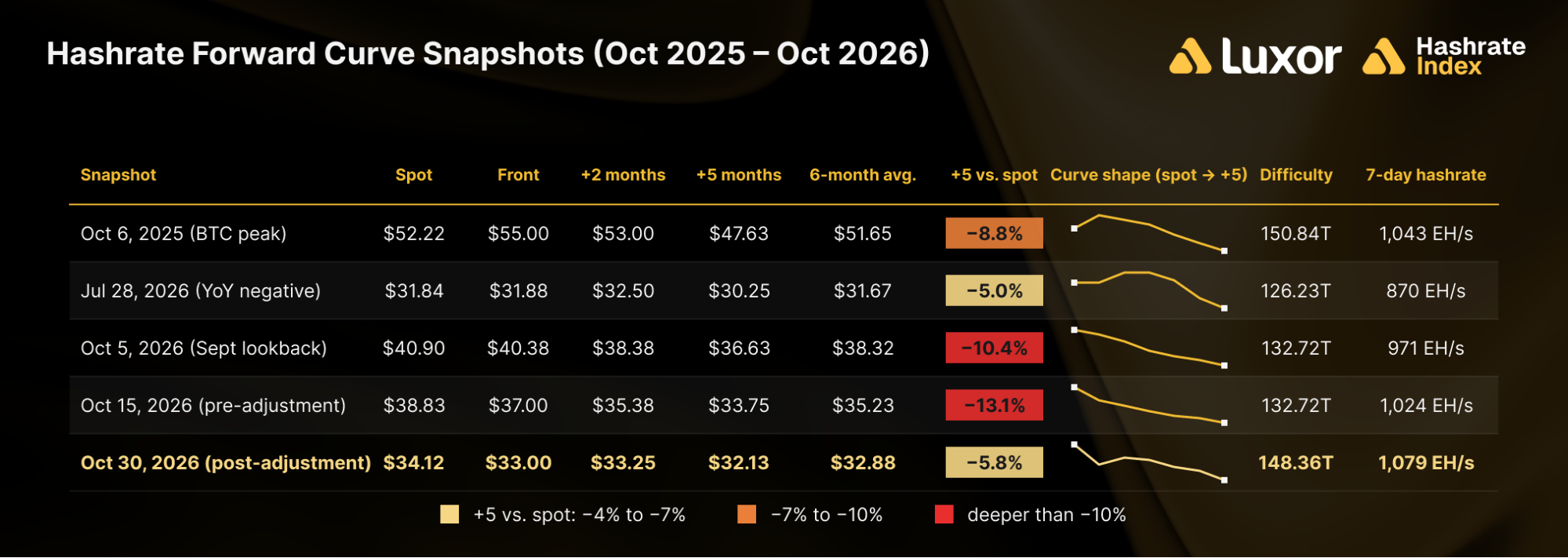
Derivatives and forward markets have provided a front-row seat to these macroeconomic and operational shifts. Snapshots from Luxor’s Hashrate Forward Market illustrate how market sentiment evolved across key milestones, including Bitcoin’s October 2025 price peak, the July 2026 contraction when year-over-year difficulty turned negative, and the subsequent autumn recovery.
In July 2026, the forward curve was remarkably flat. The market anticipated virtually no near-term difficulty growth, with contracts expiring five months out trading within a narrow $2 band of spot prices. By early October, however, the curve had steepened significantly into backwardation, implying that the network would cross the 1 ZH/s threshold by January 2027 at roughly 1,029 EH/s.
In reality, the network crossed that line months ahead of schedule in October, prompting three distinct structural shifts in the forward curve. Leading into the October 16 adjustment, the forward strip drifted lower while spot prices remained resilient. By October 15, the front-month contract sat $1.83 below spot, while the five-month contract traded at a 13% discount.
As spot prices caught down later in the month, falling to $35.91 by October 26, the depth of the backwardation eased to 11%. Following the October 29 adjustment—which brought spot hashprice down to roughly $34—the back of the curve stabilized. The March 2027 contract ticked upward from $32.00 to $32.13, leaving the five-month contract trading at approximately a 6% discount to spot.
Rather than merely shifting lower, the shape of the forward curve underwent a fundamental adjustment. The post-October 30 curve implies near-term difficulty will hold relatively steady through the remainder of the year, mirroring the roughly 1,062 EH/s network average recorded during the epoch that concluded on October 29. Having witnessed two consecutive +5% adjustments land successfully, market participants are now pricing in a period of consolidation before modest growth resumes in early 2027.
Implications for Mining Fleets and Risk Management
Reclaiming the 1 ZH/s milestone while Bitcoin’s spot price remains roughly a third below its all-time high underscores a broader structural trend across the industry: steady improvements in fleet efficiency. The hashing power that has flowed back onto the network is demonstrably cheaper and more energy-efficient to operate than the older hardware that was sidelined during the previous year’s drawdown.
For mining operators navigating these fluctuating conditions, the shifting shape of the forward curve highlights the ongoing utility of risk management strategies. With network difficulty climbing 16% since early September, locking in revenue by selling hashprice forward serves as an effective hedge against faster-than-expected difficulty growth.
While the fundamental mechanics of hedging apply broadly across the sector, the specific execution varies depending on a miner’s operational efficiency, cost of capital, and fleet composition. Efficient operators utilize these instruments to lock in operating margins and fund expansion initiatives, whereas marginal producers rely on derivatives to protect against sudden compression in hashprice during periods of unexpected network expansion. As the Bitcoin mining industry closes out the final quarter of the year, the interplay between technological efficiency, energy market dynamics, and financial derivatives will continue to dictate operational profitability across the global compute landscape.
 Cryptocurrency Mining
 Cryptocurrency Mining
 Cryptocurrency Mining