In what marks the largest cryptocurrency theft in history and one of the single-largest financial crimes of all time, digital asset giant Binance fell victim to an unprecedented security breach on October 29, 2026. According to comprehensive intelligence assessments released by blockchain analytics firm Chainalysis, the catastrophic exploit—which drained approximately $6.4 billion across multiple blockchains—has been definitively linked to TraderTraitor, a notorious North Korean cybercrime syndicate. The group has repeatedly targeted the global cryptocurrency industry, decentralized finance protocols, and individual investors to generate illicit revenue for the regime in Pyongyang.
The breach unfolded rapidly late in the afternoon. Around 4:20 p.m. Eastern Time, automated alerts began flashing as massive tranches of funds started flowing out of Binance hot wallets spanning several distinct blockchain networks. On the Ethereum network, the attacker utilized an operational wallet previously funded through privacy-enhancing mixer Tornado Cash. From this staging ground, the perpetrator submitted valid, cryptographically signed authorizations that tricked a Binance hot wallet into executing attacker-deployed code. Once the malicious code was triggered, the attacker commanded the compromised wallet to sweep its accumulated assets directly into attacker-controlled addresses. Simultaneously, other affected Binance wallets appeared to execute ordinary, signed transfer commands. By the time the dust settled across the various impacted blockchains, the unauthorized outflows totaled an staggering $6.4 billion USD.
The High-Stakes Race Against Time and Stablecoin Freezes
Following the initial breach, the attacker found themselves thrust into a frantic race against the clock. While billions of dollars worth of stolen cryptocurrency were denominated in decentralized, censorship-resistant assets like Bitcoin and Ethereum—currencies that cannot be frozen or seized by central authorities—a substantial portion of the loot was held in stablecoins such as USDT and USDC. Unlike native cryptocurrencies, stablecoins possess built-in compliance mechanisms that allow their issuers to blacklist addresses and freeze funds in coordination with law enforcement agencies and industry intelligence partners like Chainalysis.

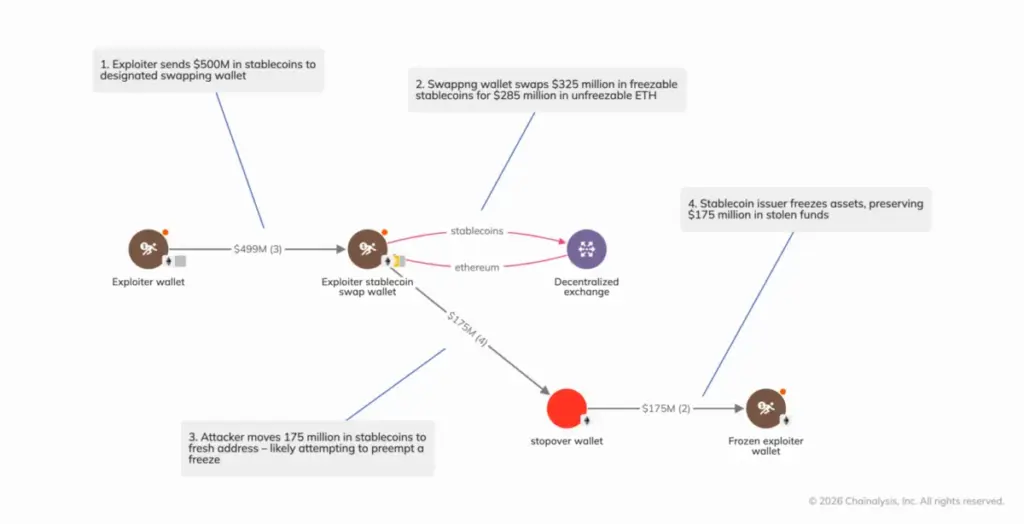
Realizing that a systemic freeze was inevitable, the exploiter moved aggressively to convert and shuffle their holdings. In an attempt to stay ahead of compliance interventions, the attacker quickly funneled $500 million in stablecoins into an intermediary wallet specifically designed to swap freezable assets into non-freezable alternatives. Over the course of roughly twenty minutes, the operational setup successfully swapped $325 million in stablecoins for $285 million in Ether. Ten minutes later, the exploiter pushed the remaining $175 million in stablecoins through a series of stopover wallets, attempting to outpace the impending blacklists.
Despite the attacker’s speed, the global cryptocurrency industry mobilized faster than anticipated. By 5:14 p.m. Eastern Time, just under an hour after the initial breach was detected, the first wave of freezes went into effect. Across multiple blockchains, Chainalysis investigators, law enforcement bodies, stablecoin issuers, and industry participants engaged in a synchronized, high-stakes defense. Operating largely in parallel, these entities shared real-time intelligence and proactive investigative leads to block the movement of stolen capital. As a direct result of this swift, cross-industry collaboration, approximately $2.8 billion of the stolen funds has been frozen to date. While this recovery effort does little to diminish the historic scale of the breach, it highlights an increasingly mature digital asset ecosystem capable of rapid, coordinated defense against sophisticated state-sponsored threats.
Commingled Funds Strengthen the Link to TraderTraitor
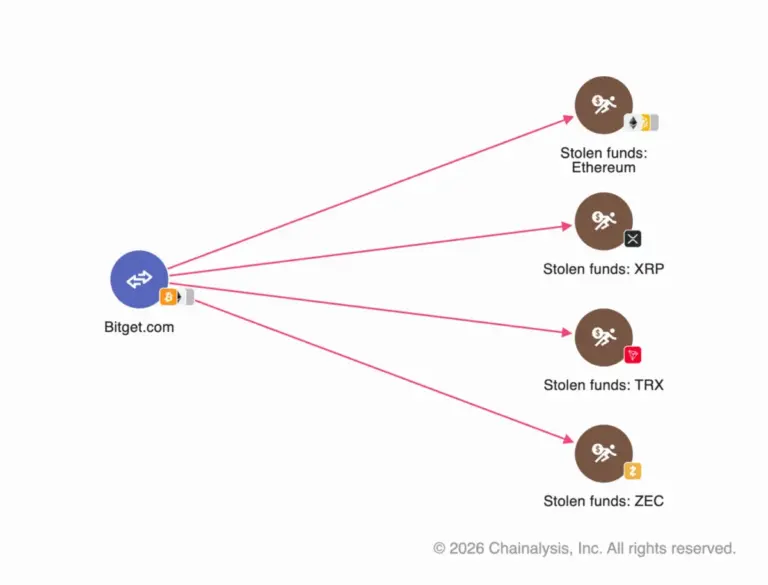
Initial laundering patterns observed immediately after the exploit pointed toward the involvement of North Korean state-backed hackers, but the definitive breakthrough came through on-chain data analysis. Chainalysis investigators monitoring the transaction streams in real time observed funds stolen from Binance directly commingling with assets stolen during the previous month’s Bitget exploit—a high-profile cyberattack that had already been formally attributed to North Korean actors.

This direct, undeniable on-chain intersection provided the critical evidence needed to solidify the attribution assessment. Armed with this verifiable blockchain footprint, Chainalysis publicly announced the link to TraderTraitor on October 30 at 12:30 a.m. Eastern Time, confirming that the state-sponsored collective was orchestrating the unprecedented financial assault.
Automated Laundering Patterns Reveal Novel Tactics
As investigators continue mapping the complex web of transactions following the Binance hack, they have uncovered laundering methodologies previously unseen in the digital forensics sector. Thousands of distinct transactions executed within extremely tight timeframes strongly indicate that the attackers are employing advanced automation to obscure the audit trail of the stolen capital. Instead of simply pushing the funds forward through standard multi-hop transfers, the perpetrators are repeatedly cycling assets among a dense cluster of addresses, frequently looping funds back to nodes involved earlier in the laundering sequence.
A significant portion of the addresses participating in this sophisticated network follow a highly consistent, programmatic pattern: they receive exactly one TRX (Tron’s native token), followed quickly by additional tranches of funds, before immediately forwarding the assets onward to fresh destinations. This repetitive, machine-driven sequence underscores a highly organized, automated infrastructure designed to fragment, redistribute, and mask the provenance of the cryptocurrency at machine speed.

Industry-Wide Vigilance and Ongoing Investigations
The investigation into the Binance breach remains deeply active, with security analysts and law enforcement agencies anticipating that the remaining unfrozen funds will continue to shift across various networks in the coming days. Chainalysis has reaffirmed its commitment to supporting Binance and the broader financial technology sector as experts trace the stolen capital, disrupt downstream laundering networks, and work to mitigate further ecosystem losses.
Cryptocurrency exchanges remain prime targets for malicious actors due to the substantial liquidity they hold, regardless of their geographic jurisdiction or regulatory standing. Although this security incident represents an unprecedented escalation in both scale and sophistication, cyber attacks targeting centralized infrastructure are an enduring risk. Industry leaders emphasize that digital asset platforms must maintain rigorous security postures, continuous monitoring, and well-rehearsed incident response protocols to react swiftly when breaches occur.
For institutional clients and compliance teams navigating the aftermath of the event, analytics providers continue to update blockchain monitoring tools to flag exposure to the specific addresses tied to the incident. As new intelligence emerges from the ongoing forensic work, investigators will continue tracking the flow of capital to aid law enforcement and protect the integrity of the wider cryptocurrency market.
 Crypto Wallets & Security
 Crypto Wallets & Security
 Crypto Wallets & Security