The Bitcoin network has officially broken back above the critical milestone of 1 Zetta-hash per second (ZH/s), marking a definitive turning point after a prolonged fifteen-adjustment consolidation phase that began earlier in the spring.
At block 971,712 on October 16, Bitcoin’s automated difficulty adjustment registered a 5.92% increase, pushing network difficulty to 140.58T. This comfortably cleared the 139.70T threshold required to officially designate a 1 ZH/s network hashrate equivalent. The upward momentum continued shortly thereafter with another 5.54% increase on October 29, which brought network difficulty to 148.36T.

This decisive upward shift brings a definitive close to a fifteen-adjustment streak where difficulty lingered below the 1 ZH/s equivalent line—a dry spell stretching all the way back to March 20 of this year. As the network enters the final stretch of the year, industry analysts are closely watching how fleet efficiency, macroeconomic pricing pressures, and seasonal energy markets intersect to shape the trajectory of global Bitcoin mining.
The Drawdown From the October 2025 Peak
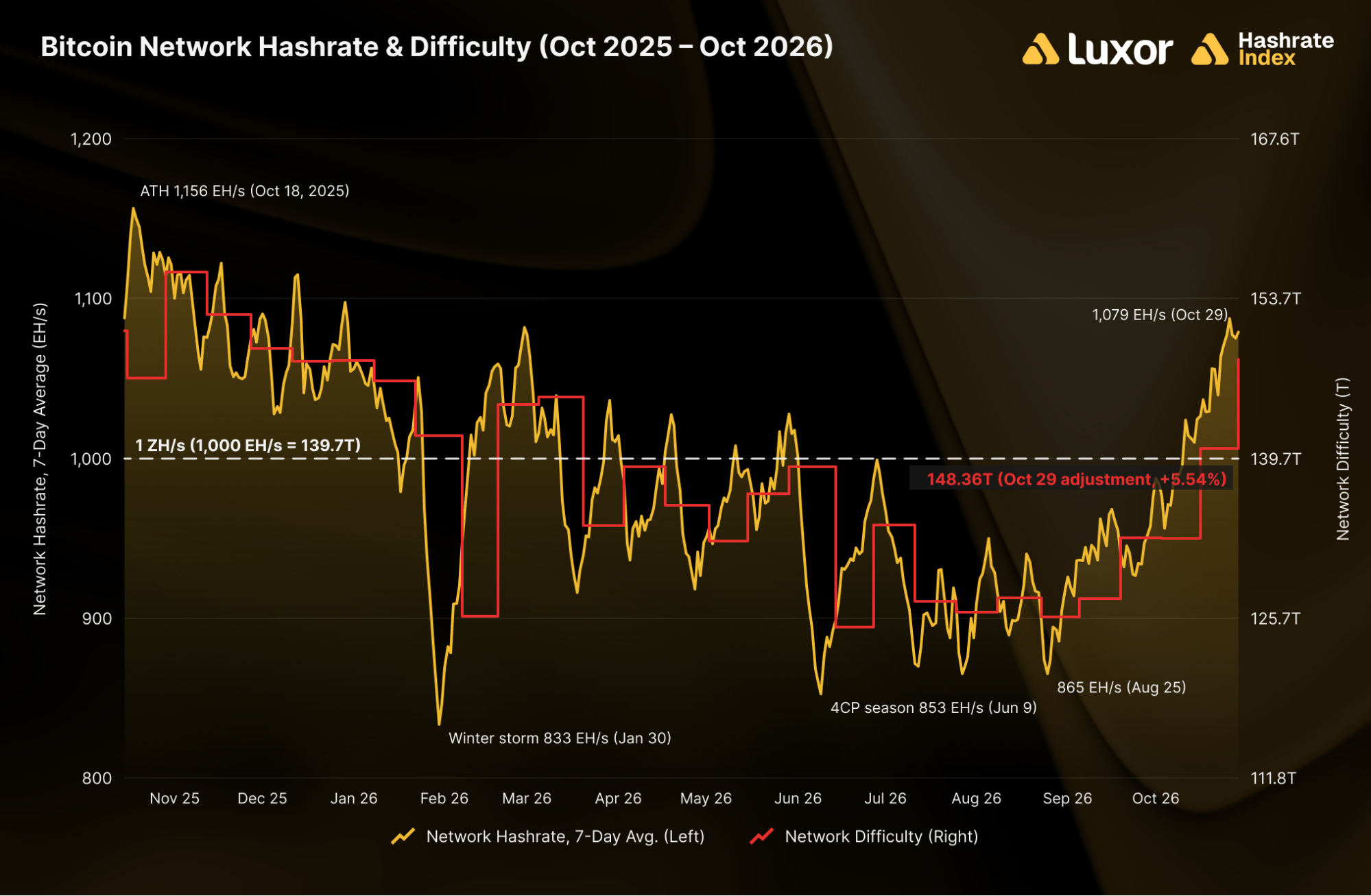
To fully understand the significance of reclaiming the 1 ZH/s threshold, one must examine the dramatic market cycles that preceded it. Exactly one year prior, network hashrate achieved a landmark 7-day average peak of 1,156 EH/s on October 18, 2025. Network difficulty followed suit just eleven days later, setting an all-time record of 155.97T.

At that juncture, Bitcoin was trading just two weeks removed from its all-time high of $124,485, and the broader hashprice index hovered around a lucrative $46 per PH/s/day. However, the subsequent twelve months delivered a sharp unwind of these historic metrics.
Three primary forces stacked against miners over the course of the year. The broader downward correction in Bitcoin’s spot price led to marginal shutdowns across less-efficient operations. Simultaneously, regional energy constraints—most notably in Texas under the Electric Reliability Council of Texas (ERCOT) framework—forced large-scale curtailments during periods of peak summer grid demand. Finally, the natural cadence of hardware deprecation played a role as older-generation Application-Specific Integrated Circuits (ASICs) were taken offline or replaced.
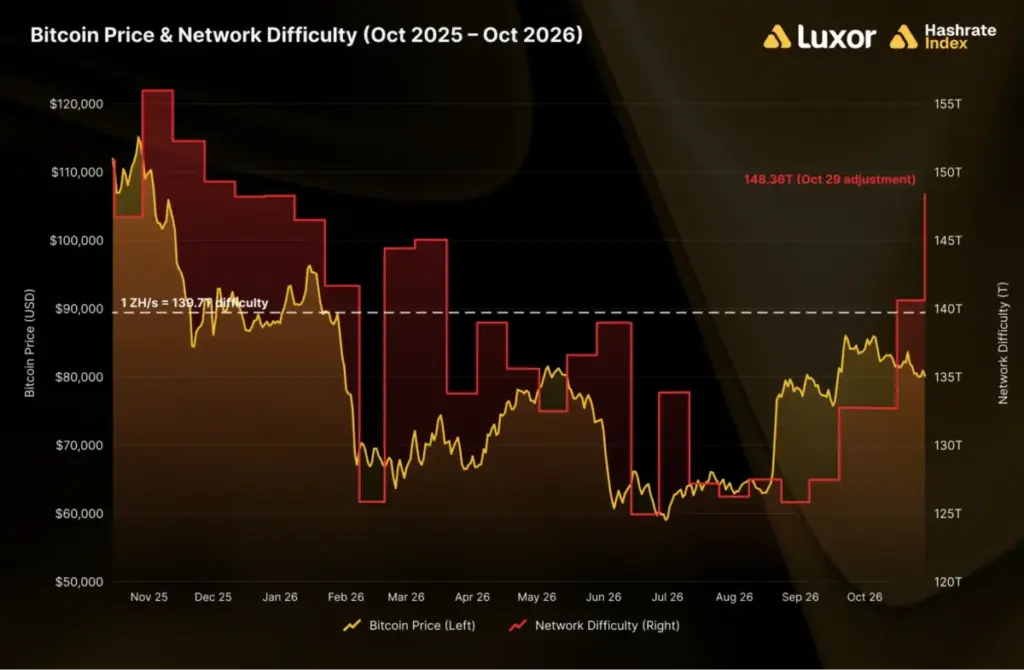
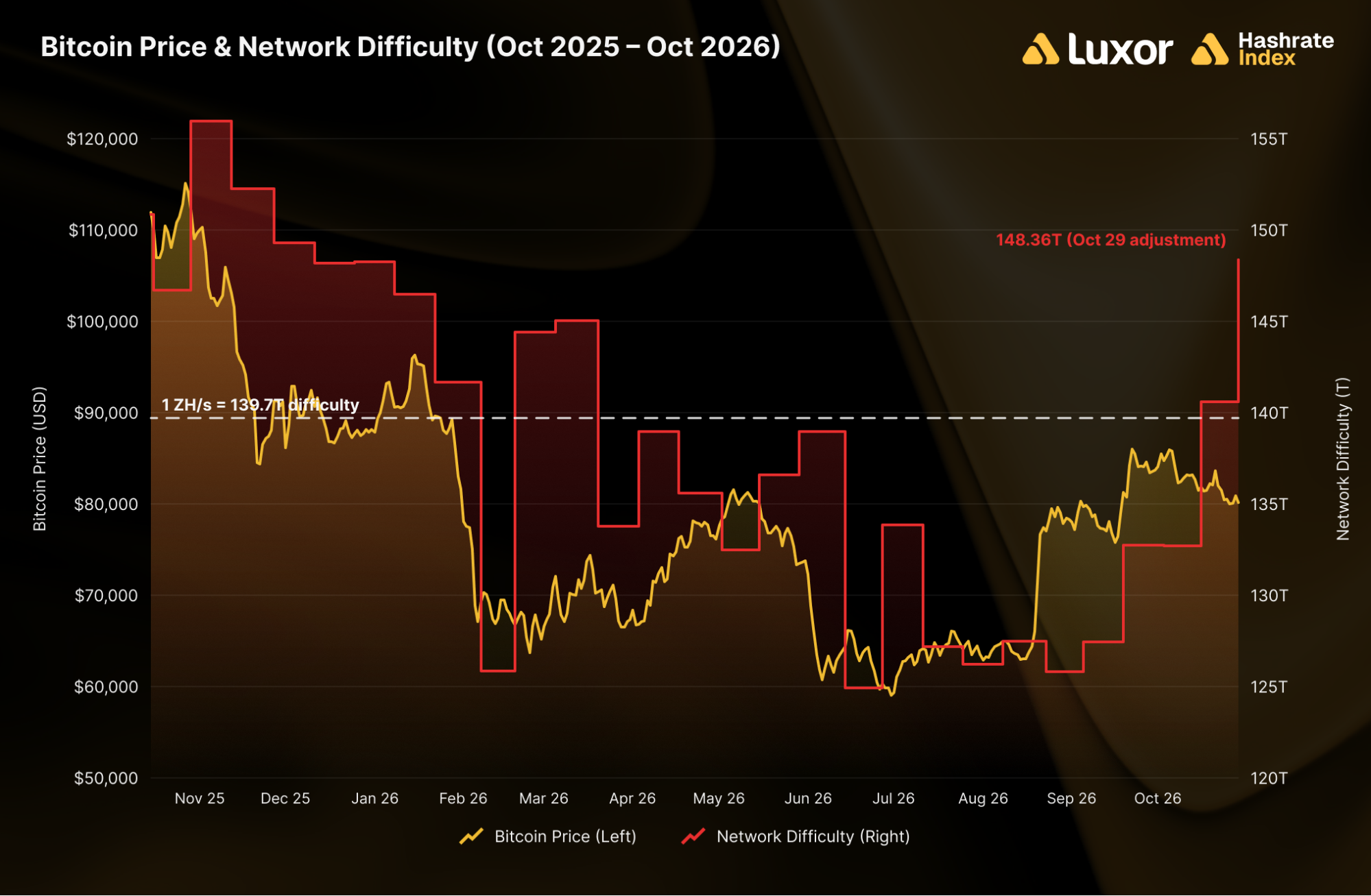
Difficulty tracked the broader spot market closely, sliding downward through the first half of the year before staging a robust recovery following an August price rally. By October 29, Bitcoin was trading near $80,150—roughly 36% below its all-time peak.
In contrast, network difficulty demonstrated a much faster recovery, sitting at 148.36T following the late October adjustment, which is only 4.9% below its historic record. Meanwhile, the 7-day average hashrate climbed to 1,088 EH/s on October 26, marking its highest reading since late December 2025. Because hashrate rebounded faster than the spot price of Bitcoin, overall hashprice compressed to approximately $34 following the October 29 adjustment, down significantly from the $46 mark seen during the peak of the previous year.
Seasonal Energy Pressures and the 4CP Cycle
The cyclical nature of industrial-scale mining operations—particularly within Texas, a global hub for the sector—has long introduced distinct seasonal volatility into network hashrate and difficulty metrics.
ERCOT’s four coincident peaks (4CP) for the year settled across the scorching summer months, landing on June 18 at 82.0 GW, July 22 at 90.8 GW, August 24 at 90.2 GW, and September 12 at 86.2 GW, yielding a four-interval average of 87.3 GW.
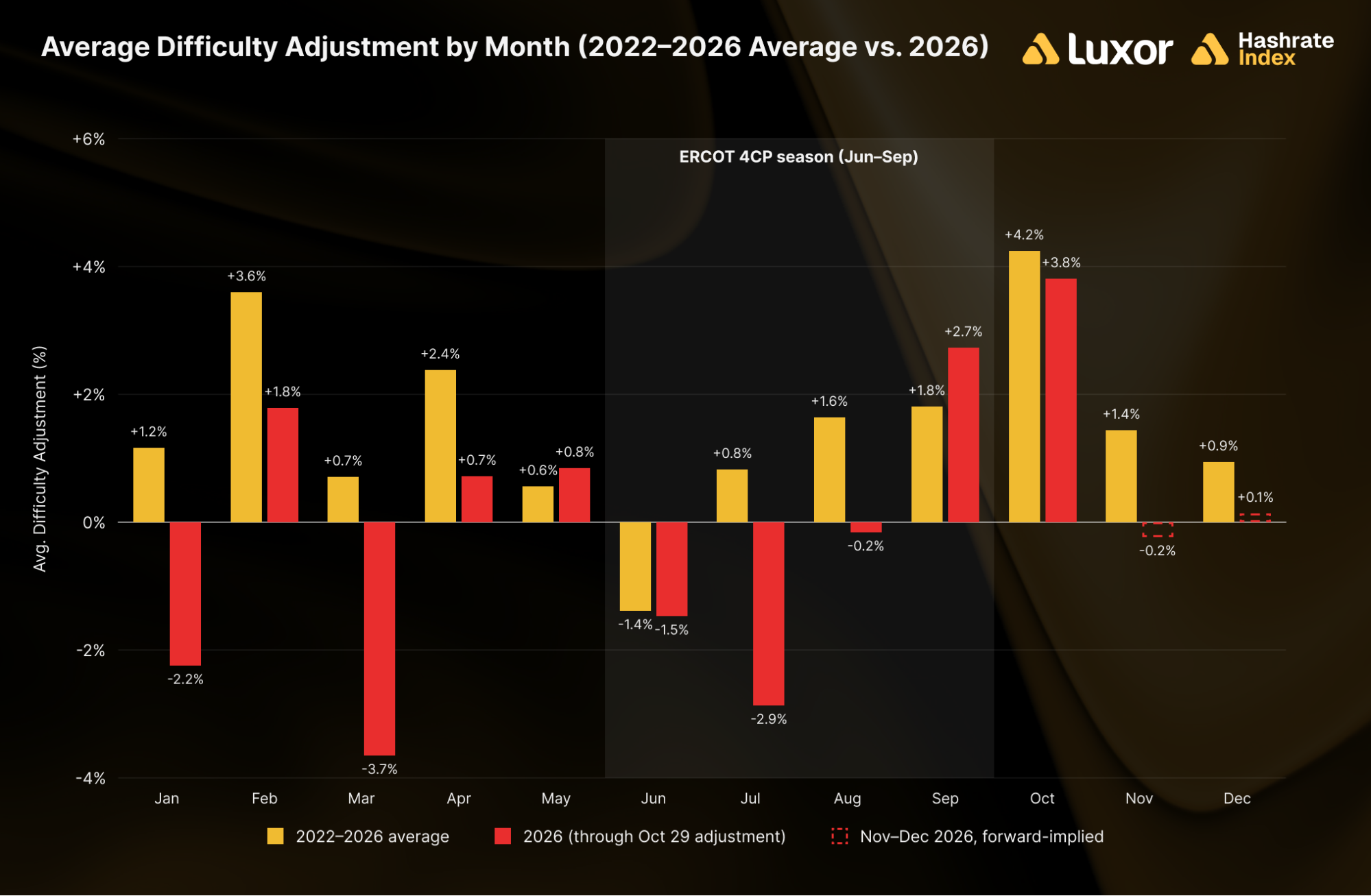
This heavy load on the Texas power grid directly correlated with a contraction in hashing power. The eight difficulty adjustments spanning from June 14 through September 19 averaged a negative 0.44%. The June 14 adjustment alone saw a staggering 10.09% drop—ranking as the eighth-largest downward adjustment of the modern ASIC era dating back to 2016. This was followed by another notable 5.00% reduction on July 11 as early summer curtailment combined with price-driven shutdowns.
Historical data from 2022 through 2026 underscores this seasonal pattern. Adjustments during the June-through-September window averaged a modest +0.75%, compared to +1.90% across the remaining eight months of the year. October traditionally emerges as the strongest calendar month, averaging a +4.25% increase as industrial load curtailments ease and Texas miners return their fleets to full capacity.
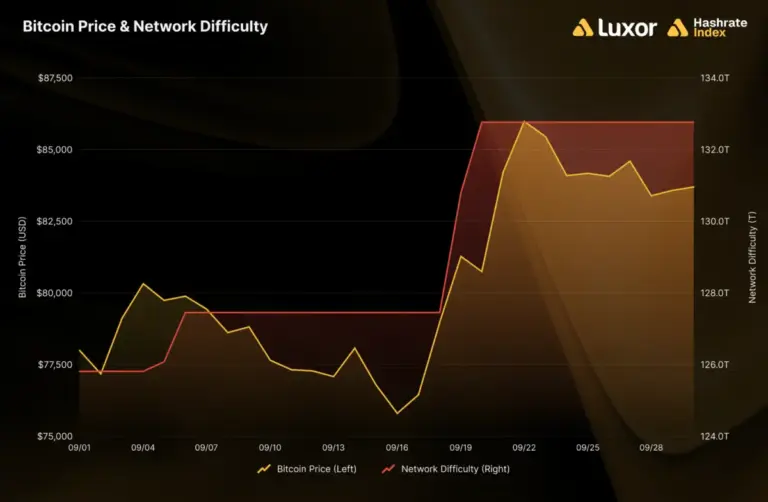
This familiar seasonal script played out precisely in 2026. Once the final ERCOT peak passed on September 12, network difficulty surged across consecutive adjustments: +4.16% on September 19, a nominal -0.03% on October 3, +5.92% on October 16, and +5.54% on October 29. This cumulative 16.4% expansion propelled difficulty from 127.45T to 148.36T in less than two months.
Shifts in the Hashrate Forward Market
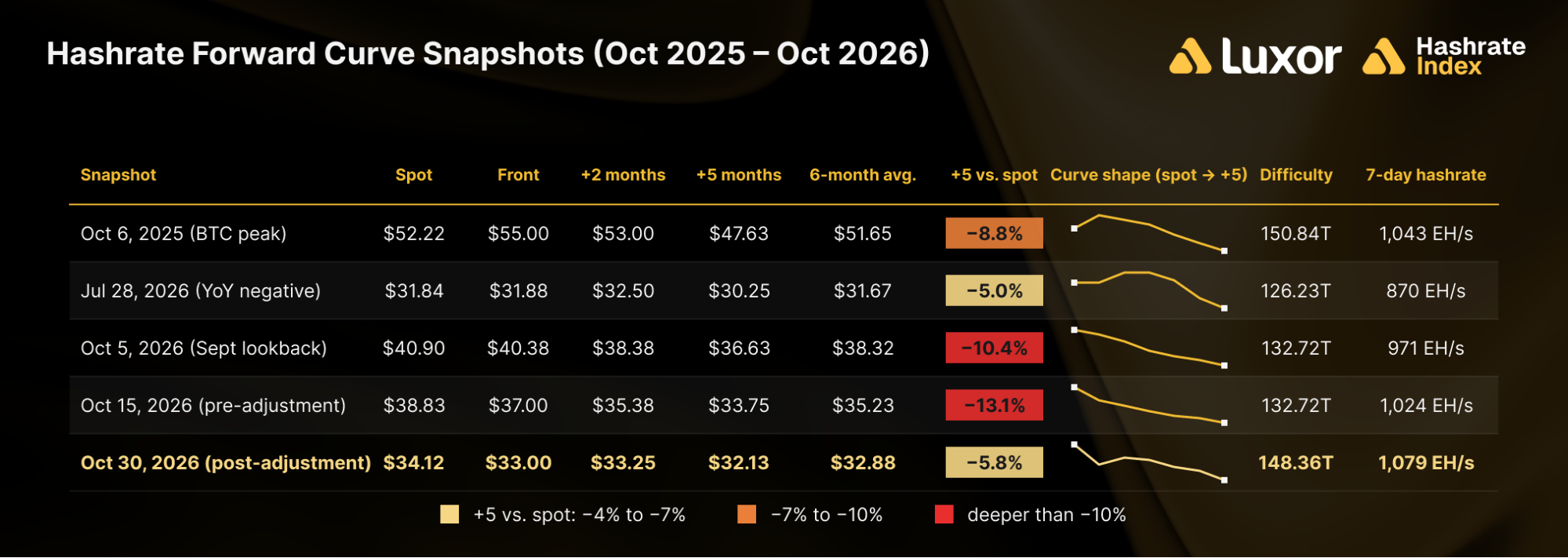
Financial derivatives tied to computational power have provided an unprecedented window into market sentiment throughout these fluctuations. Snapshots from Luxor’s Hashrate Forward Market illustrate how the industry’s forward-looking expectations evolved from the price peak in October 2025 through the autumn recovery of 2026.
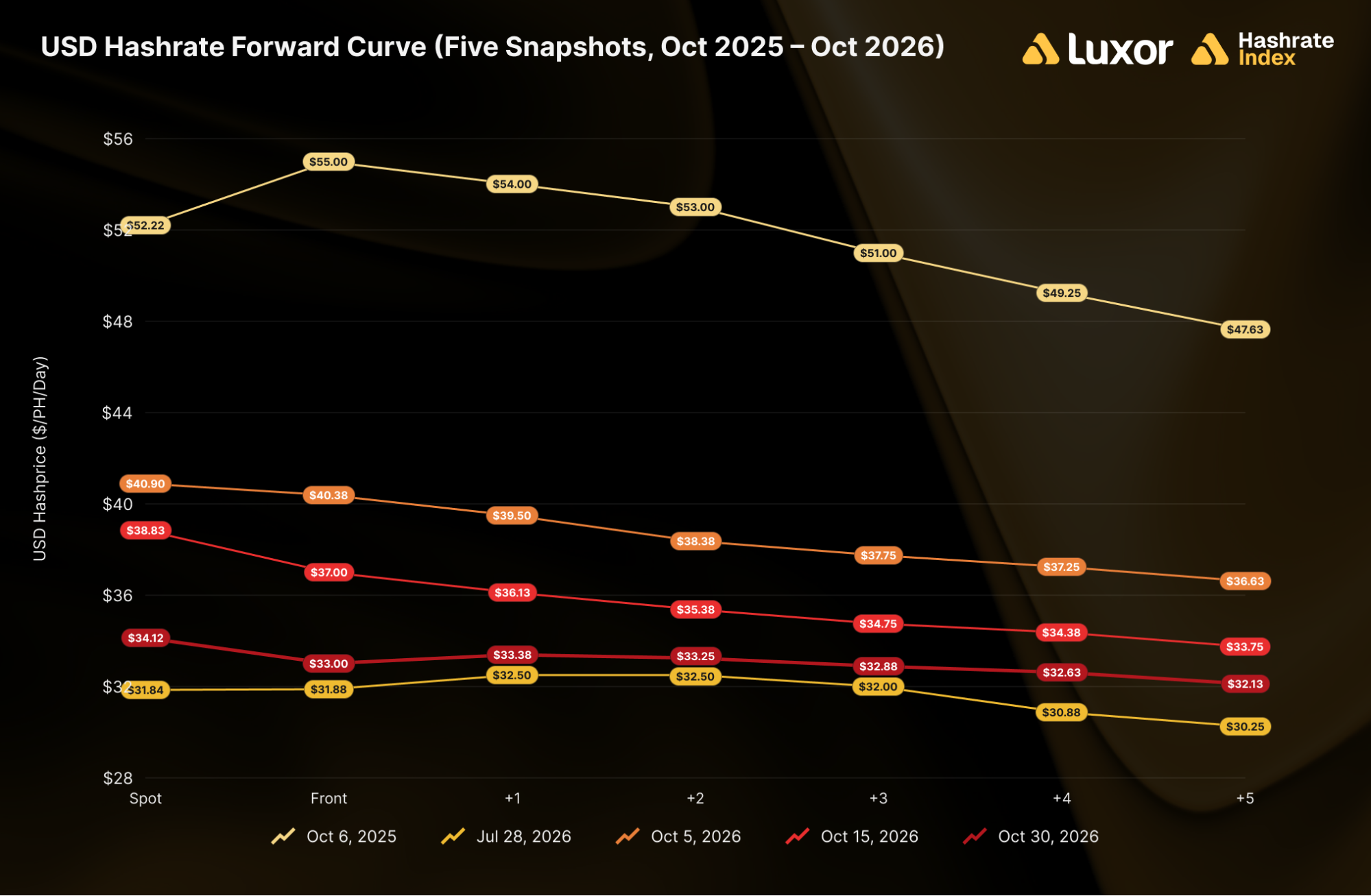
Back in July 2026, the forward curve was relatively flat, reflecting an environment where the market anticipated little to no difficulty growth, with contracts trading within a narrow band of spot prices. However, by early October, the curve had steepened into backwardation as participants priced in a steady climb back toward the 1 ZH/s threshold.
When the network crossed that threshold in October—earlier than many forward curves initially anticipated—market dynamics shifted rapidly. Leading up to the October 16 adjustment, the front-month contract traded at a discount to spot, while the five-month contract sat deeper below current levels. Following the subsequent adjustments, spot prices fell toward $34 while the back of the forward curve stabilized.

Rather than continuing its downward descent alongside spot prices, longer-dated contracts held relatively firm. The March 2027 contract adjusted slightly from $32.00 to $32.13, leaving the five-month contract trading at roughly a 6% discount to spot. This compression of the forward curve suggests that the market now anticipates a brief plateau in difficulty growth through the remainder of the fourth quarter, with more moderate expansions expected to resume as the calendar turns to 2027.
Implications for Mining Fleets and Operations
The fact that the Bitcoin network has successfully reclaimed a hashrate above 1 ZH/s while the asset’s spot price remains roughly a third below its all-time high speaks volumes about ongoing hardware efficiency gains across the ecosystem. The computational power returning to the network is characterized by newer, more energy-efficient ASIC models that boast superior joules-per-terahash metrics compared to the older generation machines forced offline during earlier drawdowns.

For commercial mining operations, navigating this environment requires sophisticated risk management strategies. With network difficulty having climbed over 16% since early September, utilizing hashrate derivatives to lock in forward pricing serves as an effective hedge against unexpected difficulty surges or price volatility.
While the fundamental requirement for hedging remains universal across the mining sector, individual operators deploy derivatives differently based on their specific cost structures and balance sheet exposures. Efficient fleets with low power costs often utilize forward contracts to lock in baseline operating margins, whereas more leveraged operators may rely on hedging to service debt obligations and protect against downside risk during broader market corrections. As the network stabilizes above 1 ZH/s and looks toward the winter months, the interplay between hardware efficiency, energy markets, and financial tooling will continue to dictate the profitability of the global mining landscape.
 Cryptocurrency Mining
 Cryptocurrency Mining
 Cryptocurrency Mining