Just days after the digital asset industry absorbed what is widely considered the largest hack in crypto history—with perpetrators making off with roughly $6.3 billion from Binance—the market is now forced to reckon with another looming shock. Prediction markets and political forecasters are increasingly pricing in a potential Democratic sweep of the upcoming midterm elections, a scenario that would place some of the crypto sector’s most persistent and vocal critics in direct control of congressional oversight and powerful committee chairships.
Unlike the sudden and devastating fallout from the Binance security breach, however, this political threat has been building in plain sight for months. According to data from prediction market Kalshi as of Tuesday morning, the probability of Democratic control over the House of Representatives was priced at roughly 94%, while the likelihood of Democrats retaining or taking the Senate hovered around 75%. While these odds do not necessarily mean that a shift in congressional power is fully priced into the broader cryptocurrency market, a change in Washington’s legislative control would hardly come as a surprise to industry insiders.
What remains far less certain—and potentially far more impactful for the sector—is precisely how a newly empowered Democratic majority would choose to wield that legislative authority. Furthermore, broader macroeconomic and geopolitical developments, particularly escalating tensions involving Iran, threaten to overshadow the domestic political narrative entirely as traders weigh risk assets against unpredictable global conflicts.
From Congressional Letters to Subpoenas
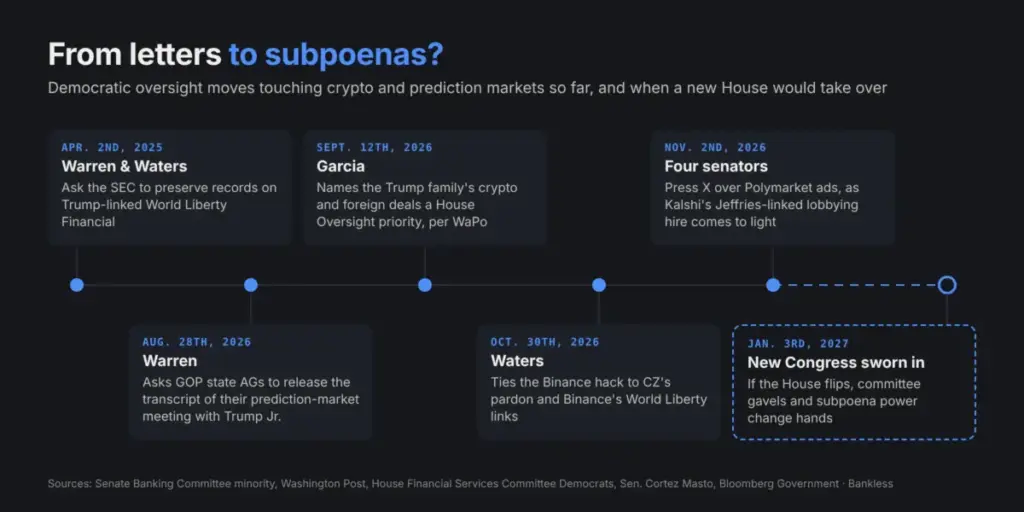
If Democrats successfully flip the House of Representatives, they will instantly assume control of critical committee investigations, equipping them with the sweeping institutional power to hold high-profile hearings and issue legally binding subpoenas for documents, financial records, and testimony. Key lawmakers have already signaled precisely where they intend to direct their investigative focus.
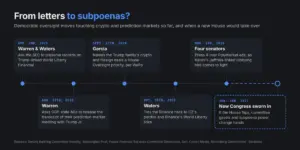
The famously anti-crypto legislative duo of Senator Elizabeth Warren and Representative Maxine Waters began laying the groundwork for these inquiries as early as April 2025. At the time, the lawmakers formally asked the Securities and Exchange Commission to preserve records concerning World Liberty Financial, a crypto project tied to Donald Trump, alongside potential conflicts of interest. Other progressive lawmakers have aggressively sought enhanced scrutiny of the associated TRUMP memecoin. Meanwhile, Representative Robert Garcia, the top Democrat on the House Oversight Committee, has explicitly identified the Trump family’s cryptocurrency initiatives and foreign business dealings as a primary investigative priority should his party win the chamber.
The massive Binance hack provides these critics with an immediate and high-profile opening. In a public statement issued on October 30, Representative Waters directly linked the staggering exchange breach to the previous presidential pardon granted to Binance founder Changpeng Zhao, commonly known as CZ, as well as Binance’s reported ties to World Liberty Financial. While industry analysts note there is no established causal connection between those political relationships and the technical exploit itself, the multi-billion-dollar breach gives congressional Democrats an undeniable opening to push aggressively for stringent new cybersecurity mandates, financial crime safeguards, and heightened accountability for centralized digital asset exchanges.
While increased scrutiny of exchange security could theoretically benefit an industry that has recently hemorrhaged vast amounts of capital through a rapid succession of hacks, the broader concern among market participants is how far that regulatory and legislative dragnet will spread. Ideally, future congressional investigations would remain narrowly focused on specific business dealings rather than dragging unrelated firms and decentralized protocols into the crossfire. However, popular prediction markets, which also maintain visible ties to the Trump family, could easily find themselves caught directly in the political crosshairs.
Donald Trump Jr. serves as a strategic advisor to Kalshi and sits on the advisory board of competitor Polymarket after his venture capital firm, 1789 Capital, completed an investment round last year. Senator Warren previously pressed Republican state attorneys general to release complete transcripts following a media report revealing that Trump Jr. had actively urged them not to mount legal challenges against prediction markets. Compounding this pressure, a group of four Democratic senators sent a formal letter to social media platform X inquiring whether Polymarket was receiving preferential treatment for its commercial advertisements.
At the legislative level, Democrats have already introduced the STOP Corrupt Bets Act, a bill designed to explicitly ban financial contracts placed on elections, sports events, government actions, and armed conflict. Such legislation would strike directly at the core business model of platforms like Kalshi, where sports and parlay contracts accounted for approximately 84% of total trading volume this year, compared to a mere 0.5% for election-related markets. This legislative push occurs against the backdrop of an intensifying turf war between state and federal regulators over who holds the ultimate authority to oversee these emerging prediction platforms. As industry commentators have observed, the congressional hearings witnessed so far may soon resemble polite gatherings compared to the aggressive inquiries a fully empowered Democratic Congress could initiate.
In anticipation of this shifting political reality, Kalshi has reportedly taken defensive steps, recently hiring a prominent lobbying firm with direct ties to Hakeem Jeffries, who is positioned to become the next House Speaker if Democrats capture the chamber. With the Commodity Futures Trading Commission currently defending prediction markets against aggressive challenges from state-level regulators, heightened congressional oversight of these platforms could easily extend to the federal agency itself.
Regulators Keep Moving Forward
Despite the growing probability of heightened congressional pushback, intense political scrutiny does not necessarily mean that regulatory progress for the broader crypto sector will grind to a halt.
Even after major legislative efforts like the CLARITY Act failed to advance through the legislative process in September, both the SEC and the CFTC have continued to clear a practical pathway forward by utilizing their existing regulatory authority. Just two days after the CLARITY Act stalled on Capitol Hill, the SEC issued a temporary regulatory exemption designed to facilitate the trading of tokenized U.S. equities on-chain by qualifying venues. Shortly thereafter, in October, the CFTC formally sought public input on updated rules governing leveraged cryptocurrency derivatives and federally registered crypto markets.
Those regulatory efforts translated into even more concrete operational progress shortly after. CFTC Chairman Michael Selig announced that equity perpetual futures could officially begin trading on qualifying U.S.-regulated exchanges. While trading platforms must still secure the necessary SEC and CFTC registrations, comprehensive product filings, and specialized clearinghouse arrangements, the official regulatory pathway is now open. Industry participants have moved quickly to capitalize on the shift; Payward has already filed the requisite paperwork to offer these single-stock perpetual futures through Bitnomial, while competing platforms Lighter and the Intercontinental Exchange-backed Trade[XYZ] are actively pursuing their own separate regulatory compliance paths.
This regulatory momentum is not entirely immune to mounting political pressure. Senator Warren has already publicly challenged the CFTC’s enforcement record and internal staffing reductions, and a Democratic-led Congress could easily subject future agency decisions to intense budgetary and investigative scrutiny. Yet, congressional oversight does not erase the statutory authority already vested in these financial regulators. Congressional investigations and regulatory approvals are tracking forward along parallel, albeit tense, tracks.
The Bigger Unknown: Iran
For market prices and investor sentiment, however, the least predictable and potentially most impactful force in the immediate term may be the geopolitical situation involving Iran. Recent reports indicated that the administration was actively weighing renewed large-scale military strikes following the conclusion of the midterms, instantly raising the specter of surging crude oil prices, stubborn domestic inflation, and another sharp pullback in global risk assets, including cryptocurrencies.
Markets experienced temporary relief when statements suggested a reluctance to rush into a major military campaign, while renewed diplomatic optimism sent global oil prices sharply lower. However, subsequent reports confirmed that U.S. military forces had carried out limited strikes against Iranian targets situated near the strategically vital Strait of Hormuz. While American officials described the military action as strictly defensive and emphasized that diplomatic negotiations remain active, the central question for global markets is whether these isolated strikes will remain contained or escalate into a wider regional conflict.
That distinction will likely determine the near-term trajectory of the cryptocurrency market. While institutional and retail investors have had weeks to digest and prepare for the growing likelihood of a Democratic-controlled Congress, the unfolding situation in Iran remains deeply unpredictable, carrying the potential to outweigh domestic political developments entirely as investors navigate an increasingly complex global landscape.
 Tokenomics & Digital Assets
 Tokenomics & Digital Assets
 Tokenomics & Digital Assets