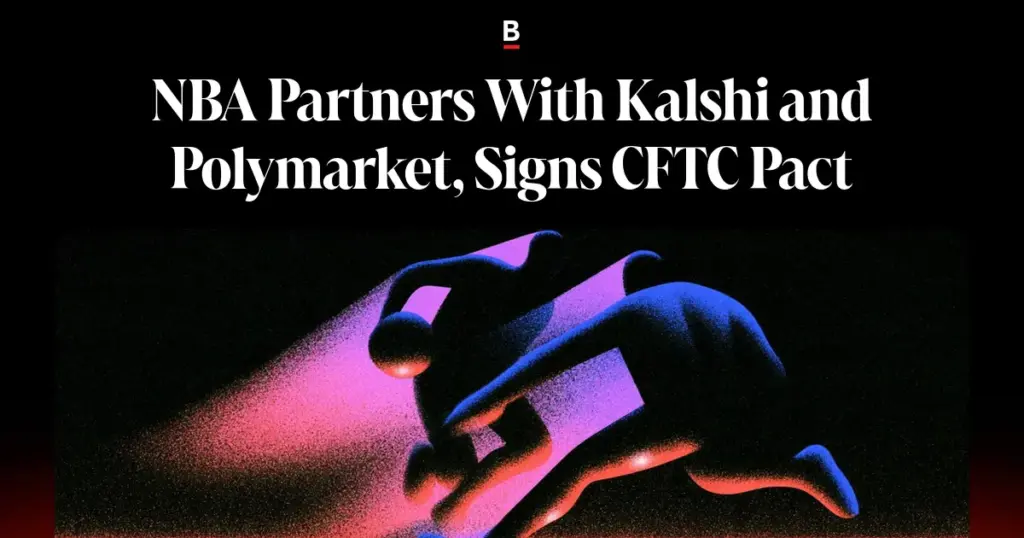
The National Basketball Association has officially entered the rapidly evolving prediction market sector, naming prominent platforms Kalshi and Polymarket as its preferred prediction market exchanges. In a parallel move that highlights the growing intersection between professional sports governance and federal financial oversight, the league also signed a non-binding memorandum of understanding with the Commodity Futures Trading Commission to establish a framework for information sharing and regulatory cooperation.
With this major announcement, the NBA becomes the third major American professional sports league to forge formal partnerships of this nature, following similar moves by Major League Baseball and the National Hockey League. The decision marks a significant milestone in how professional sports leagues are choosing to engage with decentralized and regulated prediction markets, moving away from a stance of cautious distance toward structured integration and oversight.
The partnership with Kalshi, a regulated financial exchange, and Polymarket, a prominent decentralized prediction platform, creates an official channel for these markets to operate in alignment with the league’s integrity frameworks. By establishing these official designations, the NBA aims to monitor, understand, and potentially leverage the predictive data generated by these platforms regarding basketball outcomes, player achievements, and broader league events.
Simultaneously, the memorandum of understanding signed with the CFTC underscores a commitment to regulatory transparency and cooperative oversight. As prediction markets increasingly intersect with sports betting, finance, and public speculation, federal regulators have cast a sharper eye on the sector. By entering into a formal, albeit non-binding, information-sharing agreement with the CFTC, the NBA is positioning itself as a proactive partner in maintaining market integrity, safeguarding against potential manipulation, and ensuring that game outcomes remain untainted by speculative financial interests.
This dual announcement reflects a broader strategic shift within professional sports leagues as they adapt to the normalization of betting and prediction products in the digital age. For years, sports organizations maintained strict firewalls between their competitions and speculative markets, viewing gambling and prediction platforms as potential threats to the integrity of the game. However, the sheer growth of sports betting, daily fantasy sports, and event-based prediction markets has forced a reevaluation of this policy. Rather than attempting to suppress or ignore the burgeoning prediction market economy, major leagues are increasingly opting to bring these platforms into formal compliance and partnership arrangements.
The inclusion of both Kalshi and Polymarket highlights the diverse landscape of modern prediction markets. While Kalshi operates under the direct regulatory oversight of the CFTC as a designated contract market, offering event contracts to U.S. retail investors within a traditional financial framework, Polymarket has gained massive global traction as a crypto-based prediction platform where users wager on real-world events using digital assets. By partnering with both entities, the NBA is acknowledging the dual realities of the market, encompassing both traditional regulated financial exchanges and decentralized blockchain-based platforms.
Industry observers note that these partnerships could pave the way for deeper data integrations, enhanced monitoring of suspicious betting patterns, and new avenues for fan engagement. As prediction markets continue to capture public attention—particularly during high-profile sporting events like the NBA Finals, the NBA Draft, and regular-season matchups—having official league partners helps legitimize the sector while providing the NBA with critical oversight tools.

The memorandum of understanding with the CFTC further reinforces this cooperative approach. Regulatory bodies have increasingly sought to understand how prediction markets interact with underlying sporting events, and sports leagues possess the most comprehensive data regarding player health, officiating, and team operations. By opening channels of communication with federal regulators, the NBA can assist in identifying irregular market activities while ensuring that its own interests and the integrity of its games are rigorously protected.
As professional sports leagues continue to navigate the complex intersection of digital finance, public speculation, and regulatory compliance, the NBA’s latest move sets a clear precedent. By officially aligning with preferred prediction market exchanges and establishing formal ties with federal regulators, the league is taking a calculated step toward embracing the future of event-based forecasting while fortifying the safeguards necessary to preserve the trust of its global fan base.
 Tokenomics & Digital Assets
 Tokenomics & Digital Assets
 Tokenomics & Digital Assets