The United States cryptocurrency industry is facing a major policy reset as election results confirm that President Donald Trump’s Republican Party has lost control of both chambers of Congress. The historic shift brings an end to weeks of intense speculation, massive political spending by digital asset political action committees, and high-stakes prediction market trading. With Democrats securing majorities in both the US House of Representatives and the Senate during the final two years of Trump’s presidential term, the legislative landscape for digital assets, regulatory appointments, and government oversight has been fundamentally altered.
Cointelegraph tracked the developments using live election results and race calls provided by the Associated Press, revealing a dramatic night of political upsets, high-profile losses for crypto-backed candidates, and sudden strategic pivots across Washington.
What the Crypto Industry Needs to Know Now
The transition of power in Congress directly impacts the momentum of key legislative initiatives that the digital asset sector has spent millions of dollars trying to advance. Bills like the CLARITY Act and the GENIUS Act, which previously enjoyed strong Republican backing and momentum through various committee hurdles, now face an uncertain path forward.
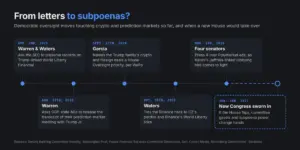
Industry analysts and legal experts suggest that any future federal rules regarding market structure, stablecoins, and self-custody rights will almost certainly require cross-partisan support to survive. Furthermore, the shift in committee leadership gives Democratic lawmakers subpoena power and oversight capabilities over federal regulators and Trump-linked business ventures, introducing a new era of scrutiny for the broader crypto ecosystem.
Live Election Updates
Democrats Win US House, Taking Control of Both Chambers of Congress
In the early hours of Nov. 4, the political map shifted decisively when the Associated Press projected that Democrats had won control of the US House of Representatives. This victory marks a critical flip of the chamber, which Republicans had held since 2023. Representative Hakeem Jeffries is now positioned to become the next Speaker of the House.
This transition grants Democrats crucial committee chairs and subpoena power. According to NBC News, this newly acquired authority includes congressional oversight of President Trump’s family and private business ventures. For the crypto sector, losing a Republican-controlled House removes a key legislative engine that had previously championed rapid deregulation and market structure reform.
Democrat Troy Jackson Unseats Susan Collins in Maine Senate Race
In a closely watched Senate matchup in Maine, Democratic challenger Troy Jackson defeated incumbent Republican Senator Susan Collins, according to the Associated Press.
Sen. Collins had previously positioned herself as a moderate voice on fiscal matters, notably standing as one of four Republicans who opposed advancing the CLARITY Act in September. At the time, she expressed specific concerns regarding the legislation’s potential impact on traditional bank deposits.
In contrast, Troy Jackson campaigned on a platform that favored clear, sensible cryptocurrency legislation. According to advocacy data from Stand With Crypto, which rates Jackson as "very pro crypto," he actively called for an end to the perceived debanking of lawful digital asset businesses and pledged to safeguard the fundamental right of American citizens to maintain self-custody over their digital assets.
Trump Congratulates Democrats on Senate Win
As the reality of the congressional shift set in, President Donald Trump responded to the election outcomes with a pragmatic message. In an interview with CBS News senior White House correspondent Weijia Jiang, President Trump extended his congratulations to the opposition party.
"My message is congratulations to the Democrats, and I look forward to working with you for the good of our country," Trump told CBS News.
Democrats Win US Senate Majority
The Associated Press confirmed that Democrats secured control of the US Senate, reaching the pivotal threshold after Democratic candidate Josh Turek won the Senate race in Iowa. This victory brought the total number of Democrats and independent lawmakers who caucus with them to 51 seats.
The outcome drastically reshapes the legislative outlook for the stalled CLARITY Act and dictates which party leaders will head influential committees overseeing financial services, banking, and digital assets. Beyond market structure bills, the new Democratic majority enables heightened congressional scrutiny regarding regulatory decisions and Trump-linked crypto commercial projects. It also grants the Senate the definitive power to confirm or block future presidential nominees nominated to key regulatory posts.
"It’s too early to say exactly what this means for crypto, but one thing is clear: nothing will pass without cross-partisan support," said Jerome de Tychey, president of Ethereum France and co-founder of EthCC, in an interview with Cointelegraph.
Democrats on Brink of Controlling Congress
Prior to securing the official majority, Democrats had already captured 50 Senate seats by flipping five seats in historically reliable Republican states—some of which had not elected a Democratic senator in decades. These unexpected pickups laid the groundwork for a sweeping legislative realignment. Earlier in the evening, Decision Desk HQ projected that the Democratic Party would also capture a majority in the US House of Representatives.
Sherrod Brown Wins in Ohio, Flips Senate Seat to the Democrats
In Ohio, long-serving Democratic Senator Sherrod Brown successfully defended his political career by defeating Republican challenger Jon Husted. The high-stakes race drew approximately $63 million in total crypto industry spending, making it one of the most expensive congressional contests in history.
The massive expenditure included roughly $56 million from the Fairshake crypto political action committee and an additional $7 million from the Winklevoss-backed Digital Freedom Fund. Both groups heavily targeted Brown or supported Husted in an effort to alter the balance of the Senate Banking Committee.
Stand With Crypto consistently characterized Brown as strongly opposed to the digital asset industry, highlighting 17 distinct public statements and his 2024 vote against overturning the Securities and Exchange Commission’s controversial SAB 121 crypto custody accounting guidance. Brown was also a prime target during the 2024 midterms, when Fairshake affiliate Defend American Jobs spent more than $40 million backing Republican Bernie Moreno, who ultimately defeated Brown in that election cycle.
Another GOP Stronghold Falls: Democrats Win Texas Senate Race
In one of the most stunning upsets of the election cycle, Democrat James Talarico defeated Republican Ken Paxton in the Texas US Senate race, according to the Associated Press. Talarico’s victory marks the first time a Democrat has won a statewide election in Texas since 1994. Decision Desk HQ reported that Talarico held a decisive lead over Paxton by approximately 1.09 million votes, capturing 56.1% of the total vote share compared to Paxton’s 42.2%.
Paxton had received notable financial support from the Winklevoss-backed Digital Freedom Fund, though both candidates earned positive ‘A’ ratings from Stand With Crypto. Paxton campaigned heavily on passing the CLARITY Act, arguing that comprehensive regulations were essential to maintaining American competitiveness in the global digital asset economy. In a June statement, Paxton emphasized that the United States must establish itself as the "crypto capital of the world" by fostering financial innovation.
Similarly, Talarico advocated for clear regulatory frameworks designed to protect everyday consumers while encouraging technological innovation. Legislative records cited by Stand With Crypto indicate that during his tenure as a Texas state representative, Talarico also voted in 2025 to establish a state strategic Bitcoin reserve.
Democrats Win South Carolina Senate Seat in Major Upsets
In South Carolina, Democratic challenger Annie Andrews defeated incumbent Republican Senator Darline Graham, according to the Associated Press. Andrews’ victory brings a decisive end to more than two decades of unbroken Republican control over the seat, marking the first time South Carolina has elected a Democrat to the Senate since 1998. Combined with earlier pickups in North Carolina, the string of victories rapidly closed the gap required for the Democrats to claim the Senate majority.
Crypto-Backed Republican Andy Barr Wins Kentucky Senate Seat
Amidst a wave of Democratic momentum, Republican Representative Andy Barr successfully secured victory in Kentucky’s US Senate race, sending a dedicated advocate of the CLARITY and GENIUS Acts to the upper chamber.
Fairshake-affiliated political action committees deployed more than $7 million to support Barr during the contentious Republican primary. Throughout his legislative career, Barr has consistently championed initiatives designed to shield lawful businesses, including digital asset firms, from politically or regulatory-motivated debanking practices.
Democrat Juliana Stratton Wins Illinois Senate Seat
In Illinois, Democratic candidate Juliana Stratton won the state’s US Senate race, successfully succeeding retiring Democratic Senator Dick Durbin. Stratton’s path to victory included navigating a competitive Democratic primary where she faced substantial political opposition from the crypto-backed Fairshake PAC, which had poured more than $5.5 million into efforts opposing her candidacy by early March.
Republican Hageman Wins Wyoming Senate Seat
Republican Representative Harriet Hageman claimed victory in Wyoming’s US Senate race against Democratic challenger James Byrd. Hageman succeeds retiring Senator Cynthia Lummis, who earned widespread acclaim in the crypto community for her advocacy.
Lummis, who served as chair of the Senate Banking Subcommittee on Digital Assets, notably sponsored the BITCOIN Act of 2025 to establish a national strategic Bitcoin reserve and supported both the CLARITY and GENIUS Acts.
Hageman has similarly maintained a favorable voting record on digital assets, having voted to pass the CLARITY and GENIUS Acts in 2025 alongside the FIT21 market structure bill in 2024. Furthermore, she cosponsored legislation aimed at prohibiting the Federal Reserve from issuing a central bank digital currency, according to Stand With Crypto. The advocacy group noted no documented position on cryptocurrency for her opponent, James Byrd.
Prediction Markets Price Democratic Control of Both Chambers
As election returns rolled in on Tuesday evening, prediction markets reacted with swift and decisive pricing adjustments. Traders on Kalshi and Polymarket assigned a 99% probability to Democrats winning control of the Senate, while pricing House control at nearly 100%. These drastic market shifts followed a cascade of unexpected results, including Democrats flipping North Carolina’s Senate seat while successfully defending seats in Georgia and New Hampshire.
Earlier in the evening, the Blockchain Association’s election dashboard showed that Democratic Senate-control odds had surged past 90% on major forecasting platforms, climbing from roughly 75% earlier in the day. Democratic House-control odds hovered near 99% as early returns confirmed heavy losses for incumbent Republicans in key swing districts.
Democratic Senators Markey and Coons Win Reelection
Incumbent Democratic Senators Ed Markey of Massachusetts and Chris Coons of Delaware easily secured reelection victories called by the Associated Press. Both lawmakers have established clear legislative records concerning the digital asset sector. Senator Markey previously voted against the GENIUS stablecoin bill in 2025, while Senator Coons has been an outspoken critic of President Trump’s commercial crypto ventures, publicly labeling a private event hosted for top holders of the TRUMP memecoin as an instance of political corruption.
Democrat Jon Ossoff Retains Georgia Senate Seat
In Georgia, Democratic Senator Jon Ossoff successfully won his reelection campaign, defeating Republican Representative Mike Collins. Ossoff had previously expressed vocal opposition to President Trump, going so far as to support impeachment proceedings in April 2025 over plans to host an exclusive private dinner for top holders of the TRUMP memecoin, arguing that the financial arrangement crossed ethical lines by monetizing access to the executive office.
1inch Sees Agencies Driving US Crypto Regulation
Maylea Ma, deputy general counsel at decentralized exchange aggregator 1inch, offered perspective on the changing political environment, suggesting that federal regulatory agencies will likely continue driving the next phase of US cryptocurrency policy regardless of congressional shifts.
While the election results fundamentally alter the trajectory of the stalled CLARITY Act, Ma noted that "real movement" in US digital asset regulation over the coming years is more likely to emerge from the Securities and Exchange Commission, the Commodity Futures Trading Commission, and the Department of the Treasury rather than Capitol Hill.
While federal agencies have increasingly engaged with crypto projects and developers, Ma cautioned that administrative engagement does not offer the permanent legal stability that the industry sought to secure through formal legislation.
"The long-term goal, of course, remains a statute that cannot be reversed every time a government changes," Ma stated.
CLARITY Opponent Wasserman Schultz Wins Reelection
Democratic Representative Debbie Wasserman Schultz secured victory in Florida’s 20th Congressional District. Wasserman Schultz was among the lawmakers who voted against the CLARITY crypto market structure bill when it initially passed the House of Representatives in July 2025.
Democrat Warner Retains Virginia Senate Seat
Democratic Senator Mark Warner easily won reelection in Virginia, defeating Republican challenger Bert Mizusawa in a race where the incumbent was heavily favored.
Warner, who supports establishing federal rules of the road for digital assets, voted against advancing the CLARITY Act in September. His opposition to the legislation was primarily centered on its perceived lack of sufficient ethics protections and safeguards preventing President Donald Trump from personally benefiting from the industry’s legislative victories.
First US Polls Close
The first polls in the midterm elections closed at 6:00 pm Eastern Time across parts of Indiana and Kentucky, with remaining polling locations in both states closing one hour later. Polls also closed at 7:00 pm ET in Georgia and Virginia, followed closely by Ohio at 7:30 pm ET, where the closely watched, multimillion-dollar contest between Senator Jon Husted and Democrat Sherrod Brown drew intense national scrutiny.
Ahead of election day, early voting statistics released by the Associated Press revealed that more than 57 million Americans had already cast their ballots, surpassing total early voting volumes recorded during the 2022 midterms across several key swing states.
Other Crypto Races to Watch
Nebraska Senate: Pete Ricketts vs. Dan Osborn
In Nebraska, incumbent Republican Senator Pete Ricketts faced an independent challenger, Dan Osborn, in a race that attracted heavy financial backing from the digital asset sector. Crypto political action committee Fairshake spent nearly $11 million supporting Ricketts, according to an October report by the Washington Examiner.
More recent campaign finance data compiled by Bankrolled from Federal Election Commission filings as of Nov. 3 indicated that the Fairshake-affiliated super PAC Defend American Jobs spent approximately $13.5 million actively opposing Osborn.
Ricketts, who serves as a member of the Senate Banking Committee, has maintained a supportive stance toward digital asset legislation, including both the CLARITY Act and the GENIUS Act. According to Stand With Crypto, Ricketts voted to advance the CLARITY Act out of committee in May and supported an unsuccessful procedural vote on the floor of the Senate in September.
 Crypto Regulation & Policy
 Crypto Regulation & Policy
 Crypto Regulation & Policy