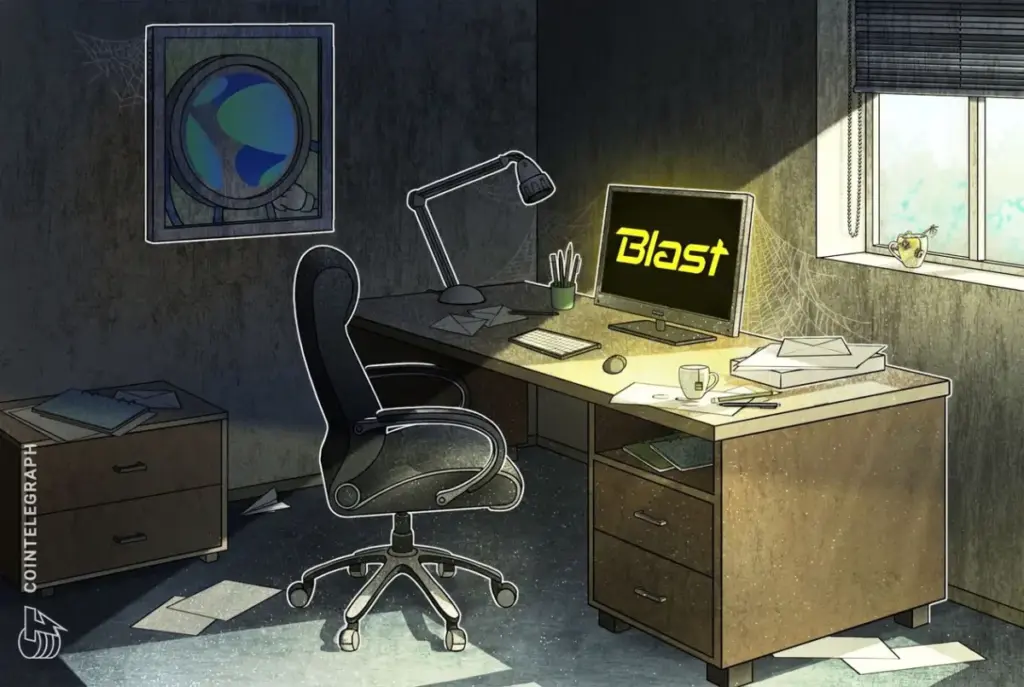
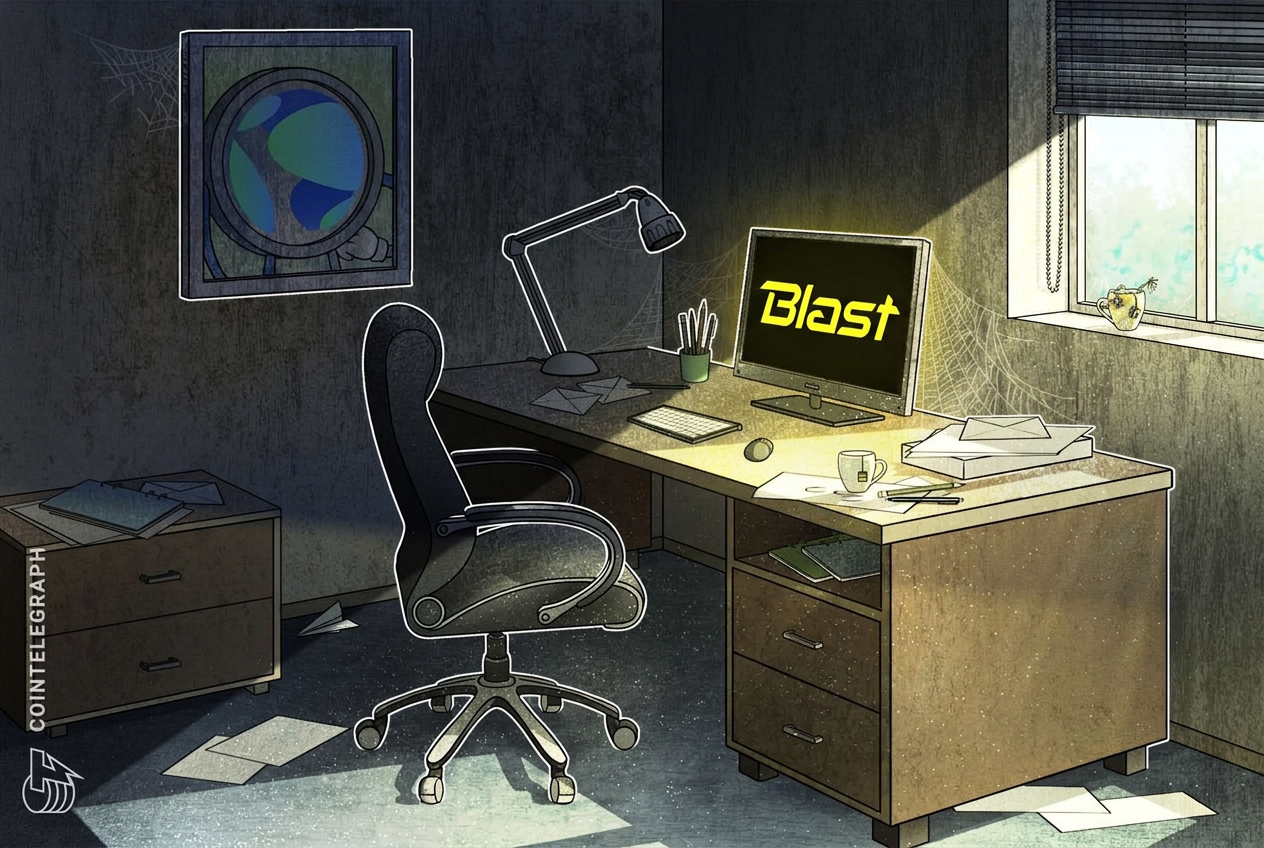
Ethereum layer-2 scaling network Blast is officially shutting down its operations after finding that its ongoing operating costs have exceeded the revenue generated by the chain.
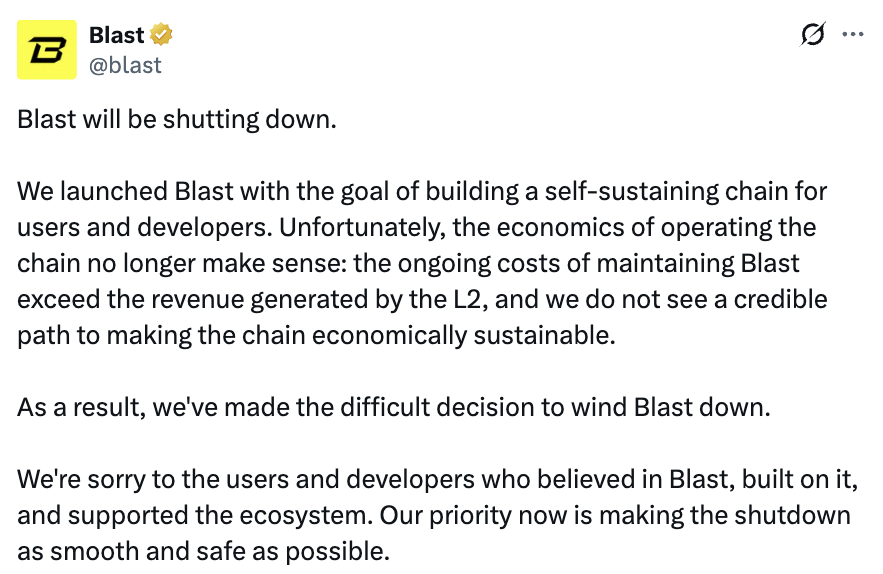
In an official announcement published on Friday via a post on X, the Blast team stated that they see no "credible path" toward making the network economically sustainable over the long term. Consequently, the project operators have strongly urged all platform users to withdraw their digital assets back to the Ethereum mainnet as the network prepares to wind down operations permanently.
"We launched Blast with the goal of building a self-sustaining chain for users and developers," the team wrote in their public statement. "Unfortunately, the economics of operating the chain no longer make sense."
The sudden closure marks a significant milestone for a protocol that once commanded billions of dollars in total value locked and arrived on the decentralized finance scene with immense fanfare and high-profile backing.
Operational Changes and Withdrawal Procedures
As part of the wind-down process, Blast has announced that it will reduce its standard withdrawal delay period to 24 hours to facilitate a faster exit for user funds. However, platform operators noted that withdrawals will be temporarily unavailable while the network systematically unwinds its underlying Lido assets, a technical procedure that is expected to take approximately one week to complete.
Users have been given a firm deadline of October 26 to execute their withdrawals smoothly through the standard Blast user interface. After this cutoff date, platform assets will technically remain accessible, but users will no longer be able to use the web interface. Instead, any remaining funds will require manual interaction directly with the foundational Blast bridge contracts deployed on the Ethereum mainnet.
To assist users during this transition, Blast has promised to publish comprehensive technical instructions detailing how to withdraw funds directly through the bridge contracts ahead of the October 26 deadline. The team has reiterated its call for community members and investors to migrate their capital back to the Ethereum mainnet well before the final automated interface closes.
Blast Emerged From Blur’s NFT Market Boom
The origins of Blast trace back to the height of the non-fungible token boom and the success of Blur, the prominent NFT marketplace founded by Tieshun "Pacman" Roquerre. Blur originally launched in October 2022 with an aggressive strategy aimed squarely at professional traders by offering substantial token incentives. This approach allowed the marketplace to rapidly challenge and eventually surpass OpenSea, which was then the undisputed leader in NFT trading volume. By the end of 2022, Blur had captured a massive share of the market, extending its dominance into early 2023 largely on the back of its highly anticipated token airdrops and lucrative trader reward programs.
Building on the momentum generated by Blur, Roquerre unveiled the concept for Blast in November 2023. The layer-2 network was pitched with unique value propositions, most notably native yield generation on Ether and stablecoins deposited into the ecosystem, alongside a gamified points program tied to an expected token airdrop.
This innovative incentive structure proved remarkably effective at drawing liquidity into the ecosystem. The strategy helped attract more than $2 billion in total deposits before the network even launched its official public mainnet in February 2024.
A Sharp Decline in Total Value Locked
Despite its explosive initial growth and high-profile market entry, Blast found it increasingly difficult to sustain its momentum amid a broader, prolonged downturn in the broader NFT market and shifting macroeconomic conditions within the decentralized finance sector.
According to data tracking from DefiLlama, Blast’s total value locked in decentralized finance applications has declined steadily since reaching an all-time peak of roughly $2.2 billion in June 2024. In the months following that high-water mark, the network suffered a catastrophic drop, shedding more than 98% of its total value locked as users and developers migrated liquidity to competing layer-2 solutions and alternative networks.
The struggles experienced by Blast closely mirror the trajectory of its sister platform, Blur. The NFT marketplace has undergone a similarly dramatic decline in usage and capital retention. Blur’s total value locked, which surged past $200 million during its early 2024 peak, has since contracted sharply and now stands at approximately $27 million, underscoring the deep cooling trend that has affected both protocols since their initial market debuts.
 Non-Fungible Tokens (NFTs)
 Non-Fungible Tokens (NFTs)
 Non-Fungible Tokens (NFTs)