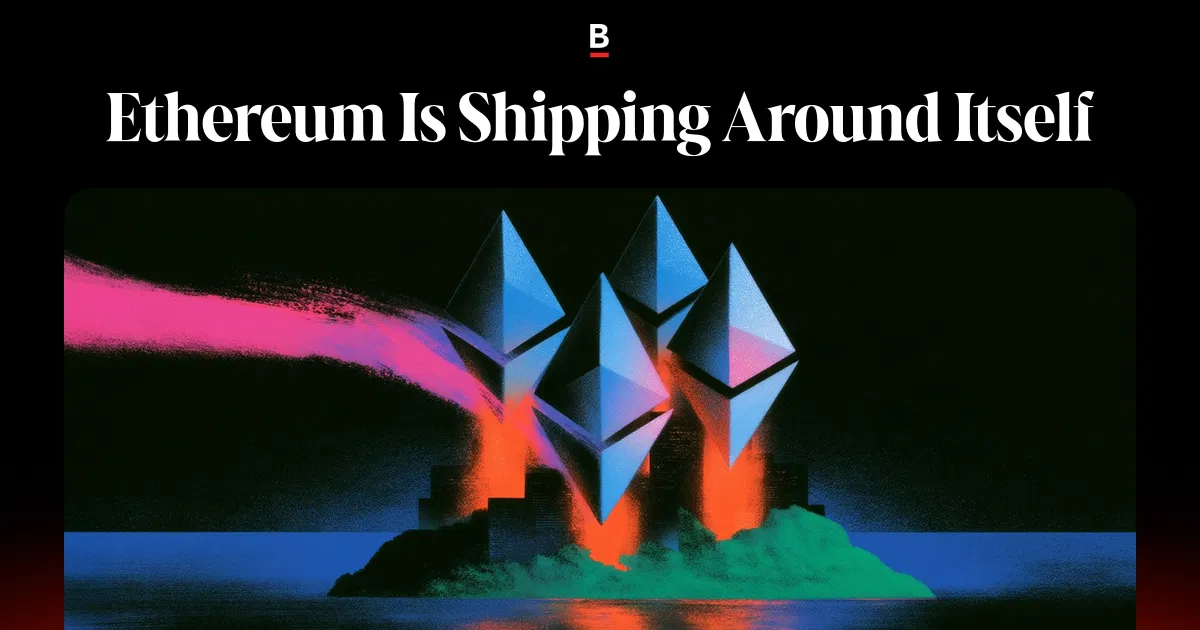
Imagine a decentralized finance lending market that lives on an Ethereum rollup but liquidates loans straight into mainnet liquidity. Even better? Its markets could be cheap to launch and cheaper to use, with collateral sent its way landing almost immediately. Plus, the underlying rollup could prove itself to Ethereum every twelve seconds, even on its absolute worst day.
While this hypothetical system may sound like a distant vision, it is actually much closer to reality than it was a month ago. Crucially, the foundational pieces required to build such an architecture are coming together completely outside of Ethereum’s traditional hard fork pipeline—the slow, deliberate, and methodical process that updates the blockchain’s core consensus rules. In fact, the primary components necessary for this sort of advanced build all took significant steps forward recently, showcasing an emerging DIY dynamic within the broader ecosystem.
Four New Pillars Without Forks
The broader Ethereum developer community is actively expanding what is possible onchain without waiting for core protocol changes. To understand how these systems can be combined, it helps to break down the individual components that have recently advanced and examine how they fit together.
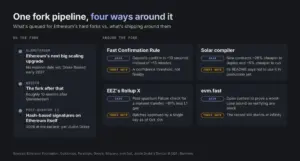
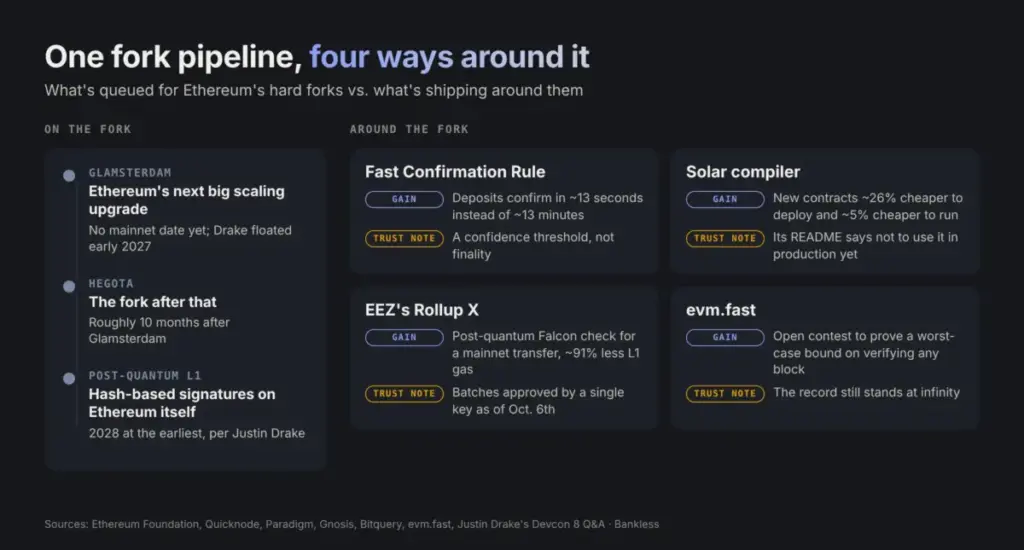
The first major development is Solar, a novel addition to the developer toolkit. In short, Solar can make Ethereum smart contracts significantly cheaper to deploy and execute, and it has arrived entirely without requiring an Ethereum Improvement Proposal. Paradigm shipped version 0.3 of Solar, its new Rust-built Solidity compiler, which translates Solidity code into the raw bytecode that the Ethereum Virtual Machine runs. This release marks the first version that actually produces executable bytecode, allowing developers to test it directly using standard development frameworks like Foundry.
According to Paradigm, contracts compiled with Solar cost roughly twenty-six percent less to deploy and about five percent less to run compared to the long-standing default compiler, solc. These theoretical savings are already bearing fruit in early decentralized finance tests. For instance, in its OUSD repository, Origin reported thirty-five percent cheaper deployments and roughly four percent gas savings per call with zero code changes required.
Of course, the technology is still in its infancy. Solar’s official documentation advises developers not to use it in production just yet, and cost savings are not entirely uniform across all codebases. When Ekubo moved its development branch to Solar, a vast majority of gas measurements fell, but a small handful actually rose. Nevertheless, the overarching potential for developer efficiency and user savings is substantial.
The second major pillar is Rollup X, a project pointing the way toward seamless cross-chain user experience within the Ethereum ecosystem. Earlier exploratory work around the Ethereum Economic Zone—an initiative led by Gnosis and ZisK, and co-funded by the Ethereum Foundation—aimed to give Ethereum and its various rollups synchronous composability. This means one chain’s contract can call another chain’s contract and immediately use the resulting data within the exact same transaction, with the entire operation reverting automatically if any individual piece fails.
During Devcon, the Ethereum Economic Zone launched Rollup X as its first public test network, complete with live demonstrations. In one demonstration, CoW Swap successfully filled a trade signed on Rollup X using liquidity sitting directly on the mainnet, with the resulting tokens landing back on the rollup within the same single transaction. In another demonstration, Rollup X verified a post-quantum signature so that a mainnet contract could successfully act upon it.
While this technology is still maturing—real-time zero-knowledge proofs are not widely expected until later, and Gnosis has noted that the network is not yet meant to hold significant economic value—Rollup X offers an early glimpse into a tightly integrated multi-chain future.
The third pillar involves the Fast Confirmation Rule, which is designed to facilitate incoming deposits and cross-chain transfers in a matter of seconds. Currently, most Layer 2 networks and standard bridges wait for absolute finality before crediting deposits originating from Ethereum, a security measure that typically takes roughly thirteen minutes. According to Ethereum Foundation documentation, the Fast Confirmation Rule instead counts validator attestations—their direct votes on network blocks—allowing a block to be treated as confirmed in about one slot, or roughly thirteen seconds.
This confirmation method is not entirely brand new, as Gnosis bridges have utilized it for Ethereum-origin transfers for weeks. What is new, however, is significantly easier developer access. Network infrastructure providers like QuickNode integrated the Fast Confirmation Rule into beta testing behind the standard safe block tag that applications already call, making adoption considerably simpler for other development teams.
The core trade-off with this approach is that it assumes at least seventy-five percent of the network’s staked ether is honest, online, and submitting attestations on time. If those conditions are not met, the system gracefully falls back to traditional finality, meaning that in extreme and rare scenarios, a fast-confirmed block could theoretically be reorganized.
The final pillar is evm.fast, an initiative tackling the absolute worst-case scenarios associated with cryptographic proving. The vision of proving state transitions to Ethereum in real time depends entirely on provers keeping pace with every single block. For the most part, they manage this successfully; ZisK currently proves the vast majority of Ethereum blocks in under ten seconds. The persistent challenge lies in the long tail of computational complexity. Because no one can yet cryptographically prove the absolute maximum work a single worst-case block could possibly require, a maliciously crafted or exceptionally heavy block could theoretically blow up proving times and stall the bridge.
The evm.fast initiative—launched collaboratively by the Ethereum Foundation, zkSecurity, and Verity Labs on the Yukon research platform—turns this complex problem into an open leaderboard. Entrants compete to prove a hard upper bound on the exact number of basic machine instructions it takes to validate any conceivable Ethereum block. By establishing a rigorous mathematical ceiling, the ecosystem can ensure that block verification remains predictable even under severe network stress.
Putting the Pieces Together
Individually, each of these four pillars represents a powerful upgrade to the developer toolkit. However, when combined, they unlock entirely new classes of decentralized applications that bypass the traditional bottlenecks of core protocol upgrades. Consider how they might integrate into a next-generation decentralized lending market.
In such an architecture, a protocol could utilize Solar to dramatically reduce the gas costs associated with deploying fresh contracts for every new market it opens. Because interest rate and liquidation calculations run continuously on every borrow, repayment, and liquidation event, even modest runtime savings compound rapidly for everyday users.

To handle liquidations safely, the lending protocol could leverage the synchronous composability offered by initiatives like the Ethereum Economic Zone. Liquidating loans on newer Layer 2 chains has historically been risky because local liquidity pools are often too shallow to absorb seized collateral during a market crash. With synchronous cross-chain execution, a liquidator could sell collateral directly into deep mainnet liquidity pools and repay the debt on the rollup within a single atomic transaction. The rollup could then safely list collateral whose true liquidity resides primarily on the mainnet, while arbitrageurs keep prices aligned without taking on traditional bridge risk.
Furthermore, incoming capital could be managed efficiently using the Fast Confirmation Rule. Rather than forcing users to wait thirteen minutes for deposits to clear from Ethereum, the lending market could credit those incoming funds in roughly thirteen seconds, keeping capital productive and allowing liquidity to rush in during periods of high demand. To maintain safety, protocols could apply a temporary discount or conservative cap to fast-confirmed collateral until full finality is achieved, mitigating the risk of bad debt from rare chain reorganizations.
Finally, incorporating worst-case proving bounds ensures that the system remains resilient during severe market crashes. Liquidations are most critical precisely when markets melt down—the exact moments when blocks are fullest and bad actors have the strongest incentives to construct complex transactions designed to slow down proof generation. A proven worst-case proving limit allows operators to provision sufficient infrastructure to guarantee that a proof lands every single slot, turning a system that is "usually fast enough" into one that is provably reliable.
For end users, the practical result of this integrated design is straightforward: the ability to borrow against assets whose deep liquidity resides on the mainnet, move collateral within seconds, experience tighter market pricing, and pay lower transaction fees, all without waiting for a core Ethereum hard fork.
Expanding Horizons Beyond the Bottleneck
This lending market architecture is merely one prominent example of what becomes possible when the ecosystem builds around core protocol constraints. Similar principles can be applied to vastly different domains, such as post-quantum treasury management applications for decentralized autonomous organizations.
In such a setup, signers could approve treasury payouts using quantum-resistant Falcon keys. A rollup would handle the computationally expensive signature verification, and the mainnet treasury could immediately act on that verified result within the same transaction. Furthermore, mainnet would only need to process a fraction of the gas costs typically required for a direct signature check, while compiler optimizations, rapid deposit confirmations, and guaranteed proving ceilings would keep the entire system running smoothly.
Similar architectural upgrades can revitalize decentralized exchanges, payment applications, and onchain gaming. The broader takeaway is that the menu of what developers can successfully build on Ethereum has expanded significantly, all accomplished without requiring a single modification to the base layer.
Ethereum’s deliberate hard fork pipeline remains an intentional and necessary bottleneck. Making core consensus changes to a multi-billion-dollar global settlement layer requires immense caution, rigorous testing, and methodical deliberation. However, the recent wave of off-fork development demonstrates that the ecosystem possesses the ingenuity to innovate outward, significantly broadening the capabilities of the network while core protocol upgrades proceed at their own measured pace.
 Tokenomics & Digital Assets
 Tokenomics & Digital Assets
 Tokenomics & Digital Assets