Luxor’s Monthly Lookback Series provides a comprehensive examination of Bitcoin hashrate market activity, tracing the trajectory of hashprice trends, forward market participation, trading activity, and contract performance. August 2026 proved to be a tale of two distinct halves for the Bitcoin mining and hashprice economy, shifting from a prolonged summer lull into a sharp, macro-driven market repricing that injected fresh capital and optimism into mining fleets worldwide.
August 2026 Spot Hashprice and Its Constituents
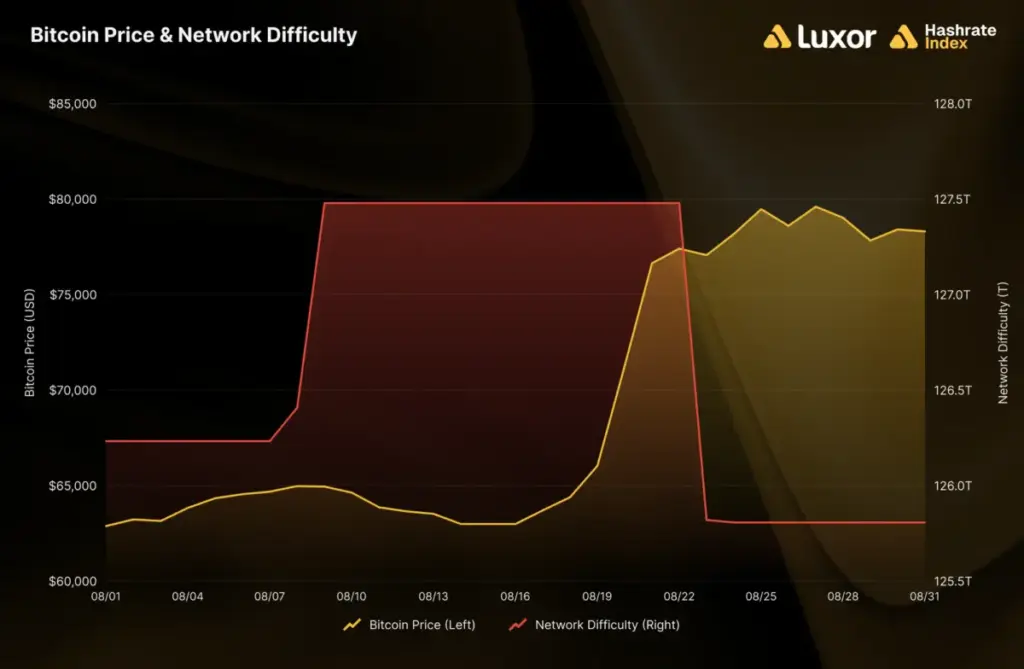
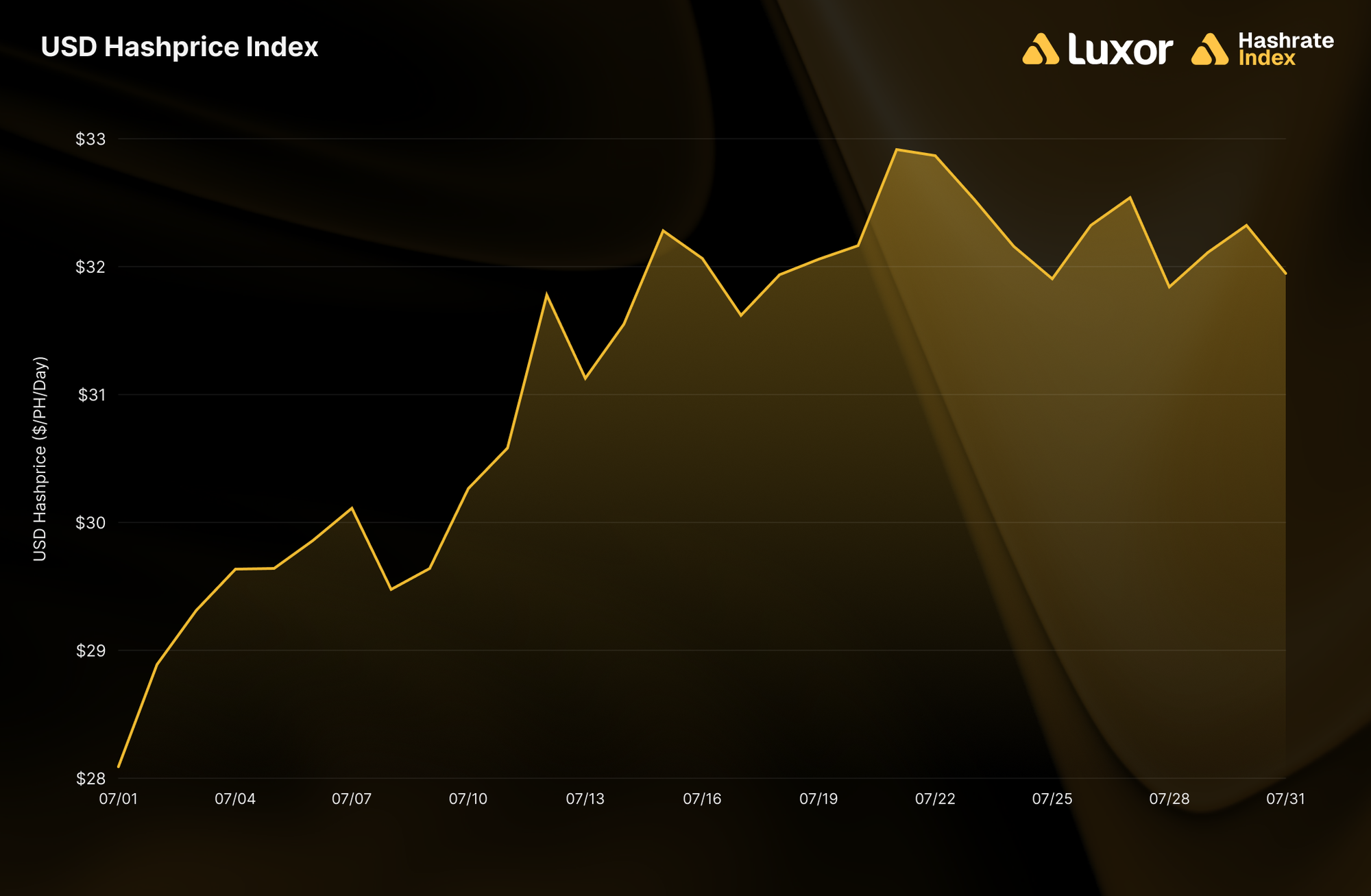
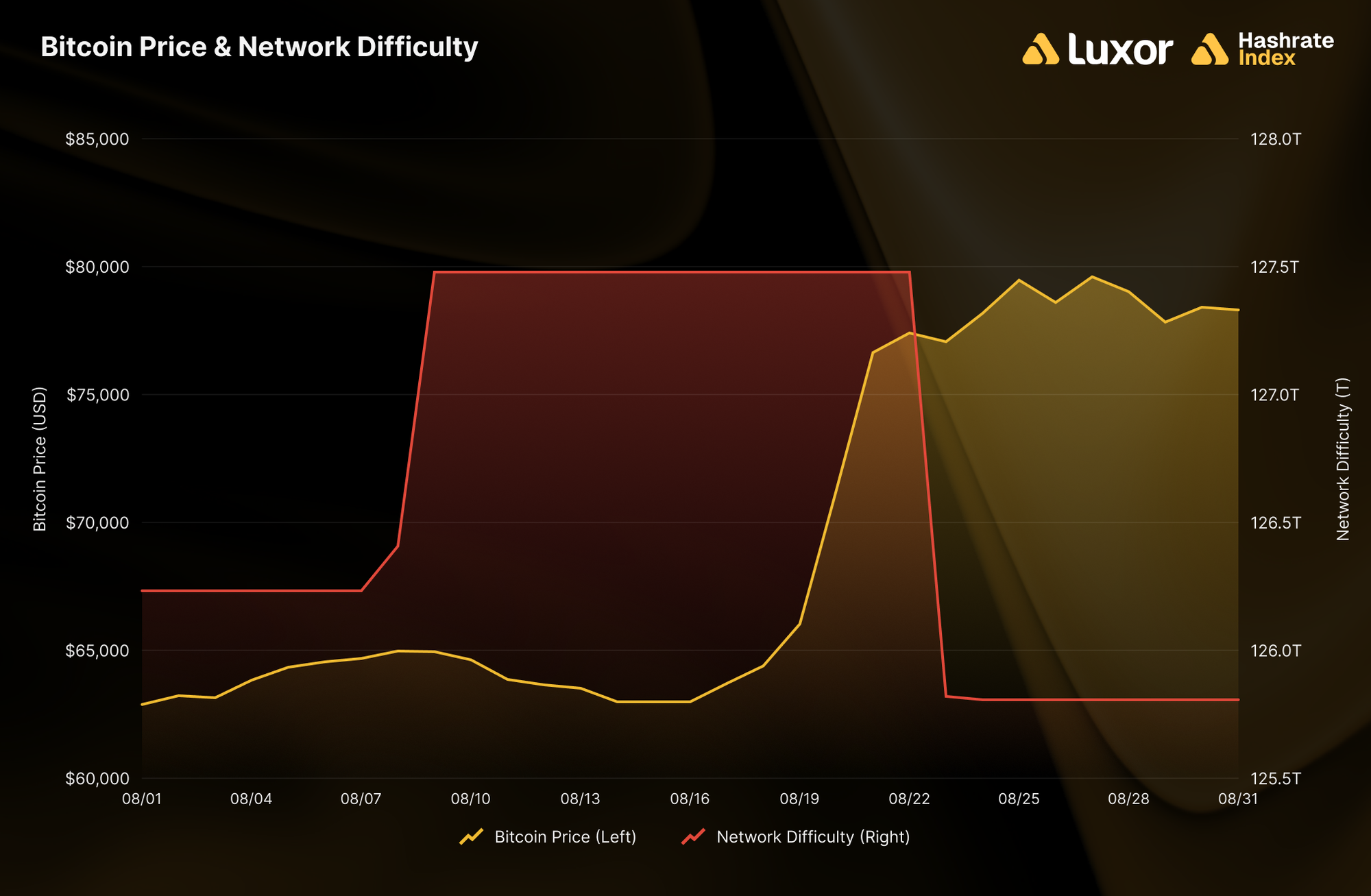
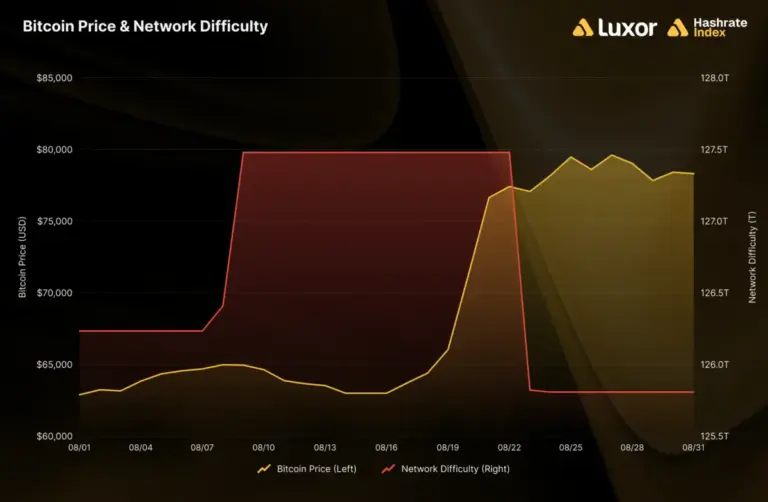
The month of August was characterized by a distinct bifurcation. For the first nineteen days, the market effectively extended the quiet, range-bound conditions seen throughout July. Spot hashprice lingered within a relatively tight band of $31 to $33 per petahash per second per day (PH/s/day), while Bitcoin traded predominantly in the low $60,000 range.

Then, the broader macroeconomic and regulatory environment shifted, causing Bitcoin to reprice aggressively. In the span of just three days, the flagship cryptocurrency surged 19.0%, and spot hashprice followed suit, transforming the economic landscape for mining operators globally.
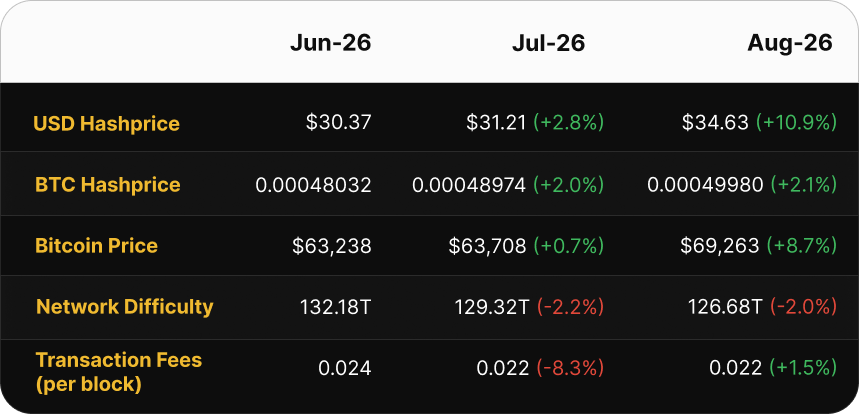
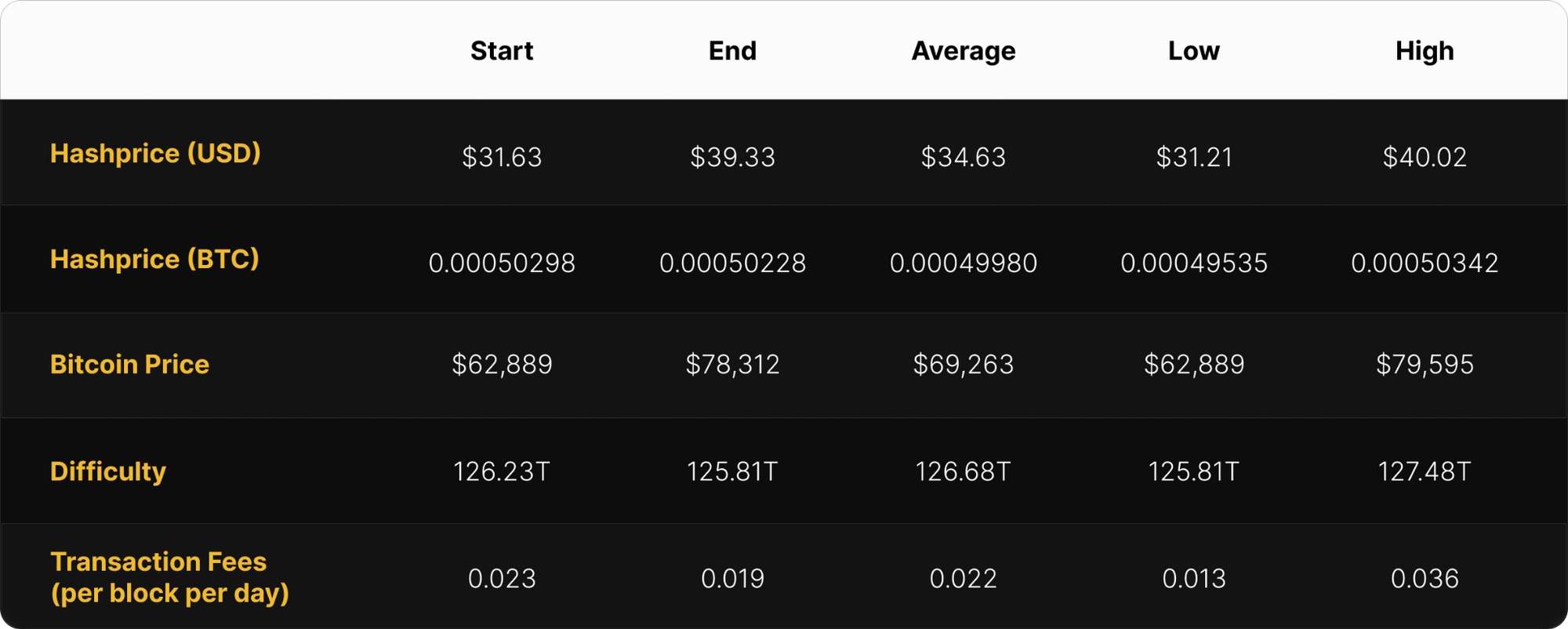
The monthly average USD hashprice rose from $31.21 to $34.63 per PH/s/day, marking a 10.9% month-over-month increase and reaching its highest level since May, when it averaged $36.60. The month opened softly at $31.63, drifting downward to a monthly low of $31.21 on August 16. However, the market reversed sharply, closing the month at $39.33—a 24.4% jump from the opening mark.
When broken down chronologically, the contrast is stark. Between August 1 and August 19, USD hashprice averaged a modest $31.90. From August 20 to August 31, that average climbed to $38.95. In fact, eleven of the final twelve days of the month settled above the $38 threshold, a valuation tier that had not been sustained since May 15.
This 24.4% open-to-close monthly move ranks as the 18th largest out of 116 months recorded since 2017, and stands as the most substantial monthly appreciation since November 2024, when hashprice climbed 30.6%. Furthermore, August 27 marked a notable milestone when daily hashprice hit $40.02, representing the first time hashprice crossed the $40 mark since January 19—a span of 220 days. Although that specific valuation held for only a single day, it underscored the sudden influx of value into the mining sector. By historical comparison, monthly averages throughout 2025 ranged between $37.89 and $59.38 with a mean of $50.68, placing August 2026 approximately 32% below that historical 2025 mean.
Bitcoin Price Performance and Catalysts
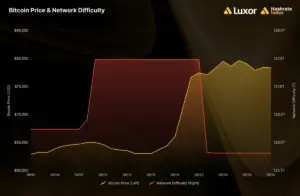
Bitcoin itself opened August at $62,889 and closed at $78,312, registering a 24.5% gain while averaging $69,263 for an 8.7% month-over-month increase. The asset reached a monthly peak of $79,595 on August 27. This performance ranks as the 22nd largest monthly gain out of 116 months since 2017, and the largest since November 2024’s 38.8% surge.
Crucially, the bulk of this movement occurred across an intense three-day window. Bitcoin averaged $66,032 on August 19, before leaping to $71,280 on August 20 and $76,635 on August 21. Specifically, August 20 delivered a 7.9% single-day gain, marking the largest single-day increase since the April 2024 halving. August 21 followed with a 7.5% jump, the third-largest single-day gain of the post-halving era. Combined, these sessions formed the largest two-day move, up 16.1%, and the largest three-day move, up 19.0%, since the halving event, positioning them among the top twenty moves recorded since 2017.
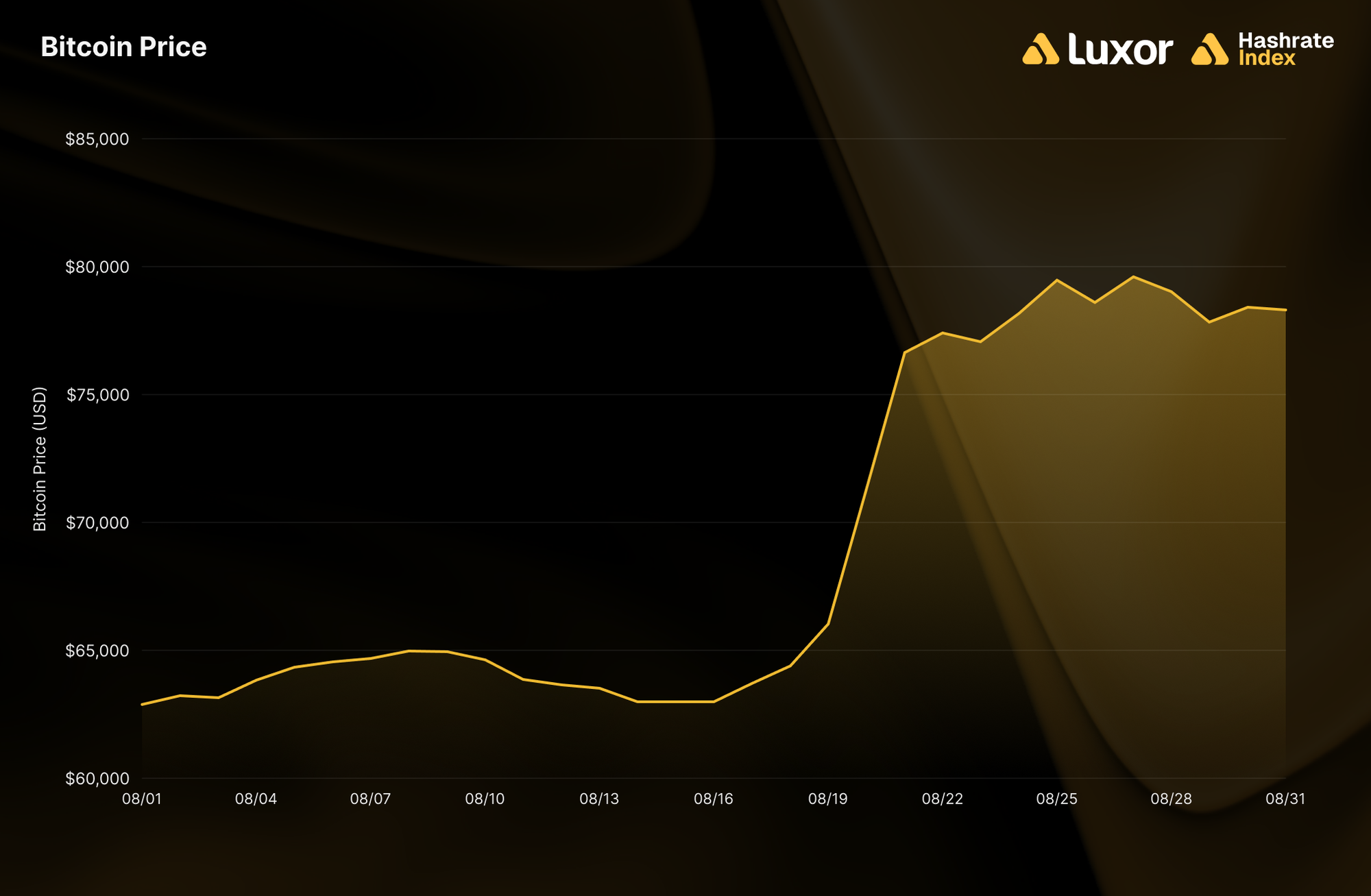
The catalysts behind this sudden repricing were multifaceted, driven by a convergence of regulatory proposals, macroeconomic adjustments, and derivatives liquidations. On August 18, the U.S. Securities and Exchange Commission proposed Regulation Crypto Assets, its first rulemaking dedicated exclusively to crypto offerings, which proposed exempting capital raises of up to $5 million and $75 million from traditional Securities Act registration requirements.
The following day, the U.S. Treasury announced plans to at least double its long-end debt buyback operations from $2 billion to $4 billion, effective September 9. Concurrently, 30-year Treasury yields pulled back nearly 10 basis points from a 19-year high. On August 20, political momentum accelerated when President Trump publicly urged the Senate to pass the Clarity Act. These policy developments triggered a massive liquidation event across derivatives markets, clearing out approximately $2.7 billion in crypto short positions.
Spot Bitcoin ETFs reinforced the rally rather than leading it, recording $3.52 billion in net inflows throughout August compared to just $172 million in July. These funds registered positive inflows on 16 of the 21 trading sessions, driving total assets under management from $76.3 billion to $99.6 billion.
The rally encountered its first major headwind on August 28 during the annual Jackson Hole economic symposium. Federal Reserve Chair Kevin Warsh delivered a keynote speech describing summer inflation readings as insufficient to signal trend improvements. Consequently, CME FedWatch probabilities of a September interest rate hike spiked from a range of 33% to 40% up to 57% to 66%. Bitcoin subsequently relinquished 1.5% of its value the following day. Despite closing at $78,312, Bitcoin remained 37.1% below its all-time peak of $124,485 reached on October 6, 2025, though this represented a recovery from the 48.9% discount seen at the end of July and the 52.6% trough recorded in June.
Network Difficulty and Block Dynamics
Network difficulty averaged 126.68T across August, marking a 2.0% decrease from July levels. The network experienced two adjustments during the month: a 0.99% upward adjustment on August 8, which nudged difficulty from 126.23T to 127.48T, followed by a 1.31% downward adjustment on August 23 that brought it to 125.81T. The net result was a negligible 0.34% change, creating a stark contrast to July’s steep 5.71% decline.
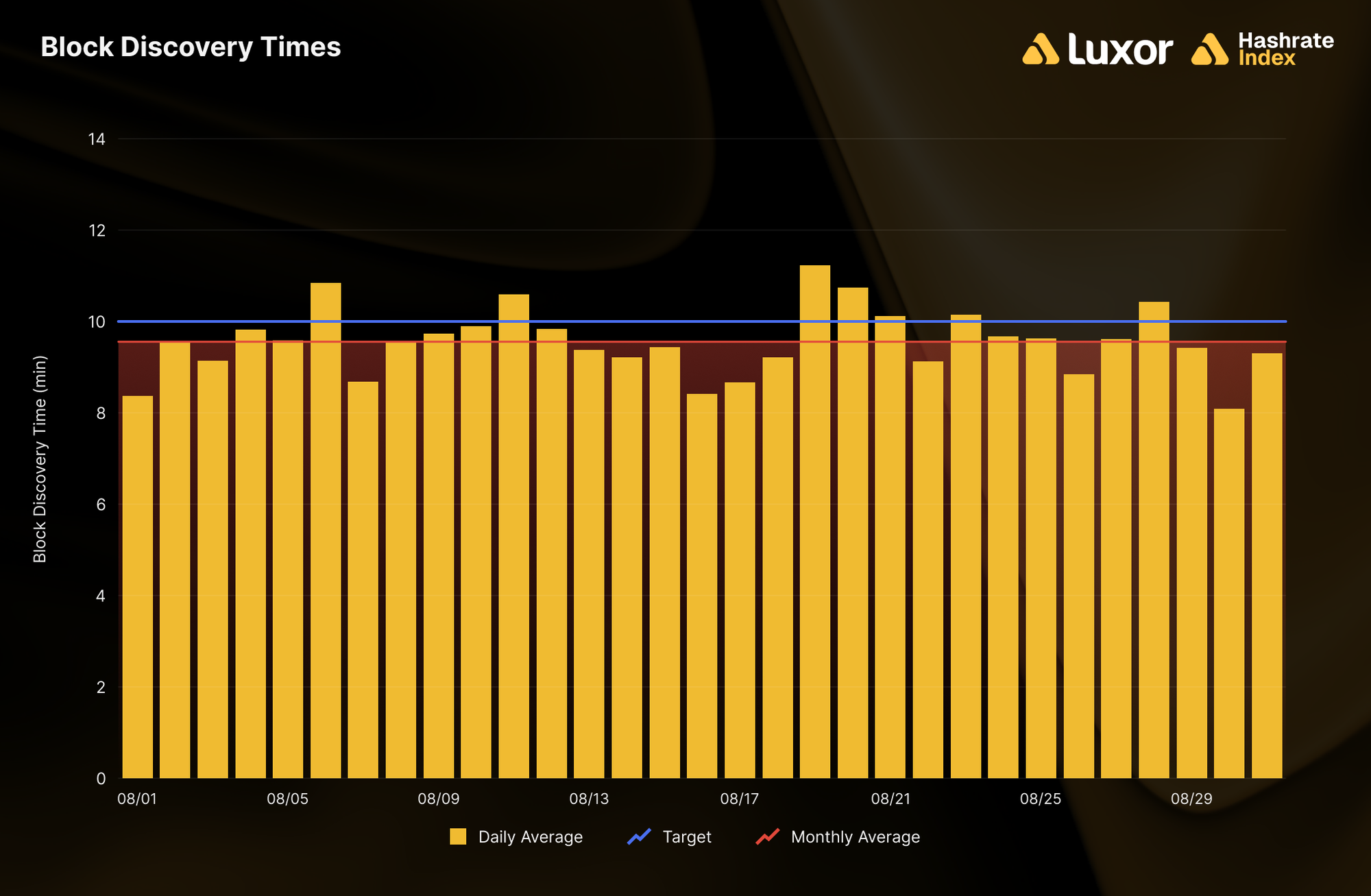
Block times averaged 9 minutes and 34 seconds, faster than July’s 9-minute and 55-minute average. Out of 31 days in the month, 24 recorded average block times running beneath the target 10-minute threshold, with the fastest daily average clocking in at 8 minutes and 6 seconds on August 30. Overall, the network produced blocks approximately 4.6% faster than prevailing difficulty levels implied, indicating that marginal hashrate forced offline during the June and July troughs was steadily returning to the network.
August 23 marked the twelfth consecutive adjustment where difficulty remained below the 139.70T mark—the rough equivalent of 1 exahash per second (EH/s) scaling—a streak that has persisted since March 20. Seasonal power management, particularly the 4CP transmission cost drag in regions like Texas, continued to influence operations. August’s two adjustments averaged a minor 0.16% reduction, contrasting with the historical 2022–2025 August norm of a 2.04% increase.
Transaction Fees and Hashprice Valuations
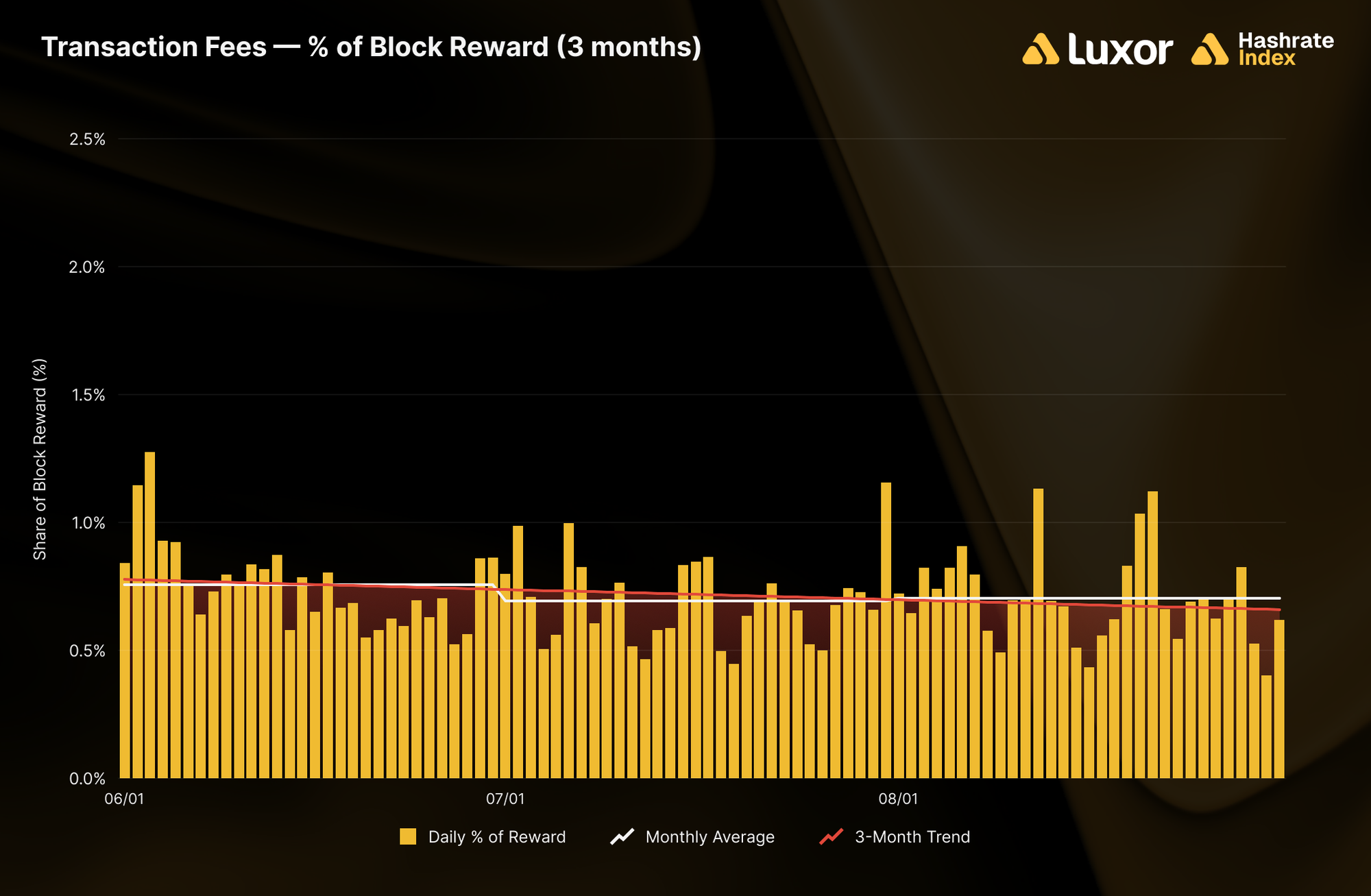
Average transaction fee collection rose 1.5% month-over-month to 0.02218 BTC per block. Fees accounted for just 0.70% of total block rewards, marking the fourteenth consecutive month that fee contribution remained below the 1% threshold. In dollar terms, the average block earned approximately $1,534 in fees, a 10.3% increase driven entirely by Bitcoin’s price appreciation rather than underlying network activity. Total monthly network fee revenue reached approximately $6.85 million.
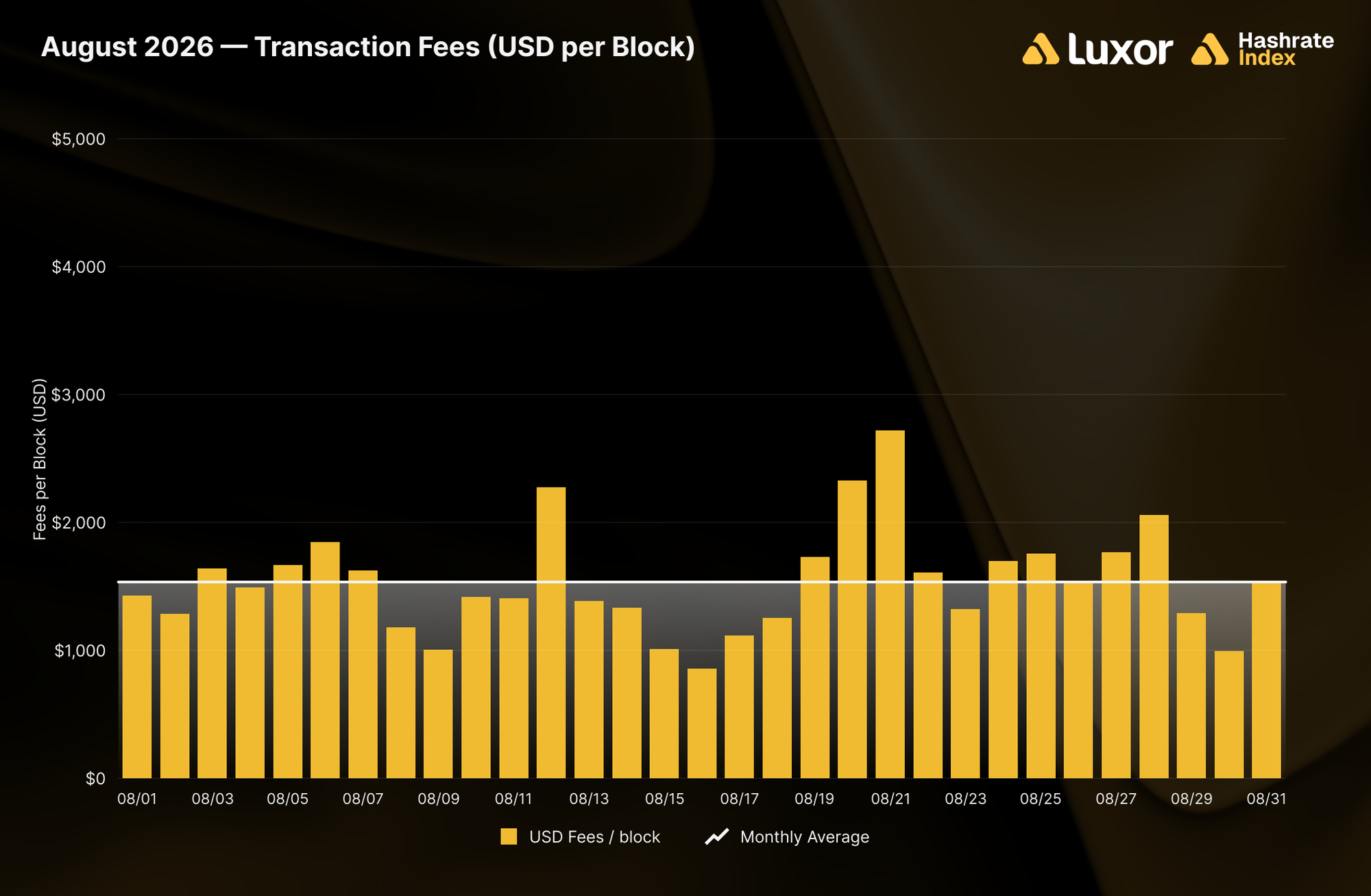
Fee collection spiked temporarily on August 12, averaging 0.03576 BTC per block—61% above the monthly average. This anomaly was traced to a single mining event: block 962,142, mined by SpiderPool at 12:16 UTC, contained 1.82 BTC in fees. Of that total, 1.60 BTC originated from a single transaction whose automated Replace-by-Fee script repeatedly incremented the attached fee every second until the entire transaction input was consumed as a fee with zero output value. The user inadvertently paid roughly $103,000 in fees to send nothing. Excluding this isolated transaction, the August 12 average normalized to 0.0330 BTC per block.
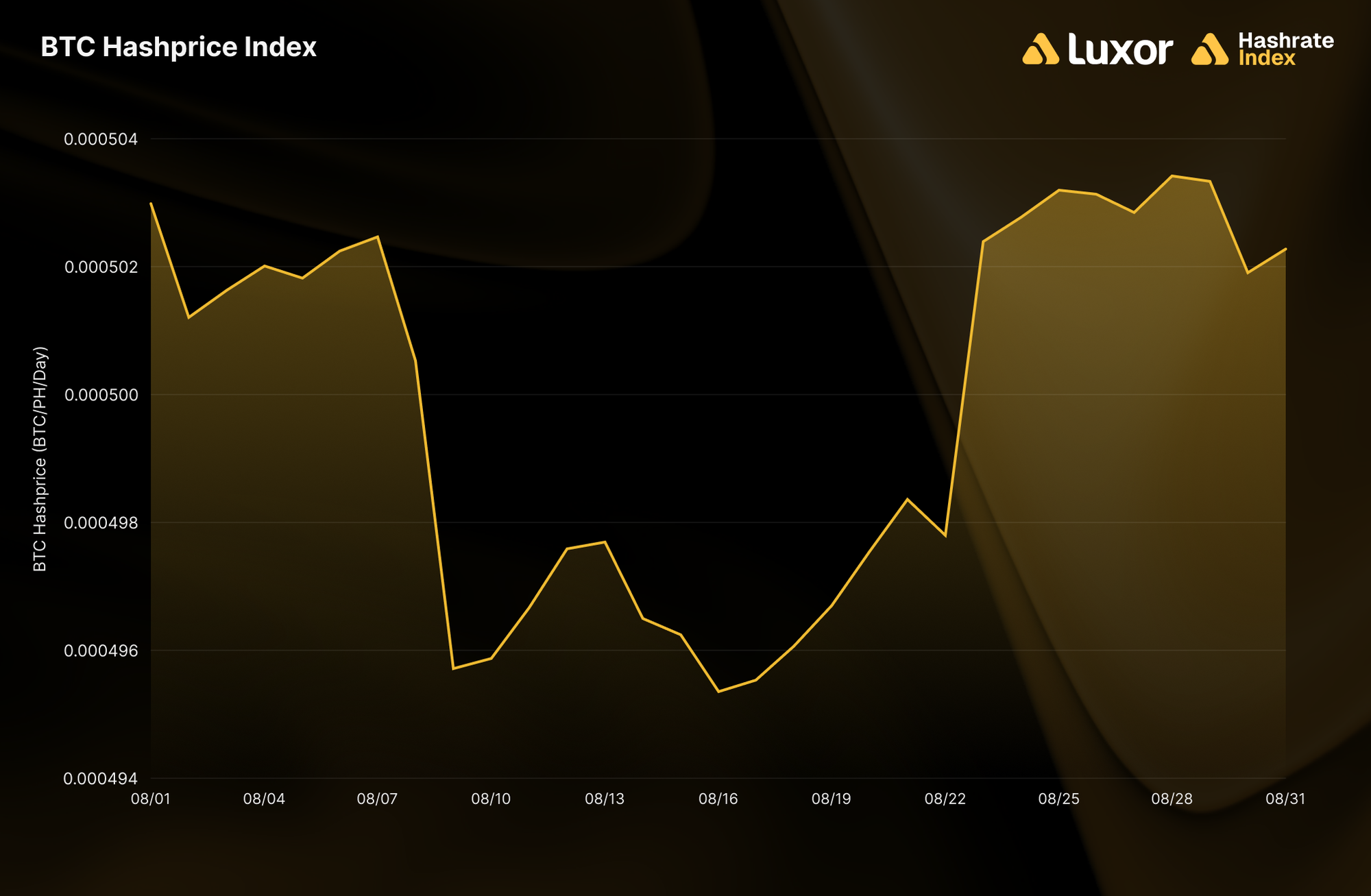
In BTC-denominated terms, the monthly average hashprice rose 2.1% from 0.00048974 to 0.00049980 BTC per PH/s/day, reaching its highest level since July 2025, supported by the lower average difficulty environment.
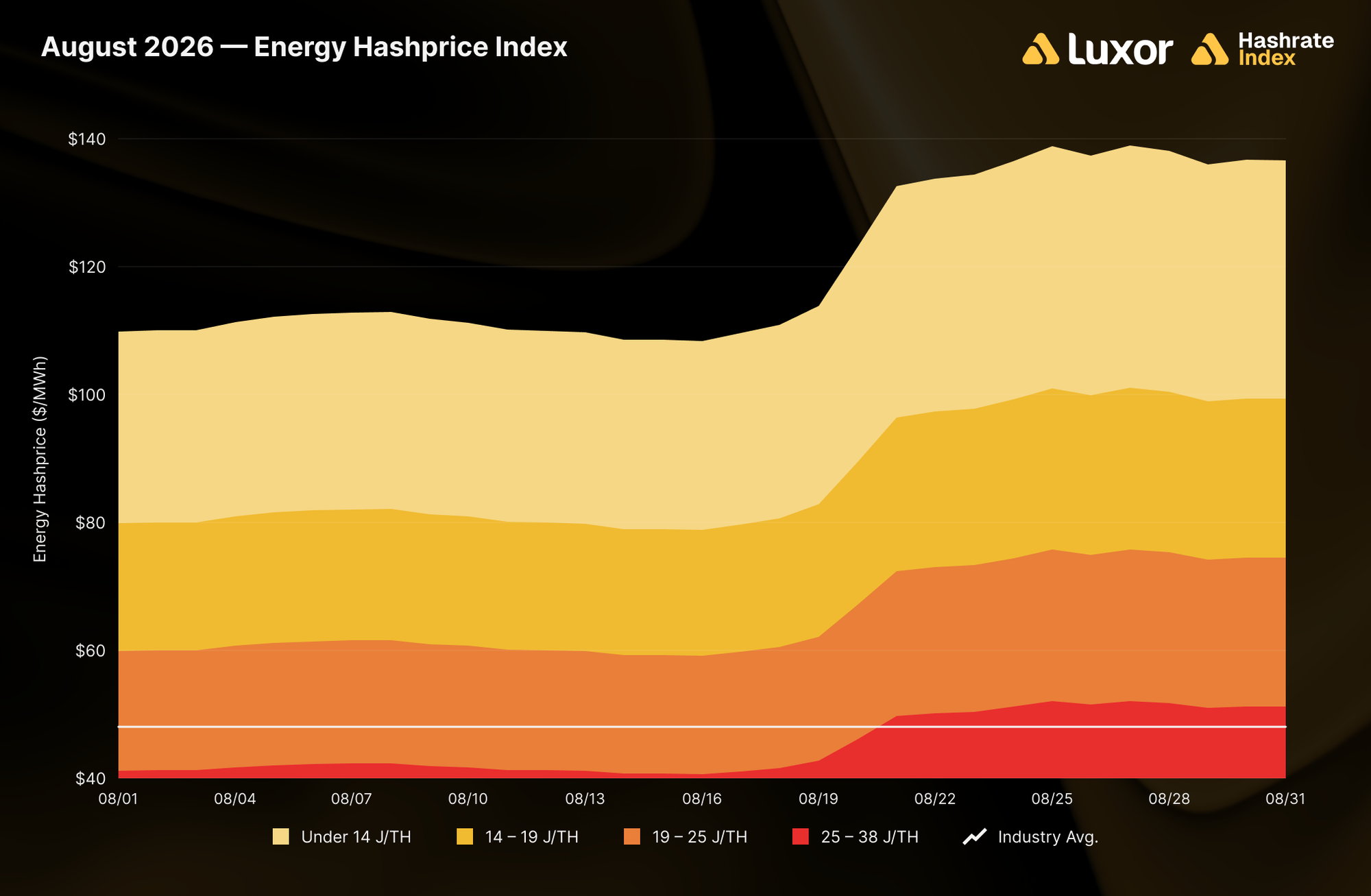
For energy-adjusted hashprice metrics, marginal fleets found temporary relief. Against a network-average power cost of roughly $48 per megawatt-hour (MWh), the 25 to 38 joules per terahash (J/TH) efficiency tier spent a third consecutive month below breakeven on average. However, this tier successfully cleared the $48 power cost threshold on 11 out of 31 days, peaking at $52/MWh on August 27 and sustaining levels above $51/MWh through month-end. Meanwhile, the most efficient modern fleets concluded the month operating above $135/MWh in energy hashprice terms.
Hashrate Market Activity and Forward Contracts
Analysis of Luxor’s hashrate forward market highlights how forward contracts traded in preceding months and how the forward curve shifted during August. Luxor’s Non-Deliverable Hashrate Forward (NDF) and Deliverable Hashrate Forward (DF) markets continued to serve as vital instruments for risk management and capital formation.
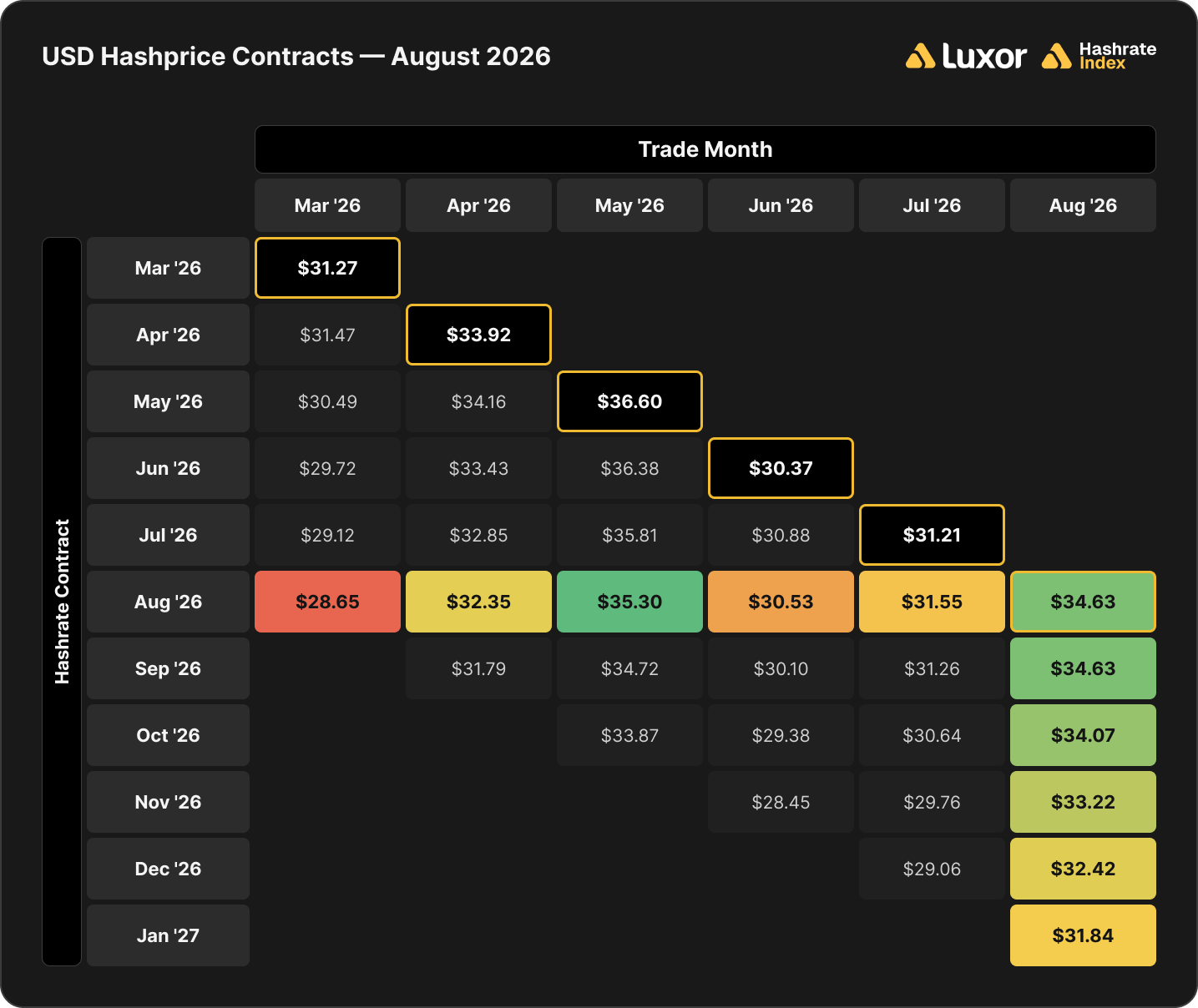
Lenders remained active on the buy side of the deliverable forward market, while public and private mining operators utilized forward contracts to lock in revenue, secure non-dilutive financing, and fund fleet expansions. Because deliverable forwards are prepaid, they typically trade at a discount to non-deliverable forwards to compensate buyers for credit risk and capital costs. Pairing a deliverable forward with an offsetting non-deliverable forward allows market participants to lock in this spread as a fixed, BTC-denominated yield for lenders or a predictable financing cost for miners. In August 2026, this annualized yield ranged between 6% and 13%.
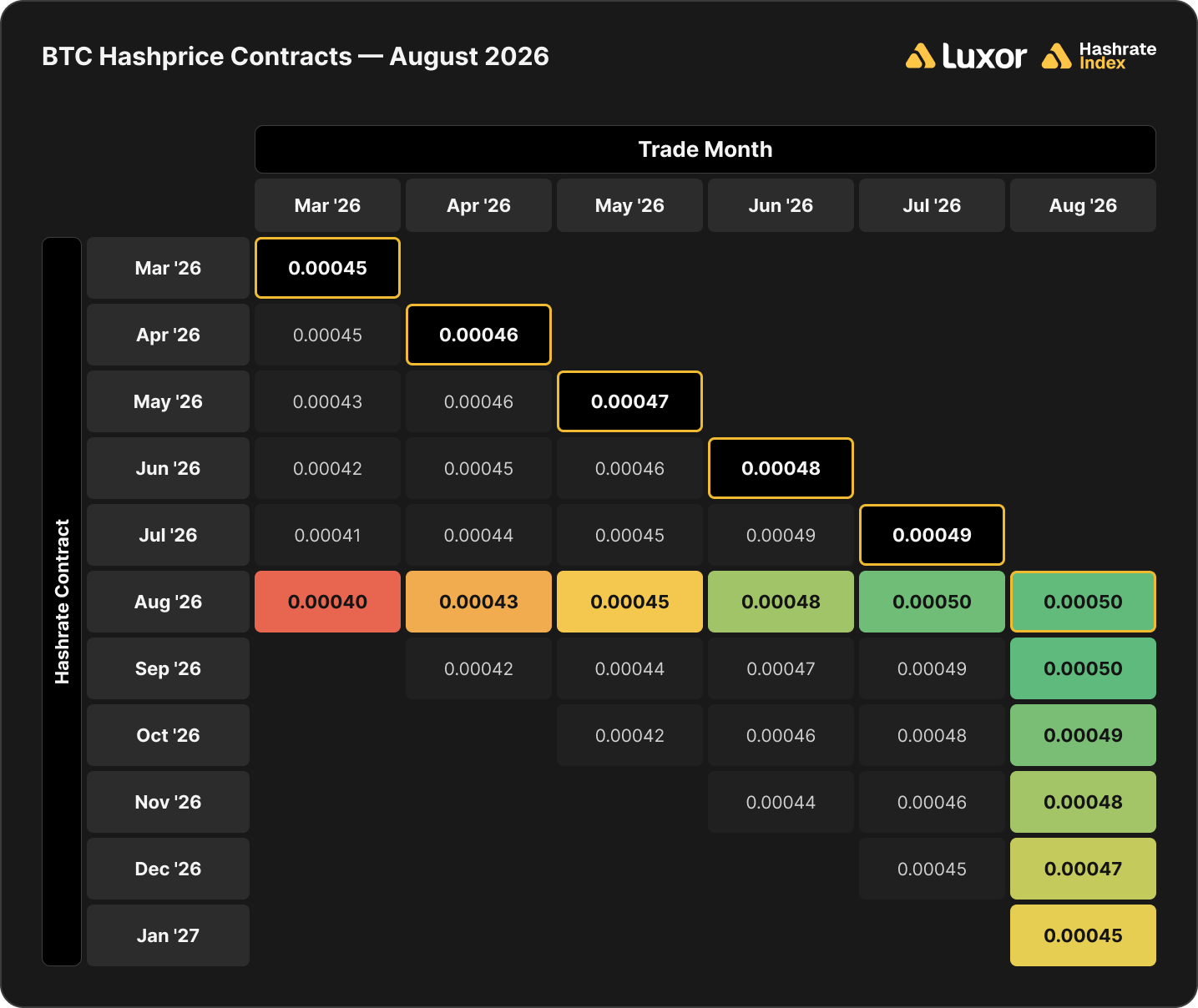
For sellers of the August USD-denominated contract, locked-in rates ranged from $28.65 to $35.30 per PH/s/day against a final spot settlement of $34.63. Only May’s three-month sale contract at $35.30 outperformed spot settlement, yielding a 1.9% return or roughly $20,819 per EH/s. All other hedges struck during earlier 2026 market lows missed the late-month price rally. Conversely, in BTC terms, buyers of forward contracts outperformed at every horizon for the fifth consecutive month, as actual difficulty remained below the forward curve’s expectations.
Across the trailing twelve months, rolling USD hashprice hedges outperformed spot at every horizon, delivering gains ranging from 5.0% for 1-month rolls to 12.5% for 5-month rolls. Conversely, rolling BTC hashprice hedges underperformed spot across all horizons, showing losses between 0.4% and 8.5%. However, looking across the entire post-halving period since May 2024, the dynamic inverts: long-duration BTC hashprice hedges maintained a lead, with the 5-month roll standing at 7.6% above spot, compared to USD hedges clustered between 1.5% and 2.4%.
During August, the USD-denominated forward curve moved in tandem with spot hashprice. Lock-in rates for the September 2026 through January 2027 contracts rose 23.8% between August 3 and August 31, closely mirroring the 24.2% gain in spot hashprice. Meanwhile, the BTC-denominated forward curve remained relatively flat, moving up by just 1.3% on average. This divergence indicated that the market repriced Bitcoin upward while maintaining its underlying expectations for network difficulty and transaction fees largely unchanged.
Implied Bitcoin prices derived from dividing USD contract values by BTC contract values showed the September contract’s implied price moving from approximately $63,600 to $78,500, with the broader curve settling between $78,000 and $79,600 across all five forward months. Based on an assumed transaction fee collection of 0.0222 BTC per block, the forward market raised its expectation for September difficulty by 1.0% to 126.62T, reflecting a network already operating faster than its nominal target. Conversely, the market trimmed its expectations for October through January by 1.0% to 2.2%, adjusting implied December hashrate from 985 EH down to 964 EH, and January 2027 from 1,007 EH down to 985 EH. This marked the third consecutive month that the forward curve moderated its autumn expansion expectations.
Concluding Outlook for the Mining Sector
As September commenced, the market held onto the gains established late in August. Through the first week of September, spot hashprice averaged $39.60 while Bitcoin hovered near $79,000.
Industry breakeven efficiency thresholds shifted accordingly. With estimated industry-average power costs at $0.048/kWh, July’s $31.21 hashprice placed breakeven efficiency near 27 J/TH. At August’s average of $34.63, breakeven moved to approximately 30 J/TH, and at $40 hashprice, it extended to roughly 35 J/TH. This provided much-needed relief to the 25 to 38 J/TH efficiency tier that had spent much of the summer operating underwater.
Looking ahead, market participants are closely monitoring upcoming macroeconomic events, particularly the Federal Reserve’s FOMC rate decision and discussions surrounding legislative frameworks like the Clarity Act. With estimated total net ASIC capacity standing at approximately 1,150 EH against an active hashrate of roughly 915 EH/s, an estimated 235 EH remains offline, curtailed, or in transit. As miners return equipment to operation in response to higher hashprices, subsequent difficulty adjustments will determine whether the network absorbs this returning capacity or if rising difficulty begins to compress miner margins once again.
 Cryptocurrency Mining
 Cryptocurrency Mining
 Cryptocurrency Mining