In the fast-paced and often unpredictable world of cryptocurrency derivatives trading, market participants are constantly forced to adapt their strategies in real time as price action unfolds across various timeframes. This dynamic was recently highlighted in a trading update concerning the JSTUSDT perpetual contract, where a market participant detailed a calculated re-entry into a long position following an initial misstep and subsequent stop-loss execution. The update provides a transparent look into the analytical process of identifying structural market errors, refining entry parameters based on higher-timeframe zones, and managing risk in volatile digital asset markets.
The sequence of events began with an initial long entry strategy that was predicated on confirmation signals emerging from a smaller, localized fair value gap on the price charts. In modern technical analysis, a fair value gap represents an imbalance or inefficiency in price delivery, often acting as a magnet where prices tend to retrace before continuing in the direction of the prevailing trend. However, trading these imbalances requires a keen understanding of scale and hierarchy within market structures.
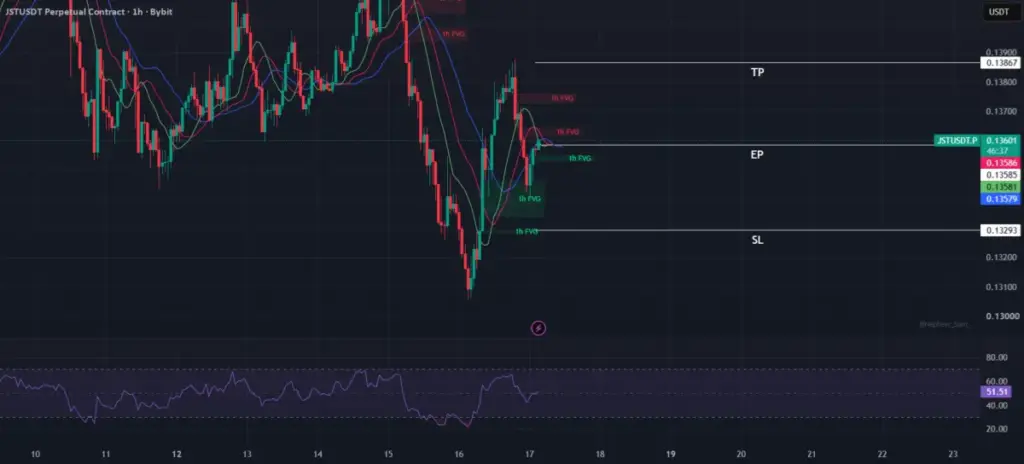
Reflecting on the initial trade, the analyst acknowledged a critical tactical error in the execution phase. The primary mistake lay in prematurely selecting the smaller fair value gap as the primary zone of interest before the asset’s price had fully descended into a more significant and structurally sound bullish fair value gap clearly visible on the higher-timeframe one-hour chart. In technical trading methodology, higher-timeframe zones typically carry substantially more weight and reliability than lower-timeframe counterparts, as they represent broader institutional interest and more significant liquidity pools.
Consequently, the initial long position failed to sustain its upward momentum, leading to a natural downward continuation that ultimately triggered the pre-determined stop-loss order. In professional trading, hitting a stop loss is a standard component of risk management designed to protect capital from catastrophic drawdowns during incorrect market assumptions. Rather than abandoning the broader bullish thesis for the asset, the trader monitored how the market reacted once it reached the more robust, larger-scale fair value gap identified on the one-hour timeframe.
Following the initial trade hitting its stop loss, the price action performed a deeper retracement directly into this larger fair value gap. This movement aligned with the trader’s broader hypothesis regarding the asset’s underlying market structure. Instead of jumping into the market impulsively upon the initial touch of the zone, the trader exercised patience by waiting for concrete market confirmation before committing capital to a new long position. Confirmation signals in this context typically involve localized structural shifts or candlestick patterns that indicate institutional buying pressure stepping in to defend the liquidity zone.
Once the requisite confirmation materialized, a new long position was initiated on the JSTUSDT perpetual contract. To maintain disciplined risk parameters, the stop loss for this secondary attempt was strategically placed just below the absolute low of the large, defining candle that was directly associated with the formation of the larger fair value gap. Positioning the stop loss beyond the structural invalidation point ensures that if the broader thesis fails and the price breaks below the foundational support zone, the trade is automatically closed with a manageable, predetermined loss.
Regarding the upside objectives for this reattempted long position, the target has been established at a conservative risk-to-reward ratio of one-to-one. This means that the projected profit target is equal in distance to the risk assumed via the stop loss placement, reflecting a pragmatic approach to the current market conditions surrounding the JSTUSDT perpetual contract. By maintaining a balanced risk profile, the strategy aims to capture a measured upward expansion without overextending expectations in a potentially range-bound or volatile environment.
Disclaimer
The information and publications provided in this report are not meant to be, and do not constitute, financial, investment, trading, or other types of advice or recommendations supplied or endorsed by TradingView. Readers seeking to engage in cryptocurrency trading or investment activities should conduct their own thorough research and risk assessment before committing capital to digital asset markets. Further details and policy guidelines regarding financial decisions and trading disclosures can be found directly within the official Terms of Use.
 Crypto Investing & Trading
 Crypto Investing & Trading
 Crypto Investing & Trading