The broader structural outlook for Bitcoin remains firmly anchored in a bearish trend, according to recent market observations and technical assessments. While market participants continually attempt to pinpoint exact reversal points and trend continuations, recent price action has highlighted the intricate ways in which institutional and retail order flow can temporarily disrupt expected trajectories. Analysts examining the leading cryptocurrency have pointed to a nuanced sequence of events surrounding key technical boundaries, shedding light on why previous projections regarding the timing of a sustained decline required reassessment.
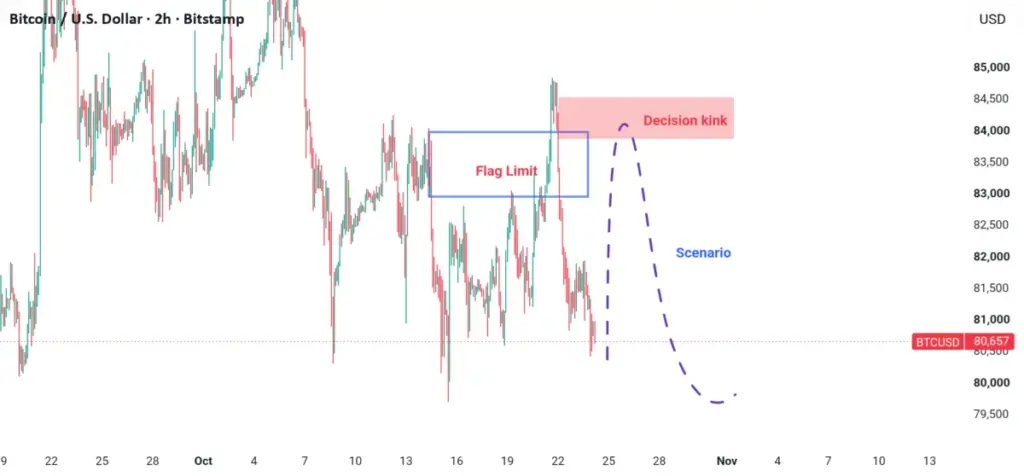
In a prior technical evaluation of Bitcoin’s price action, market observers anticipated that a downward impulsive move would initiate directly from a clearly designated limit flag. In technical analysis, a limit flag often serves as a conceptual marker for significant supply zones, liquidity pools, or areas where large limit orders are concentrated. The initial hypothesis suggested that upon reaching this specific threshold, selling pressure would definitively outweigh buying interest, triggering the anticipated bearish retracement without substantial delay.
However, live market conditions frequently introduce complexities that standard linear projections fail to capture immediately. As the price approached the anticipated inflection zone, market data revealed the presence of a distinct underlying order resting just below the primary limit flag. This hidden or secondary liquidity pocket was actively loaded by incoming market orders, absorbing momentum and altering the immediate mechanics of the exchange order book.
When such localized liquidity clusters are engaged, the market often experiences a period of absorption rather than an immediate rejection. In the case of Bitcoin’s recent movements, this specific area below the primary marker became a focal point for transaction execution. The presence of these loaded orders meant that the initial limit flag was not merely touched and respected as a rigid ceiling; instead, it was subjected to repeated interactions, effectively being loaded and reloaded as market participants transacted within the zone.

This dynamic of repeated loading and reloading fundamentally changes how a price zone behaves during subsequent retracements. Rather than acting as a simple, impenetrable barrier that instantly repels upward momentum, the zone evolved into a fortified operational area. Consequently, when the price experienced subsequent retracements, the underlying accumulation of orders within this band proved resilient enough to hold the price temporarily, delaying the anticipated bearish continuation and creating a tighter consolidation range than many market participants had initially factored into their short-term strategies.
The interplay between supply and demand zones remains a cornerstone of professional market analysis, particularly in highly liquid yet volatile asset classes like cryptocurrency. Supply and demand concepts focus on tracking where significant institutional orders reside, rather than relying solely on lagging momentum indicators. When large blocks of orders are loaded into specific price brackets, they can temporarily distort traditional technical patterns, causing prices to linger or retrace in ways that challenge conventional expectations.
As Bitcoin continues to trade within this broader bearish framework, market participants are keeping a close watch on how these zones react to ongoing volume fluctuations. The ability of the lower loaded area to maintain its integrity during retracements underscores the importance of looking deeper into order book dynamics and liquidity distribution. While the overarching macro trend continues to favor downward pressure, these localized structural nuances demonstrate that short-term price behavior is frequently dictated by the micro-mechanics of order execution rather than sweeping directional momentum alone.
As is standard practice across major financial and cryptographic tracking platforms, market analyses of this nature serve informational and analytical purposes rather than acting as definitive financial directives. Information concerning supply and demand dynamics, technical configurations, and price action interpretations provided by market analysts and charting platforms does not constitute financial, investment, trading, or other forms of professional advice. Market participants engaging with digital assets must consider the inherent risks associated with cryptocurrency volatility and the complex nature of order flow execution.
 Crypto Investing & Trading
 Crypto Investing & Trading
 Crypto Investing & Trading