Global financial markets faced heightened pre-FOMC volatility as traders navigated a compressed trading environment characterized by contracting volume, sharp reversals, and failed breakout attempts across both precious metals and digital assets. A comprehensive review of the active trading scorecard since the morning session reveals that while selective short positions delivered solid gains, attempts to catch long entries against prevailing momentum proved costly in an environment stripped of sustained buying fuel.
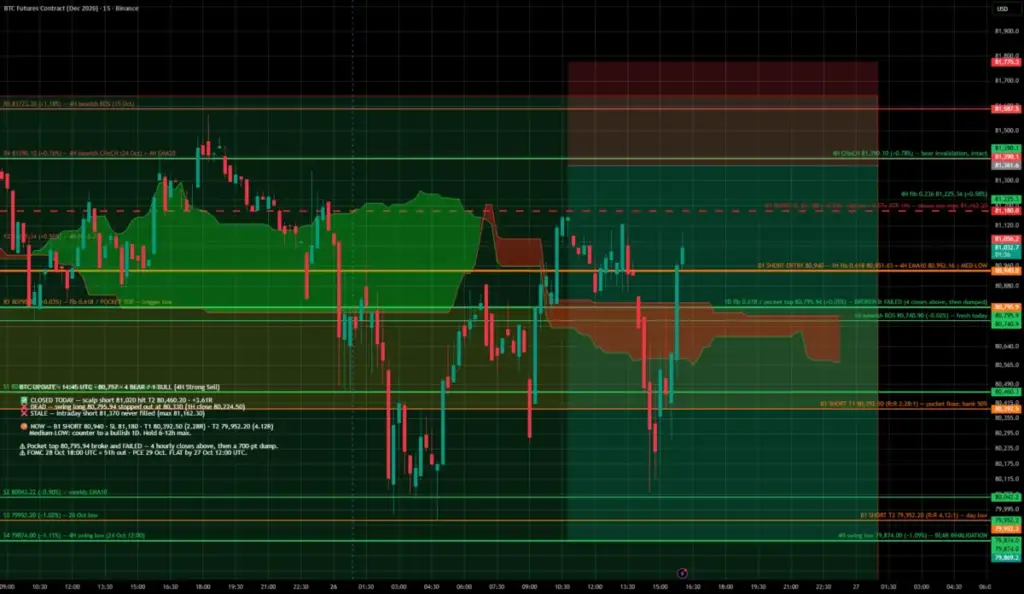
The morning session set a definitive tone for the day’s price action. Early trades targeted a gold scalp short from $4,021.00, which successfully triggered and hit both primary targets at $4,007.20 and $3,998.99, extending down to a one-hour low of $3,988.83 to secure a rewarding 3.24R return. Similarly, a Bitcoin scalp short initiated at $81,020 triggered cleanly, hitting its second target at $80,460.20 and dropping to a session low of $80,063 for a 3.61R gain. Combined, these two short positions delivered a strong 6.85R return for the active book, vindicating the bearish pressure observed at key technical levels.
However, not all planned executions materialized or ended in profit. An intraday gold short opened at $4,018.50 experienced minor drawdowns, hovering around eleven percent of total risk while its stop-loss at $4,035.50 remained entirely intact. Meanwhile, a Bitcoin intraday short placed at $81,370 never filled as price action topped out at $81,162.30 before reversing downward, leaving the order stale without an entry. A swing short on gold from $4,026.00 missed its activation by a mere fifty-eight cents, with the asset’s high printing at $4,025.42.
The most notable blemish on the session’s ledger came from a low-probability Bitcoin swing long initiated at $80,795.94. Bought directly into a bearish four-hour change of character, or CHoCH, the position was quickly stopped out at $80,330 within the exact same hourly bar, resulting in a one-R loss. Market analysts noted that attempting to buy the dip into a bearish institutional shift was a clear structural error in construction, even though the trade had been appropriately flagged as low probability from its inception.
Two primary technical developments fundamentally altered the session’s narrative. First, gold decisively rejected its upper supply stack. The twelve-hour bar printed the daily high at $4,025.42 before the subsequent thirteen-hour bar flushed sharply down to $3,988.83, ultimately closing at $3,993.18 on roughly one and a half times average volume. Market participants identified this price action as a clean rejection of the supply zone rather than an impulsive breakout, though prices have since attempted a modest recovery toward $4,022.
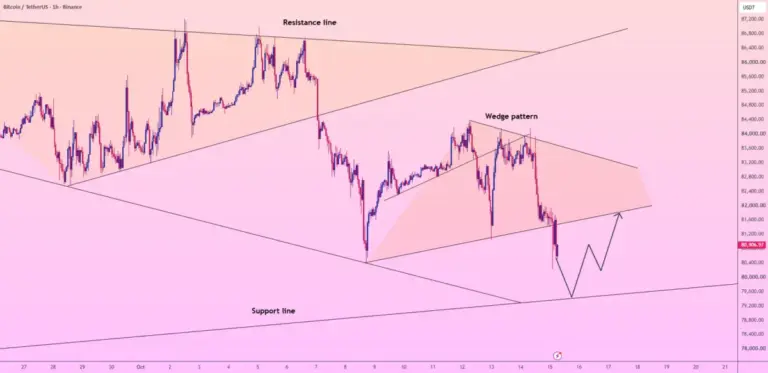
Second, Bitcoin’s key pocket top broke and subsequently failed under heavy selling pressure. Following four consecutive hourly closes above the $80,795.94 threshold between the early morning hours, the asset suffered a severe seven-hundred-point dump through the level. A fresh one-hour bearish break of structure printed at $80,740.90, delivering one of the session’s cleanest signals. Market veterans emphasize that a level which breaks and is immediately rejected often serves as a significantly stronger future resistance barrier than one that has never been tested.
Underlying these technical rejections is a broader market environment defined by heavily contracting volume. Current metrics show gold trading at roughly three-quarters of its average volume, while Bitcoin languishes at approximately half of its normal activity. Analysts attribute this sluggish participation to pre-FOMC chop, which explains why the aggressive upside spikes toward the $4,025 gold mark and the $81,162 Bitcoin level ultimately failed due to a lack of follow-through fuel.
In light of these developments, trading desks have updated their tactical setups while issuing clarifications regarding the macroeconomic calendar. Initial assumptions placing the Federal Open Market Committee meeting within a twenty-four-hour window were corrected; bar timestamps indicate that current operations sit at fourteen hundred hours UTC, while the actual central bank decision is scheduled for late afternoon on October 28, placing the major macro event roughly fifty-one hours away rather than imminently overnight. Consequently, tonight’s session carries no direct high-impact macroeconomic catalysts, with structural wind-downs expected to commence early next week.
Updated risk parameters for the upcoming sessions prioritize careful exposure management. The preferred setup centers on a gold scalp short with an entry planned around $4,028.50, triggered by a touch of the one-hour fifty-period exponential moving average and the fifteen-minute upper Bollinger Band cluster. Invalidation is marked by a one-hour close above $4,034.68, with a tight stop-loss placed at $4,036.20 and targets set to capture downward movement toward $4,011.76 and $3,999.00 over a standard holding window of three to eight hours.
A secondary setup targets a Bitcoin short position with an entry near $80,940, capitalizing on a touch of the one-hour golden Fibonacci retracement level and the four-hour ten-period exponential moving average. With invalidation tied to a four-hour close above $81,390.10, the risk plan incorporates a stop-loss at $81,180 just above the daily high, targeting downward liquidity pools at $80,392.50 and $79,952.20 over a six-to-twelve-hour holding period. Meanwhile, the previously opened gold intraday short is being actively managed by halving the position size while letting the runner target lower liquidity levels with an adjusted stop-loss.
Other potential setups have been firmly rejected due to unfavorable risk-reward profiles or dangerous structural geometry ahead of the macro announcement. Chasing gold longs with less than one-ratio reward potential, attempting to buy Bitcoin at mid-range prices far below logical stop shelves, or entering swing shorts with stops too tight to survive standard daily average true range fluctuations have all been ruled out. Strict risk protocols dictate that no positions should be held unhedged overnight into the upcoming FOMC statement, ensuring that portfolios remain protected against sudden gap risks in an environment where the upcoming central bank print remains the primary catalyst on the horizon.
 Crypto Investing & Trading
 Crypto Investing & Trading
 Crypto Investing & Trading