
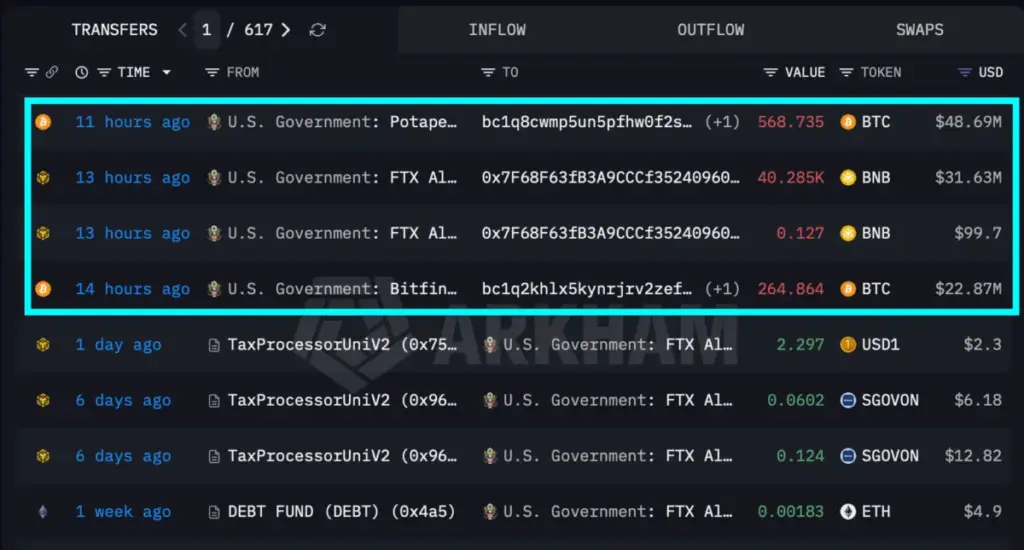
Wallets supposedly linked to the United States government moved more than $100 million in cryptocurrency on Tuesday, according to on-chain data provided by blockchain intelligence firm Arkham. The substantial movement of digital assets involved multiple transactions across different blockchain networks, drawing significant attention from market observers, analysts, and cryptocurrency investors who closely monitor government-held digital asset portfolios.
According to the data compiled by Arkham, the government-linked entity first sent 833.599 Bitcoin, which was worth approximately $71.6 million at the time of the transaction, to two separate addresses that Arkham’s monitoring systems currently do not label. Within a matter of hours, both of those intermediate addresses passed the coins onward to addresses that Arkham specifically labels as Coinbase Prime deposit addresses.
In a separate yet roughly contemporaneous set of transactions, another government-labeled wallet initiated a transfer of about 40,285 Binance Coin, or BNB, valued at roughly $31.63 million. This digital asset transfer was directed to a primary unlabeled address designated as 0x7F68F63fB3A9CCCf352409603421E0A574FbAD90. That initial receiving address then swiftly sent the entirety of the BNB assets onward to a second unlabeled address, identified on the blockchain as 0x6fB3Fe7b7E78AbB84CE007cBC7412C850B15A579.
A closer look at the origins of the transferred assets reveals that the Bitcoin originated from specific forfeiture and seizure cases handled by federal law enforcement authorities. Specifically, the transfer included 568.7 Bitcoin coming from a wallet that Arkham labels as containing Potapenko and Turogin forfeited funds, alongside an additional 264.9 Bitcoin that was recovered from coins previously seized in connection with the high-profile Bitfinex hack case. Meanwhile, the transfer of BNB originated from a pool of assets that had been seized from Alameda Research, the defunct quantitative trading affiliate of the collapsed cryptocurrency exchange FTX.
Despite the eye-catching scale of the transfers, federal authorities maintain massive holdings of digital assets acquired through various law enforcement and regulatory enforcement actions. The United States government still holds approximately $27.5 billion in cryptocurrency overall. Industry historians and financial analysts point out that to date, the federal government has not utilized taxpayer money to make any new cryptocurrency purchases, meaning the entire multi-billion-dollar treasury consists exclusively of seized assets derived from criminal investigations, civil forfeitures, and asset recovery operations.
Large-scale movements of cryptocurrency originating from government-controlled or government-labeled wallets routinely spark widespread speculation, discussions, and temporary fears across the global crypto community regarding an impending market sell-off. Market participants frequently worry that the sudden influx of millions of dollars in digital assets onto major institutional custody platforms or exchanges could precede a liquidation event that might depress spot prices. However, industry analysts emphasize that such concerns do not appear to be warranted in the context of Tuesday’s transactions.
Addressing the nature of these blockchain movements, market commentator Jose Rosell took to social media platform X to provide context and alleviate potential panic among retail and institutional traders. Rosell explained that a transfer of digital assets on a blockchain ledger is fundamentally distinct from an actual market sale. He further noted that under a directive established by a March executive order, bitcoin that has been forfeited to the federal government is intended to be held securely within a Strategic Bitcoin Reserve, rather than being haphazardly dumped onto the open market to disrupt trading conditions. As the broader digital asset ecosystem continues to evolve alongside shifting regulatory and governmental frameworks, the tracking of these multi-million-dollar state-held portfolios remains a focal point for understanding the intersection of public policy and blockchain technology.
 Cryptocurrency News
 Cryptocurrency News
 Cryptocurrency News







