Zcash (ZEC) emerged as one of the standout performers in the digital asset market following the recent U.S. Senate elections, outpacing major cryptocurrencies as broader financial markets rallied. This political catalyst coincided with a period of intense market volatility that saw both traditional equities and cryptocurrencies experience downward pressure leading into Tuesday’s vote. However, once election outcomes confirmed a shift in control of the Senate, financial markets experienced a sharp upward movement, with ZEC leading the charge among privacy-centric digital assets.
This initial market momentum is now intersecting with a major technical milestone for the network. Zcash is implementing its latest core network upgrade, designated as NU7, which is scheduled to activate at block 3,543,405. The upgrade addresses several foundational bottlenecks that have historically limited the growth and scalability of the protocol, including sluggish transaction confirmations, restricted throughput, legacy infrastructure, and the long-term economic security of the network as mining block rewards gradually diminish over time.
The activation of NU7 represents a critical phase in the evolution of Zcash, bridging the gap between its current operational limitations and its long-term ambition to function as a globally scalable, private digital currency.
What’s Coming in NU7?
At its core, the NU7 upgrade introduces four primary modifications designed to enhance network performance, security, and economic sustainability.
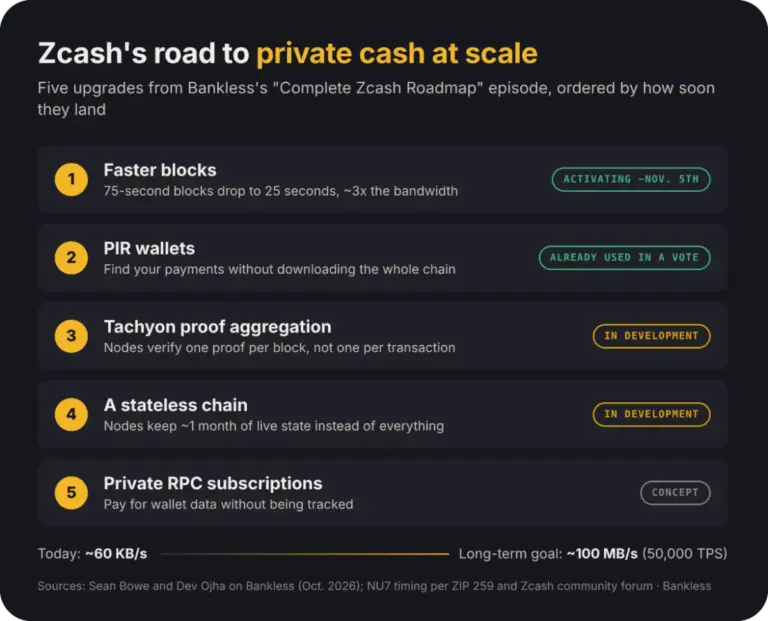
The first major adjustment centers on transaction speed and overall throughput. By reducing the targeted time interval between newly mined blocks, Zcash transactions will be able to achieve their first confirmation in an average of 25 seconds, a significant improvement from the previous 75-second benchmark. This reduction brings the protocol closer to functioning efficiently as practical digital cash, while simultaneously optimizing critical operational transfers such as exchange deposits and cross-chain movements.
Because the maximum size of each block remains unchanged, tripling the rate at which blocks are produced naturally triples the network’s raw transaction capacity. However, this increase does not translate to an identical threefold expansion in private, shielded transactions. NU7 implements specific volume limits on the amount of shielded activity each individual block can process, ensuring that capacity for newer Orchard-style transactions increases by a factor of approximately 2.3 rather than the full theoretical multiplier.
This leads directly to the second major focus of the upgrade: enhanced network safeguards. Shielded transactions rely heavily on zero-knowledge cryptography, which demands significantly more computational overhead for network nodes to verify and for user wallets to sync and process. Without proactive protective measures, malicious actors could potentially flood the network with complex transactions designed to slow down nodes or overwhelm user wallets with extraneous data. The newly established capacity caps are engineered to prevent these vulnerabilities as the blockchain increases its operational speed.
The third pillar of NU7 is the introduction of the Network Sustainability Mechanism, often referred to as NSM. Similar to Bitcoin, the Zcash network relies on a decentralized cohort of miners to secure the underlying ledger. The compensation miners receive through newly minted coins and transaction fees forms the bedrock of the network’s security budget. As the protocol’s scheduled block rewards continue to halve over time, these direct payments could eventually decline to a point where miner participation drops, potentially lowering the economic cost of executing an attack against the network.
To proactively mitigate this risk, NU7 restructures the distribution of transaction fees. Moving forward, miners will receive 40 percent of transaction fees collected on the network, while the remaining 60 percent will be systematically set aside. This portion of ZEC is effectively placed into cold storage, temporarily removed from active circulation, and scheduled to be gradually reintroduced into the economy as supplemental mining rewards starting around February 2031. Through this mechanism, the network essentially saves a portion of current transaction fees to subsidize future security budgets, all without altering the established four-year halving schedule or breaching the hard cap of 21 million total ZEC tokens.
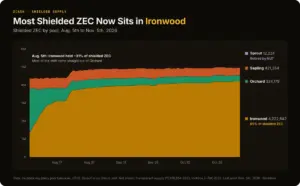
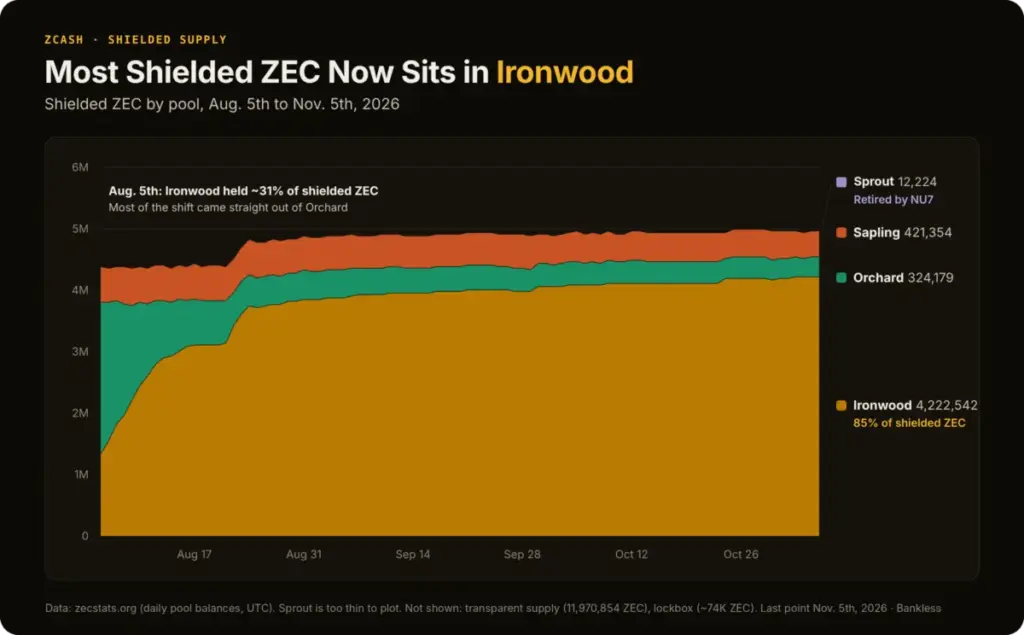
The final component of NU7 involves systemic maintenance and the retirement of outdated protocol architecture. Zcash originally launched in 2016 with Sprout, its pioneering shielded pool. Over the intervening years, the introduction of newer, highly optimized pools such as Sapling, Orchard, and Ironwood has rendered the original Sprout architecture largely obsolete. Although the final third-party wallets supporting Sprout had already been deprecated, retaining the legacy codebase within the protocol continued to introduce unnecessary complexity and potential security vulnerabilities.

NU7 completes the long-awaited retirement of this legacy system by officially banning all version 4 transactions, which represented the sole remaining format capable of interacting with Sprout funds. Industry metrics indicate that roughly 12,200 ZEC remained within the Sprout pool ahead of the upgrade, and these legacy coins will become unspendable unless a future protocol upgrade introduces a specialized recovery path. This comprehensive ban also encompasses older Sapling and transparent version 4 transactions, requiring any remaining legacy wallets to migrate to modern formats. Existing Sapling funds, however, remain fully spendable once the corresponding user wallets are updated.
The Road to Tachyon
Beyond the immediate structural improvements delivered by NU7, the upgrade represents a critical stepping stone in Zcash’s broader roadmap to achieve mainstream payment network scalability.
Scaling a privacy-centric protocol requires addressing multifaceted engineering challenges. As outlined by Zcash cofounder Sean Bowe and zero-knowledge researcher Dev Ojha during recent technical discussions, the network must continue to optimize how private transactions are processed, empower lightweight wallets to maintain synchronization despite surging network activity, and accelerate the propagation of blocks across its proof-of-work infrastructure.
The most ambitious engineering effort currently on the horizon is Tachyon, a fundamental redesign of the cryptographic architecture underpinning Zcash’s private payment system. Under the existing framework, network nodes must independently verify a distinct zero-knowledge proof for every single shielded transaction while maintaining an expanding database of historical nullifiers to prevent double-spending. Tachyon aims to aggregate numerous individual proofs into a single, cohesive proof while allowing nodes to prune historical data bloat, effectively removing two of the most significant physical ceilings on network throughput. Furthermore, this architectural overhaul establishes a cleaner, more direct migration path toward achieving long-term post-quantum privacy standards. While development is actively underway, no firm activation date has been established.
Long-term research initiatives extend well beyond the scope of Tachyon. Network developers are actively investigating private information retrieval techniques to solve the persistent challenge of allowing lightweight wallets to detect incoming transactions without requiring them to scan the entire blockchain history. Concurrently, engineers are working on protocol enhancements to accelerate block propagation speeds as transaction volumes scale upward.

The Bigger Picture
Financial markets reacted to Zcash well in advance of the NU7 deployment, with ZEC leading a robust post-election rally. Tonight’s activation of the NU7 upgrade provides that speculative market momentum with tangible fundamental backing, introducing faster confirmation times, expanded capacity for private transactions, and a sustainable economic model designed to secure miner participation as block rewards continue their downward trajectory.
While these protocol enhancements do not instantly guarantee that Zcash will achieve widespread adoption as private digital cash at a global scale, NU7 successfully establishes the necessary operational headroom required while the development community works toward the implementation of Tachyon. Until a concrete timeline for subsequent upgrades is established, the near-term trajectory of Zcash will largely depend on the persistence of its current market momentum and the successful execution of its foundational infrastructure upgrades.
 Tokenomics & Digital Assets
 Tokenomics & Digital Assets
 Tokenomics & Digital Assets