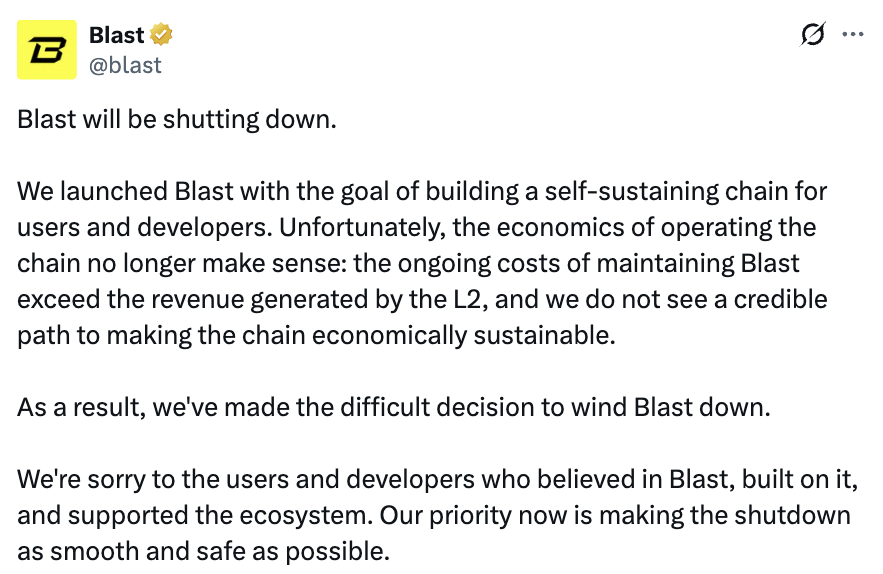
Ethereum layer-2 network Blast is shutting down its operations after operating costs outpaced the revenue generated by the blockchain, marking a significant contraction for one of the ecosystem’s high-profile scaling solutions.
In an official announcement published on Friday through a post on X, the Blast team revealed that they see no credible path forward to achieving economic sustainability for the network. Consequently, the project has strongly urged all users to withdraw their digital assets back to the Ethereum mainnet as the infrastructure winds down.
"We launched Blast with the goal of building a self-sustaining chain for users and developers," the team stated in the announcement shared on X. "Unfortunately, the economics of operating the chain no longer make sense."
As part of the wind-down procedure, the network is taking steps to facilitate user exits. Blast has announced that it will reduce its standard withdrawal delay to just 24 hours. However, withdrawals will be temporarily unavailable while the network initiates the process of unwinding its underlying Lido assets, a technical operation that is expected to take approximately one week to complete.
Users have been given a firm deadline of Oct. 26 to execute their withdrawals smoothly through Blast’s native user interface. After this date passes, assets will technically remain accessible on-chain, but the automated interface will no longer be supported. Consequently, any subsequent withdrawals will require users to interact directly and manually with the underlying Blast bridge contracts deployed on the Ethereum mainnet.
To prepare the community for this transition, Blast has announced that it will publish detailed instructions for withdrawing funds directly through the bridge contracts ahead of the Oct. 26 cutoff. The team has reiterated its call for all participants to move their funds back to the Ethereum mainnet well before the deadline to avoid any operational friction.
Blast Emerged From Blur’s NFT Boom
The history of Blast is deeply intertwined with the broader evolution of the decentralized finance and non-fungible token ecosystems. Blast was originally founded by Tieshun "Pacman" Roquerre, the visionary creator behind the prominent NFT marketplace Blur. Blur first burst onto the digital asset scene in October 2022, rapidly carving out a dominant market share by challenging incumbent platforms like OpenSea. By strategically targeting professional, high-volume traders with sophisticated financial incentives and lucrative token reward programs, Blur quickly captured industry attention.
By the end of 2022, Blur had successfully surpassed OpenSea in overall trading volume, extending its lead significantly through early 2023. This explosive market entry was heavily fueled by its highly anticipated token airdrop and structured trader reward incentives, establishing Roquerre and his core team as major forces in the Web3 space.
Building on the momentum of Blur, Roquerre unveiled the Blast network concept in November 2023. Blast was pitched to the market with a compelling value proposition: offering native yield on Ether and prominent stablecoins, alongside a gamified points program tied to an anticipated ecosystem token airdrop. This aggressive growth strategy proved immensely effective at drawing capital. The network managed to attract more than $2 billion in total deposits through its pre-launch bridging phase even before its official mainnet went live in February 2024.
However, despite its explosive early adoption and substantial capital inflows, Blast’s rapid growth ultimately proved difficult to sustain. The network faced mounting headwinds amid a broader, prolonged market downturn and a severe contraction in trading activity across the wider NFT sector.
According to comprehensive data from DeFiLlama, Blast’s decentralized finance total value locked has suffered a catastrophic decline, plunging by more than 98% since it reached an all-time peak of roughly $2.2 billion in June 2024. As transactional activity dried up and user engagement dwindled, the revenue generated by the chain shrank drastically, eventually falling well below the ongoing costs required to maintain secure and efficient layer-2 operations.
The broader ecosystem surrounding the founders has experienced similar downward pressures. Blur, the flagship NFT marketplace that originally spawned the Blast initiative, has also undergone a severe contraction. The platform’s total value locked, which surged impressively to more than $200 million during its early 2024 peak, has since retreated significantly and now stands at approximately $27 million, according to current DefiLlama protocol statistics.
With operational expenses continuously exceeding incoming revenue and the broader market failing to provide a viable turnaround, the Blast team has opted to wind down the network entirely rather than operate at an ongoing deficit. Users are now advised to monitor official channels for bridge contract instructions and complete their asset migrations ahead of the fast-approaching October deadline.
 Non-Fungible Tokens (NFTs)
 Non-Fungible Tokens (NFTs)
 Non-Fungible Tokens (NFTs)