North America maintained its position as the most influential region for the global cryptocurrency markets during the 12-year reporting period ending July 1, 2026. Backed by the deep investor base of the United States, shifting regulatory frameworks, the proliferation of stablecoins, and the accelerated integration of traditional finance, the region continues to export its crypto-economic trends to the rest of the world.
According to market data, the United States and Canada occupied the top spots on the global "big-money index," an unweighted measurement tracking the sheer crypto-economic power of covered countries. Combined, their respective crypto economies totaled $3.02 trillion during the 2026 reporting period, representing a modest 1.9% contraction compared to the previous cycle.

This regional dip was primarily driven by a slowdown in the United States. The U.S. crypto economy contracted by 2.2% to $2.78 trillion, a predictable outcome amidst a challenging bear market environment. However, the world’s single largest crypto market largely preserved the near-doubling of value it achieved during the 2025 reporting period. Institutional forces, including the rise of crypto exchange-traded funds (ETFs), accelerated asset tokenization, and the widespread adoption of stablecoins, played a critical role in anchoring those gains.
Industry leaders point to market maturation as the underlying driver of these trends. The foundational infrastructure established in previous years is successfully translating into products with active users, sustainable liquidity, and robust market structures. Throughout the period, three primary U.S.-developed crypto products drove significant domestic and international activity: artificial intelligence commerce, stablecoins, and tokenized real-world assets. Meanwhile, Canada’s crypto economy bucked the broader regional downtrend, expanding by 2.3% to reach approximately $250 billion, bolstered by robust peer-to-peer activity among its diverse immigrant populations.
The United States Leads the AI On-Chain Economy

The global race in artificial intelligence development is reshaping traditional sectors, and the digital asset ecosystem is no exception. Research into x402—one of the most prominent digital payment rails enabling AI agents to autonomously execute financial transactions—highlights how this machine-driven economy is taking shape.
As autonomous software increasingly initiates on-chain payments, the United States has solidified its role as the dominant builder of this infrastructure. Core American crypto enterprises, including Circle, the issuer of the leading agent currency USDC, and Coinbase, the developer of the x402 protocol, are actively supporting the ecosystem. Major financial institutions are also taking notice. BlackRock’s Head of Digital Assets Research, Will Su, noted that the firm is monitoring agentic commerce closely, highlighting that AI agents could generate meaningful demand for frequent, low-value payments around the clock.
By the close of the 2026 reporting period, more than 138 million x402 transactions had been processed on Base, the leading blockchain network for agentic commerce. On-chain payment architecture makes economic activity feasible in ways that legacy financial rails cannot replicate, particularly regarding micro-payments. Traditional credit card networks cannot profitably process transactions worth fractions of a penny. Conversely, stablecoin rails capable of settling transactions for less than a fraction of a cent make it economically viable for machines to spend tiny amounts of capital on-demand, opening up entirely new markets for pay-as-you-go goods and services like real-time application programming interface data queries.

Industry experts describe a clear division of labor emerging between payment systems, with traditional credit card rails reserved for consumer-prompted agent payments, while stablecoin rails handle machine-to-machine settlements that fall below the economic thresholds of card networks.
AI Payments Show Increasing Stickiness and Purposeful Adoption
Data tracking the lifecycle of x402 wallets reveals that agentic commerce is shifting past its initial experimental phase into a stage characterized by sustained utility and structural maturation. While early adoption was largely defined by one-off users executing isolated trades before abandoning the protocol, newer cohorts of wallets demonstrate significantly higher commitment.

When grouping wallets by the quarter in which they were first funded, the share of wallets receiving a second funding injection within 30 days climbed steadily. For wallets funded in the third quarter of 2025, approximately 70.6% received secondary funding. By the second quarter of 2026, that figure rose to 89.3%. On-chain analysts view these subsequent top-ups as the digital equivalent of renewing a software subscription.
Furthermore, the operational purpose of these wallets has sharpened considerably. The time gap between a wallet’s initial funding and its first x402 expenditure has compressed drastically. In late 2025, the median age of a wallet initiating its first x402 transaction was 73 days. By the third quarter of 2026, that median interval dropped to just 18 minutes. Concurrently, the proportion of wallets executing payments within their first hour of being funded jumped from 4% to 67%. These metrics indicate that users are no longer provisioning wallets merely to park capital or test protocols; rather, funds are deposited because specific machine-driven tasks are already queued.
What AI Agents Are Buying On-Chain

While the earliest iterations of agentic payments were largely dominated by speculative fads such as short-lived memecoins, the maturation of the x402 protocol has fostered sustainable commercial use cases, particularly within the information and technology sectors.
Millions of transactions now flow from AI wallets into knowledge-based services, including automated code review, advanced financial intelligence, and data search tools. Because AI models require continuous streams of machine-readable data, on-chain micro-payments provide an ideal settlement mechanism. Additionally, autonomous agents are utilizing these payment rails to access gaming services, token issuance platforms, gambling infrastructure, and agentic developer tooling. A significant portion of transaction volume also flows into model inference, with AI agents effectively purchasing computational intelligence from other AI systems.
Geographic analysis indicates that American-funded AI agents dominate this space, accounting for roughly 30% of all geolocated agent-to-service transactions globally. U.S.-linked wallets represent 88.1% of geolocated AI model inference transactions, 41.8% of payments directed toward agent frameworks and tool catalogs, and 23.2% of expenditures on data and search APIs.

In contrast, Chinese-attributed wallets exhibited a different pattern, concentrating heavily in security and code analysis. Approximately nine out of ten transactions directed toward smart contract security audits originated from Chinese-linked wallets, primarily flowing into automated auditing services like AgentLISA. Chinese operators also maintained strong market shares in financial intelligence and settlement rails, though they accounted for a negligible 0.1% of model inference transactions. Observers attribute this variance to a combination of economic realities and domestic preference, as China’s open-weight AI models are largely free to access, whereas U.S.-developed commercial models operate on metered, pay-per-use structures.
The U.S. Dominates Digital Dollar Export and Bitcoin Import Dynamics
The regulatory and economic positioning of the United States within the global digital asset landscape is characterized by a distinct dual trend: the heavy export of dollar-denominated stablecoins and the substantial accumulation of institutional bitcoin.

Following legislative developments such as the GENIUS Act, the U.S. has cemented its status as the world’s leading exporter of digital currencies. Stablecoins have effectively transformed U.S. sovereign debt into the preferred currency for cross-border businesses and peer-to-peer economies abroad. Concurrently, the introduction and expansion of spot bitcoin exchange-traded funds have fueled a steady increase in the U.S. share of global bitcoin activity.
While stablecoins comprise a relatively smaller share of domestic U.S. crypto activity compared to overseas markets—where international users lean on digital dollars to bypass domestic banking limitations—Americans are increasingly utilizing bitcoin as a macroeconomic store of value. Institutional participation has driven this trend, positioning the U.S. as a net importer of bitcoin through cross-border flows for the first time in years. While retail-sized transfers under $10,000 generally register as net outbound, high-value institutional transactions, particularly brackets exceeding $10 million, represent massive inflows of capital and accumulated assets.
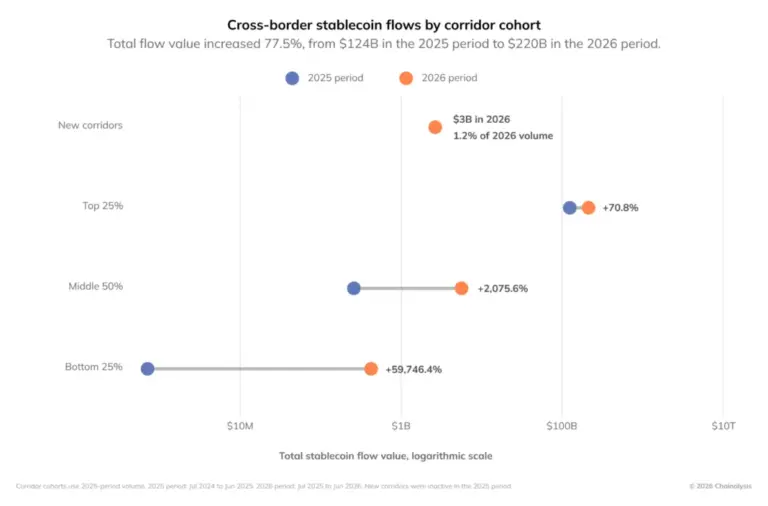
Stablecoin adoption abroad continues to reinforce traditional financial structures by driving demand for short-dated U.S. government debt, which serves as the underlying reserve backing major tokens like USDC. Despite regulatory efforts in other jurisdictions—such as the European Union’s MiCa framework and new stablecoin licensing frameworks introduced in Singapore and Hong Kong—alternative currency tokens continue to capture a minute fraction of global order book volume, demonstrating that regulatory readiness currently outpaces international market adoption.

Tokenization and Real-World Assets
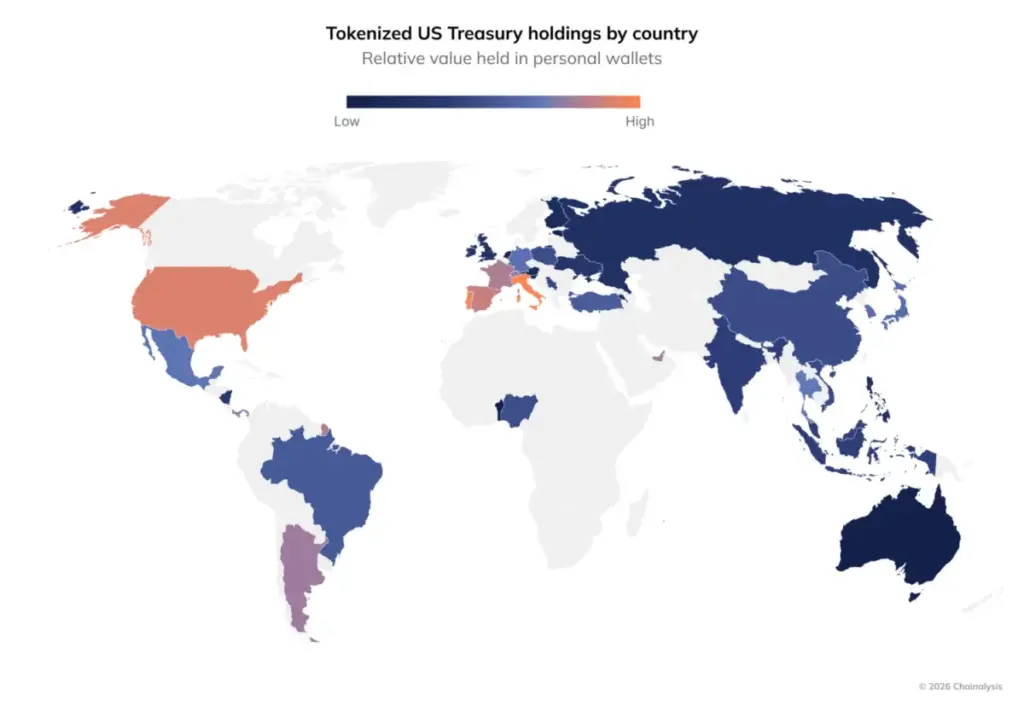
The tokenization of real-world assets expanded rapidly during the 2026 reporting period, with the global market reaching $36.07 billion by the end of the second quarter, representing a 135% period-over-period growth rate. United States sovereign debt remained the single largest real-world asset category on-chain, accounting for $15.42 billion, or roughly 42.8% of total tokenized asset value.
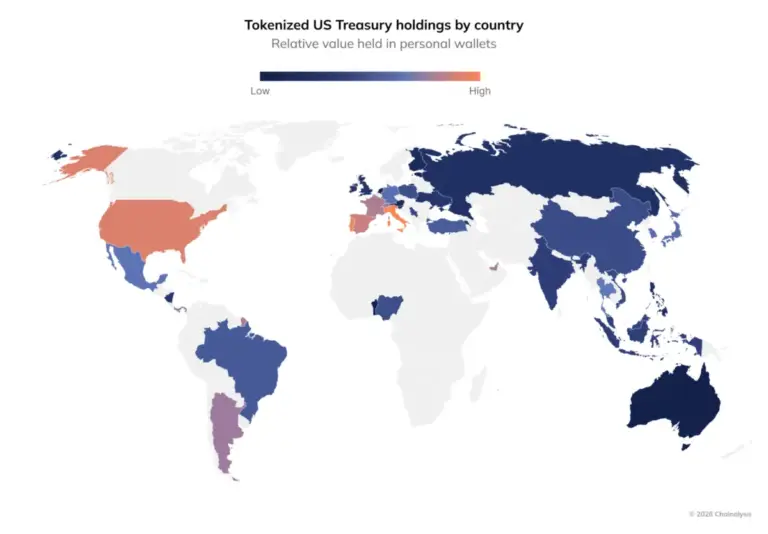
While niche asset classes such as corporate credit and private equity experienced triple-digit percentage expansions from modest baselines, tokenized U.S. Treasury debt dominated absolute dollar growth. Interestingly, while U.S. domestic participants represent roughly 11% of the global tokenized holder base, international investors drive a substantial portion of tokenized Treasury value. Jurisdictions such as Italy, Portugal, and Singapore account for outsized shares of tokenized sovereign debt holdings, illustrating how blockchain infrastructure enables retail and institutional investors abroad to bypass traditional brokerage hurdles and directly access U.S. government debt instruments.

Canada Emerges as a Leader in Peer-to-Peer Adoption
North America’s northern neighbor exhibited distinct structural characteristics within its $247.7 billion crypto economy during the 2026 reporting period. Despite modest overall growth of 2.3%, Canada secured the most robust peer-to-peer crypto economy among G7 nations, ranking seventh globally across domestic and cross-border transaction flows.
Stablecoins captured 44% of Canadian dollar-based order book volume by mid-2026, up significantly from 30% the previous year, with USDC commanding the vast majority of activity. Analysts note that this heavy reliance on U.S. dollar-denominated stablecoins creates policy concerns for Canadian regulators, as it mirrors the global trend of routing capital into U.S. debt instruments rather than domestic alternatives.

Canada’s cross-border remittance economy also demonstrated exceptional strength, supported by the country’s high foreign-born population. Remittance corridors connecting Canada to nations such as India, China, and the Philippines expanded significantly, with stablecoin and bitcoin transfers across these specific corridors reaching $2.36 billion through millions of transactions. Users increasingly rely on blockchain rails to circumvent the high average costs associated with traditional wire transfers and banking networks. Furthermore, domestic peer-to-peer transaction volumes in Canada showed a strong statistical correlation with fluctuations in temporary visa and immigrant permit populations, indicating that individuals with active international financial lives are driving grassroots crypto utilization in their daily routines.
As North America moves forward, the underlying infrastructure of the digital asset economy—ranging from AI payment protocols and tokenized Treasuries to globally exported stablecoins—remains anchored by American institutions and developers, even as its user base scales across international borders.
 Crypto Wallets & Security
 Crypto Wallets & Security
 Crypto Wallets & Security