Prediction markets are flashing significant warning signs for the cryptocurrency industry as the November 3 midterm elections draw closer. Prominent prediction platforms Polymarket and Kalshi indicate that Democrats hold a strong probability of capturing both chambers of Congress, raising questions about the future of federal digital asset legislation. Polymarket currently assigns a 62% chance of a Democratic sweep of Congress, while Kalshi places the odds at 61%. Such a political outcome could severely complicate the cryptocurrency sector’s ongoing efforts to revive the Digital Asset Market Clarity Act and reshape regulatory frameworks in Washington.
After years of intensive lobbying, millions of dollars spent on political campaigns, and countless rounds of negotiations over federal cryptocurrency legislation, the digital asset industry could find itself facing an unexpected setback. With the upcoming midterm elections poised to shift the balance of power on Capitol Hill, market participants increasingly anticipate that Democrats will secure control of both the House of Representatives and the Senate. This shift would hand the party substantial influence over the next chapter of federal digital asset policy, potentially altering the regulatory landscape for crypto firms, exchanges, and investors nationwide.
Trading activity across prediction platforms reflects these shifting political dynamics. On Polymarket, the Balance of Power market assigned a 62% probability to Democrats capturing both the House and Senate, driven by more than $21.2 million in trading volume. Meanwhile, a Republican Senate paired with a Democratic House carried 30% odds, while a complete Republican sweep stood at just 9%. The reverse scenario—a Democratic Senate and a Republican House—registered a mere 1%, with other potential outcomes accounting for less than 1% of the market share.
Kalshi’s competing market paints a nearly identical picture of the upcoming political landscape. With approximately $35.87 million traded on its contracts, the platform gives Democrats a 61% chance of sweeping Congress. In comparison, a divided government featuring a Democratic House and a Republican Senate holds 29% odds. A complete Republican sweep commands 11% support, while a Republican House paired with a Democratic Senate stands at just 0.9%.
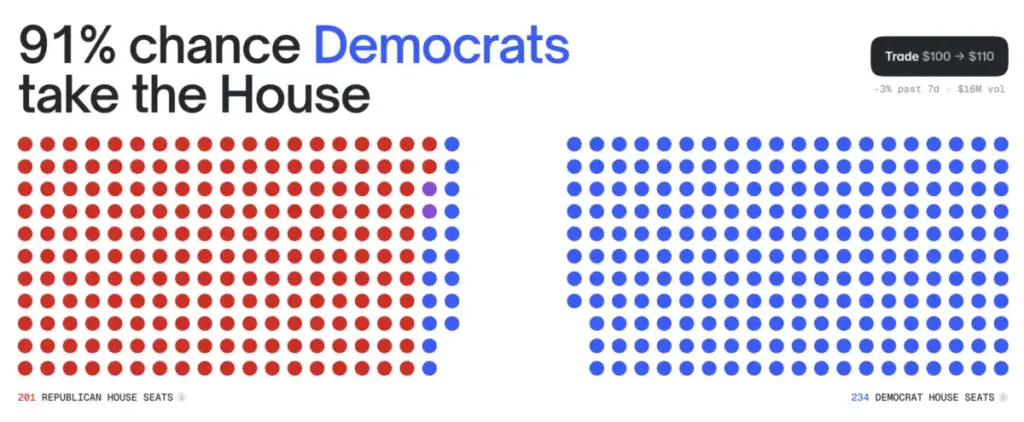
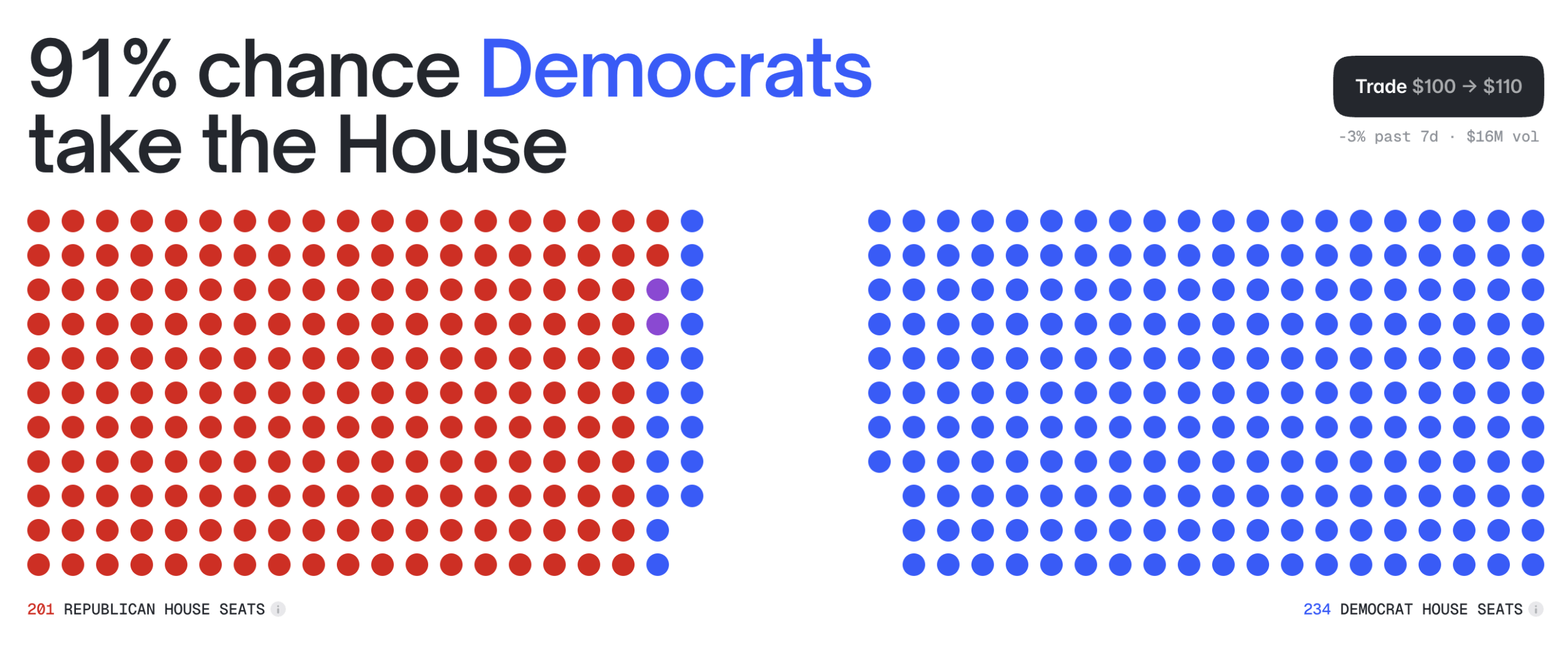
Individual chamber markets offer further insight into the political arithmetic shaping the current cycle. Polymarket assigns Democrats a commanding 91% chance of retaining or controlling the House, compared to 10% for Republicans, with traders projecting a 234-201 Democratic majority. A separate contract tracking a "Blue Wave" carries 87% odds, signaling that traders expect notable Democratic gains across the country.
The Senate remains a comparatively tighter contest, though Democrats maintain a clear edge. Polymarket gives Democrats a 63% chance of controlling the chamber against 38% for Republicans, backed by roughly $6.23 million in trading volume and a projected 52-48 Democratic majority. Kalshi’s Senate market, which has attracted $57.3 million in volume, similarly puts Democrats at 61% and Republicans at 39%. While these figures do not serve as guarantees of election outcomes, they highlight where financial traders currently believe political momentum is heading.
Senate Battlegrounds and Gubernatorial Contests
A series of competitive Senate races help explain the underlying factors driving the projected Democratic advantage. Polymarket currently favors Democratic-aligned or Democratic candidates in several key battleground states, including James Talarico in Texas at 64%, Troy Jackson in Maine at 59%, Abdul El-Sayed in Michigan at 72%, Mary Peltola in Alaska at 74%, and Sherrod Brown in Ohio at 62%. Conversely, Republican candidates retain advantages in other critical states, such as Kansas, where Roger Marshall holds 62%; Iowa, where Ashley Hinson commands 57%; South Carolina, where Darline Graham Nordone stands at 85%; and Nebraska, where Pete Ricketts carries 72%.
At the state level, 36 gubernatorial seats will also be contested on November 3, with both major parties defending 18 seats. Polymarket favors Xavier Becerra in California at 96%, Greg Abbott in Texas at 77%, Byron Donalds in Florida at 78%, Jocelyn Benson in Michigan at 94%, David Crowley in Wisconsin at 81%, Amy Acton in Ohio at 70%, and Aaron Ford in Nevada at 55%. Meanwhile, the race in Georgia remains a close toss-up, with Rick Jackson polling at 52% against Keisha Lance Bottoms at 48%.
Other election-related markets have also captured significant trading attention. California’s proposed billionaire wealth tax carries 25% approval odds, while Idaho’s abortion legalization measure stands at 51%. In Michigan, a proposal for a constitutional convention faces an 89% probability of rejection, and Colorado’s life-sentence measure for underage sex traffickers holds 71% approval odds. While these state-level ballot measures and gubernatorial races will not directly determine congressional control, they demonstrate the broad scope of political wagering ahead of November. For cryptocurrency businesses, however, the congressional numbers carry the most direct and consequential implications.
The CLARITY Act and Legislative Obstacles
The Digital Asset Market Clarity Act, widely known as the CLARITY Act, was originally designed to resolve Washington’s long-running debate over federal cryptocurrency oversight. After passing the House in July 2025 by a strong bipartisan vote of 294 to 134, the legislation sought to establish clear jurisdictional boundaries between the Commodity Futures Trading Commission and the Securities and Exchange Commission.
Under the proposed framework, qualifying digital commodities would fall primarily under CFTC supervision, while the SEC would maintain regulatory authority over securities-related activities. Additionally, cryptocurrency exchanges, brokers, and dealers would be subjected to formal registration and disclosure mandates, with specific exemptions carved out for mature decentralized networks.
Despite these initial steps, legislative negotiations eventually encountered a major impasse. Although Republican lawmakers incorporated 126 substantive changes requested by Democrats, the Senate ultimately rejected a procedural motion on September 15, 2026, by a 49-50 vote, falling 11 votes short of the mandatory 60-vote threshold. Every present Democrat voted against advancing the bill, joined by four dissenting Republicans.
Core disagreements during the negotiations centered on strict ethics restrictions concerning federal officials’ cryptocurrency holdings, illicit-finance safeguards, software developer liability, and the competitive threat that yield-bearing stablecoins pose to traditional bank deposits. Furthermore, reported cryptocurrency-related income exceeding $1.4 billion associated with President Donald Trump emerged as a prominent sticking point, with Democratic lawmakers demanding more robust conflict-of-interest protections.
With the current congressional session nearing its close, the legislative prospects for the bill have effectively collapsed. Any future iteration of the legislation would require fresh consideration when the 120th Congress convenes in January 2027, potentially under a newly structured Democratic leadership.
Potential Regulatory Implications of a Democratic Majority
A Democratic takeover of Congress would not automatically outlaw digital assets or instantly reverse existing regulatory policies. Nevertheless, it could make the industry’s preferred legislative framework significantly harder to achieve. Committee leadership across financial services, banking, and agricultural panels would shift to Democrats, granting them direct control over legislative calendars, hearings, and negotiations.
Furthermore, the existing framework of the CLARITY Act would face a complete reset, requiring new introductions and opening the door for Democratic leaders to demand revisions that go far beyond previously negotiated concessions. Ethics restrictions could also become a nonnegotiable priority for lawmakers pushing for strict divestment and blind-trust requirements for senior federal officials.
Decentralized finance applications could face heightened compliance obligations, while stablecoin rewards might encounter tighter federal limitations due to concerns over banking sector stability. Although existing agency initiatives at the SEC and CFTC could face increased congressional oversight and funding challenges, reversing established rules would require deliberate administrative action. Additionally, heightened congressional investigations into crypto industry spending, exchange custody practices, and political funding initiatives could emerge, altering the operational environment for digital asset businesses as the industry looks toward 2027.
 Bitcoin & Major Altcoins
 Bitcoin & Major Altcoins
 Bitcoin & Major Altcoins