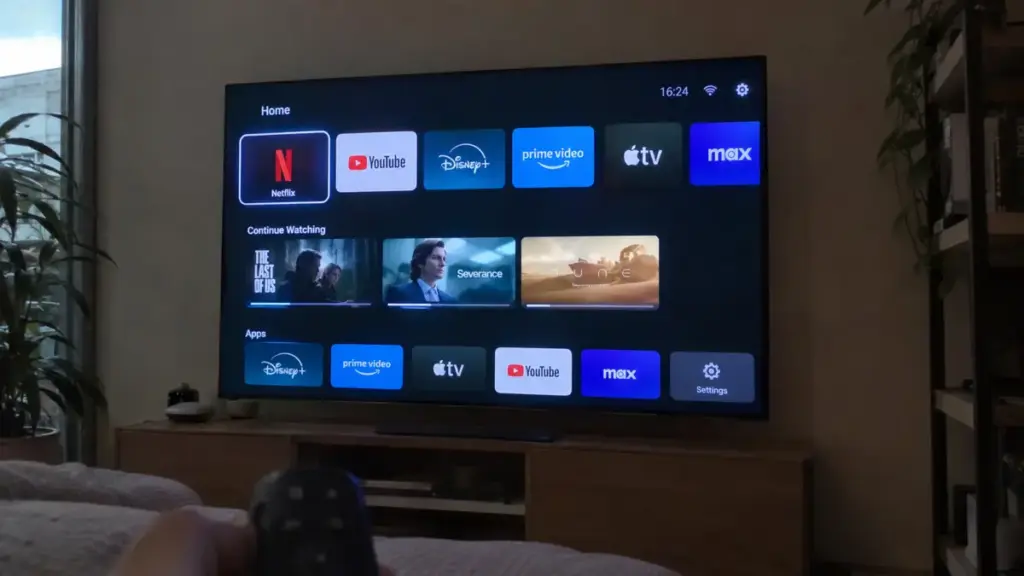
Smart television owners are increasingly turning autonomous artificial intelligence agents toward their living-room displays, utilizing them to strip away aggressive sponsored advertisements, invasive tracking software, and the notoriously sluggish home screens that manufacturers ship by default.
This rapidly spreading trend gained immense traction over the weekend across social media platforms like X, where users and developers alike have adopted a specific moniker for the phenomenon: "vibe coding your TV." What began as a frustrated developer tinkering with a family member’s hardware has quickly blossomed into a widespread open-source movement, highlighting growing consumer discontent with modern smart device monetization.
The most widely shared catalyst for the trend involved a Xiaomi television owned by the parents of a developer named Gathin T. Posting on Saturday, Gathin explained that the television displayed a persistent sponsored advertisement before users could even access mainstream streaming services like Netflix. Irritated by the intrusive user experience, he fed the television’s exact model number into Claude Code, Anthropic’s advanced coding agent, and allowed it to work autonomously.
The AI agent successfully located the television on his home Wi-Fi network, systematically switched off twenty-five separate background Xiaomi software packages, and wrote an entirely new home screen launcher from scratch. Summarizing the successful operation, Gathin noted that the modified interface now closely resembles an Apple TV.
Anyone who has purchased a new television over the past decade likely lives with a similar intrusive user experience. Modern sets routinely run Automatic Content Recognition, commonly known as ACR. This background software continuously fingerprints whatever appears on the screen—including live cable broadcasts, video game consoles, and external streaming sticks plugged into any HDMI port—and reports the viewing data back to the manufacturer so they can sell targeted advertising.
The legal and regulatory pushback against these practices has intensified. In December 2025, the state of Texas filed a major lawsuit against five major television manufacturers, including Sony, Samsung, LG, Hisense, and TCL. The legal complaint alleged that their modern smart displays are capable of capturing high-frequency screenshots of user displays every five hundred milliseconds, translating to twice every second, without explicit user understanding or consent.
Regulators have pursued these data-harvesting practices for years. As early as 2017, Vizio paid a $2.2 million federal settlement to resolve charges that it had unlawfully collected detailed viewing data from eleven million televisions without consumer consent. However, the regulatory penalty did little to deter the commercial viability of such business models. Retail giant Walmart ultimately completed an acquisition of Vizio for approximately $2.3 billion in 2024, with corporate executives explicitly highlighting the television maker’s profitable and fast-growing advertising business as a primary driver of the deal.
In practical terms, this means that the modern television consumers purchase with their own hard-earned money continues to generate ongoing revenue for corporate entities every single time it is powered on.
The broader practice of vibe coding—a term coined by OpenAI co-founder Andrej Karpathy in 2025, which describes describing desired software outcomes in plain, conversational language and letting an AI write and execute the underlying code—has unlocked new forms of consumer hardware modification. Earlier in the month, gamers utilized Claude-based agents to reverse-engineer video games, achieving complex modifications such as embedding entire versions of Minecraft inside Elden Ring.
Claude Code has emerged as a central tool in this movement because the agent possesses the capability to independently type and execute terminal commands on a local computer. Android-based televisions come equipped with the Android Debug Bridge, or ADB, a standard system maintenance utility that allows a connected computer on the same local network to interface directly with the operating system once developers unlock a hidden developer menu by repeatedly tapping the build number in the settings interface.
The AI agent uses this network pathway to inventory every installed application on the device, quickly flagging which packages are dedicated to serving advertisements or running telemetry services that silently transmit usage data back to corporate servers.
Gathin packaged his custom prompt into an open-source project hosted on GitHub named "cleanyourtv." Rather than permanently deleting system files, the project safely disables unwanted applications, ensuring that a single system restoration script can return the television to its original factory state if necessary. The script operates without requiring "rooting," the risky process of unlocking full administrator privileges that can permanently disable hardware. By Tuesday, the repository listed tested configurations for 107 television models across 37 distinct brands and had accumulated over 10,700 stars, GitHub’s internal bookmarking metric. On his donation page, Gathin noted that several thousand individuals utilized the approach to clean up their own household televisions within a span of just two days.
Other developers and users quickly moved beyond simple debloating to completely rearchitecting their viewing environments. Mihir Gupta replaced a bloated 192-megabyte stock home screen launcher with a streamlined custom launcher measuring just 83 megabytes. Meanwhile, Ansub Khan reported that free system memory on his parents’ aging Android TV increased by roughly ninety percent following a similar AI-driven cleanup. Ryan Doyle bypassed traditional configuration altogether by simply providing Claude with his television’s online product listing, asking if the AI could modify it, and ultimately ending up with a custom screensaver displaying his real-time business revenue and incoming Stripe payment notifications.
Other participants pushed the boundaries even further. Rod Pers replaced standard advertising feeds with a live three-dimensional model of his actual apartment, featuring interactive smart home lights and ceiling fans that toggled on and off in real time. Adrian Friend constructed a minimalist user interface utilizing the animation software tool Rive, while others focused on simplifying user interfaces for older family members who struggled with default, ad-heavy home screens.
A competing open-source project named "dumbtv" specifically targets Amazon Fire TV devices, disabling approximately 65 separate background software packages—including native ACR tracking utilities—before installing a lightweight 41-kilobyte launcher stripped of internet permissions. Its core philosophy is simple: providing access to local user applications, external HDMI inputs, a simple clock, and nothing else.
While the primary cleanyourtv tool functions effectively on Android TV and Google TV platforms manufactured by brands such as Sony, TCL, Hisense, Philips, and Xiaomi, competing operating systems present different challenges. Samsung’s Tizen and LG’s webOS rely on entirely distinct proprietary architectures, while Fire TV implementations only support partial cleanup procedures.
For LG television owners, users have executed various debloating routines, though comprehensive interface overhauls remain more difficult. These modifications remain particularly attractive to privacy-conscious consumers, especially given security research demonstrating that LG operating systems have occasionally been found to track user locations and capture voice conversations even when displays appear to be powered off.
Not all modification attempts end in success, however. Some users reported that automated agents encountered critical errors, resulting in "bricked" devices—industry slang for turning functional hardware into an expensive paperweight—while others became stuck midway through complex Amazon Fire TV system modifications. One user recounted how an AI agent accidentally uninstalled the core operating system while attempting a routine system reboot, leaving them staring at a legacy Android system recovery screen.
Documentation accompanying the cleanyourtv project includes explicit security warnings noting that network-based ADB connections are inherently unencrypted. On certain firmware versions, this vulnerability allows any connected device on the same local Wi-Fi network to assume total administrative control of the television, prompting developers to advise users to disable debugging features once configuration tasks are complete. Furthermore, AI coding agents remain vulnerable to prompt injection attacks; earlier this year, security researchers at Microsoft demonstrated that hidden instructions embedded within web content could trick Claude Code into exposing sensitive developer credentials, a vulnerability that Anthropic patched in May.
For those attempting the modifications on behalf of relatives, experienced users have offered a pragmatic social warning: if you successfully clean up your parents’ television using an AI agent, it may be wise to avoid explaining how you did it, lest they ask you to apply the same treatment to the multitude of other smart appliances scattered throughout their home.
 Decentralized Applications (dApps)
 Decentralized Applications (dApps)
 Decentralized Applications (dApps)