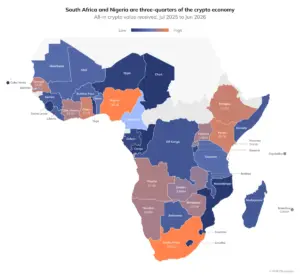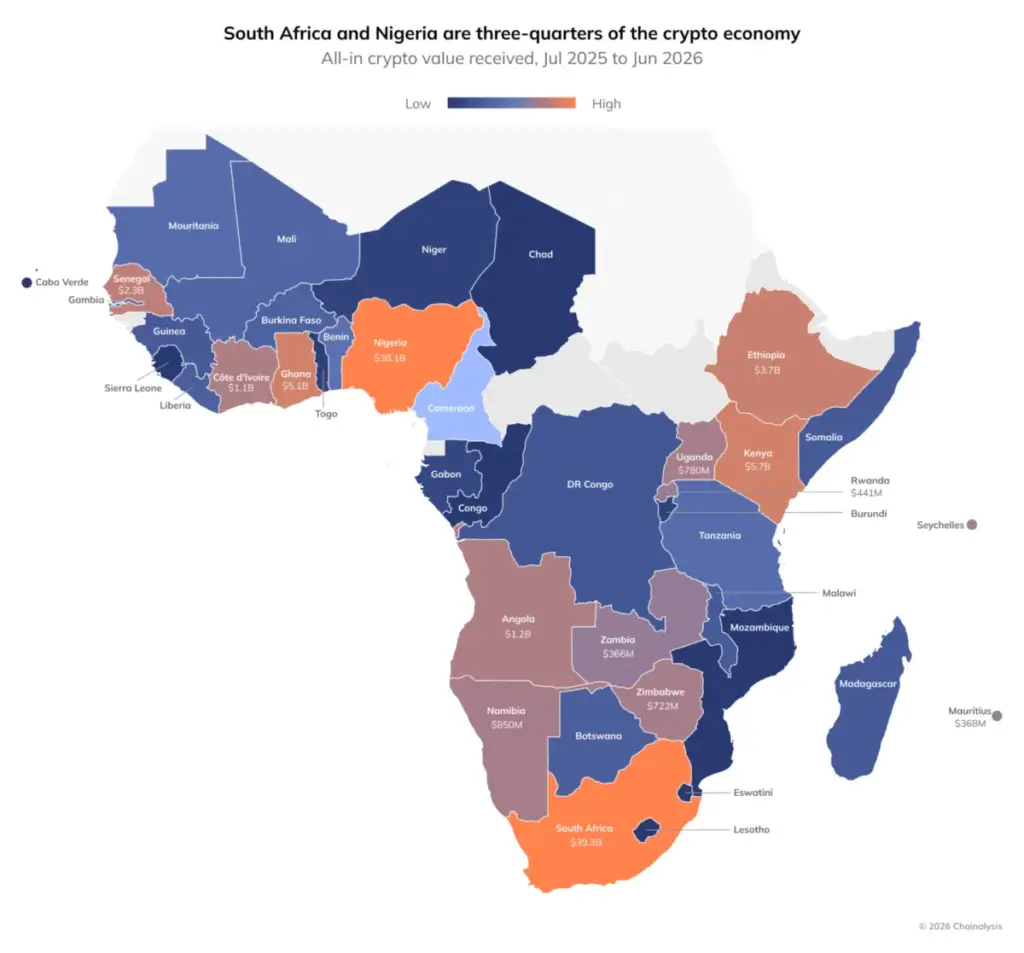
Sub-Saharan Africa remains the smallest cryptocurrency economy globally by total transaction volume, but it has officially cemented its status as the fastest-growing. Between July 1, 2025, and June 30, 2026, the regional crypto economy expanded by 13.4%, surging to a total valuation of $101 billion. This remarkable trajectory was propelled heavily by robust adoption in South Africa, alongside shifting dynamics across several smaller markets within the region.
Financial Inclusion and Everyday Realities
The rapid uptake of digital assets across Sub-Saharan Africa is being fueled by a simple, persistent economic reality: millions of individuals and businesses continue to struggle to access affordable, reliable, and traditional financial services. For everyday citizens, cryptocurrencies offer a practical alternative for managing personal finances, preserving wealth against inflation, and transferring money. For enterprises, digital assets enable significantly faster and more cost-effective cross-border payments and settlements.
For the region as a whole, the fundamental appeal of cryptocurrency transcends speculation, newly invented financial instruments, or complex investment vehicles. Instead, it serves as a pragmatic tool to address pressing everyday challenges. Mercy Emmanuel, Stablecoin and Blockchain Commercial Lead at Nigerian fintech company Flutterwave, encapsulates this sentiment: "For African markets, the most commercially relevant innovations will be those that reduce friction in existing financial activities rather than those that introduce complexity simply for the sake of using blockchain technology."

South Africa and Nigeria Dominate Regional Activity as Growth Diverges
South Africa and Nigeria continue to dominate the Sub-Saharan cryptocurrency landscape, together accounting for more than three-quarters of all regional activity. However, the two powerhouses are currently following diverging trajectories.
South Africa’s crypto economy expanded to $39.3 billion during the reporting period, posting an impressive 52% year-over-year growth rate despite broader global market headwinds. This expansion was broad-based, registering increases across every measurable category, led primarily by cross-border peer-to-peer (P2P) stablecoin flows and professional service flows.
In contrast, Nigeria’s crypto economy reached a nearly identical $38.1 billion, representing a slight 3% decline year-over-year. While overall centralized exchange (CEX) and service-related activity experienced growth, it was ultimately outweighed by a 45% drop in decentralized exchange (DEX) activity and a 17% decline in cross-border P2P flows. Despite this minor contraction, Nigeria secured third place globally in grassroots adoption.

Smaller regional markets also demonstrated varied momentum. Ghana’s crypto economy grew by 80% to hit $5.1 billion, supported by increases in both CEX and DEX activity. Senegal witnessed an extraordinary surge of 215%, pushing its market to $2.3 billion, largely driven by centralized exchanges. Conversely, Ethiopia recorded an 8% decline down to $3.7 billion, heavily influenced by a reduction in decentralized exchange volumes. Together, these contrasting trends highlight the uneven pace of adoption, proving that while smaller markets possess immense room for rapid expansion, they remain highly sensitive to local and regulatory shifts.
A Third of Sub-Saharan Africa’s Crypto Lands in Personal Wallets
Research indicates that personal wallets play an unusually large role in Sub-Saharan Africa’s digital asset economy, pointing to an adoption model where individual users maintain direct control over how cryptocurrency is held and transferred. Personal wallets accounted for 32.3% of the total value received across the region during the 2026 period—the highest share recorded anywhere in the world. This widespread self-custody suggests that adoption is largely driven by users seeking to manage their own funds independently rather than relying on established exchanges or corporate intermediaries.
Cross-border P2P transfers constituted the vast majority of this personal wallet activity, representing 70.9% of incoming value, compared to 18.5% from domestic P2P transactions and 10.7% from service-to-wallet transfers. Limited access to reliable custodial services and recurring regulatory uncertainty help explain this strong preference for self-custody. In Nigeria, for instance, severe restrictions were imposed on banks serving crypto platforms between 2021 and 2023, followed by ongoing tensions with major international exchanges. Such regulatory shifts naturally encourage users to adopt self-custody to insulate themselves against potential future disruptions.

Stablecoin Activity Surges More Than Sixfold Across the Region
Stablecoins have rapidly become the defining feature of the Sub-Saharan African cryptocurrency market. Between 2022 and 2026, the value of stablecoins received via P2P channels multiplied more than sixfold, climbing from $2.3 billion to $14.6 billion. Over the same timeframe, incoming Bitcoin value dropped by 60%, falling from $36 billion to $14.6 billion.
This stark shift highlights a powerful, practical use case: stablecoins empower individuals and businesses to hold value in U.S. dollars and other stable currencies without needing to open traditional, foreign-currency-denominated bank accounts. In a region frequently plagued by local currency depreciation, restricted access to foreign exchange, and expensive, sluggish cross-border banking, stablecoins provide a reliable mechanism to receive payments, protect purchasing power, and move funds seamlessly.
Philip Kwaw Sebuabe, Head of the Virtual Assets Department at the Bank of Ghana, notes that stablecoins are attracting intense interest beyond simple trading, particularly for cross-border transactions, remittance settlements, and foreign-currency preservation. Gillian Darko, Vice President of Strategy at stablecoin payments infrastructure firm Yellow Card, echoes this perspective, identifying stablecoins as the region’s largest commercial opportunity to satisfy mounting demand for reliable payment systems that seamlessly bridge savings and investments.

The utility of stablecoins is perhaps most visible in international remittances, where stablecoin transfer values more than doubled year-over-year from $235 million to $492 million, while Bitcoin remittances remained relatively flat. Furthermore, local-currency stablecoins are beginning to attract attention, with experimentation underway in South Africa, Ghana, Kenya, and Tanzania. The Bank of Ghana, for instance, has examined cedi-backed models that enable stablecoins to settle transactions instantly while ensuring final beneficiaries receive traditional local currency via bank accounts or mobile money wallets without ever needing to touch crypto themselves.
Crypto Corridors Expand as Businesses Seek Cheaper Payments
Intra-regional business payments experienced rapid growth during the report period, underscoring cryptocurrency’s vital role in commercial cross-border transactions. Traditional business payments within Africa have long suffered from severe structural friction, with only a small fraction of intra-continental payments clearing natively, leading to significant financial losses and regulatory barriers.
Faced with these hurdles, crypto payment corridors connecting African enterprises and consumers have emerged as an appealing alternative. Active intra-regional corridors nearly doubled from 80 to 152, with 95 of those handling bidirectional flows. Concurrently, total transaction volume more than tripled from $34.3 million to $116.5 million, while the average volume per corridor rose from $429,000 to $766,000. These metrics reflect deeper transactional connectivity across routes where conventional financial architecture has historically fallen short.

North America Leads Crypto Remittance Inflows into Sub-Saharan Africa
Remittances remain a cornerstone of economic stability for many Sub-Saharan African nations, accounting for upwards of 20% of GDP in countries like The Gambia and Lesotho. In total, the region recorded $41 billion in remittance inflows in 2025. Yet, sending money to the region remains exceptionally costly; the World Bank reported an average fee of 7.9% for a $200 transfer—the highest of any region globally.
Cryptocurrency has stepped in to alleviate these financial burdens by reducing costs, removing intermediaries, and accelerating delivery times. Western nations accounted for the vast majority of crypto-remittance inflows into Sub-Saharan Africa, reaching $888 million during the reporting period, representing a 36% year-over-year increase. The total number of transactions grew by 43%, surpassing one million individual transfers in 2026.
North America dominated these inflows at $645 million, supported by large diaspora populations originating from Nigeria, Ghana, and Ethiopia. Meanwhile, inflows from Australia and New Zealand registered the fastest relative growth, nearly tripling from $48 million in 2024 to $143 million in 2026. Western Europe experienced modest growth, rising from $79 million to $100 million.

An analysis of diaspora demographics reveals fascinating patterns. North America and Australia sent considerably more crypto remittances than population size alone would predict, whereas Western Europe lagged far behind. Although Western Europe is home to 64% of the Sub-Saharan-born residents across analyzed destination countries, it accounted for just 10% of total crypto remittances. France, for example, hosts a diaspora population comparable to the United States but accounted for only $5.4 million in outbound crypto remittances, compared to $223 million from the U.S. On a per-capita basis, Canada recorded the highest outflow at $736 per Sub-Saharan-born resident, far outpacing the U.S. and drastically overshadowing Western Europe’s average of $17.90 per resident.
South Africa’s Booming Real-World Crypto Economy
South Africa has cultivated a robust, crypto-fueled real-world economy where consumers and local businesses routinely use digital assets to purchase everyday goods and services. Domestic business-like payments—defined as peer-to-peer transfers resembling merchant transactions, capped at $50,000 to exclude statistical outliers—reached $8.34 billion during the 2026 period. Every successive quarter outperformed the last, with Q2 2026 generating over $1 billion more in service-like transfers than Q3 2025. Remarkably, these retail and service payments grew at a faster pace than South Africa’s booming institutional crypto sector, which logged $1.29 billion in inflows over the same timeframe.
This commercial expansion was bolstered by significant infrastructure developments. In 2025, popular QR code payment service Scan to Pay partnered with cryptocurrency platform MoneyBadger to launch an initiative enabling consumers to spend Bitcoin effortlessly across a massive retail footprint. By August 2026, the partnership encompassed nearly 700,000 active merchant locations.

Carel van Wyk, CEO of MoneyBadger, emphasized that South Africans are increasingly integrating crypto into daily purchasing habits for both in-store and online shopping. Data from Q2 2026 indicated that half of all payments processed through the platform were under $13, while 87% remained below $60, with e-commerce accounting for 48% of total payment value.
South Africa as a Regional Hub
Historically, South Africa has functioned as a primary gateway for international and continental investment, boasting Africa’s largest stock market, advanced banking institutions, and deep-seated industrial trade links. Research indicates the nation is now serving as the primary continental conduit for international cryptocurrency flows as well.
A comparison between South Africa’s cross-border crypto payments and its traditional foreign direct investment (FDI) footprint reveals substantial overlap across key markets such as Nigeria, Kenya, the Democratic Republic of the Congo, Tanzania, Namibia, and Zimbabwe. This alignment suggests that crypto flows frequently travel along the same commercial corridors as traditional corporate investments. However, discrepancies exist; Botswana and Zambia attract high levels of traditional South African FDI but record lower crypto flows, while Senegal and Cameroon exhibit the reverse pattern, demonstrating a partial alignment between traditional trade and digital asset movements.

South Africa’s position as a regional crypto hub may face new headwinds following recent regulatory proposals. In August, the National Treasury and the South African Reserve Bank published a draft Crypto Asset Manual for Cross-Border Activities aimed at integrating digital assets into the nation’s capital flow management framework. While initial drafts suggested restrictive pre-approvals that would severely limit offshore crypto transfers for individuals and entirely ban them for corporations, strong public and industry backlash prompted the reserve bank to announce a comprehensive revision of the rules.
Nigeria’s Shift Toward Domestic Exchanges and P2P Bitcoin
Nigeria has solidified its position as a highly service-oriented market, with users funneling $25.2 billion into cryptocurrency platforms and digital services during the reporting period—a staggering 172% increase over four years. Domestic exchanges drove nearly all of this growth, capturing $4.13 billion and accounting for 92% of the net increase in inflows. In total, domestic platforms received $6.22 billion, representing half of Nigeria’s entire centralized exchange influx. This marks a dramatic evolution in market share, up from 27% in 2025 and just 7% in 2022.
This pivot toward domestic platforms is largely a byproduct of past regulatory friction between Nigerian authorities and major international exchanges. In response to currency depreciation concerns, the government temporarily restricted access to several global platforms, creating a vacuum that local exchanges aggressively filled.

This domestic regulatory landscape entered a more structured phase in July 2026 when President Tinubu signed an Executive Order on Virtual Asset Coordination, establishing a specialized council chaired by the Central Bank to harmonize virtual asset rules and stablecoin frameworks. Furthermore, the Securities and Exchange Commission (SEC) has proposed new operating guidelines that mandate significantly higher capital requirements for digital asset custodians and exchanges by June 2027. While these measures provide much-needed regulatory clarity, the elevated compliance and capital costs threaten to favor larger, well-funded enterprises, potentially reshaping the competitive dynamics of the Nigerian market.
Simultaneously, peer-to-peer activity remains vital to Nigeria’s ecosystem, distinguished by an unusual reliance on Bitcoin for smaller transactions. Bitcoin accounted for 92% of Nigeria’s small domestic wallet transfers under $10,000—totaling $923 million out of $1 billion during the reporting period—compared to a regional average of just 22%. This unique preference highlights a continued consumer demand for direct, decentralized value transfers even as formal domestic exchange services expand.
Looking Ahead
Sub-Saharan Africa’s diverse cryptocurrency adoption patterns highlight a region deeply driven by pragmatic utility. While South Africa’s market is increasingly shaped by robust commercial service activity and retail spending, Nigeria’s ecosystem remains characterized by vibrant P2P markets and a distinct preference for Bitcoin. Across the wider continent, mounting demand for efficient cross-border settlement and inflation-resistant stablecoin solutions continues to attract both everyday users and institutional players.

Ultimately, the future trajectory of Sub-Saharan Africa’s crypto economy will hinge on regulatory developments. Clear, balanced legislative frameworks will provide financial institutions, investors, and businesses with the confidence required to scale operations. As Absa CIB’s Rob Downes aptly observes, regulation remains the single most critical enabler for the digital asset sector across the continent. Whether this growing investment successfully translates into broad-based financial inclusion and modernized regional infrastructure will depend entirely on crypto’s ongoing capacity to deliver tangible, everyday economic value.
 Crypto Wallets & Security
 Crypto Wallets & Security
 Crypto Wallets & Security