As industrial data center operators face unprecedented constraints on electrical grid capacity, a high-stakes competition for power has intensified across the digital infrastructure landscape. Three distinct types of hardware—specialized application-specific integrated circuits (ASICs) for Zcash mining, top-tier Bitcoin mining machines, and rented artificial intelligence accelerators—are increasingly competing for the exact same megawatt-hours of power. Determining which asset emerges victorious depends entirely on the metric being evaluated, whether that is revenue generated per unit of energy consumed or the capital expenditure required to bring the infrastructure online.
Evaluating performance on a level playing field requires looking at revenue per megawatt-hour, as energy remains the primary shared input across all three machine classes. Market conditions on October 13, 2026, with Zcash trading at $1,185 and the broader Zcash network operating at a hashrate of 27.8 GSol/s, provide a clear baseline. With the network issuing 1,440 ZEC daily, a standard factory-stock Antminer Z15 Pro generates gross revenues of $51.54 per day. After accounting for $5.34 in electricity costs calculated at an industrial baseline of $0.08 per kilowatt-hour, the machine retains $46.20 in daily gross profit.
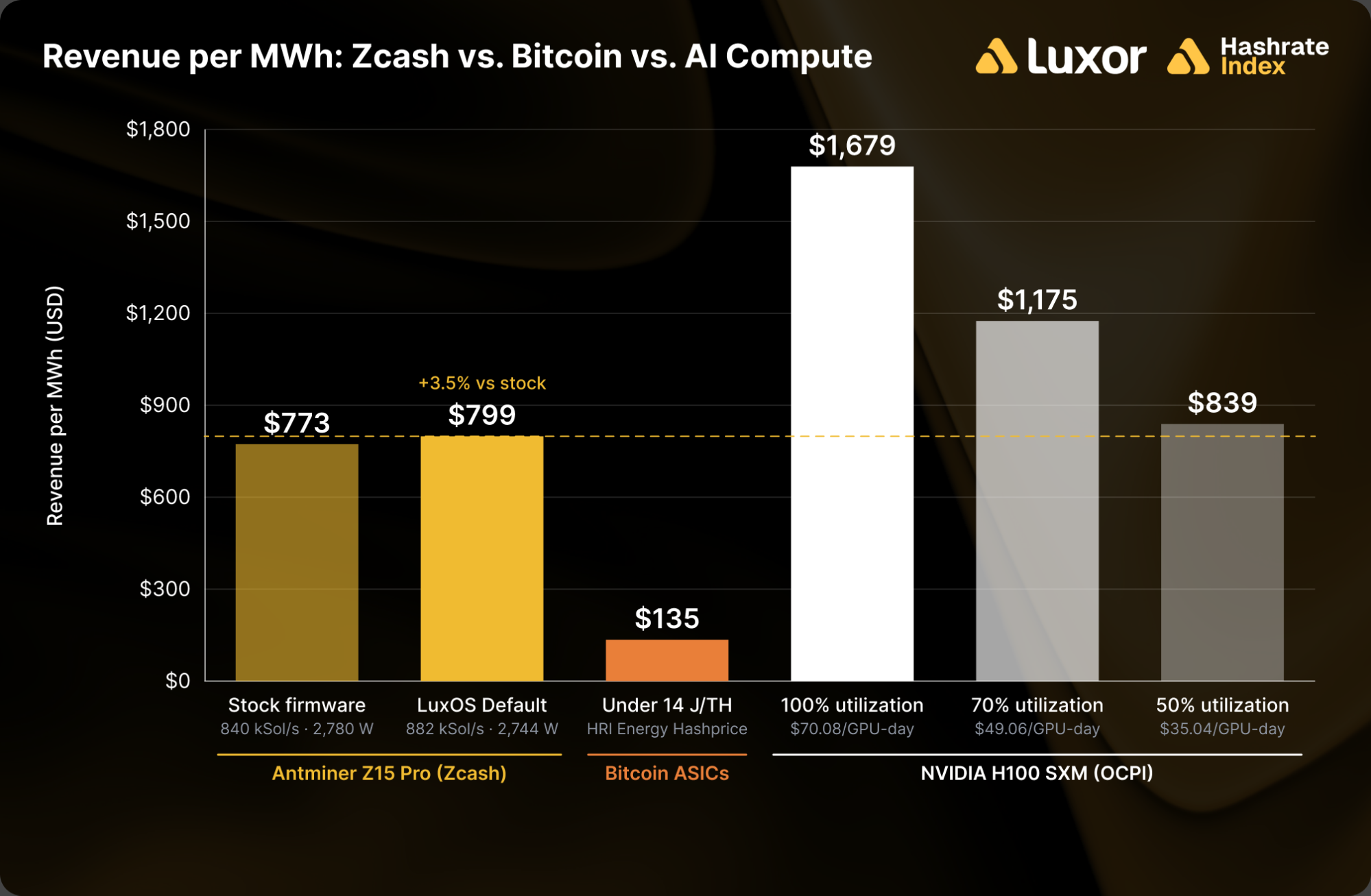
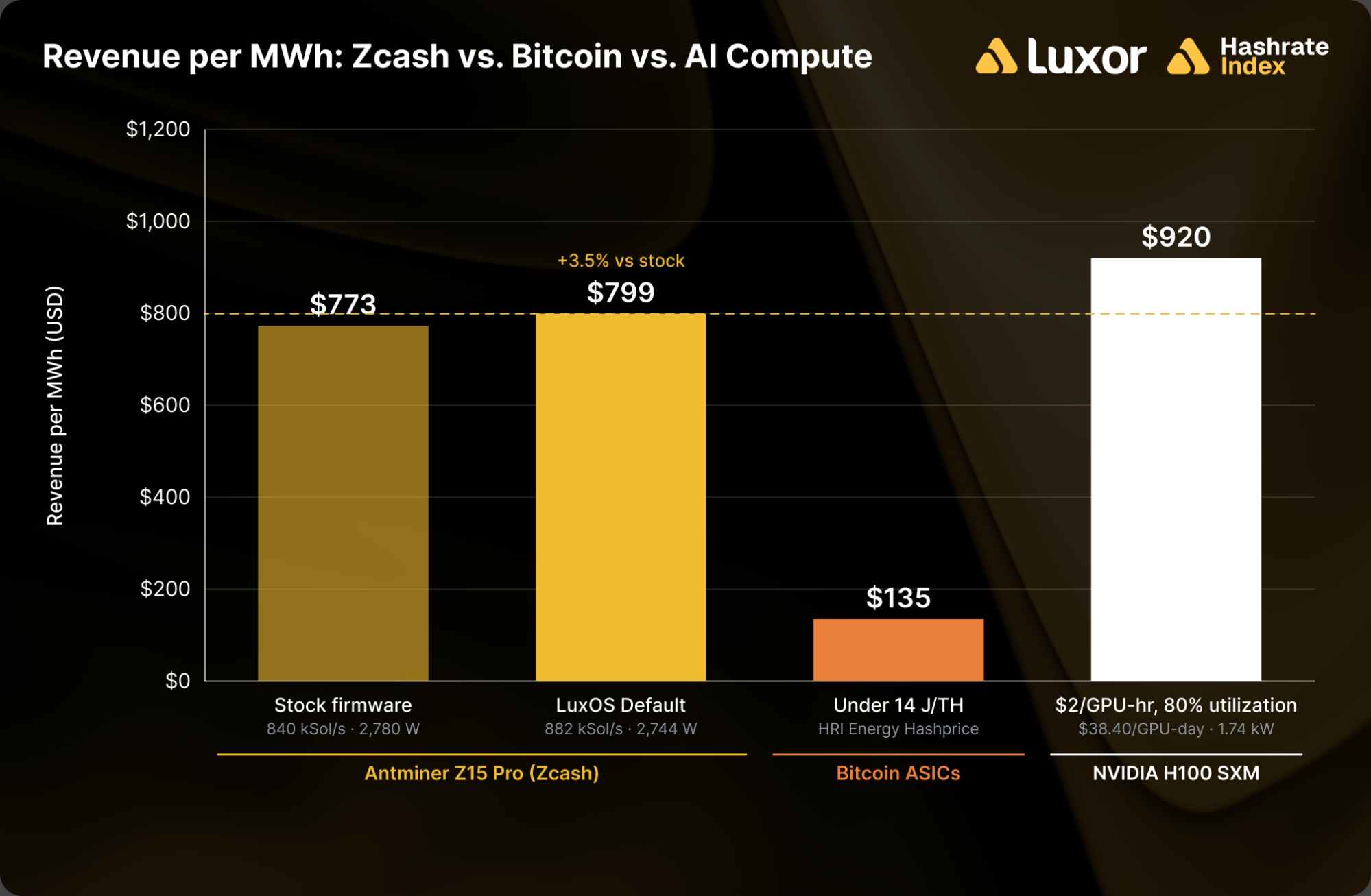
This translates to a robust 90 percent profit margin and a power break-even ceiling of $0.77 per kilowatt-hour—nearly ten times what typical industrial mining facilities negotiate for power. By comparison, top-tier Bitcoin mining hardware lags significantly behind. Amid a hashprice environment sitting at $39.71 per petahash per day, energy hashprice data indicates that hardware fleets operating below 14 Joules per terahash generate roughly $135 per megawatt-hour, while S21-class machinery hovers around $98 per megawatt-hour. Grayscale’s projection from September estimating a fourfold advantage for Zcash mining has proven conservative, as ZEC prices continued to climb for weeks following the forecast.
Yet, artificial intelligence infrastructure introduces a formidable wildcard into the equation. Based on data center settlements for NVIDIA H100 accelerators priced at $2.92 per GPU-hour, a single unit grosses $70.08 daily. When factoring in facility power consumption—calculated at 1.74 kilowatts per GPU paired with a Power Usage Effectiveness of 1.3—the revenue scales to approximately $1,679 per megawatt-hour, more than double the output of a stock Z15 Pro. While isolating the GPU board’s draw inflates that figure past $4,100 per megawatt-hour, analysts emphasize that facility-level power consumption provides the most accurate comparison, as it mirrors the wall-power draw already captured in ASIC metrics.
However, the H100 maintains its revenue supremacy exclusively when operating at full rental capacity. If utilization drops to 50 percent, revenue declines to approximately $839 per megawatt-hour, bringing it roughly in line with the Z15 Pro, with the crossover point occurring between 46 and 48 percent utilization.
The financial hierarchy dramatically reverses when evaluating performance through the lens of capital expenditure rather than energy efficiency. Deploying a megawatt of Z15 Pro miners requires roughly 360 machines, given current retail list prices ranging between $8,800 and $16,000 per unit, housed within a basic electrical shell costing a few hundred thousand dollars per megawatt. In contrast, a megawatt dedicated to H100 infrastructure accounts for approximately 575 graphics processing units. Market tracking of new eight-GPU H100 nodes reveals hardware costs between $31,000 and $40,500 per GPU, pushing raw hardware expenditures alone to between $18 million and $23 million per megawatt—or roughly $13 million for refurbished alternatives—housed inside Tier-3 facilities that often exceed the cost of the computing hardware itself. Consequently, the Z15 Pro achieves a full capital payback within six to eleven months on $46 of daily gross profit.
This dynamic underpins assertions that Zcash mining outperforms AI infrastructure on capital intensity and deployment speed. While this edge holds true for initial capital efficiency and time-to-market, it evaporates when examining revenue generated per unit of energy at standard market rental rates.
Lower rental pricing structures narrow the performance gap swiftly. If H100 rental rates decline to $2.00 per GPU-hour at an 80 percent utilization rate, the hardware generates approximately $920 per megawatt-hour, exceeding a LuxOS-optimized Z15 Pro by 15 percent. Should utilization drop below 70 percent at that rental rate, or if the hourly rate dips below $1.70, the ASIC surpasses the GPU in revenue per megawatt-hour before even factoring in its substantial capital expenditure advantage. Consequently, transitioning infrastructure from traditional ASICs to AI accelerators represents a calculated wager on sustaining both high rental rates and high operational utilization.
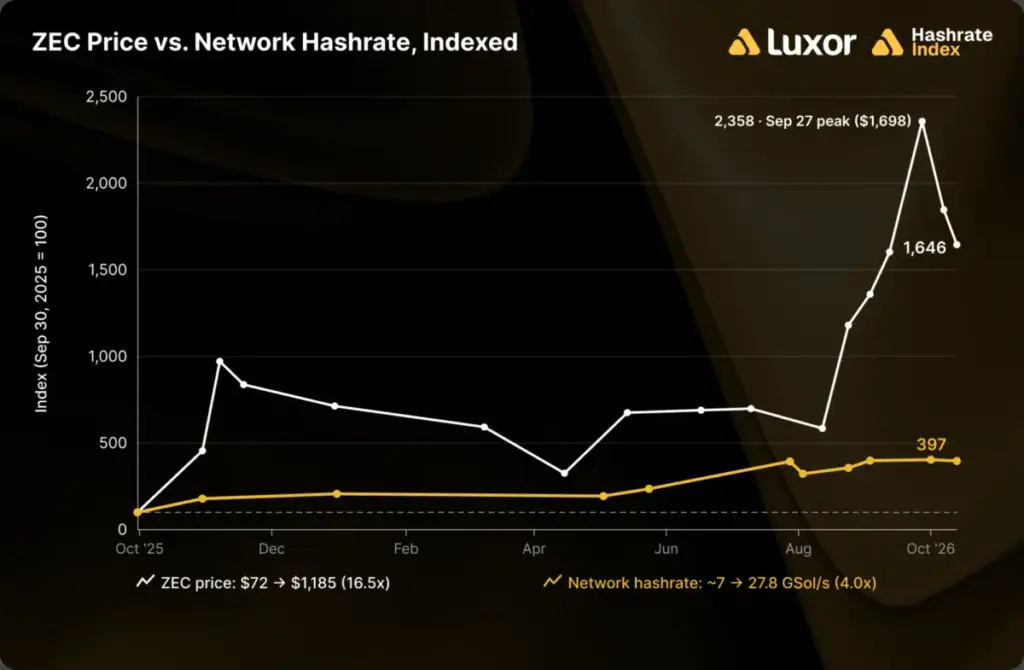
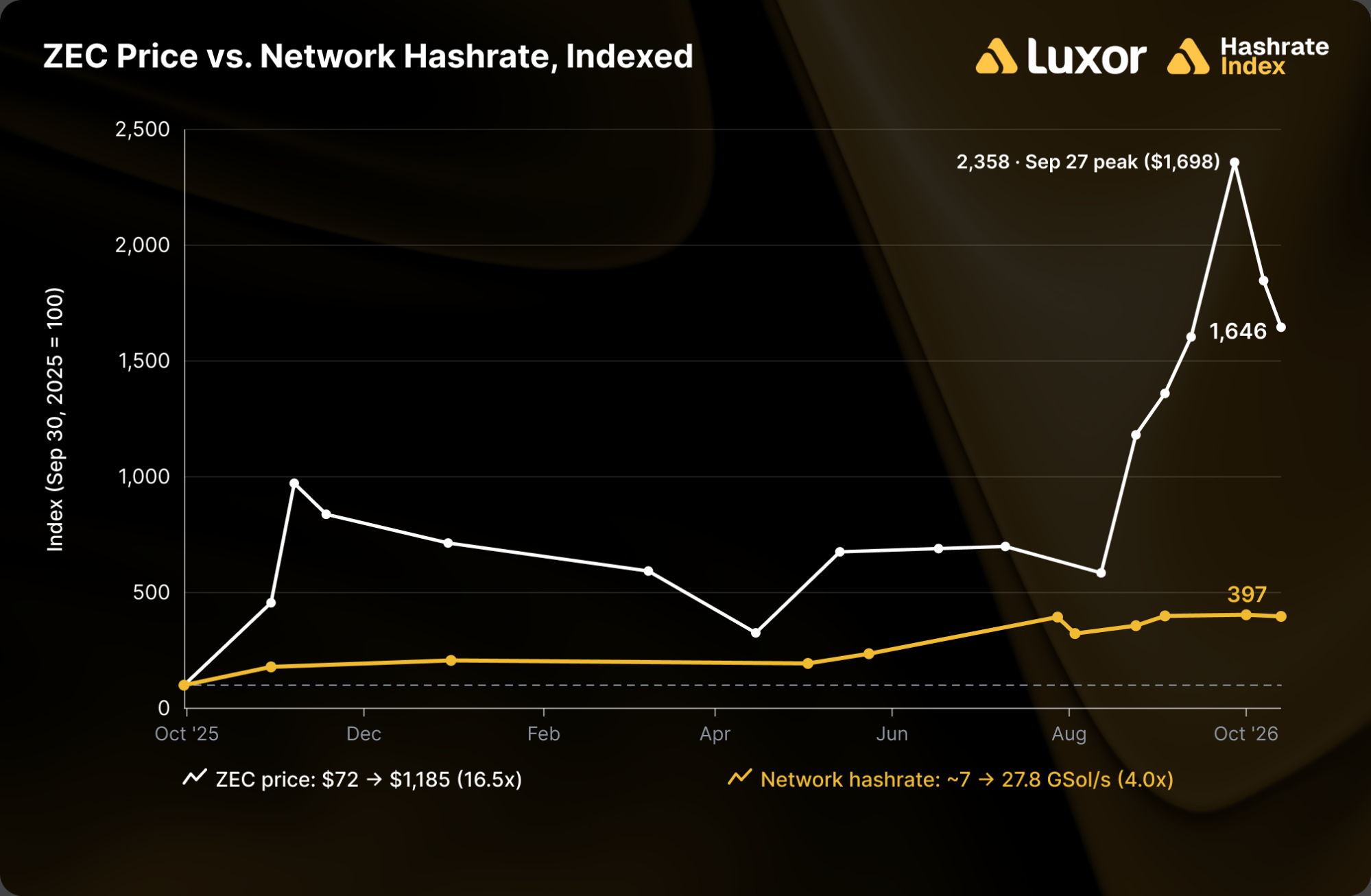
Over the preceding twelve months, Zcash experienced dramatic market shifts as price appreciation significantly outpaced network hashrate growth. The Zcash network hashrate expanded roughly fourfold over a twelve-month window, rising from approximately 7 GSol/s prior to a September 2025 market rally to reach 27.8 GSol/s. Simultaneously, ZEC spot prices surged from $72 to a peak of approximately $1,698 on September 27—a 23.6-fold expansion—before correcting downward by roughly 30 percent. Throughout both phases of the rally, hashrate lagged behind price momentum, remaining largely flat during the subsequent spring drawdown. Per-machine revenue held steady near $0.06 per kSol per day because asset prices consistently outpaced the influx of new mining hardware.
Because the daily miner emission pool remains fixed at roughly 1,440 ZEC, valued at approximately $1.7 million, every newly deployed machine dilutes the earnings of existing operators. The current network capacity equates to roughly 33,000 operating Z15 Pro units drawing 90 megawatts of power. At prevailing asset prices, these machines remain cash-positive even if network hashrate expands tenfold. The primary operational constraint remains physical hardware availability rather than electrical grid capacity, with in-stock Z15 Pros exhibiting severe scarcity and driving market prices up by 2.4 to 4.3 times since April. With Bitmain’s next-generation Equihash ASIC hardware not anticipated until the second quarter of 2027—and firms like Fortitude Mining already securing priority allocations valued up to $100 million—miners face tight hardware availability.
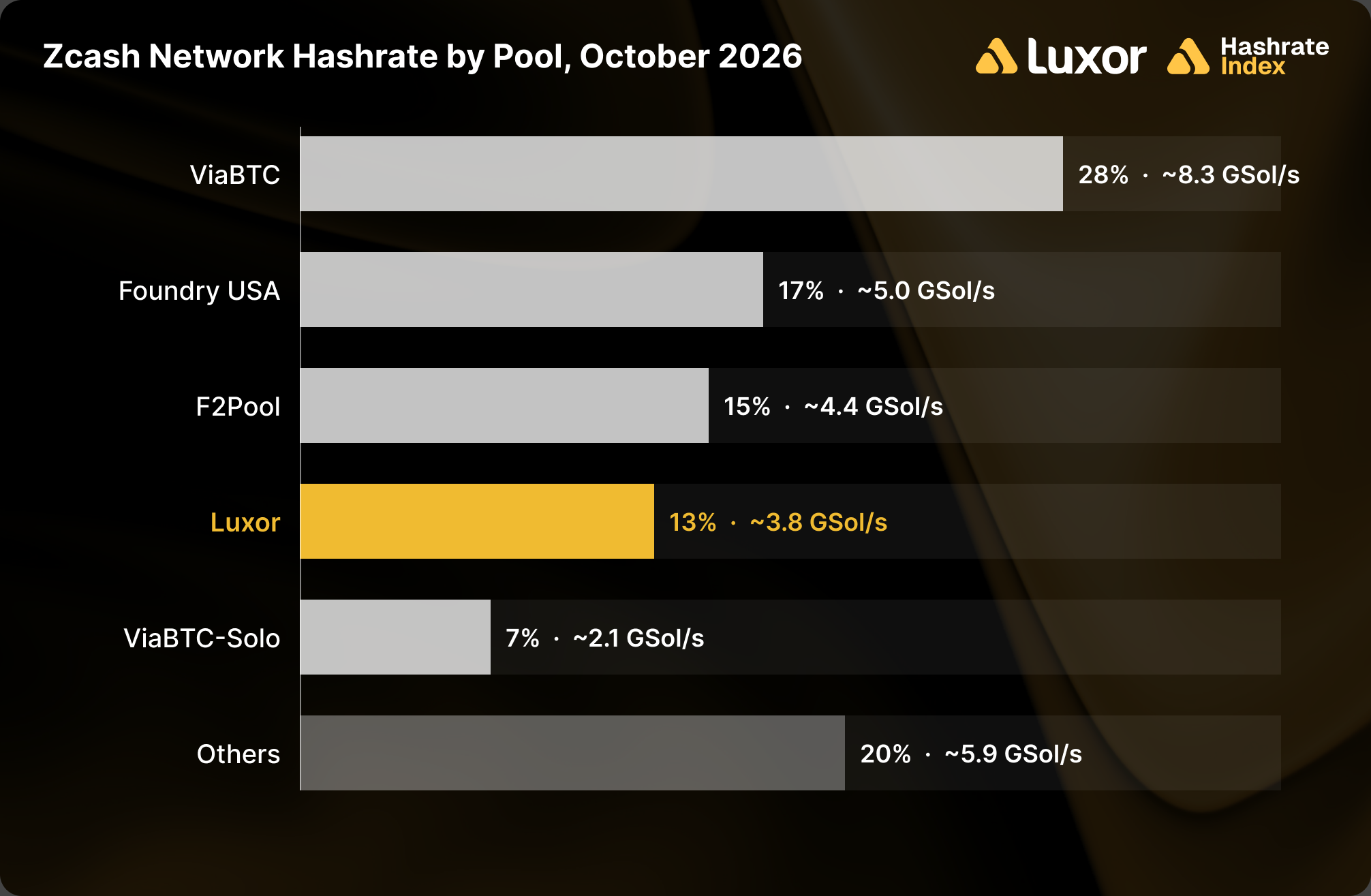
Network distribution data indicates that six major mining pools control approximately 80 percent of the Zcash network, anchored by ViaBTC leading at 28 percent and Luxor operating at 13 percent. The largest publicly disclosed enterprise operator is Cypherpunk Technologies, whose 4.2 GSol/s Z15 Pro fleet constituted 18 percent of the network during its August launch, settling near 15 percent as the network expanded around the existing footprint rather than contracting.
In the absence of new semiconductor silicon arriving before the second quarter of 2027, firmware optimization remains the primary mechanism for expanding Equihash hashrate from currently deployed machines. Firmware solutions such as LuxOS introduced Z15 Pro support, bringing advanced overclocking and underclocking profiles traditionally utilized by Bitcoin mining fleets to Equihash hardware. Performance benchmarking across multiple profiles compared against Bitmain’s stock firmware baseline of 840 kSol/s at 3.31 Joules per kSol demonstrates nuanced operational trade-offs.
Only the default profile surpasses stock performance across both efficiency and output metrics, delivering a 5 percent hashrate increase alongside a 1 percent reduction in power consumption, yielding $799 per megawatt-hour compared to the $773 baseline. Aggressive overclocking profiles trade energy efficiency for absolute revenue generation, lowering efficiency metrics down to approximately $600 per megawatt-hour under maximum settings while boosting daily hashrate output by 14 percent sustainably. This trade-off remains economically viable under low-cost power structures and high profit margins, though operators in power-constrained environments must carefully evaluate their specific electrical constraints.
Ultimately, the broader compute competition defies simplistic categorization. Evaluated on a per-megawatt-hour basis, a fully utilized AI accelerator outpaces a Zcash ASIC, which in turn outperforms Bitcoin mining hardware by a significant margin. Conversely, when measured against capital expenditure requirements, the ASIC secures a definitive advantage by achieving full payback within a single year. Across all asset classes, operational continuity remains paramount, as idle GPUs and stock-firmware ASICs forfeit valuable revenue. Within the Zcash ecosystem specifically, persistent supply constraints ensure that firmware optimization will remain the primary operational lever for network participants well into 2027.
 Cryptocurrency Mining
 Cryptocurrency Mining
 Cryptocurrency Mining