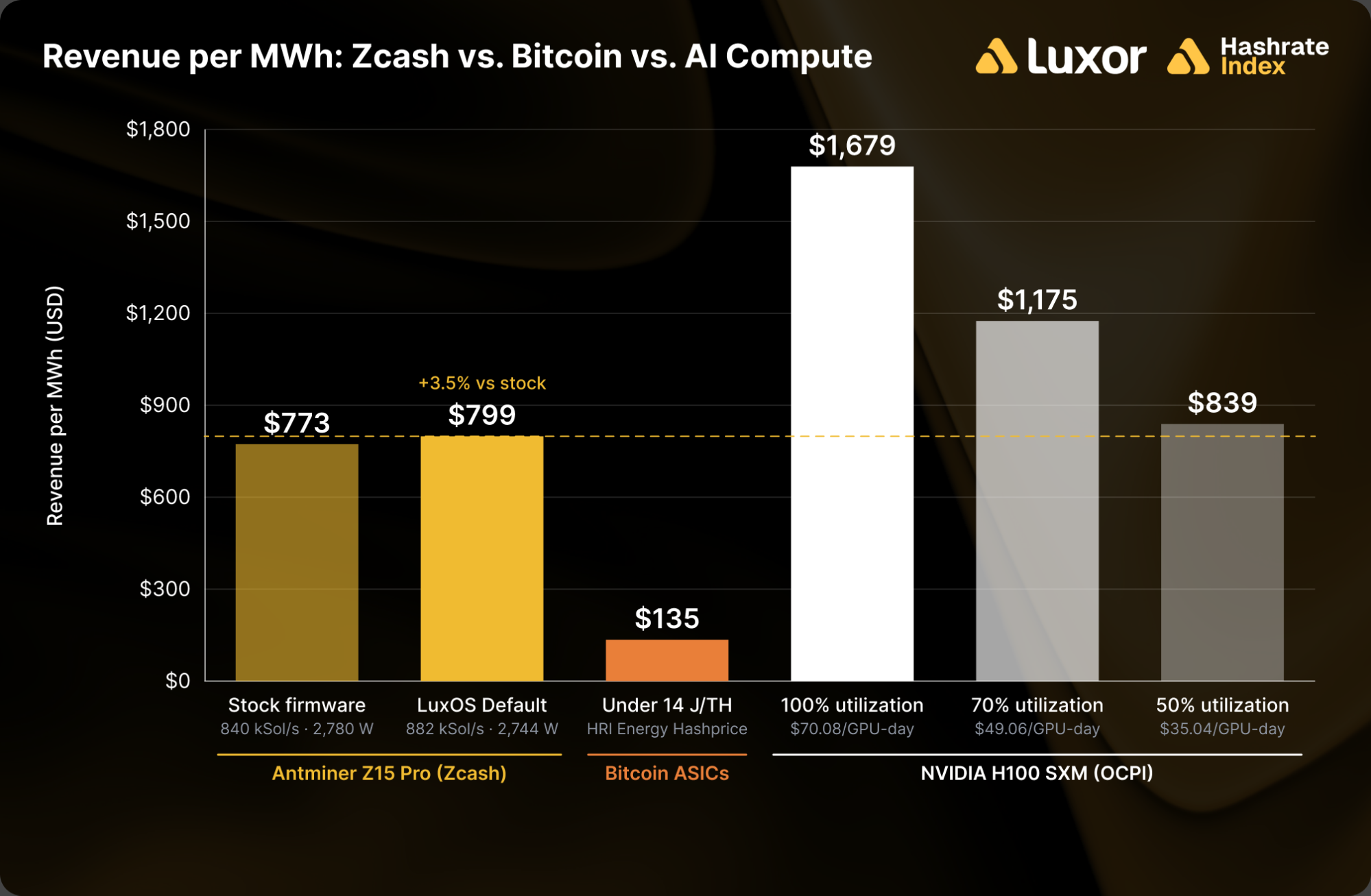
Energy has become the ultimate denominator in the modern compute economy, forcing a direct economic showdown between three distinct hardware classes vying for the same megawatt. Recent market data from October 2026 illustrates how shifting economics have blurred the lines between cryptocurrency mining and artificial intelligence infrastructure. When priced at a standard industrial power rate of $0.08 per kilowatt-hour, an Antminer Z15 Pro mining Zcash yields approximately $770 in revenue per megawatt-hour. Meanwhile, top-tier Bitcoin ASICs lag significantly behind at roughly $135 per megawatt-hour, while a rented NVIDIA H100 graphics processing unit pulls in about $1,680 assuming continuous high utilization.
This convergence of disparate technologies into shared data center spaces highlights a fundamental reality of modern infrastructure development: the ultimate winner of the compute competition depends entirely on how revenue and costs are measured relative to power consumption.
Three Machines, One Megawatt
Because electricity is the primary shared input across all three hardware types, evaluating revenue on a per-megawatt-hour basis provides the clearest metric for cross-sector comparison. Market snapshots taken in mid-October 2026, with Zcash (ZEC) trading at $1,185 and network hashrate resting at 27.8 GSol/s, reveal stark operational differences.
Zcash miners currently process a fixed daily block reward pool of 1,440 ZEC. Under these network conditions, a stock Antminer Z15 Pro generates a gross daily revenue of $51.54. After accounting for $5.34 in electricity costs at $0.08 per kWh, the machine retains a net daily profit of $46.20. This translates to an exceptional 90 percent profit margin and a power break-efficiency threshold of $0.77 per kWh—nearly ten times what typical industrial cryptocurrency miners pay for grid power.
By comparison, Bitcoin mining hardware trails far behind. With Bitcoin hashprice hovering around $39.71 per petahash per day, energy hashprice metrics place modern fleets under 14 joules per terahash at roughly $135 per megawatt-hour, with flagship S21-generation hardware generating about $98 per megawatt-hour. Earlier bullish estimates regarding Zcash mining profitability have proven conservative as ZEC maintained an upward price trajectory.
The wild card in the equation remains artificial intelligence hardware. Based on recent OCPI-H100 settlement rates of $2.92 per GPU-hour, a single H100 generates $70.08 daily. Factoring in facility power consumption of 1.74 kW per GPU including Power Usage Effectiveness overhead, this performance yields roughly $1,679 per megawatt-hour—more than double the output of a stock Z15 Pro. However, this financial advantage depends entirely on consistent rental demand. When GPU utilization drops to 50 percent, revenue declines to approximately $839 per megawatt-hour, aligning closely with the performance of Zcash mining equipment.
Where the ASIC Wins: Capital, Not Energy
While artificial intelligence hardware commands a higher return per unit of energy under optimal market conditions, the financial dynamics flip entirely when evaluated against initial capital expenditures. Deploying one megawatt of Z15 Pro miners requires roughly 360 machines, translating to hardware investments ranging between $3.2 million and $5.8 million housed within standard warehouse shells costing a few hundred thousand dollars per megawatt.
Conversely, equipping a megawatt for artificial intelligence requires approximately 575 NVIDIA H100 GPUs. Recent AI hardware price tracking indicates that new eight-GPU nodes cost between $31,000 and $40,500 per individual GPU, bringing the raw hardware expenditure alone to between $18 million and $23 million, with refurbished units running closer to $13 million. Furthermore, these systems require Tier-3 data center facilities that often exceed the capital cost of the GPUs themselves. Consequently, Zcash mining hardware offers a remarkably rapid capital payback period of just six to eleven months based on current gross daily returns.
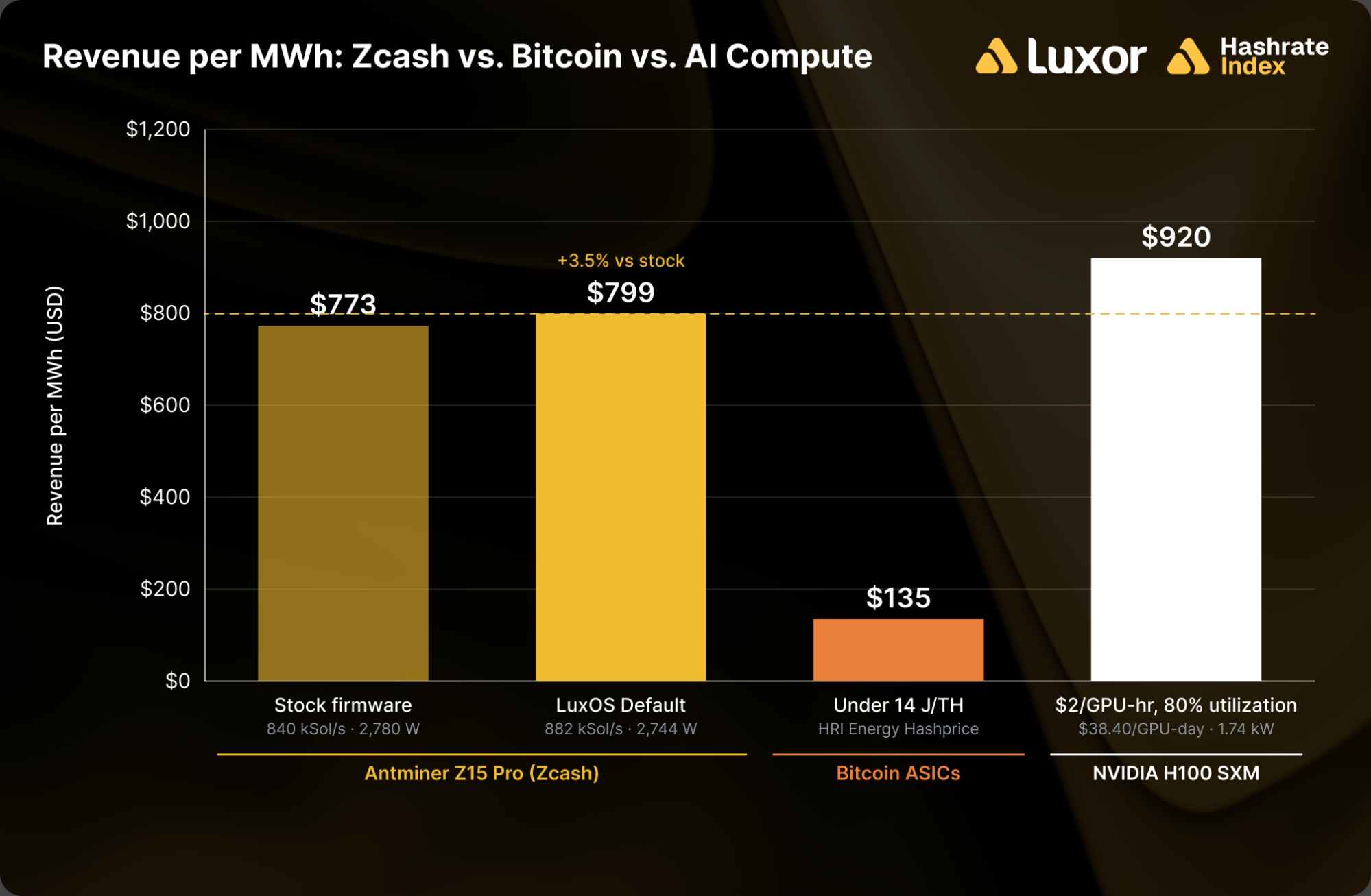
This dynamic explains the growing interest in pivoting mining sites toward alternative compute workloads. While AI infrastructure dominates in revenue generation per megawatt-hour, ASICs retain a massive advantage in capital intensity and deployment speed. Nevertheless, lower cloud rental rates narrow this performance gap rapidly. If H100 rental rates decline to $2.00 per GPU-hour at an 80 percent utilization rate, revenue drops to approximately $920 per megawatt-hour, bringing it within striking distance of optimized ASIC operations.
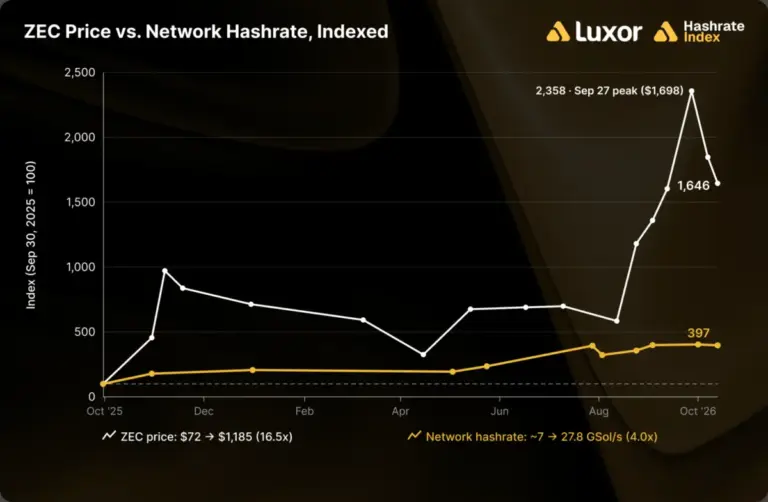
Price Outran Hashrate in the Zcash Ecosystem
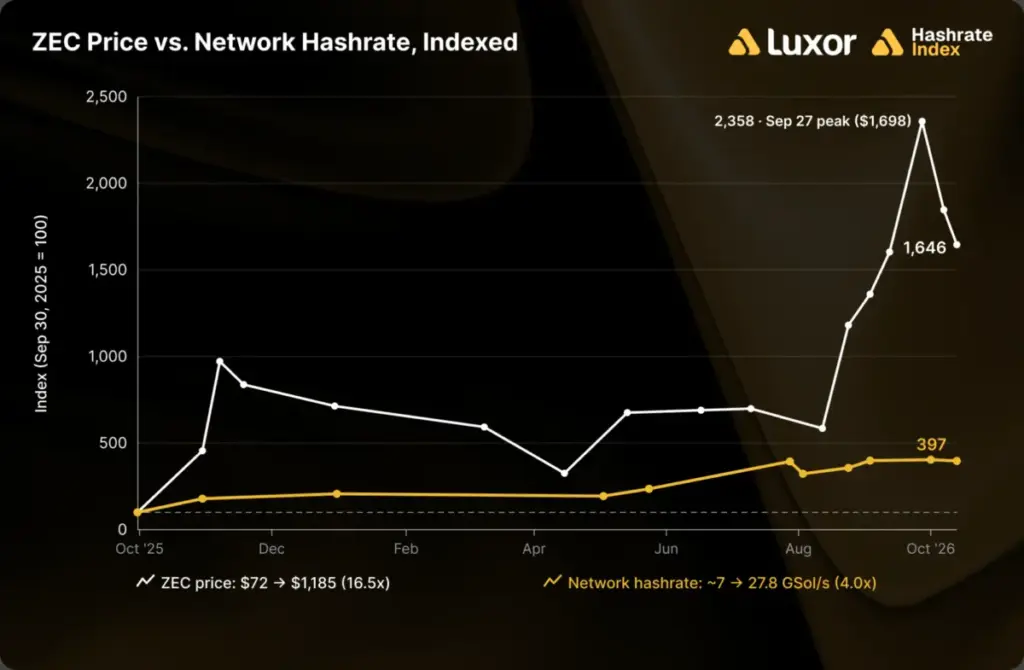
The underlying economics of Zcash mining have been heavily influenced by a dramatic divergence between token price appreciation and network hashrate growth. Over a twelve-month period leading into October 2026, the Zcash network hashrate expanded roughly fourfold, climbing from approximately 7 GSol/s to 27.8 GSol/s. Simultaneously, the price of ZEC experienced explosive volatility, surging from $72 to a peak of nearly $1,698 before correcting downward by roughly 30 percent.
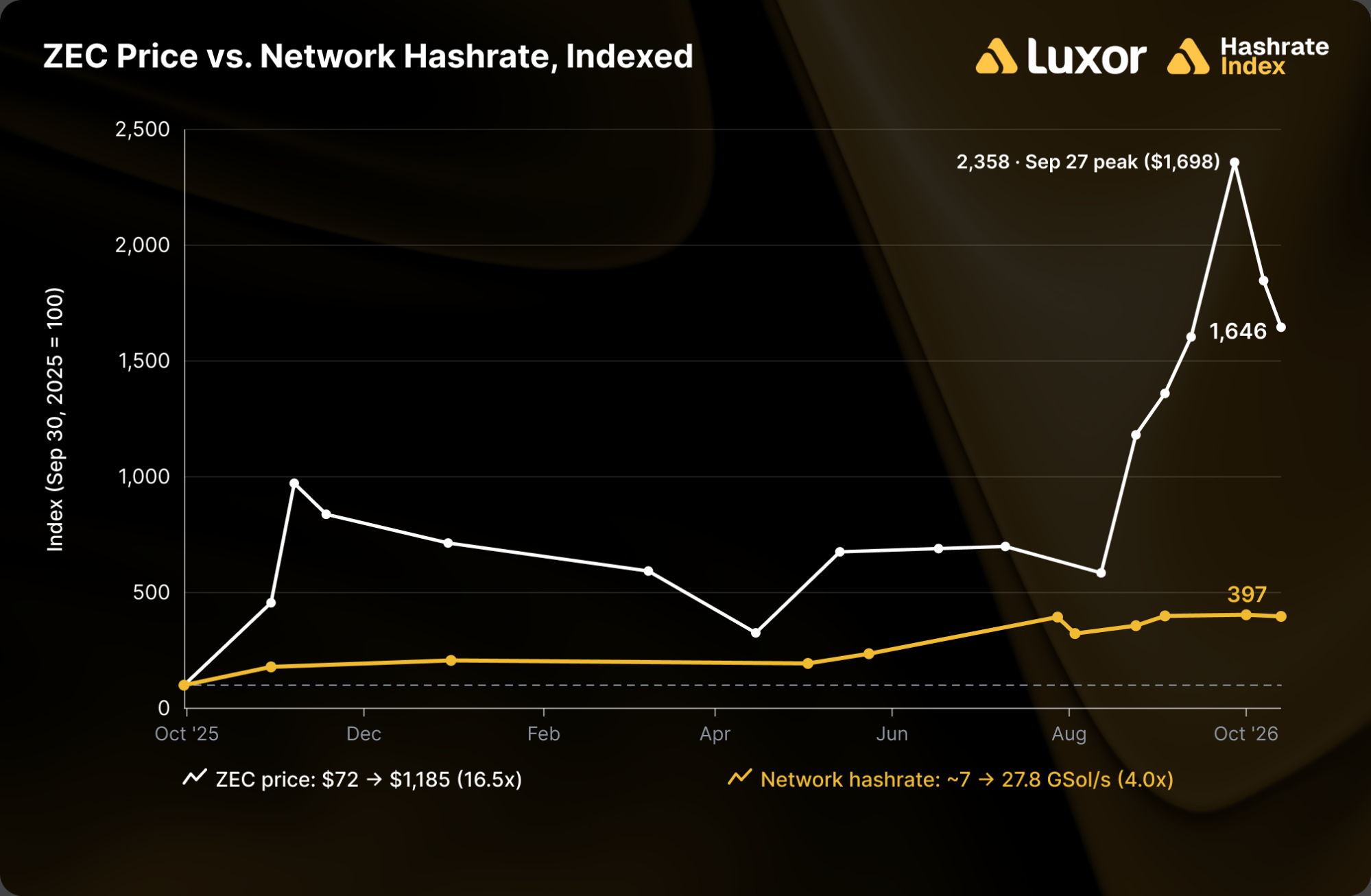
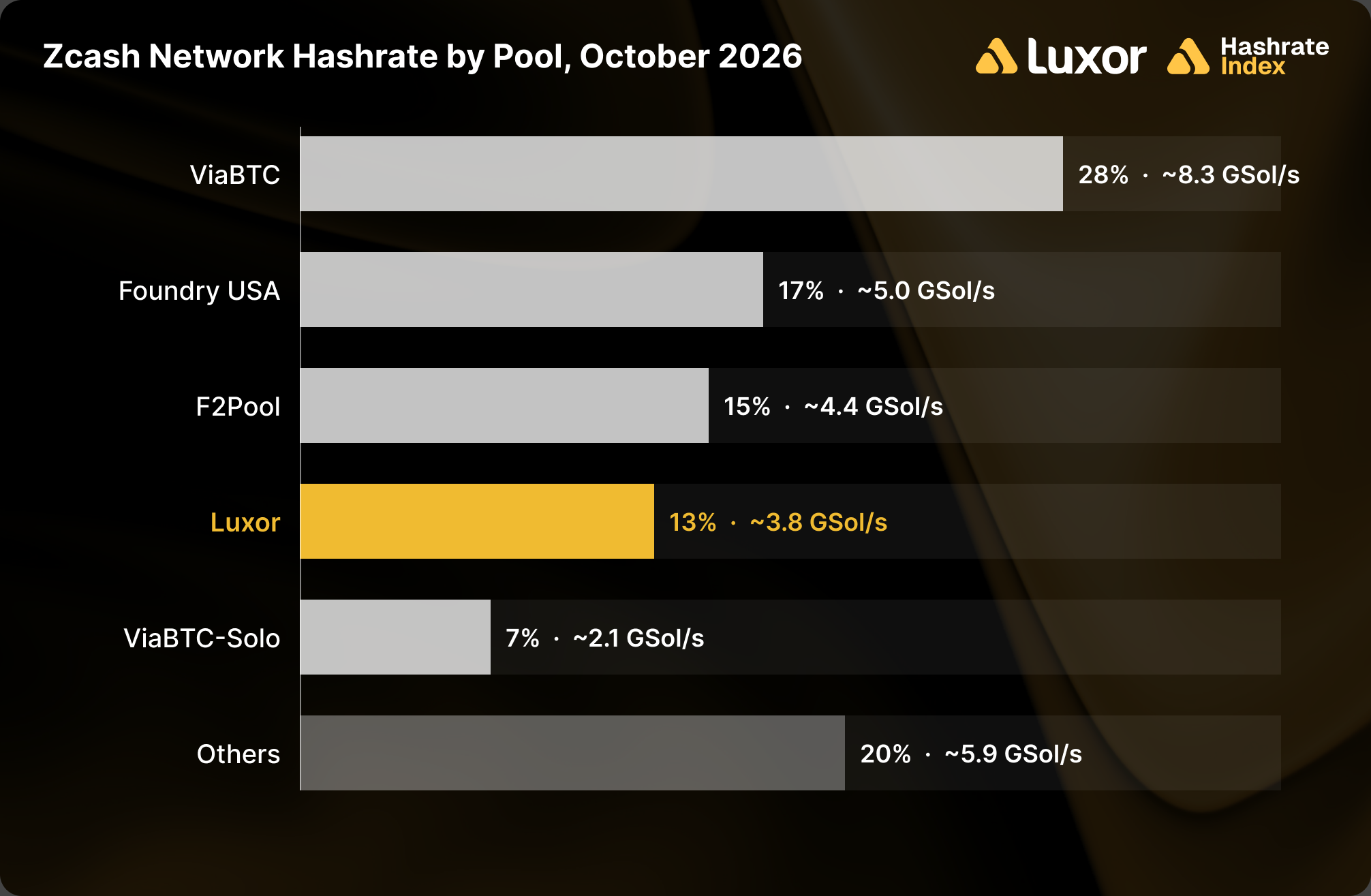
Because network hashrate lagged behind price appreciation during the height of the rally, per-machine revenue remained remarkably resilient. The total daily miner reward pool remains fixed at 1,440 ZEC, meaning that every newly deployed machine dilutes the earnings of existing operators. The network currently represents the equivalent of roughly 33,000 Z15 Pro units drawing 90 megawatts of power. Despite this expansion, the hardware remains cash-positive under current pricing conditions, with sufficient margin to absorb a substantial increase in network difficulty before hitting economic limits.
At present, hardware supply serves as the primary binding constraint rather than power availability. In-stock Z15 Pro units have become scarce, driving secondary market prices significantly higher, while next-generation Equihash ASICs from manufacturers like Bitmain are not widely anticipated until the second quarter of 2027.
Firmware Optimization as a Stopgap
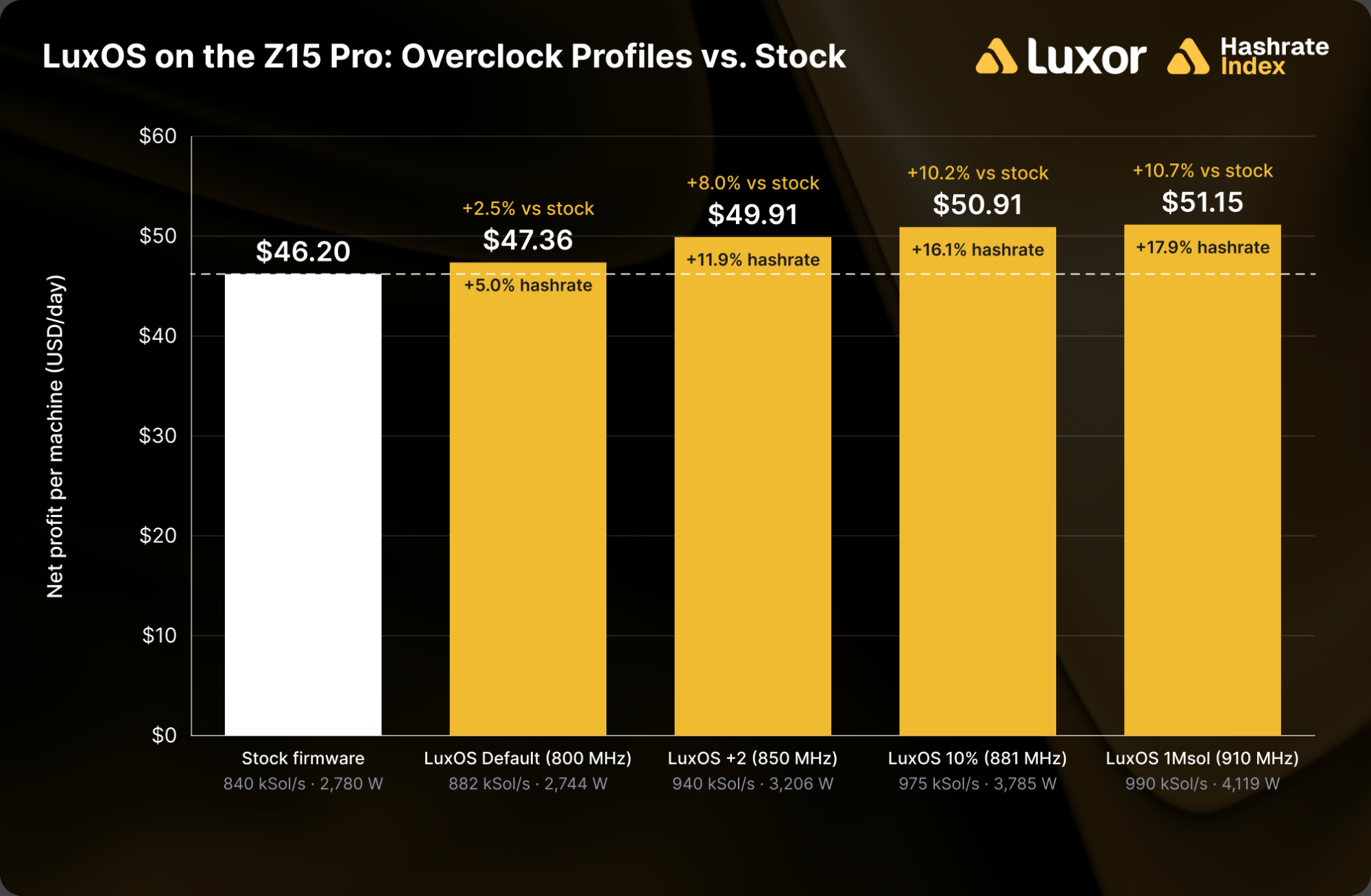
With new silicon manufacturing pipelines constrained until mid-2027, operators seeking to expand Equihash hashrate from existing deployments rely almost exclusively on specialized third-party firmware. Software integrations such as LuxOS have introduced advanced tuning profiles for the Z15 Pro, allowing operators to apply overclocking and underclocking methodologies previously restricted to Bitcoin mining fleets.
Performance benchmarking of various firmware profiles demonstrates that moderate adjustments can yield efficiency gains. Default optimization profiles can deliver a five percent increase in hashrate alongside a one percent reduction in power consumption, pushing revenue to nearly $799 per megawatt-hour. However, aggressive overclocking profiles trade electrical efficiency for absolute output, increasing hashrate by double digits while raising power draw proportionally. While viable for operations with low-cost electricity and wide profit margins, such aggressive tuning remains inefficient for power-constrained facilities.
Ultimately, the broader compute competition encompasses multiple distinct economic races. On a per-megawatt-hour basis, a continuously rented artificial intelligence GPU outperforms a Zcash ASIC, which in turn outpaces traditional Bitcoin hardware by a wide margin. Yet when measured against capital expenditure, ASICs secure a decisive victory through rapid payback timelines. As miners increasingly experiment with multi-compute strategies on shared energy sites, hardware utilization remains the defining variable across both cryptocurrency and artificial intelligence infrastructure.
 Cryptocurrency Mining
 Cryptocurrency Mining
 Cryptocurrency Mining